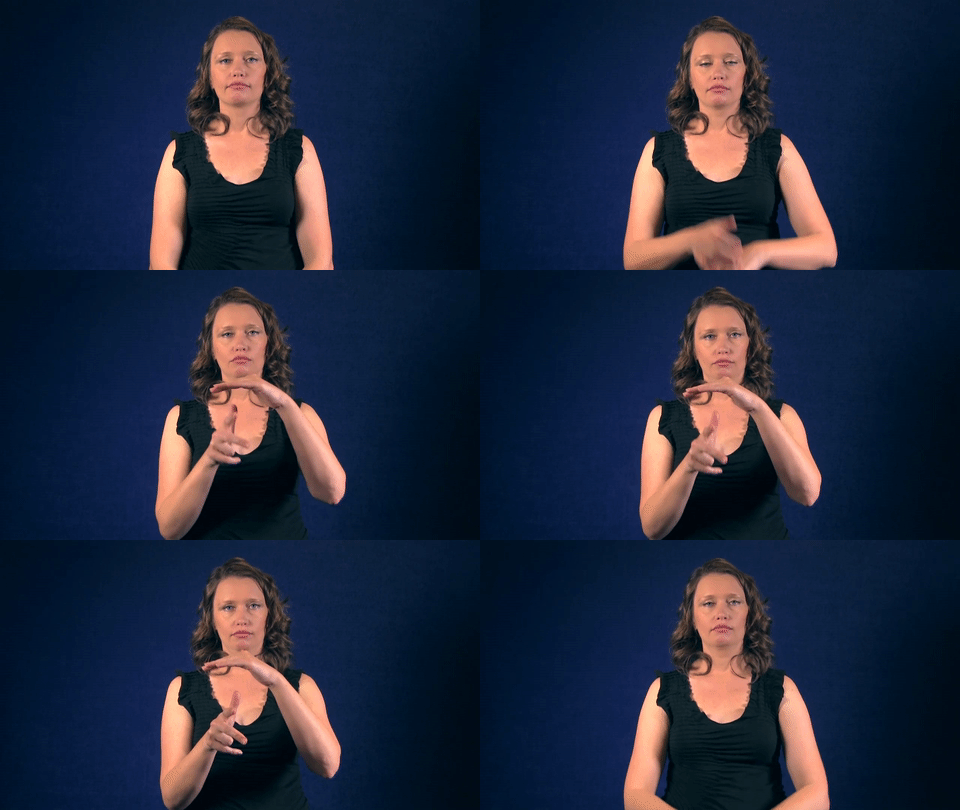
Definition: A building for housing a motor vehicle.
Sign for GARAGE in ASL
Practice Activities:
Begin your practice of the sign for GARAGE in ASL by working on isolating the movement. Repetition is important, so stand in front of a mirror and practice the sign slowly, focusing on palm orientation and handshape. Take moments to freeze and check for accuracy before continuing again in motion.
Once you feel confident with the sign, begin incorporating it into short phrases. Sign basic sentences like “MY CAR IN GARAGE” or “GARAGE NEXT TO HOUSE.” Switch up the locations and objects—try practicing “BIKE STAY IN GARAGE” or “DAD CLEAN GARAGE.” These sentence variations will help solidify vocabulary parallels and structure recall.
Use a drawing prompt to boost memory and creativity. Sketch a simple layout of a house and label different parts in ASL signs. Then, describe the drawing using signs like “GARAGE ON LEFT SIDE” or “FRONT DOOR HERE, GARAGE THERE.” Add pretend elements like cars or bikes and explain what each item is doing using directional signs.
For storytelling, create a mini-narrative where someone is looking for a tool in the garage. Sign a short sequence such as “I LOOK TOOL, GO GARAGE, TOOL NOT THERE, I LOOK AGAIN.” Role-play gestures enhance clarity during storytelling, so incorporate visual facial expressions for confusion or surprise.
Partner up to quiz each other or act out short scenarios. One person can sign about what’s in the garage, and the partner will respond or ask clarifying questions like “WHAT IN GARAGE?” or “CAR IN GARAGE?” Use flashcards with household words and describe where each item is kept using the sign for GARAGE in ASL.
Finally, watch short videos or vlogs in ASL where a garage is mentioned. Observe how native signers use realistic context to deliver meaning. Practice retelling their content using the same grammar and signs.
Cultural Context:
In American Sign Language, representing everyday locations like a garage is essential for fluent communication. The sign for garage in ASL fits within a broader category of signs that describe buildings, places, and objects commonly found in daily life. Understanding how this sign is used provides context for how Deaf individuals discuss home spaces and vehicles.
The sign for garage in ASL often reflects the physical relationship between a car and a structure, which makes it visually intuitive. It can vary slightly by region or age group, but the core concept remains understood across the Deaf community. This kind of visual representation helps ASL stay closely tied to the real-world environments people navigate every day.
Garages are considered an extension of the home, and knowing the sign for garage in ASL allows for smooth communication about domestic spaces. Whether talking about parking, working on cars, or using the garage for storage, the sign becomes essential when describing these activities. It’s a key part of discussing residential layouts or giving directions.
The sign for garage in ASL is also frequently used in casual conversations. For example, someone might sign about cleaning out the garage, repairing items inside, or even holding a garage sale. These daily uses show how integral the sign is to vocabulary involving household tasks and routines.
In Deaf culture, signs like the sign for garage in ASL demonstrate the rich, descriptive nature of the language. ASL often relies on depicting how structures appear or how they function, and the sign for garage captures both ideas effectively. This enhances understanding and promotes a more vivid mental image when communicating.
Communities with a strong Deaf presence often include ASL vocabulary that reflects the local lifestyle. For suburban areas where garages are common, the sign for garage in ASL may come up frequently in conversation. It becomes part of storytelling, instructions, and even jokes or shared experiences.
In educational settings, students learning ASL are often introduced to signs that represent home and community structures early in their lessons. The sign for garage in ASL is usually included because of its usefulness in constructing full sentences about daily living. It supports the development of expressive and receptive signing skills.
In media and content created by and for the Deaf community, the sign for garage in ASL might appear in vlogs, discussions, or DIY tutorials. Knowing this sign expands your ability to understand and participate in ASL media. It also connects learners with cultural references and real-life applications of the language.
The visual nature of the sign for garage in ASL makes it memorable and easy to teach
Extended Definition:
The sign for garage in ASL is a practical and commonly used term in everyday conversations. Whether referring to a building for parking a car or a workspace for repairs, knowing the correct sign can help with clear and efficient communication in American Sign Language.
To sign garage in ASL, one hand usually represents the surface or floor, while the other hand mimics the movement of a car entering or residing in a space. The sign visually conveys a vehicle going into a structure, making it intuitive for learners and fluent signers alike. Understanding the context is important since the same sign might reflect different meanings depending on the sentence.
The sign for garage in ASL might vary slightly depending on regional variations or personal signing style, but the core concept remains the same. It is vital to observe facial expressions and non-manual markers when using this sign, as they can enrich the meaning and tone of the message . ASL is a visual language, so clarity and intention make a big difference in how a sign is received.
This sign is often used when discussing directions, home layouts, renovations, or car maintenance. For example, someone may ask you where your garage is located, or describe an incident involving a garage door. Being confident with the sign for garage in ASL can make these everyday conversations smoother and more natural.
When teaching the sign to beginners, it can help to pair it with the fingerspelled word first to reinforce understanding. Over time, learners will recognize the distinct shape and motion that defines the sign for garage in ASL and be able to use it fluidly in conversation. This approach also bridges the gap between English and ASL vocabulary.
Garage is a term often featured in dialogues about weather too—such as where to store a car during a snowstorm or rain. Discussing these scenarios in ASL becomes easier when the vocabulary includes functional signs like garage. Practice within relevant contexts strengthens memory and usage.
Some people use an iconic approach to remember the sign—as if visualizing the car pulling into a small house or building. This visualization can be helpful, especially for visual learners or younger students picking up the language. The more sensory input associated with a sign, the easier it becomes to retain.
In addition to home garages, this sign is relevant for commercial contexts as well, such as parking garages in cities or maintenance shops. The sign for garage in ASL adapts well to broad discussions, provided the surrounding vocabulary supports the meaning. Knowing how to frame the sign accurately boosts
Synonyms: carport, parking space, automobile shelter, vehicle storage, car shed
Educational resources: Find related learning materials in our course bank!
Want more? Check out some of our popular learning activities on the homepage!
Need to look up a sign? Use our highly rated dictionary: https://aslinteractive.com/best-asl-dictionary/
Follow us on tiktok: https://www.tiktok.com/@aslinteractive. More social media links at the bottom of this page!
Long-tail Keywords: what is the sign for garage in ASL, how do you sign garage in ASL, ASL sign for garage
Categories:
tags: garage in American Sign Language, how to sign garage in ASL, ASL sign for garage, learn garage in ASL, garage sign language meaning
Parameters
*Handshape*:
The handshape for the sign for GARAGE in ASL uses a flat B handshape with the dominant hand. The non-dominant hand is stationary, palm down, representing the ground or structure. The dominant hand, shaped like a small car, moves under the non-dominant hand as if parking in a garage ️ .
In the sign for GARAGE in ASL, the handshape mimics the action of a vehicle going under a cover. This visual metaphor supports clear communication and helps learners remember the meaning.
*Palm Orientation*:
The palm orientation for the sign for GARAGE in ASL involves both hands. The dominant hand, typically in the shape of the number “3” (open ‘3’-hand), has the palm facing downward as it moves underneath the non-dominant flat hand, which is held horizontally, palm facing the ground.
This motion represents a car moving into a garage. The sign for GARAGE in ASL visually mimics how a vehicle enters a covered space. Keep both sets of fingers relaxed and natural to maintain clarity and fluidity.
*Location*:
The sign for garage in ASL is produced in the area directly in front of the chest. The dominant hand moves underneath the non-dominant flat hand, mimicking the motion of a car going into a garage. Both hands are typically held around mid-torso level. This placement helps visually represent the spatial concept behind the sign for garage in ASL .
*Movement*:
The sign for garage in ASL uses a flat, horizontal non-dominant hand to represent the floor. The dominant hand forms a “3” handshape (representing a car) and moves forward and under the flat hand, as if driving into a structure or space. This movement visually mimics a car driving into a garage.
To clearly convey the concept, the movement should be steady and deliberate. The sign for garage in ASL emphasizes the idea of sheltering or parking a vehicle under a covering.
*Non-Manual Signals*:
When using the sign for GARAGE in ASL, the facial expression remains neutral or mildly descriptive, depending on the context. Slight eyebrow movement may occur if clarifying the type or size of the garage, especially in comparisons or explanations.
The sign for GARAGE in ASL does not typically involve strong emotional expressions unless the garage is unusually significant or problematic. Maintain steady eye contact and a calm demeanor to match the everyday nature of the concept.
*Prosody, Dominant/Non-Dominant Hand*:
The sign for GARAGE in ASL uses a dominant hand shaped like the number 3, representing a car. The non-dominant hand remains flat and horizontal, palm facing downward, to represent the floor or roof of the garage. The dominant hand moves underneath the non-dominant hand in a short forward motion, as if a car is pulling into a space.
This visualization strongly conveys the concept behind the sign for GARAGE in ASL. Both hands work together to demonstrate the spatial relationship of a car entering a structure. Make sure your palm orientations are clear and the motion is consistent.
Tips for Beginners:
When learning the sign for GARAGE in ASL, focus on clear hand positioning and concise motion. Use your non-dominant hand flat and palm down to represent the top of a garage. With your dominant hand shaped like a small car (usually in a “3” handshape), repeatedly move it under the flat hand as if driving into a garage. Keep the movement small and consistent so the meaning is immediately recognizable.
A helpful tip is to visualize a toy car entering a toy garage. This mental image makes it easier to remember the correct motion and hand shapes. Be mindful of your hand orientation—your dominant hand should move toward your chest and slightly under the base hand, not just to the side. The clearer your movement and shape, the more easily others will understand the sign for GARAGE in ASL.
Beginners sometimes hold the base hand too high or too far away from the body, making the sign look awkward or unclear. Keep your base hand steady and at a comfortable height around chest level. Try practicing in front of a mirror to ensure your signs are visible and symmetrical when viewed head-on.
Another thing to keep in mind is facial expression. While not heavily required for this noun, using a neutral or logical expression helps match the tone of everyday conversation. By pairing accuracy in shaping both hands with a calm expression, your sign for GARAGE in ASL comes across clearly and naturally.
Don’t forget to practice the sign in context: talk about places with garages, different types of garages (home, parking structures), or directional use in sentences. Engaging with the sign in real-world scenarios reinforces your understanding. And as always, review often and watch how fluent signers execute it—it helps build muscle memory and improve speed over time.
Connections to Other topics:
The sign for GARAGE in ASL connects directly to spatial and location-based vocabulary. Signs like HOUSE, BUILDING, or APARTMENT can be integrated into conversations where GARAGE is contextually relevant. This helps build richer narratives around living spaces, property, or construction.
This sign also relates well to compound signs or classifiers when discussing vehicles. For example, combining the sign for GARAGE with CAR or PARK creates more specific concepts like “car parked in garage” or “garage full of cars,” using classifiers representing vehicle movement into a structure . These combinations teach learners how ASL uses spatial direction and referencing to demonstrate real-world positioning.
The sign for GARAGE in ASL can also tie into topics like home improvement, storage, or mechanics. When someone is talking about cleaning the GARAGE, storing tools, or fixing a vehicle, the signs TOOL, CLEAN, and WORK are commonly paired. This broadens vocabulary and allows for descriptive storytelling involving actions that take place around or inside a garage.
It’s also useful when discussing locations in directional or mapping contexts. Terms like LEFT, RIGHT, or NEXT TO might be used alongside the sign for GARAGE to give clearer directions or describe a home layout. These prepositions and directionals give learners more spatial awareness in ASL grammar.
Additionally, this sign relates to common workplace and hobby vocabulary. Many people use garages as workspaces or to pursue DIY projects, so signs like FIX, MAKE, BUILD, and PROJECT often appear in these conversations. These layered concepts help learners understand ASL storytelling techniques that rely on sequence, space, and context.
Lastly, the sign for GARAGE in ASL can be used in academic or instructional settings. Whether instructing someone where to park or explaining a drawing of a home layout, it ties into educational ASL related to plans, designs, and home features ️ . This makes it a versatile and visually grounded term useful across daily and professional scenarios.
Summary:
The sign for GARAGE in ASL is an example of how spatial referencing plays a vital role in signing environments and locations. It incorporates classifier usage, specifically using a classifier to represent a vehicle entering a space, which reflects how ASL prioritizes visual logic and conceptual mapping.
To produce the sign for GARAGE in ASL, the dominant hand typically represents a car, while the non-dominant hand represents a structure or overhang. The dominant hand moves into or under the non-dominant hand, showing the vehicle entering or residing within the garage space. This iconic representation makes the concept easy to recognize even without a spoken equivalent.
The sign aligns with ASL’s use of classifiers and role-shifting techniques. Rather than using arbitrary signs, many ASL concepts rely on visual-spatial characteristics to convey meaning. The sign for GARAGE in ASL creatively uses this concept to simulate depth and positioning.
In terms of ASL morphology, this sign functions as a noun incorporating a directional or spatial component. Users must be aware of palm orientation, handshape, and movement to ensure the classifier accurately depicts the car and the structure. Misplacement of these elements can lead to miscommunication or ambiguity.
The classifier showing the car moving under a structure emphasizes perspective-taking. The viewer visualizes a scene as if observing from the side, allowing the signer to set up the garage spatially. This immersive method enhances comprehension and memory retention.
The sign for GARAGE in ASL demonstrates ASL’s strength as a gestural and spatial language. It’s not only about conveying that a garage exists — it’s about showing what it looks like and how it functions relative to other elements in the visual field. This kind of depiction is particularly useful in storytelling or when offering directions.
Culturally, garages represent not only physical spaces but also places of work, storage, or leisure. In Deaf culture, describing locations like garages often involves additional descriptors, showing relationship to other spaces such as houses, driveways, or workshops. ASL discourse will often include these narrative extensions that enrich context.
When using the sign for GARAGE in ASL, context affects how detailed the signer might be. For example, in technical discussions or visual descriptions, the signer might add supplemental classifiers to describe the shape, entrance, or use of the garage. In casual conversation, a single, brief sign may suffice.
The sign also connects to others in a spatial lexicon family in ASL. Signs for HOUSE, DRIVEWAY, PARKING, and CAR share related classifiers and similar articulatory spaces. This makes the sign for GARAGE in ASL feel intuitive, especially when framed among these other household or transportation-related terms.
Syntax in ASL often positions location-based signs like GARAGE before or after an action or subject depending on emphasis. If a person is referencing where a car is located, one would sign CAR, then GARAGE, integrating directional or indexing gestures to match spatial coherence in the conversation.
Linguistically, the representation here involves constructed action, mental rotation, and viewpoint embedding. Signers must orient their signs to align with real or imagined environments. The sign for GARAGE in ASL taps directly into cognitive linguistics by requiring mental mapping from signer to audience.
Applied linguistics sheds further light on how second language learners or children acquire this type of sign. Students tend to learn such classifier-based signs later in development because they require a good deal of abstract reasoning. The concept of space-as-language is challenging for those unfamiliar with visual grammar.
Using the sign for GARAGE in ASL across various dialects may show minor variation. Some signers emphasize the covering aspect more, while others extend the non-dominant hand to reflect a broader structure. Like regional spoken languages, regional differences in ASL sometimes emerge from community norms and education settings.
In instructional settings, this sign offers insight into teaching spatial logic and classifier use. Instructors often pair it with visual aids like toy cars and model buildings to bridge comprehension. Kinesthetic learning supports ASL acquisition, especially for signs blending physical movement with symbolic meaning.
Communicatively, it offers Deaf individuals a concrete way to explain living environments, car locations, or even mechanical workspaces. This flexibility reflects ASL’s natural use in a range of registers, from technical to conversational. The sign for GARAGE in ASL can feature in narratives, jokes, or even metaphors.
For instance, someone might sign GARAGE metaphorically to convey where ideas are built or stored, much like we say “toolbox” for mental strategies in English. ASL’s visual metaphors allow signs to travel fluidly between literal and figurative meanings, adding expressive power to everyday dialogue.
Technology has played a role too. With the advent of virtual interpreting and video communication, signs like GARAGE need to be presented clearly within camera frames. Signers adjust their speed and size of classifier movement to accommodate screen space limitations, offering new adaptations in digital ASL use.
In storytelling, particularly in
Want more? Check out some of our popular learning activities!
ASL Interactive Resources
ASLInteractive YouTube Channel
Follow us on tiktok: @aslinteractive.com
Follow us on Instagram: aslinteractive
Facebook page: aslinteractive
Facebook group: aslinteractive
LInkedIn: ASL Interactive LLC
Twitter: @ASL_interactive
*Some information on this page is AI-generated. AI can make mistakes. Please check the information.


Responses