Sign for HAIR in ASL | ‍♀️ ASL Dictionary

Definition: The thin, thread-like structures growing on the skin of humans and animals.

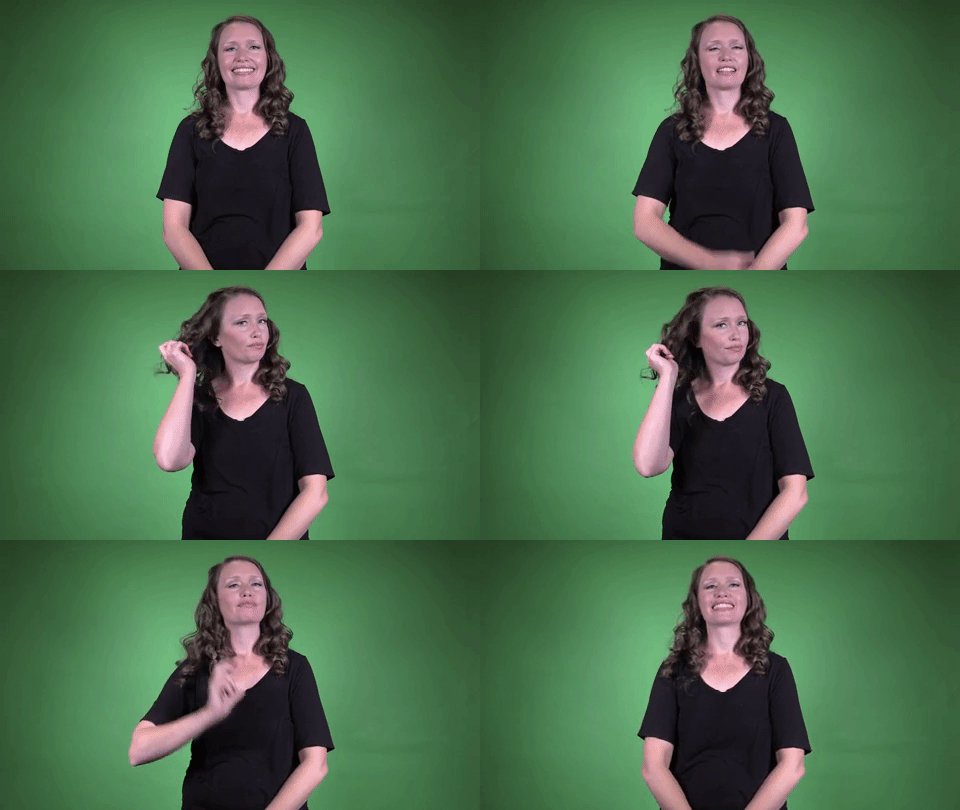
Sign for HAIR in ASL

YouTube player

Practice Activities:

To get comfortable with the sign for HAIR in ASL, begin by practicing the sign in front of a mirror. Repeating the sign slowly and clearly will help build muscle memory. Make sure your hand forms a pinch near the side of your head, mimicking grabbing a small strand of hair.

After mastering the sign in isolation, try using it in common phrases like “long hair,” “cut hair,” or “I like your hair.” This will help reinforce how the sign can be used in everyday conversation. Use facial expressions to show emotion, such as happiness about someone’s hairstyle or frustration about a bad hair day.

To add context, try describing different types of hairstyles using ASL. For example, say “Her hair is curly” or “His hair is short and brown.” Create flashcards with hairstyle photos and sign a sentence to match each image. This activity deepens your understanding of both vocabulary and classifiers often used with the sign for HAIR in ASL.

For partner practice, take turns describing each other’s hairstyles without pointing. The goal is to rely strictly on signing, encouraging more accurate and expressive use of the sign for HAIR in ASL. Give feedback on clarity and fluidity.

Storytelling is another great way to expand your fluency. Try telling a short story about a trip to the hair salon, describing the steps using transition signs and the sign for HAIR in ASL. Include signs for emotions—like excitement, surprise, or disappointment—to give the story depth.

Finally, watch ASL videos or vlogs that include the sign for HAIR in ASL and try to interpret or mimic those segments. Practicing in multiple contexts will ensure a deeper retention of both the sign and its uses.

Cultural Context:

In American Sign Language, physical characteristics like hair play an important role in everyday conversations. Understanding the sign for HAIR in ASL not only helps with describing people but also reflects cultural and linguistic norms within the Deaf community.

The sign for HAIR in ASL is often used in conversations about personal appearance, grooming, or describing someone visually. In Deaf culture, visual description is essential, and being able to sign details like hair color, length, and texture supports clear communication.

When signing HAIR, handshape and location are crucial. The sign for HAIR in ASL is typically made near the head, symbolizing where hair grows. This adds a visual logic to the sign that makes it intuitive for both Deaf and hearing ASL users.

Non-manual markers, like facial expressions, often accompany the sign for HAIR in ASL to emphasize texture, style, or emotion. A signer might describe wild hair with a dramatic expression or smooth hair with a calm and flowing hand movement, creating a richer narrative.

The importance of describing features like hair in ASL also connects to how Deaf individuals identify or refer to others. For example, someone might refer to another person as the girl with curly hair, using the sign for HAIR in ASL along with a descriptive classifier to clearly show what they mean.

Hair is deeply embedded in personal identity and expression. Therefore, learning how to accurately use the sign for HAIR in ASL allows for more respectful and inclusive communication. It also demonstrates cultural awareness and sensitivity to how the Deaf community shares and receives visual information.

In children’s ASL education, learning body-related vocabulary like the sign for HAIR in ASL is foundational. It builds the language base needed for describing people, telling stories, and even playing games that rely on visual characteristics.

In signed storytelling, mentioning details like hair helps create vivid mental images. The sign for HAIR in ASL can be used to enhance the personality of characters or set the scene without needing extra words, which shows how expressive the language can be.

Social contexts matter too. Complimenting someone’s style or discussing haircuts involves using the sign for HAIR in ASL naturally. These common interactions support relationship-building in the Deaf community, where visual language is central.

Variations in signing may occur depending on region, age, or individual style, but the standard sign for HAIR in ASL remains widely understood. Just like in spoken languages, understanding these nuances strengthens fluency and cultural connection.

Whether describing

Extended Definition:

The sign for hair in ASL is a common and useful term used in everyday conversations. It helps describe physical appearance, discuss grooming habits, or reference body parts. In American Sign Language, this sign is typically made by using a hand gesture that mimics holding or tugging a strand of hair near the head.

Understanding the sign for hair in ASL is important for discussing personal care and identity. Hair is a key part of how we express ourselves, and knowing how to communicate this concept through signing helps facilitate better conversations in the Deaf and hard-of-hearing community. It also builds vocabulary for talking about hairstyle preferences, hair color, and grooming.

When learning the sign for hair in ASL, you’ll notice that the movement and handshape are easy to remember. It usually involves a hand forming a small pinch and gently pulling near the temple or scalp. This mimics the natural motion of pulling or touching a strand of hair, which makes the meaning clear even to new signers.

This sign is also useful in various settings, such as beauty salons, school settings, or medical environments where describing a person’s appearance is necessary. It’s also commonly used in storytelling or when teaching children about body parts. The sign can be modified slightly to discuss concepts like long hair, short hair, or no hair.

The grammatical use of the sign for hair in ASL can change depending on the sentence. For example, in combination with other signs, it can describe someone’s hairstyle or indicate an action being performed on the hair. Signers may also use facial expressions to add detail, such as showing admiration or describing a messy look.

In ASL culture, signs like hair are often taught to young children early on. This allows them to express basic needs or emotions related to how they feel or look. Additionally, learning signs that describe the human body is a foundational step in American Sign Language education.

The sign is usually understood without needing extra clarification because it aligns closely with the real-world motion of engaging with hair. When used in context, the sign for hair in ASL effectively communicates meaning without needing fingerspelling or additional description. However, if you need to be more specific, you can pair it with color signs or directional placement.

When building your ASL vocabulary, including the sign for hair in ASL helps when engaging in conversations about appearance, identity, or care routines. For example, it may be useful when making appointments, describing someone to others, or telling stories. With regular practice,

Synonyms: strand, lock, tress, mane, filament

Educational resources: Find related learning materials in our course bank!

Want more? Check out some of our popular learning activities on the homepage!

Need to look up a sign? Use our highly rated dictionary: https://aslinteractive.com/best-asl-dictionary/

Follow us on tiktok: https://www.tiktok.com/@aslinteractive. More social media links at the bottom of this page!

Long-tail Keywords: what is the sign for hair in ASL, how do you sign hair in ASL, ASL sign for hair

Categories:

tags: hair-related signs, body parts in ASL, personal grooming in ASL, appearance vocabulary in ASL, ASL for everyday vocabulary

Parameters

*Handshape*:

The handshape used in the sign for HAIR in ASL involves forming an F handshape , where the thumb and index finger come together to form a circle, while the remaining fingers are extended. This small-sized shape mimics grasping a single strand or small section of hair.

In the sign for HAIR in ASL, this F handshape touches or pulls at a spot on the head, usually near the temple or above the forehead. The sign is simple but effectively represents the concept of hair by mimicking the action of touching it.

*Palm Orientation*:

For the sign for HAIR in ASL, the palm orientation is generally inward toward the head. The dominant hand forms an “F” handshape, with the thumb and index finger coming together to gently grasp a small section of hair near the temple or top of the head. This orientation keeps the fingers pointing upward or slightly angled forward, depending on where the signer indicates the hair.

The inward-facing palm helps emphasize the personal and physical location of hair on one’s body. When demonstrating the sign for HAIR in ASL, maintaining accurate palm orientation ensures clarity and avoids confusion with other signs using a similar handshape.

*Location*:

The location for the sign for HAIR in ASL is at the side of the head, typically around the temple or just above the ear. The hand makes a small pinching motion, usually with the thumb and index finger, close to where a strand of hair might naturally hang.

This placement near the scalp mimics the location of actual hair, making the sign for HAIR in ASL highly iconic. It involves minimal movement and remains within the neutral space close to the body.

*Movement*:

To perform the sign for HAIR in ASL, use your dominant hand in the “F” handshape, with the thumb and index finger forming a circle. Gently grasp or tug a small section of your hair near the front or side of your head using this handshape.

The movement is minimal—just a slight pulling motion to indicate the concept. The sign for HAIR in ASL is most often done near your scalp to clearly signal the reference to hair.

*Non-Manual Signals*:

When showing the sign for HAIR in ASL, the facial expression is typically neutral, as it’s a descriptive sign rather than an emotional one. Slight eyebrow furrowing may occur if the sign is being used in a question, like asking about hair length or color. ‍

Maintaining steady eye contact helps emphasize clarity when using the sign for HAIR in ASL, especially when describing hairstyles or features. There’s no exaggerated emotion unless hair is part of a dramatic storytelling context.

*Prosody, Dominant/Non-Dominant Hand*:

The sign for HAIR in ASL uses the dominant hand only. The dominant hand forms an “F” handshape, where the thumb and index finger touch to create a small circle. This circle grasps a small section of imaginary hair near the temple or the side of the head and pulls outward slightly.

The non-dominant hand is not involved in the sign. The sign for HAIR in ASL clearly represents pulling or indicating a strand of hair and is commonly used in both everyday and descriptive contexts.

Tips for Beginners:

When learning the sign for HAIR in ASL, it’s important to focus on handshape and placement. The sign uses a modified “F” handshape where the thumb and index finger come together to lightly tug a piece of imaginary hair on the side of your head. Make sure your touch is gentle and natural—it’s a small movement, not exaggerated or stiff.

A common mistake beginners make with the sign for HAIR in ASL is placing the sign too far away from the head or using the wrong fingers. Practicing in front of a mirror can help ensure your movement is clear and natural. Remember, facial expressions are minimal for this sign, so don’t overdo your reaction.

Consistency is important. When you sign HAIR, always go for the same general location near the temple or just above the ear. If you change placement each time, it could confuse your conversation partner. Repetition will help keep your movements consistent.

One helpful tip is to review the sign for HAIR in ASL in context. Try describing someone’s hair color or style in a short sentence. This builds memory retention and fluency. Immersing yourself in full sentences will help you feel more fluent over time.

Watch others sign often! By viewing native or fluent users demonstrate the sign for HAIR in ASL, you’ll naturally pick up nuances that you might miss in formal instruction. This is especially helpful for understanding how quickly or smoothly the sign should be done.

Another effective practice method is recording yourself. Play back the video to spot inconsistencies in handshape or movement. This self-review process can build your confidence and improve muscle memory.

Use flashcards or prompt cards with images to encourage quick recall of the sign for HAIR in ASL. This visualization method supports stronger connections between the sign and its meaning

Connections to Other topics:

The sign for HAIR in ASL connects closely with vocabulary related to physical appearance, grooming, and body parts. Since HAIR is part of the body, the sign is often taught alongside others like FACE, EYE, NOSE, and EAR, helping learners understand spatial aspects and classifiers used on the head. It also functions well with signs like BRUSH, COMB, and SHOWER, creating compound ideas such as brushing your hair or washing your hair.

In compound uses, the sign for HAIR frequently appears in phrases that describe actions or characteristics. For example, pairing it with LONG or SHORT describes hair length, while combining it with COLOR signs like BLACK, BLONDE, or RED expresses hair color. In this way, it becomes an important part of descriptors commonly used in storytelling or giving personal information.

There are also more abstract uses of the sign for HAIR in ASL. When talking about styling or salon visits, phrases like HAIR CUT or HAIR DYE integrate HAIR with verbs like CUT or color terms like PURPLE or GREEN. These combinations help expand vocabulary related to occupations, such as HAIR STYLIST.

Culturally, the sign for HAIR in ASL can be adapted to describe varied hairstyles and textures. You might see classifiers and descriptive signs used with it to show braids, curly hair, or shaved patterns. These variations tie into identity, ethnicity, and self-expression—topics commonly discussed within the Deaf community ‍♂️.

Learning the sign for HAIR in ASL also supports better understanding of personal care routines and self-description in both narrative and conversational ASL. It reinforces ways to describe someone’s look, their daily habits, and even their mood based on hair condition or style. This makes it a fundamental building block for rich expression in ASL dialogues.

Summary:

The sign for HAIR in ASL is visually intuitive and easy to remember. It mimics the act of gently pulling a small section of hair, typically from the side of the head, often using the index finger and thumb in a pinching motion.

To perform the sign, use a handshape where the tip of the thumb touches the tip of the index finger. This forms a small closed circle, similar to the handshape for the sign for SMALL or LITTLE.

Bring this handshape up to the side of your head, near the area where sideburns might be, or slightly above. Make a slight pulling or pinching gesture outward, as if taking hold of a strand of hair.

The location of the sign is important, as placement near the head reinforces the idea being conveyed. Minor variations exist depending on region or personal signing style, but the motion and meaning remain consistent.

The sign for HAIR in ASL connects heavily to physical traits and personal identifiers. Describing someone’s hair is often part of initial identification, just like talking about height, gender, or clothing.

ASL places heavy importance on visual and physical descriptions. The sign for HAIR allows signers to give detail about style, color, length, texture, and volume, either alone or in combination with other signs.

In casual, conversational ASL, the sign for HAIR is often combined with classifiers. Classifier handshapes can be used to describe curly, long, straight, or frizzy hair with specific, spatialized gestures.

The grammatical use of the sign depends on the sentence. It frequently appears as a noun—for example, “your hair looks nice”—but is also used as part of verbs when discussing grooming activities like brushing or cutting.

When used with facial expressions and non-manual markers, the sign becomes more emotionally rich. A raised eyebrow or pursed lips can indicate approval, confusion, or description, enhancing the message attached to the sign.

Culturally, the concept of hair carries diverse significance in Deaf communities. Like in hearing culture, hair can symbolize style, individualism, professionalism, and also identity as it intersects with race and gender.

In Deaf culture, self-expression through appearance, including hair, often holds special importance. Since communication is visual, hairstyles can either invite or distract from effective engagement.

The sign for HAIR in ASL becomes part of broader discussions around inclusivity. For example, Black Deaf individuals often discuss natural hair styles or protective styles in ways that demand culturally sensitive signing.

There is no standard sign for every type of hairstyle, so classifiers and descriptive techniques are key. They allow users to describe afro-textured hair, braids, fades, and more with visual granularity.

Linguistically, the sign for HAIR is a strong example of iconicity in ASL. The motion reflects the real-world action of touching or interacting with hair, reinforcing the meaning instantly to viewers.

This iconic link helps make the sign intuitive for new learners. However, it also adds creativeness for fluent signers to adapt in rich ways with storytelling, poetry, and visual metaphors.

From a linguistic perspective, the handshape and placement are minimal but effective. ASL signs can involve three key parameters: handshape, movement, and location, all present in the sign for HAIR.

The sign is normally performed with the dominant hand. However, when describing someone sitting opposite the signer, the location can shift to reflect their body metaphor and directionality.

Applied linguistics brings insights when teaching the sign for HAIR in ASL. Teachers often pair it with practice in describing people, which helps students develop fluidity in visual description.

The sign also appears in context-rich dialogues such as “I washed my hair” or “Who cut your hair?” These help learners connect vocabulary with practical conversation.

Children learning the sign for HAIR in ASL often associate it first with their own grooming routines. This helps reinforce personal pronouns and ownership concepts like MY HAIR or YOUR HAIR.

The sign also appears in everyday contexts. Conversations about allergies, head lice, styling, fashion, or even wigs will naturally involve the sign for HAIR in ASL.

The keyword phrase is also used in Deaf beauty pageants, vlogs, and visual culture online. Deaf creators often share hairstyle tips, product reviews, and routines, using the sign fluidly in ASL storytelling.

Exploring the sign for HAIR in ASL opens doors to signs for various grooming habits. Brushing, combing, shampooing, blow drying, and coloring are all associated signs used in sequence or combination.

When used narratively, the sign contributes to storytelling and performance. Poets in ASL can use hair-symbolism to reference identity, transformation, trauma, or power in deeply visual ways.

Issues around hair discrimination also show up within Deaf discourse. The sign for HAIR is central in activism, where topics like the CROWN Act are explained and discussed using ASL.

The sign

Want more? Check out some of our popular learning activities!

ASL Interactive Resources

ASLInteractive YouTube Channel

Follow us on tiktok: @aslinteractive.com

Follow us on Instagram: aslinteractive

Facebook page: aslinteractive

Facebook group: aslinteractive

LInkedIn: ASL Interactive LLC

Twitter: @ASL_interactive

*Some information on this page is AI-generated. AI can make mistakes. Please check the information.


Responses