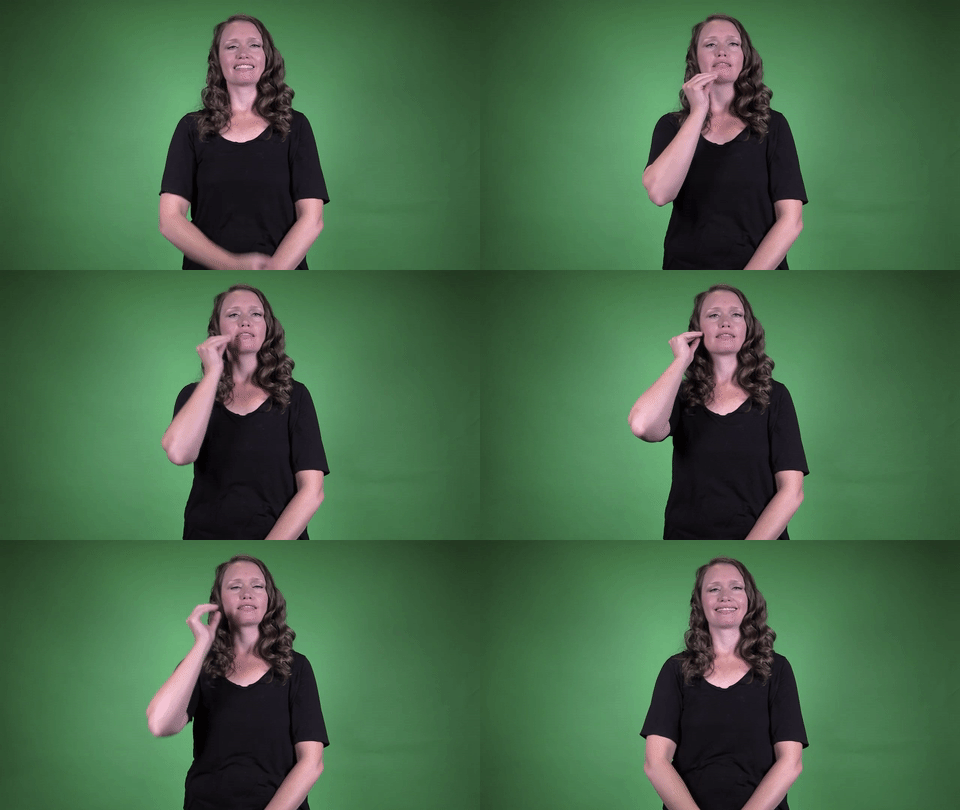
Definition: The place where one lives.
Sign for HOME in ASL
Practice Activities:
Start by practicing the sign for HOME in ASL in front of a mirror to ensure correct handshape and movement. Repeat the sign slowly and then increase your speed while maintaining clarity. Try signing it five times in a row, paying attention to the touch points from the mouth to the cheek.
Use flashcards to match images of a house or common places to live with the sign for HOME in ASL. This will help connect the visual idea with the sign. You can also draw a simple home and practice signing as you label parts of the house.
Incorporate the sign into simple phrases. For example, sign: I GO HOME, or I LIKE MY HOME. Rehearse these phrases daily to build fluency. Try changing the subject or verb to create new combinations like SHE VISIT HOME or WE CLEAN HOME.
Create a short story where the main character returns home after a long time away. Sign the beginning where the character is elsewhere, then incorporate the sign for HOME in ASL as a key plot point when they return. Record yourself or sign in front of a partner for feedback.
With a study partner, play an activity where one person signs a sentence with HOME and the other person guesses what they said. Reverse roles and track how many correct responses are given. Add complexity by including signs for family members or activities done at home.
Try a walk around your house while signing HOME every time you enter a new room. This reinforces location and personal connection to the concept of home. Finally, watch ASL videos that include the sign in different contexts to see how it is used naturally and expressively.
Cultural Context:
In American Sign Language, signs often reflect deep cultural meaning, and the sign for HOME in ASL is no exception. This sign represents more than just a structure where someone lives—it reflects safety, family, and a core part of Deaf identity.
When using the sign for HOME in ASL, it’s important to understand its deeply rooted association with both physical space and emotional connection. The sign combines elements that show a transition from the mouth to the cheek, symbolizing nourishment and rest—basic aspects of feeling at home.
The Deaf community places high value on family ties and community support. The sign for HOME in ASL often references more than where someone sleeps at night; it reflects community gathering spaces, Deaf-friendly environments, and places where clear communication thrives. In Deaf culture, true comfort comes from shared language and accessible communication.
Deaf individuals might refer to certain schools for the Deaf, local clubs, or national events as a sense of home. Signing HOME in ASL in the context of any of these places signals emotional grounding as much as a physical location. The sign supports themes of pride, culture, and belonging.
HOME in ASL also carries the weight of historical context. Before mainstream schools were more inclusive of Deaf education, residential schools often became second homes to many Deaf children. These environments shaped lifelong relationships and provided cultural immersion. The sign for HOME in ASL sometimes communicates those shared experiences and formative years.
Language access shapes where people feel at home. In Deaf culture, a space becomes truly home when ASL can be used freely and understood widely. The sign for HOME in ASL can symbolize any environment where ASL flourishes, like Deaf-owned businesses or culturally rich events.
This cultural richness is captured in the sign for HOME in ASL, because it’s never just about a house—it’s about belonging. Whether referring to a physical dwelling or a cultural space, the sign for HOME in ASL connects directly to identity and Deaf pride.
Home is also an emotional location in the Deaf experience. For many in the community, finding a place where they are understood and valued is essential. Using the sign for HOME in ASL often expresses this emotional safety and acceptance.
Because ASL is a visual, spatial language, signs like HOME in ASL carry multiple layers of meaning depending on context. A signer may modify the sign slightly to reflect personal interpretation, but the essence—connection, comfort, identity—remains.
Using the sign for HOME in ASL is a reminder that place is more
Extended Definition:
The sign for home in ASL is a foundational term that appears frequently in day-to-day conversations. Understanding this sign can help learners communicate about where they live, return to, or feel most comfortable. It’s an essential vocabulary word in American Sign Language used by both beginners and fluent signers.
The ASL sign for home combines the concepts of eating and sleeping, symbolizing the place where one eats and rests—your home. It typically involves a motion from the corner of the mouth to the side of the cheek using a flat, closed hand. This sign is expressive and iconic, capturing the idea of personal space and familiarity.
Context matters a great deal when using the sign for home in ASL. Depending on facial expressions and sentence structure, it can be used to talk about someone’s actual house or refer to a broader idea such as hometown or homeland. Facial grammar helps to determine the depth of meaning behind the sign.
In conversation, knowing how to use the ASL sign for home allows for important sentences like “I’m going home” or “She is at home.” These simple but powerful statements become accessible and natural with just a bit of practice. Using signs that are related to places, like home, school, or work, establishes a foundation for more complex communication.
The sign for home in ASL also connects with cultural identity in the Deaf community. Non-verbal language users often express emotional ties and daily routines through such familiar signs. This makes signing about home not only practical but meaningful within personal narratives.
When fingerspelling isn’t necessary, the sign for home becomes even more valuable. It allows users to be quicker and more efficient during conversations. A single fluid motion replaces the need to focus on each letter, enhancing fluency and confidence.
Beginners learning the ASL sign for home benefit greatly from consistent practice and visual referencing. Watching native signers, replaying video demonstrations, and using mirrors help reinforce the correct movement and handshape. Over time, the sign becomes second nature, fitting comfortably into common phrases and questions.
It’s important not to confuse the sign for home in ASL with similar signs like house or building. While related, each has a distinct handshape and movement. Clarity in these signs enhances understanding and makes communication more precise.
Teachers and educators often start with the sign for home when introducing place-based vocabulary. Its familiarity and emotional relevance make it an excellent entry point into more advanced ASL topics. By signing home, learners form connections between language and lived experience
Synonyms: house, residence, dwelling, domicile, abode
Educational resources: Find related learning materials in our course bank!
Want more? Check out some of our popular learning activities on the homepage!
Need to look up a sign? Use our highly rated dictionary: https://aslinteractive.com/best-asl-dictionary/
Follow us on tiktok: https://www.tiktok.com/@aslinteractive. More social media links at the bottom of this page!
Long-tail Keywords: what is the sign for home in asl, how do you sign home in asl, how to say home in american sign language
Categories:
tags: home signs, daily life ASL, ASL vocabulary home, ASL everyday signs, living space ASL
Parameters
*Handshape*:
The handshape for the Sign for HOME in ASL uses a flat “O” handshape , where the fingers and thumb are brought together to form a closed shape. This handshape is consistent throughout the sign and remains firm but relaxed.
In the Sign for HOME in ASL, the flat “O” touches the side of the mouth, then moves to the cheekbone. This motion symbolizes the idea of eating (mouth) and sleeping (cheek), both common activities done at home.
*Palm Orientation*:
For the sign for HOME in ASL, the palm orientation is generally neutral or slightly inward. The fingertips of a flat-O handshape touch the side of the mouth and then move to the side of the cheek, mimicking where you eat and sleep—key aspects of a home.
When performing the sign for HOME in ASL, the palm faces in toward the side of the head, maintaining a relaxed wrist. This orientation helps clearly convey the concept without confusing it with similar signs.
*Location*:
The sign for HOME in ASL is produced near the side of the face, specifically starting at the cheek and moving toward the area near the ear. It typically touches the cheek near the mouth first, then moves slightly upward and back toward the ear, as if indicating the idea of nourishment and rest—what “home” traditionally represents.
This location near the face helps visually link the sign for HOME in ASL to the concept of where one eats and sleeps. The movement and handshape are clear and concise, making it a commonly used and easily understood sign.
*Movement*:
The movement for the sign for HOME in ASL begins with your dominant hand in a flat “O” shape, where your fingertips are touching. Touch the tips of your fingers to the side of your mouth near the corner of your lips.
Then, move your hand in a short arc to touch your cheek just above the jawline near your ear. This sign shows the idea of a place where you eat and sleep, capturing the concept of the sign for HOME in ASL .
*Non-Manual Signals*:
The non-manual signals used with the sign for HOME in ASL typically include a neutral or slightly pleasant facial expression, showing comfort or familiarity. Since the concept refers to a personal or private space, the eyes may slightly soften, and the body posture remains relaxed.
When emphasizing the sign for HOME in ASL in a sentence, raised eyebrows may accompany the sign if used in a yes/no question. A small head nod can emphasize affirmation, helping convey the context of “home” clearly .
*Prosody, Dominant/Non-Dominant Hand*:
The sign for HOME in ASL is made with the dominant hand using a flattened “O” handshape. The hand starts at the side of the mouth, then moves in a slight arc to touch the cheek near the ear. The non-dominant hand is not used in this sign.
To clearly convey the sign for HOME in ASL, facial expressions are kept neutral or slightly pleasant, emphasizing comfort or familiarity. Prosodic cues such as a gentle, deliberate movement can help differentiate it from other similar signs.
Tips for Beginners:
When learning the sign for HOME in ASL, it’s important to note that this sign combines the concept of “eat” and “sleep.” To execute it correctly, use your dominant hand in a flattened “O” handshape, touching your cheek near your mouth (like eating) and then moving it to touch your cheek near your ear (like sleeping). Make sure the motion is smooth and fluid, without pausing between the two parts.
A key tip for beginners is to keep your fingers together tightly in the “O” shape. If your fingers are too spread out, the sign may be mistaken for a different concept. Practice in front of a mirror to make sure your handshape and movement look clean and natural.
Pay attention to facial expressions—while they aren’t exaggerated for this sign, a neutral or pleasant expression works best. Avoid looking stiff or robotic when signing. It’s also helpful to practice in context by using the sign for HOME in ASL within full sentences, rather than in isolation.
Beginners often switch the order of the movement or place the hand too high or low on the face. Repeating the sign slowly at first and gradually building up to a natural speed can help avoid these common errors. Be sure the contact points of the sign are clear and consistent for accuracy.
Another useful strategy is to watch native signers use the sign for HOME in ASL in different conversations. This helps reinforce fluidity and gives you exposure to slight variations or styles. Sign with others as much as possible—even casual practice helps solidify muscle memory.
Whether you’re learning ASL casually or pursuing fluency, using the sign for HOME in ASL correctly and confidently is a great milestone. Patience and regular use in everyday signing will lead to long-term success .
Connections to Other topics:
The sign for HOME in ASL connects closely to the concept of location and belonging, which appears across various ASL core vocabulary. It visually draws from the idea of a place where one eats and sleeps, which links it semantically to signs like EAT, SLEEP, and HOUSE. HOME is signed by bringing a flattened “O” handshape from the mouth to the cheek, symbolizing these activities without explicitly showing them.
This sign has strong ties to compound or blended signs in ASL. For instance, the phrase HOME-WORK blends the sign for HOME and the sign for WORK, representing schoolwork done at home. In real-life contexts, such compounds emphasize how the concept of HOME integrates into daily routines and responsibilities, reflecting broader meanings beyond the physical space.
HOME can also appear in time-based phrases like STAY-HOME or GO-HOME, which incorporate directional or temporal elements into the meaning. These examples show how the sign for HOME in ASL layers additional meaning when paired with verbs or adverbs, changing the overall message conveyed within a sentence. It also links to signs such as FAMILY or SAFE, as they all tap into the idea of comfort, refuge, or connection.
Within cultural context, the sign for HOME in ASL also appears when talking about Deaf culture, such as phrases like HOME SIGN, referencing natural sign systems developed in homes without formal sign language exposure. Understanding the sign for HOME in ASL offers insight into the way ASL expresses physical, emotional, and social spaces.
This sign also connects to conversational and narrative skills in ASL when describing living situations, family dynamics, or personal stories. ASL storytelling often involves using HOME as a setting or emotional anchor, making it a recurring and meaningful sign in fluent and expressive signing.
Summary:
The sign for HOME in ASL carries deep cultural and emotional connotations. It transcends the mere concept of a dwelling and connects directly to one’s sense of belonging and personal space .
To produce the sign for HOME in ASL, begin by using a flat “O” handshape—a relaxed version of the “O” from the ASL alphabet. Touch your cheek near the corner of your mouth and then touch it again near your ear. This motion symbolizes the combination of eating and sleeping, elemental activities associated with home.
This sign is derived from two other signs: EAT and SLEEP. ASL often condenses signs with related meanings to create shortcuts for efficient communication. The sign for HOME in ASL illustrates this clever linguistic merging perfectly.
Etymologically, the location of the sign around the mouth and then ear suggests routine and personal comfort. These body areas often symbolize human needs and experiences in ASL. That connection intensifies the emotional warmth tied to the sign for HOME in ASL.
The movement is smooth and deliberate but not exaggerated. It reflects familiarity and repetition, perhaps mirroring how we return home each day. The symmetry of the movement implies a sense of balance and safety.
There is no dominant hand requirement; the sign can be adapted to both left and right-handed signers. However, consistency within one’s signing is key. Receptive understanding is rarely impaired if these rules are followed.
Facial expressions often play a role in adding meaning to the sign. A relaxed or affectionate facial expression can enhance what is communicated with the sign. This emotional layering is vital to fully expressing the idea of home in ASL.
The sign for HOME in ASL is rarely modified unless combined in a compound sign. It remains standardized across dialects in Deaf communities. This consistency supports its semantic weight and positions HOME as a symbolic anchor in discourse.
In ASL grammar, the sign for HOME in ASL functions as a noun. It can be the subject, object, or part of a locative expression. Word order flexibility in ASL allows HOME to appear at various points in key statements without confusion.
For example, “I GO HOME” involves a directional verb and emphasizes the destination. The sign for HOME in ASL in this case emphasizes where the action culminates. Conversely, “HOME I LOVE” might suggest a stronger emotional focus or contrast.
Time indicators are often used with HOME to specify when actions involving the home take place. Phrases like “YESTERDAY HOME” or “HOME TOMORROW” are common. This shows how the sign for HOME in ASL interacts fluidly with temporal markers.
Pronominal pointing can be used with HOME. The signer may indicate a location while making the HOME sign to show spatial relationships. This is helpful when describing multiple homes or changes in residence.
In multilingual Deaf communities, the sign for HOME in ASL may resemble home-related signs in other signed languages. However, nuances like contact points, movement, and handshape make the ASL version unique. Knowing this helps avoid confusion in cross-signing situations.
Culturally, the sign for HOME in ASL connects deeply to the idea of Deaf identity and safe spaces. A Deaf household may represent linguistic access, community storytelling, and shared values. Thus, the sign begins to outperform its literal meaning.
In narratives, especially in storytelling or shared experiences, the sign for HOME often marks a turning point or emotional foundation. Returning home or growing up in a Deaf home may be recounted with emphasis on this sign. Its simplicity invites rich storytelling ♂️ .
The architectural or size-based aspects of a house are generally described with classifier signs. Signers use those after establishing “HOME” to build visual information. This layering lets HOME stand as a conceptual sign before details are added.
The sign for HOME in ASL is often used with possessive classifiers and pronouns. For example, “MY HOME” or “HER HOME” is shown by altering the hand’s orientation. The classifier system in ASL lends nuance to these constructions.
Linguistically, the phonological elements of the sign for HOME present as a combination of location, movement, and handshape. It’s minimal yet rich, making it a preferred example in teaching classifiers and directional verbs. It illustrates how complexity resides in simplicity.
The handshape involved, though simple, is distinctly connected to iconicity. The flattened “O” mimics bringing something to the face, mirroring acts associated with home life. Its ease of production makes it easily acquired by beginner signers.
Applied linguistics studies often highlight the acquisition of HOME in the early stages of ASL learning. This sign resonates with both hearing and Deaf students alike. It provides intuitive learning due to its emotional and conceptual accessibility.
In Deaf education, setting up the concept of “HOME” is foundational when teaching narrative sequencing. It serves as a basis from which other past or future experiences can unfold. As such, it’s part
Want more? Check out some of our popular learning activities!
ASL Interactive Resources
ASLInteractive YouTube Channel
Follow us on tiktok: @aslinteractive.com
Follow us on Instagram: aslinteractive
Facebook page: aslinteractive
Facebook group: aslinteractive
LInkedIn: ASL Interactive LLC
Twitter: @ASL_interactive
*Some information on this page is AI-generated. AI can make mistakes. Please check the information.


Responses