Definition: A feeling of expectation and desire for a certain thing to happen.
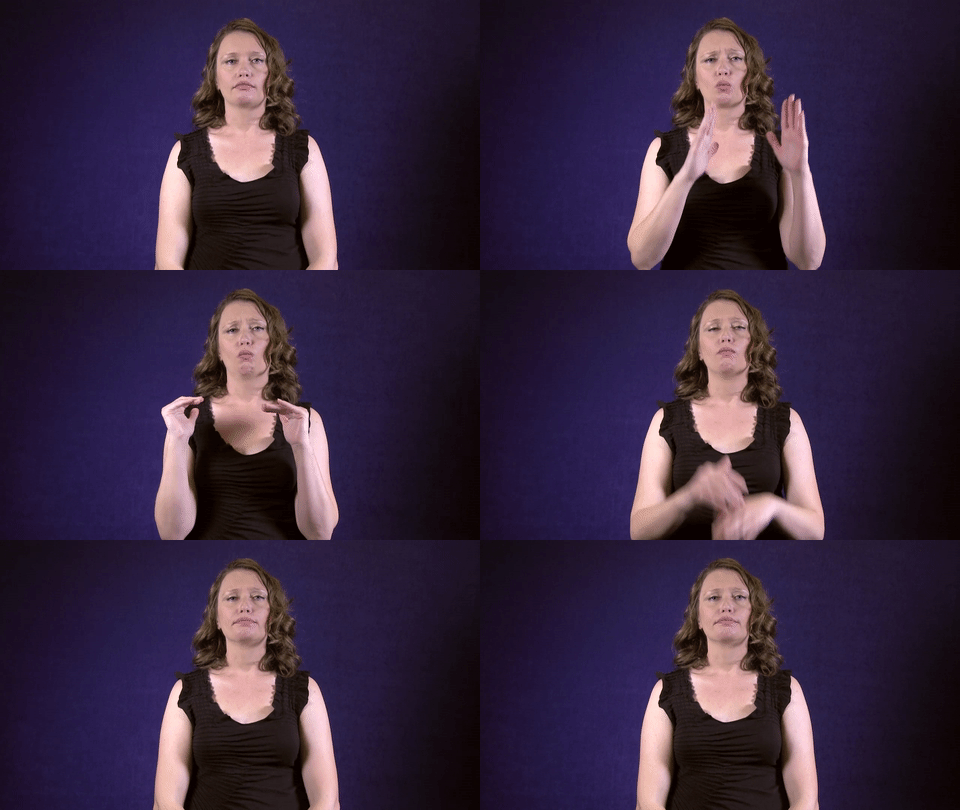
Sign for HOPE in ASL
Practice Activities:
Start by practicing the sign for HOPE in ASL in front of a mirror to perfect your handshape and movement. Sign the word slowly at first, then gradually increase your speed while keeping precision. Repeat the sign multiple times to build muscle memory and comfort with the motion.
Create flashcards with the word “hope” written on one side and a picture representing hope on the other. Each time you flip the card, sign the word to reinforce your visual connection. Watch yourself sign on video for self-evaluation and adjust your technique as needed.
Use the sign for HOPE in ASL in simple practice sentences such as “I hope for peace,” “They hope to win,” or “We hope she visits.” Sign the sentence slowly, then again at a conversational pace. Try changing the pronoun or subject to increase your fluency and personalize the practice.
Storytelling is a powerful way to incorporate the sign for HOPE in ASL. Create a short story about a character who is hoping for something positive, like finding a lost pet or achieving a goal. Sign the story to a partner, or record yourself to review your fluidity and accuracy.
For group or partner work, take turns acting out scenarios using the sign for HOPE in ASL. One person describes a situation—like waiting for exam results or expecting good weather—and the other responds with an appropriate sentence incorporating the sign. This encourages spontaneous usage and helps retain vocabulary through context.
Engage in a journaling activity where you sign one thing you hope for each day. Keep a video log of your daily hope signs to build expressive skills. Over time, this practice will make using the sign for HOPE in ASL feel natural and meaningful in real-life communication.
Cultural Context:
In American Sign Language, the sign for HOPE in ASL represents more than just a gesture; it carries emotional and cultural depth within the Deaf community. Hope is a universal concept, but how it is expressed visually through ASL reflects the values of resilience and community spirit found in Deaf culture.
The sign for HOPE in ASL is often used during conversations centered on optimism and future possibilities. Whether it’s about personal goals or collective aspirations, this sign brings a sense of unity and shared experience. People use it when they talk about looking forward to better times or expressing encouragement to others.
In Deaf culture, visual language is filled with emotion and intent. The sign for HOPE in ASL is often accompanied by facial expressions that amplify its meaning, showing sincerity and belief in better outcomes. It’s used in uplifting messages, storytelling, religious gatherings, community events, and educational contexts.
The concept of hope has always played a crucial role in movements for Deaf rights and accessibility. The sign for HOPE in ASL carries that same energy—it’s not just a word; it symbolizes progress, understanding, and change. When used in rallies or community advocacy, it reminds others that the community remains strong and forward-looking.
In spiritual or religious contexts, the sign for HOPE in ASL is regularly seen during sermons or prayer. It powerfully connects people to messages of faith, while preserving the richness of their own language. Churches and spiritual groups that are accessible to Deaf members use the sign to convey trust in brighter futures and divine guidance.
Children in Deaf schools are introduced to the sign for HOPE in ASL as part of learning how to discuss and believe in their dreams. Teachers use it to inspire students and build confidence. This form of motivation is embedded into the language, making ASL both educational and empowering.
Social media has also helped amplify the importance of this sign. When people share their personal journeys or community achievements in videos, they often include the sign for HOPE in ASL to convey heartfelt emotions. It spreads positivity across platforms and fosters inclusion within and beyond the Deaf world ✨.
In artistic performances like poetry, storytelling, or theater, ASL performers use the sign for HOPE in ASL with expressive flair. It becomes part of the visual rhythm, adding layers of meaning to emotion-driven pieces. Audiences—whether Deaf or hearing—can feel the impact of that sign through its beauty and intention.
During difficult times, such as natural disasters or social injustice, community leaders and
Extended Definition:
The sign for hope in ASL is a beautiful and meaningful gesture that symbolizes optimism, faith, and a positive outlook. In American Sign Language, this concept is conveyed through a two-handed movement that combines elements of thought and care. It reflects the emotional and philosophical depth often associated with the word hope.
To perform the sign for hope in ASL, both hands start near the forehead, indicating a connection with the mind or thoughts. The dominant hand comes forward slightly while both hands lower and close slightly in a repeated motion, suggesting the intertwining feelings of desire and expectation. This sign is expressive and emotive, capturing the blend of longing and positivity that defines hope.
The meaning goes beyond the motion of the hands. The sign for hope in ASL is often used in contexts where someone is sharing their dreams, goals, or prayers. Whether it’s expressing a wish for better days, success in a difficult task, or recovery from illness, the sign visually conveys a hopeful heart and determined spirit.
When learning the sign for hope in ASL, it’s important to maintain the proper facial expressions, as they play a critical role in conveying emotion in sign language. A soft, sincere expression enhances the meaning of the sign and makes communication more effective. Facial grammar in ASL adds clarity and dimension, making the message more heartfelt and authentic.
This sign can be combined with other ASL signs to create more complex messages. For example, you can sign phrases such as “I have hope” or “Never lose hope” to offer encouragement or support. It’s a versatile vocabulary word that finds use in casual conversations, motivational talks, spiritual discussions, and storytelling.
In Deaf culture, the concept of hope is particularly meaningful. The sign for hope in ASL may be included in life-affirming events, such as graduations, rallies, or healing circles. It holds emotional resonance and is deeply valued when used in times of uncertainty or transition.
Learning the sign for hope in ASL can be an empowering experience for both Deaf and hearing individuals. It opens the door to compassionate communication and bridges emotional connections through visual language. It’s a reminder that hope transcends sound and is felt deeply through expressive movement.
For ASL students and educators, teaching this sign offers a chance to explore the emotional layers of ASL vocabulary. Videos, flashcards, and in-person instruction can enrich understanding and correct usage. It’s a great sign to practice with expressions and context-based examples to gain fluency and confidence.
Consistent use and
Synonyms: anticipation, expectation, optimism, aspiration, faith
Educational resources: Find related learning materials in our course bank!
Want more? Check out some of our popular learning activities on the homepage!
Need to look up a sign? Use our highly rated dictionary: https://aslinteractive.com/best-asl-dictionary/
Follow us on tiktok: https://www.tiktok.com/@aslinteractive. More social media links at the bottom of this page!
Long-tail Keywords: what is the sign for hope in ASL, how do you sign hope in ASL, how to say hope in American Sign Language
Categories:
tags: hope signs, ASL emotions, feeling signs, abstract ASL concepts, ASL vocabulary for hope
Parameters
*Handshape*:
The dominant and non-dominant hands use a relaxed flat handshape, similar to the number five but with slightly curved fingers. Both hands open and close slightly in a forward motion near the forehead area, representing the concept behind the sign for hope in ASL.
The sign for hope in ASL uses gentle, expressive handshapes to indicate an emotional and abstract idea. The curved, relaxed fingers help convey a sense of longing or aspiration visually and conceptually.
*Palm Orientation*:
The palm orientation for the sign for HOPE in ASL begins with both hands open in a loose “flat O” or bent handshape. The dominant hand starts near the forehead while the non-dominant hand is positioned lower near the chin. Palms generally face the head at the start of the motion.
As the hands move, they flutter slightly forward and downward. Throughout the sign for HOPE in ASL, the palms maintain an inward-facing orientation, showing a connection to thought or expectation.
*Location*:
The sign for HOPE in ASL is typically made in the area around the forehead and lower face. Both hands start near the forehead, with the fingertips of one bent hand touching near the temple and the other hand below in front of the mouth area.
This location highlights cognitive and emotional concepts, making it a natural fit for the sign for HOPE in ASL. The use of the head and face emphasizes the thoughtful, forward-looking nature of the sign.
*Movement*:
To perform the sign for HOPE in ASL, start with both hands in flat “O” handshapes near the forehead and chest areas. The dominant hand begins near the forehead, while the non-dominant hand is closer to the chest.
Both hands open slightly into relaxed “5” shapes as they move forward and downward in a gentle alternating motion. The sign for HOPE in ASL mimics a thoughtful or wishful gesture, often used to convey optimism or desire .
*Non-Manual Signals*:
The non-manual signals for the sign for hope in ASL typically include a soft, neutral or slightly hopeful facial expression. Eyebrows may be slightly raised to show positivity or anticipated outcomes.
Mouth movements are minimal but may reflect calmness or a gentle uplifting emotion. When using the sign for hope in ASL, your overall demeanor should convey optimism or a quiet confidence, reinforcing the sign’s meaning .
*Prosody, Dominant/Non-Dominant Hand*:
The sign for HOPE in ASL uses both hands with the dominant hand in a bent handshape near the forehead and the non-dominant hand in a similar bent handshape in front of the body. The dominant hand moves slightly forward and downward toward the non-dominant hand, suggesting a connection or thought moving outward from the mind.
When performing the sign for HOPE in ASL, the hands remain open and relaxed, and the motion is fluid yet subtle. Facial expression can enhance the meaning, typically reflecting optimism or anticipation. Using both hands ensures the sign for HOPE in ASL conveys clarity and emotional tone.
Tips for Beginners:
When learning the sign for HOPE in ASL, it’s important to master the motion and handshape combination correctly. The sign uses a two-handed movement, where one hand brushes near the forehead and then moves downward, while the other hand follows a similar motion a moment later. Practice getting the rhythm of the movement right—smooth and thoughtful, without looking rushed.
New learners often struggle with the timing and spatial accuracy of this sign. Be sure to start near the forehead and bring the motion forward, symbolizing the abstract concept of looking forward or having expectations. It helps to watch clear video examples of native signers to see the motion in fluid action. Visual repetition builds muscle memory faster than isolated practice.
Understanding the emotional context behind the sign for HOPE in ASL can make your signing more expressive and clear. ASL is not just about hand movements—it incorporates facial expressions and body language deeply. Keep your facial expression in line with the emotion of the sign. This means a gentle, optimistic look can enhance your message when signing hope.
Signing too quickly or without clear motion can make your sign look like a different word. Pace yourself and execute the movements deliberately. Beginners tend to either exaggerate the movement or make it too small—strive to find a balance that mirrors natural native use.
If you’re signing in conversation, always make sure your signing space is visible to the other person. Signing too low or too wide can make it hard to understand. The sign for HOPE in ASL stays close to the upper center of the body, which is standard ASL signing space.
Set aside regular time each day to practice the sign for HOPE in ASL along with other emotional concept signs. Over time, use it in short phrases to strengthen recall. Repeated, meaningful use in context leads to long-term retention.
Connections to Other topics:
The sign for HOPE in ASL connects deeply with abstract emotions and future-oriented concepts, making it closely related to signs like DREAM, FAITH, and BELIEVE. These signs are often used in contexts that express optimism, aspirations, or emotional resilience. Understanding how these abstract concepts overlap helps learners grasp how ASL represents intangible feelings visually through space and movement.
In expressive ASL storytelling, the sign for HOPE in ASL may combine with signs like FUTURE, PLAN, or WAIT, forming intuitive and culturally rich compound phrases. For example, pairing HOPE with the sign for SUCCESS can describe a positive outlook toward upcoming achievements. Such combinations enrich communication and allow for nuance in conveying degrees of expectation or desire.
The structure of the sign also closely mirrors conceptual metaphors. It begins near the forehead and moves outward, paralleling how thoughts or dreams project from the mind into envisioned outcomes. This movement can be compared to the sign for THINK or DREAM, highlighting mental activity and projection. Recognizing these movement similarities strengthens a learner’s ability to retain and differentiate signs.
In community and cultural discussions, the sign for HOPE in ASL is often present when conveying collective goals or societal change. It appears frequently in religious and motivational contexts, linking it to signs like PRAY, UNITY, or CHANGE. These thematic associations show how the sign is more than vocabulary—it’s a tool for advocacy, identity, and emotional sharing.
Learners may also see the sign for HOPE used in narratives about healing, recovery, and personal perseverance. It connects with signs like STRONG, CONTINUE, and PATIENCE, often in sequences that build emotional pacing. Recognizing these sign clusters promotes smoother expression and comprehension during conversations or visual storytelling. Knowing how and when to use the sign for HOPE in ASL unlocks expressive depth across various contexts.
Summary:
The sign for HOPE in ASL involves a specific movement and configuration of both hands. To perform it, start with both hands in a flat “O” handshape near the sides of the head. Then, flick the fingers downward slightly as if mimicking the onset of a thought or aspiration being projected outward. This movement can sometimes vary slightly depending on region and context, but the essence of the sign remains consistent across most signing communities.
The sign conveys an internal feeling or expectation of positive outcomes. Because hope is often abstract and emotional, the sign reflects that through its gentle and expressive movement. It’s not abrupt or forceful; instead, it communicates longing, optimism, or a positive outlook.
In ASL grammar, the sign for HOPE in ASL functions primarily as a verb or noun, depending on the sentence structure. Placement, facial expressions, and context allow one sign to embody multiple parts of speech. This also reflects ASL’s visual and spatial syntax, which supports fluid role-shifting and conceptual accuracy without needing auxiliary words.
For instance, to express “I hope you come,” a signer would use the sign for HOPE in ASL combined with directional verbs and appropriate facial expressions. The raised eyebrows or slight smile indicates the emotional context behind the sign. Such grammatical nuance allows ASL to be incredibly expressive even with just a few signs.
Culturally, hope has deep resonance within the Deaf community. Historically, the pursuit of access, inclusion, and equity has been grounded in hope. The sign for HOPE in ASL often appears in organizations, mottos, and personal narratives about Deaf pride, resilience, and advocacy. It captures more than wishful thinking—it becomes a symbol of ongoing effort and belief in positive change.
Many ASL users connect this sign with other related signs like DREAM, BELIEVE, or FUTURE. The combination of these signs can tell layered stories of ambition and optimism. These interconnections reveal how individual signs in ASL rarely exist in isolation; they are part of a web of expression that draws from experience and emotion.
Linguistically, the sign for HOPE in ASL demonstrates iconicity in a subtle form. While not directly mimicking hoping, the movement from the head outward visually represents a thought or expectation projected into the future. This embodiment of abstract ideas is a core feature of ASL’s visual modality.
From an applied linguistics perspective, this sign shows how visual-gestural languages navigate concepts that are largely internal. Spoken languages might rely on metaphors or idioms for hope. In contrast, ASL can directly convey internal states through a mix of manual signs, facial grammar, and space. This richness enhances the sign’s communicative power.
A unique insight arises when examining how children acquire the sign for HOPE in ASL. It often develops after more concrete vocabulary is mastered, reflecting both the abstract nature of the concept and the cognitive development needed to grasp it. Educators in bilingual ASL-English settings often teach the sign through storytelling, connecting it to emotional experiences.
In religious or spiritual settings, the sign for HOPE in ASL appears frequently during services or expressions of faith. It holds specific emotional weight, symbolizing trust in a higher power or perseverance. These contexts highlight how deeply intertwined emotion and language are within the Deaf experience.
The presentation of hope in visual storytelling—such as ASL poetry, theatre, or Deaf cinema—often features the sign as a motif. Repetitive use or modification of the HOPE sign across a performance builds emotional impact. It’s a way to bind sentiment across multiple visual expressions.
The sign for HOPE in ASL also exists in contrast with signs like DOUBT or FEAR. This binary structure helps to define the semantics of each sign. By showing polarity, signers can emphasize the emotional stakes of a situation, voicing, for example, uncertainty followed by regained hope.
Social media has expanded the usage of this sign in new ways. Short-form ASL videos often use this sign against political or social backdrops, sharing messages of persistence and vision for the future. Because it is simple yet powerful, the sign translates well across digital platforms.
From a semiotic viewpoint, the sign for HOPE in ASL carries denotative meaning (what it literally means) and connotative meaning (the emotions it implies). The tactile and visual features of the sign make it rich in both. It’s not just a word substitute—it gives emotional shape to a value deeply held.
In interactions involving language deprivation or late access to ASL, teaching signs like HOPE becomes particularly meaningful. It offers individuals a way to discuss abstract emotions they may have lacked tools to express previously. This underscores the importance of early language exposure.
The emotion tied to the sign allows it to be emphasized or scaled in performance. Bigger movements, slower pacing, or combined facial expressions can intensify the meaning. This non-linear delivery is a hallmark of ASL, where intensity can be
Want more? Check out some of our popular learning activities!
ASL Interactive Resources
ASLInteractive YouTube Channel
Follow us on tiktok: @aslinteractive.com
Follow us on Instagram: aslinteractive
Facebook page: aslinteractive
Facebook group: aslinteractive
LInkedIn: ASL Interactive LLC
Twitter: @ASL_interactive
*Some information on this page is AI-generated. AI can make mistakes. Please check the information.


Responses