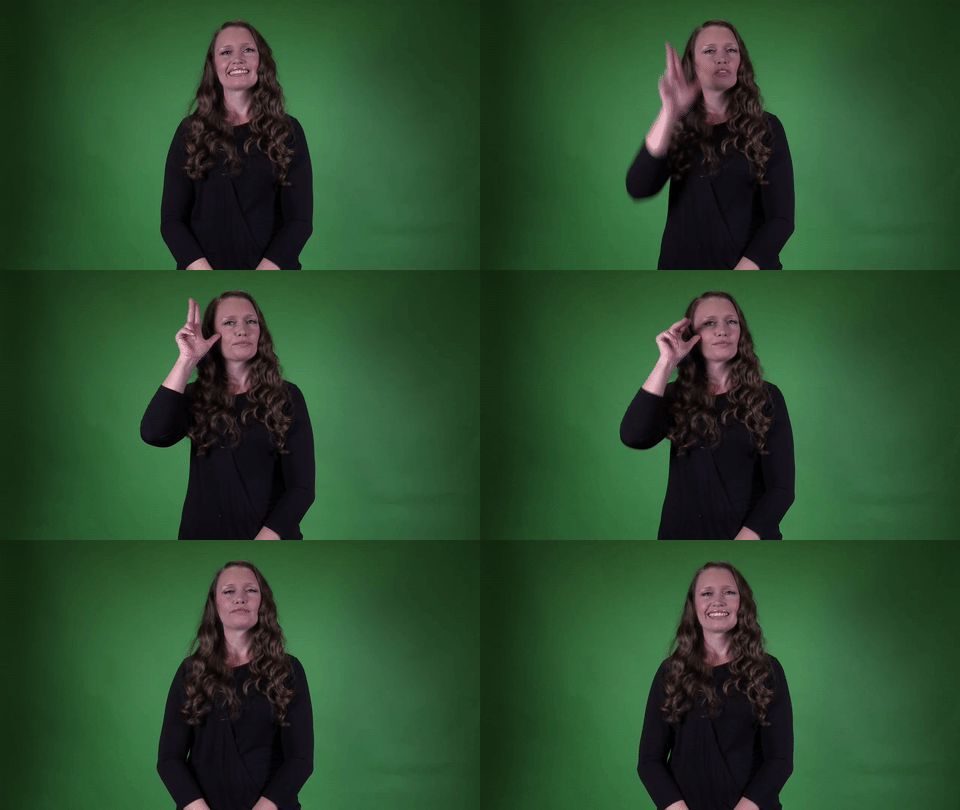
Definition: A large domesticated animal used for riding and carrying loads.
Sign for HORSE in ASL
Practice Activities:
Start by practicing the sign for HORSE in ASL in isolation. Stand in front of a mirror and repeat the sign slowly, focusing on hand shape and movement. Try doing the sign ten times with each hand, even though it is typically done with the dominant hand, to build muscle memory and familiarity.
Next, incorporate the sign into simple sentences. Use phrases like “I ride a horse,” “The horse is brown,” or “Do you like horses?” Sign each sentence slowly and clearly, then speed up as you become more confident. Record yourself signing and play it back to check for accuracy in both the sign for HORSE in ASL and your overall sentence fluidity.
Create a short story involving a horse using other signs you’ve learned. For example, you might tell a three-sentence story: “I went to the farm. I saw a big horse. I fed the horse an apple.” Use expressive non-manual signals to show emotion and keep the story engaging.
Role play with a partner or in a small group using the sign for HORSE in ASL. One person can pretend to be a farmer while the other asks questions about animals on the farm. Include questions like “How many horses do you have?” or “What color is your horse?” Practice both asking and responding to these questions.
Play a category game where you sign different animals and include the sign for HORSE in ASL frequently to reinforce recognition. You can also play a guessing game where you describe an animal using signs (e.g., “It’s big, it runs fast, it lives on a farm”) and your partner guesses it’s a horse.
For additional practice, find videos or ASL stories about farm animals and try to recognize and copy the sign for HORSE in ASL whenever it appears.
Cultural Context:
In Deaf culture, the sign for HORSE in ASL is more than just a way to describe a beloved animal. It reflects a long-standing cultural connection to visual storytelling, where gestures vividly express ideas, characteristics, and emotions. The sign for HORSE in ASL uses the dominant hand to mimic ears flicking back, symbolizing one of the most recognizable traits of a horse.
Horses have always held a special place in many cultures, including within American Sign Language communities. Whether for work, transportation, or companionship, they represent freedom and strength. The sign for HORSE in ASL captures that grace and energy visually, allowing Deaf signers to communicate these ideas clearly.
Deaf children often learn animal signs like the sign for HORSE in ASL early because they tend to be engaging and fun. These signs allow kids to connect with the natural world and express their interests. Using the sign for HORSE in ASL during storytime or while visiting a farm enriches communication and invites interaction.
Storytelling in ASL often features animals like horses to add action and drama to narratives. The sign for HORSE in ASL plays a key role in fables, folk tales, and personal stories shared in the Deaf community. This physical depiction adds depth and emotion that spoken language might lack, providing a deeper cultural experience.
The sign for HORSE in ASL may vary slightly depending on region or age group, just like accents in spoken language. Nonetheless, the general movement and handshape remain recognizable across most communities. These small variations highlight the rich diversity within ASL.
Deaf artists and performers often include animal signs like the sign for HORSE in ASL in poetry, theater, and visual art. These signs elevate expression and bring abstract concepts to life. Seeing a horse gallop through signing carries a powerful impact on viewers, providing cultural enrichment beyond basic vocabulary.
In Deaf education, teachers use signs like the sign for HORSE in ASL to support multisensory learning. Students can physically engage with the language while learning about animals, reinforcing both linguistic and cognitive growth. The use of visual and spatial skills strengthens memory and deepens understanding.
Attending Deaf events like festivals or social gatherings lets people see signs like the sign for HORSE in ASL in action. These environments celebrate the richness of ASL and encourage cultural pride. Watching fluent signers use expressive animal signs connects attendees to the heart of the community.
In film and TV portraying Deaf characters, the sign for HOR
Extended Definition:
The sign for HORSE in ASL is a simple yet expressive gesture that captures the essence of the animal. It is often one of the earlier animal signs learners pick up due to its clear visual representation and ease of production. In American Sign Language, depicting animals like a horse often involves using classifiers or handshapes that mimic features such as ears or tails.
To make the sign for HORSE in ASL, the dominant hand uses an extended “U” handshape with the thumb placed near the temple. With the palm facing outward, the fingers bend twice, mimicking the motion of a horse’s ears flicking. This movement adds personality to the sign and helps convey the image of a horse in a dynamic and memorable way.
Facial expressions can also enhance the sign, making it more lifelike and vibrant. In fluent signing, the speed and attitude of the movement might change depending on the context, such as talking about a playful pony versus a strong stallion. Signers often add context with directional signs or follow-up classifiers to indicate the action or behavior of the horse.
The sign for HORSE in ASL can be useful in storytelling, especially in children’s books, farmyard tales, or discussions about animals. It also appears in conversations about themes such as horseback riding, visiting a ranch, or watching a parade with horses. In educational settings, students benefit from learning this sign through games, interactive flashcards, or during visits to the zoo.
Regional variations in the sign are minimal, making it widely understood across different ASL communities. Still, instructors might introduce students to slight differences or older versions of the sign to increase exposure and understanding of ASL’s diversity. Using the sign for HORSE in ASL supports not only vocabulary building but also the development of classifiers and thematic storytelling skills.
This animal sign is also crucial for users who live in agricultural areas or have hobbies involving horses. Riders and equestrians who are deaf or hard of hearing often include this sign in their daily activities, ranging from barn chores to equestrian competitions. The sign might be paired with others such as “ride,” “saddle,” or “gallop” for more detailed communication.
When teaching or learning the sign for HORSE in ASL, it’s helpful to practice alongside related signs like “farm,” “cow,” or “animal,” making it easier to remember thematic vocabulary. ASL learners gain more confidence when they can create short sentences or stories using common animal signs. This
Synonyms: stallion, mare, steed, equine, pony
Educational resources: Find related learning materials in our course bank!
Want more? Check out some of our popular learning activities on the homepage!
Need to look up a sign? Use our highly rated dictionary: https://aslinteractive.com/best-asl-dictionary/
Follow us on tiktok: https://www.tiktok.com/@aslinteractive. More social media links at the bottom of this page!
Long-tail Keywords: what is the sign for Horse in ASL, how do you sign Horse in ASL, ASL sign for Horse
Categories:
tags: animals, farm animals, horseback riding, equestrian signs, ASL animals
Parameters
*Handshape*:
The handshape used in the sign for HORSE in ASL involves forming the letter “U” handshape with your dominant hand. Extend the index and middle fingers straight up while the ring finger, pinky, and thumb remain folded or relaxed.
This specific handshape mimics a horse’s ears and is essential in conveying the sign for HORSE in ASL . The movement, location, and facial expression work together, but the correct handshape helps distinguish it from similar signs.
*Palm Orientation*:
The palm orientation for the sign for HORSE in ASL begins with the dominant hand in an “H” handshape. The palm faces sideways, with the knuckles near the side of the head and the palm facing out slightly. The fingers bend up and down like a horse’s ear flicking.
To clearly convey the sign for HORSE in ASL, keep the hand firmly in position while maintaining the outward-facing palm direction. This orientation helps visually define the natural motion associated with a horse.
*Location*:
The sign for HORSE in ASL is located near the side of the head, particularly at the temple or just above the cheekbone. The dominant hand is used with the palm facing backward, and the middle and index fingers extended and together to represent the ears of a horse.
When performing the sign for HORSE in ASL, the fingers alternate flapping slightly to mimic the motion of horse ears. This movement and placement near the head help to visually convey the meaning of the animal.
*Movement*:
To make the sign for HORSE in ASL, place your dominant hand near the side of your head with the palm facing forward. Form the “U” handshape (index and middle fingers together and extended) while the thumb touches the temple.
Move the extended fingers upward and backward in short double flicking motions, mimicking a horse’s ear twitching . The sign for HORSE in ASL visually represents a horse’s ears and is typically done with a cheerful and energetic motion.
*Non-Manual Signals*:
When producing the sign for HORSE in ASL, the facial expression should remain neutral and relaxed, matching the casual nature of the concept. Raise your eyebrows slightly if using the sign in a question, such as when asking if someone has a horse . Keep eye contact consistent to ensure clarity and engagement.
The sign for HORSE in ASL often includes slight head tilts when expressing affection or interest in horses. Avoid exaggerated gestures unless emphasizing excitement or curiosity. This maintains the authenticity of the sign for HORSE in ASL while supporting clear communication.
*Prosody, Dominant/Non-Dominant Hand*:
The sign for HORSE in ASL uses the dominant hand in the “U” handshape, placed at the side of the head with the palm facing down. The thumb is placed on the temple, and the fingers bend twice to mimic a horse’s ears flicking.
The non-dominant hand is not used in the sign for HORSE in ASL. This sign emphasizes movement and mimicry, capturing a horse’s physical traits.
Tips for Beginners:
When learning the sign for HORSE in ASL, it’s important to remember that the motion and handshape together convey the concept clearly. Hand clarity is key—start with an open “U” handshape (the index and middle fingers extended upward together), placing your thumb at your temple. Then flick your two fingers up and down like a horse’s ear moving. Practice this movement slowly at first to ensure your fingers aren’t too stiff or moving in a wobbly way.
A common mistake that beginners make when practicing the sign for HORSE in ASL is either placing the hand too high above the temple or fluttering the fingers too quickly. The motion should be smooth and simple—not exaggerated or dramatic. Consistency with location and movement will make the sign more recognizable and accurate in conversation.
Mirror practice can be really helpful. Use a mirror to check if your hand is in the proper position and the motion looks like your instructor or reference video. Watching your fingers from a front-facing view often makes any unwanted extra movement easier to detect and correct. Repeating the sign slowly and gradually building up speed can help build muscle memory with correct technique.
Facial expression is not essential for this particular sign, but maintaining neutral eye contact and fluency will enhance overall clarity. Make sure your signing hand does not cover your face when performing the sign—this is another frequent beginner mistake. Keep the hand motion at the side of the head rather than in front of it.
Expose yourself to native signers using the sign for HORSE in ASL in full sentence context. Videos from Deaf creators or live interactions during classes are invaluable ways to see how the sign fits into natural flow. This environment also helps reinforce vocabulary retention and receptive skill building.
Connections to Other topics:
The sign for HORSE in ASL connects to a broader family of animal-related signs, many of which use classifiers or share similar handshapes and locations near the side of the head. For example, both HORSE and DEER use an extended “U” handshape near the temple or forehead area, mimicking ears or antlers. This visual-spatial correspondence makes it easier for learners to group and remember animal signs.
Understanding the sign for HORSE in ASL also supports the use of classifiers in storytelling or narrative contexts. Classifier “CL:3” can represent a horse running or traveling, especially in stories involving horses or western themes. By pairing the base sign with classifiers, signers can convey detailed action, such as a horse galloping across a field .
This sign is sometimes used as part of compound signs or within phrases like RIDE-HORSE or POLICE-HORSE. In these cases, the base sign for HORSE is modified or linked with signs such as RIDE, showing a broader concept. COLLECTING-HORSE or HORSE-SHOW also use sign combination strategies where semantics and portrayal are critical for clarity.
The structure of the sign for HORSE in ASL also relates to signs for domesticated animals, emphasizing the cultural importance of animals in Deaf storytelling and education. HORSE, DOG, and CAT share the role of foundational vocabulary when introducing common animals to learners.
Finally, exposure to the sign for HORSE in ASL builds a pathway toward understanding regional or historical signs. Different regions may modify it slightly, or older signers may use more elaborate versions as part of traditional ASL storytelling. This adds depth to both receptive and expressive skills, especially in culturally rich settings like ASL literature or community narratives.
Summary:
The sign for HORSE in ASL is produced using the dominant hand, forming the “U” handshape with the index and middle fingers extended and together, and the other fingers folded against the palm. The hand is placed near the side of the head, at the temple or the top of the ear, and then the fingers “flick” or bend outward a couple of times, imitating the movement of a horse’s ears.
This iconic sign reflects how horses use their ears to communicate, drawing on visual metaphor, a significant feature in ASL sign creation. This kind of classifiers-based and visually oriented system makes ASL vibrant and deeply connected to real-world referents.
The location of the sign near the head helps reinforce its animal association. Unlike many signs which happen in a neutral signing space, this one interacts with the signer’s head—helping to both underscore the horse’s head features and connect viewers to the sign intuitively.
The flicking movement mimics alert, twitching ears—a common behavior in horses. ASL uses this kind of physical mimicry often, allowing signers to convey not just identity but behavior and emotion within one signal.
The sign for HORSE in ASL is used both for literal and figurative speech. In literal contexts, it can label the animal or anything directly associated with it, like horseback riding, grooming, or farming.
In more abstract use, the sign may appear in idioms, such as “back the wrong horse,” though idioms generally depend on deeper cultural translation and may not always follow English parallels. This shows how ASL navigates metaphor differently than spoken English.
ASL has a few classifiers that expand on the sign for HORSE, especially when the conversation involves action verbs or detailed descriptions. For example, using a two-handed classifier to describe a person riding a horse involves blending the HORSE sign with additional body gestures to show galloping or jumping.
Grammatically, the sign functions typically as a noun. However, by pairing it non-manually with directional verbs or classifiers, a fluent signer can create nuanced constructions suitable for storytelling or technical explanation.
Deaf culture has a strong appreciation for the natural world and animals. Animals like horses, known for their utility and grace, are common topics in ASL poetry and narratives, especially in rural Deaf communities where animals play a daily role.
Storytelling in sign language often includes animated conversations about animals, and the sign for HORSE in ASL easily lends itself to dramatic expression. Facial expressions and body posture upgrades this simple sign into expressive, cinematic moments.
From a sociolinguistic point of view, the sign for HORSE in ASL provides insight into how ASL users experience and process the world differently than auditory-centric cultures. The sign isn’t arbitrary—it’s shaped with the full intention to invoke imagery and movement.
The use of iconicity, seen clearly in the sign for HORSE in ASL, is more frequent in signed languages than spoken ones. While all languages have some degree of symbolic association, ASL capitalizes on the human tendency to associate gestures with meaning.
Over time, subtle community variations may appear. Some signers may flick the fingers once, others might do it twice or vary the speed. These changes give the sign regional flavor and reflect the concept of linguistic variation within ASL itself.
Linguistic borrowing from other signed languages, like British Sign Language or International Sign, might resemble or differ from the sign for HORSE in ASL, but shared universal imagery can create overlap. Yet each language maintains its own unique visual vocabulary.
Applied linguistics shows that children acquiring ASL as a first language often gravitate toward signs like HORSE because of their clear visual relevance. The flicking movement is easy for young learners to mimic, making it a great early lexicon addition.
In Deaf education, animal signs like the sign for HORSE in ASL help bridge learning between formal sign language and lived experiences. Many schools include field trips or multimedia projects that reinforce these basic signs using pets and farm animals.
The visual-spatial aptitude of Deaf individuals often contributes to mastery of animal signs with physical connotations. When performing the sign for HORSE in ASL with strong facial engagement, slight shifts can imply a wild horse, a domesticated one, or even a fantasy animal like a unicorn.
In ASL literature and cinema, animals often symbolize personality traits. A horse signifies strength, freedom, or endurance. The sign for HORSE in ASL, when layered with expressive acting, becomes a tool to explore identity and social roles.
Within ASL poetry, the physicality of a horse can be amplified through gestures extending from the original sign. Signers might gallop across a narrative, using space creatively to communicate journey, independence, or even fantasy themes like Pegasus figures.
When communicating with Deafblind individuals, the sign for HORSE in ASL changes slightly into a tactile form, where the hands must navigate each other by touch rather than sight. Even
Want more? Check out some of our popular learning activities!
ASL Interactive Resources
ASLInteractive YouTube Channel
Follow us on tiktok: @aslinteractive.com
Follow us on Instagram: aslinteractive
Facebook page: aslinteractive
Facebook group: aslinteractive
LInkedIn: ASL Interactive LLC
Twitter: @ASL_interactive
*Some information on this page is AI-generated. AI can make mistakes. Please check the information.


Responses