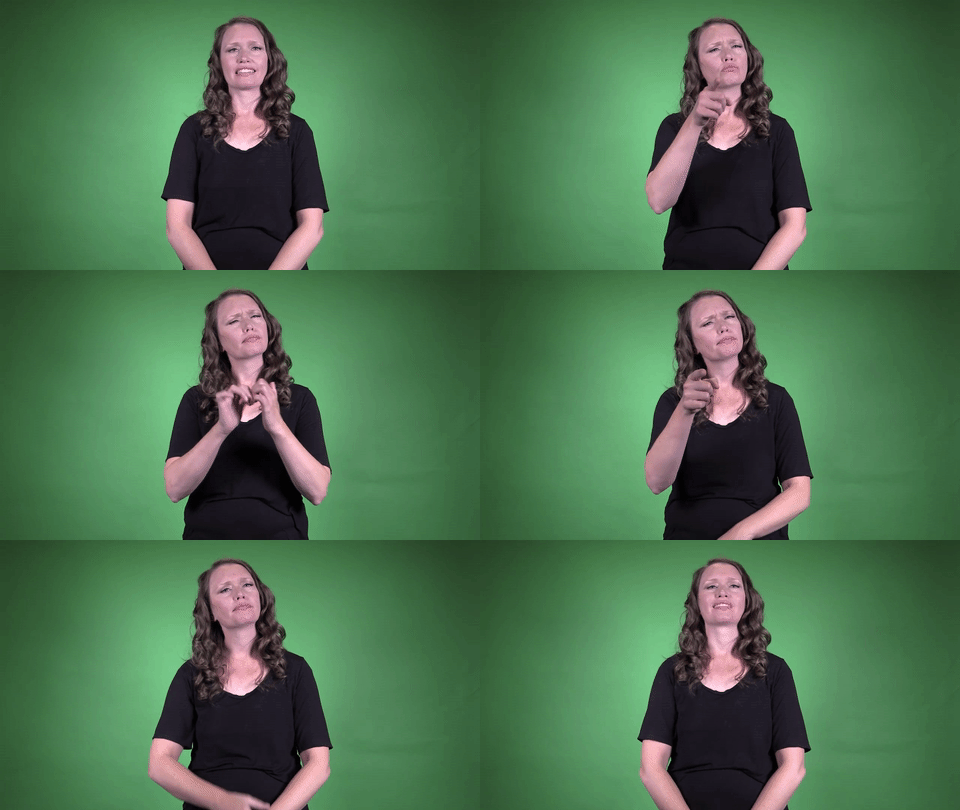
Definition: A common greeting asking about someone’s well-being.
Sign for HOW ARE YOU in ASL
Practice Activities:
To practice the sign for HOW ARE YOU in ASL, begin by standing in front of a mirror. Sign each word slowly and clearly, checking your handshape, palm orientation, and movement. The sign starts with both hands in bent “B” handshapes touching at the knuckles, then you swing them forward slightly as if opening a book, followed by pointing to the other person with the index finger. Practice this fluid motion multiple times until it feels natural.
Next, try the sign in isolation, saying it aloud as you sign. Then use it in different contexts such as greeting yourself in the mirror or greeting a stuffed animal or pet. This simple phrase is a great way to start conversations with Deaf friends or classmates, so the more fluently you can produce it, the more confident you’ll feel.
Incorporate the sign for HOW ARE YOU in ASL into short dialogues. For example, create an interaction: you sign “HOW ARE YOU,” then another person signs back “GOOD” or “TIRED.” Practicing back-and-forth exchanges helps build conversational rhythm. Switch partners if possible to get different signing styles and responses.
Use storytelling journaling prompts to make your practice meaningful. Try starting a short ASL story or vlog by greeting your viewer with the sign for HOW ARE YOU in ASL. Then describe how you are feeling today using facial expressions and feeling-related signs like “HAPPY,” “STRESSED,” or “EXCITED.”
Join group practice or attend a Deaf event where you can use the phrase as an actual greeting. Each time you meet someone new, initiate the conversation with the sign for HOW ARE YOU in ASL. This reinforces real-world use and shows basic courtesy in Deaf culture ♂️. Aim to use this greeting every day to increase fluency and build signing comfort.
Cultural Context:
In American Sign Language, the sign for how are you in ASL is used frequently during greetings and everyday interactions. It reflects a polite and friendly way to check in with someone’s well-being, and it’s commonly one of the first phrases new learners of ASL pick up.
The sign for how are you in ASL is more than just a phrase—it connects people in both casual and formal settings. In the Deaf community, it supports respectful social interaction and shows an effort to communicate in a culturally appropriate manner.
Understanding the sign for how are you in ASL includes recognizing its grammatical and cultural components. Unlike English, ASL uses facial expressions and body language to show tone and emotion, especially during greetings like these.
When someone signs how are you in ASL, they are usually showing genuine interest, which is deeply valued in Deaf culture. Taking the time to use this phrase appropriately in context helps build trust and rapport.
In ASL, greetings such as the sign for how are you in ASL are often paired with warm facial expressions or slight head nods. These non-manual signals can completely change the meaning of a sign, making cultural understanding essential.
The sign for how are you in ASL isn’t always answered literally. In Deaf culture, it’s common to respond briefly or simply say good or fine with a smile if the conversation doesn’t need to go into detail.
You might also see slight regional variations in how people sign how are you in ASL. Although the core structure stays the same, hand shapes and movement can vary slightly depending on location and community.
When learning ASL, understanding when and how to use specific phrases like the sign for how are you in ASL can help avoid awkward moments. It shows respect for the language and the community that uses it.
Many Deaf individuals appreciate when hearing people take the initiative to learn greetings, starting with the sign for how are you in ASL. It opens doors to communication and shows that the person values accessibility.
In social settings like Deaf events or classrooms, using the sign for how are you in ASL is a great way to signal that you’re familiar with the language. Even if your signing is still basic, simple phrases create a welcoming atmosphere.
ASL is a visual language, and the sign for how are you in ASL allows speakers to show emotion and connection in a way that written text or spoken words often cannot. This expression is as much about feeling as it is about vocabulary.
Children learning ASL as a first language start by
Extended Definition:
The sign for how are you in ASL is a common greeting used in everyday American Sign Language conversations. It is often one of the first phrases learned by ASL students and is widely used in both casual and formal interactions. This sign allows Deaf and hearing individuals to connect in a respectful and personal way.
To sign the phrase, begin with both hands in a bent position, placed near the chest. The hands are then moved in a circular outward motion. After signing how, the index finger of one hand points toward the other person, completing the you portion. The full sign is fluid and friendly, demonstrating interest and engagement with the other person.
The sign for how are you in ASL isn’t always about inquiring someone’s well-being in depth. Much like spoken English, it can also be used as a general greeting without expecting a detailed response. It serves an important role in starting a conversation and establishing a connection between people.
In ASL, facial expressions are just as important as hand movements. When signing how are you, it’s essential to include a friendly and curious facial expression. This expression adds emotional context to the phrase and ensures your intent is clear. Without it, the sign might come across as flat or robotic.
This phrase is an excellent example of how American Sign Language combines signs to form complete thoughts. While each individual component—how and you—has its own sign, combining them brings new meaning. In many ASL phrases, context and non-manual signals provide the subtle cues that replace intonation used in spoken language.
It’s important to remember that ASL has its own grammar structure, which sometimes differs from English. That means the sign for how are you in ASL might not follow a direct English word order. In natural ASL, people might sign how you or even just how, depending on context and familiarity.
When used in community settings, this sign is a great way to show cultural respect and linguistic inclusion. Knowing and using the sign for how are you in ASL helps break down communication barriers and fosters stronger relationships with Deaf individuals. It also demonstrates basic ASL knowledge, which can encourage deeper learning.
Children and adults alike can easily learn this useful sign. It’s simple, visually descriptive, and reinforced frequently through greetings and everyday practice. Practicing often with peers or in front of a mirror can help solidify muscle memory and facial expression use.
Whether you’re an ASL student, a parent teaching your child, or someone wanting to be more inclusive, using
Synonyms: how’s it going, what’s up, how have you been, how are things, how are you doing
Educational resources: Find related learning materials in our course bank!
Want more? Check out some of our popular learning activities on the homepage!
Need to look up a sign? Use our highly rated dictionary: https://aslinteractive.com/best-asl-dictionary/
Follow us on tiktok: https://www.tiktok.com/@aslinteractive. More social media links at the bottom of this page!
Long-tail Keywords: what is the ASL sign for how are you, how do you sign how are you in American Sign Language, how to say how are you in ASL
Categories:
tags: ASL greetings, basic ASL phrases, conversational ASL, beginner ASL signs, everyday ASL vocabulary
Parameters
*Handshape*:
The handshape for the Sign for HOW ARE YOU in ASL begins with both hands in a curved “C” or bent “B” shape, palms facing downward and fingertips pointing toward each other. The backs of the fingers almost touch as they start near the center of the chest.
To complete the Sign for HOW ARE YOU in ASL, move the hands outward slightly in a rolling motion, resembling a questioning gesture. Then, point with the index finger of one hand toward the person, using a simple pointing gesture.
*Palm Orientation*:
The palm orientation in the sign for HOW ARE YOU in ASL starts with both hands bent at the knuckles, palms facing down and fingertips touching lightly or close together. As you make the signing motion, the palms rotate upward and slightly out, ending with open hands facing the person you’re addressing.
In the sign for HOW ARE YOU in ASL, this shift in palm orientation conveys the transition from asking “how” to addressing “you.” The entire sign is smooth and fluid, emphasizing the friendly and inquisitive nature of the phrase .
*Location*:
The sign for HOW ARE YOU in ASL is produced in the neutral space directly in front of the chest, slightly below shoulder height. It begins with both hands curved, knuckles touching, as if forming the letter “C” with each hand facing down and towards each other.
As you gesture the sign for HOW ARE YOU in ASL, the hands move outward in a rolling motion, followed by a direct point toward the person you’re addressing. The movement stays within the personal space between the chest and mouth level.
*Movement*:
Begin by placing both curved hands (bent hands) together at the knuckles, palms facing each other, fingertips pointing slightly down. Move the hands forward and slightly upward in a quick, smooth arc, flipping the palms up as you go. This represents the “how” in the sign for HOW ARE YOU in ASL.
After completing “how,” point directly at the person with your dominant hand’s index finger to indicate “you.” The entire motion should feel fluid and friendly. The sign for HOW ARE YOU in ASL is typically accompanied by a warm facial expression to convey care or interest.
*Non-Manual Signals*:
During the sign for HOW ARE YOU in ASL, the facial expression is warm and friendly, often accompanied by slightly raised eyebrows and a slight head tilt forward. A soft smile helps convey genuine interest and friendliness.
This non-manual signal creates a welcoming tone, matching the conversational intent of the sign for HOW ARE YOU in ASL. Eye contact is maintained to show engagement and sincerity .
*Prosody, Dominant/Non-Dominant Hand*:
The sign for how are you in ASL uses both hands in a symmetrical motion. The dominant and non-dominant hands start in a curved “B” shape, fingertips touching and palms facing down. Both hands move outward in a slight rolling motion, as if showing how something is done. Then, the dominant hand points directly at the person being addressed to sign “you.”
In the context of the sign for how are you in ASL, the prosody involves a slight lean forward paired with friendly facial expression . This adds warmth and shows genuine interest. It’s a common greeting phrase in conversation and is often accompanied by eyebrow movement to convey care and engagement.
Tips for Beginners:
When learning the sign for HOW ARE YOU in ASL, start by breaking the full phrase into its components: HOW and YOU. HOW is signed by placing both hands in a curved shape (like holding two cups), touching the knuckles together and then rolling your hands forward slightly. YOU is simply pointed directly at the person you’re addressing.
Make sure your body language and facial expression are friendly when using the sign for HOW ARE YOU in ASL. This greeting is more than just hand gestures—tone comes across visually in ASL. A slight smile and open posture help convey warmth and genuine interest.
One common mistake beginners make is moving their hands too quickly or sloppily, which can change the meaning or make the sign unclear. Take your time and practice in front of a mirror to ensure your handshape and motion are correct. Smooth, deliberate movement is key.
While practicing the sign for HOW ARE YOU in ASL, watch videos of fluent signers and try to mimic both the motion and their expressions. Pay close attention to the palm orientation when signing HOW. It’s easy to accidentally twist the hands inward too far or not rotate them at all.
Be careful not to add unnecessary words or signs. In ASL, grammar and structure differ from English, so there’s no need to sign extra filler. HOW followed by YOU is clear and grammatically correct.
Practice the transition between the two signs until it feels fluid. Since the sign for HOW ARE YOU in ASL is frequently used, having it polished will help in many real-life interactions. It’s a great starting point for greeting others and showing respect within the Deaf community.
how are you in asl sign, sign language for how are you, sign for how are you in asl
Connections to Other topics:
The sign for HOW ARE YOU in ASL connects closely to ASL’s structure of facial expressions and non-manual markers, as the tone of a greeting is heavily conveyed through context, expression, and body language. This phrase acts as an introductory question and is foundational for conversational ASL. It demonstrates the importance of understanding and using question markers, making it a gateway into forming polite questions and social discourse in the Deaf community.
In ASL, the sign for HOW can also appear in other phrases such as HOW LONG, HOW MUCH, or HOW MANY. These compound phrases rely on similar hand configurations, but the movement and facial expression help distinguish the meanings. HOW often involves a subtle rolling or twisting gesture between the knuckles, which becomes intuitive once learners are familiar.
The phrase HOW ARE YOU is often followed by common responses in ASL such as GOOD, FINE, or TIRED. These signs form functional exchanges in daily interaction and help learners begin thinking about responses, not just greetings. The phrase often flows naturally into learning about emotions and conditions, linking it to signs like HAPPY, SAD, SICK, or BUSY, expanding vocabulary quickly.
In informal settings, the sign for HOW ARE YOU in ASL may be shortened through context or omitted entirely, assuming the other person understands. This introduces the idea of ellipsis in ASL and conversational shortcuts, a useful concept for more advanced learners. These shortcuts mirror everyday language use and how phrasing can shift based on familiarity or speed.
Understanding the sign for HOW ARE YOU in ASL also provides insight into common question structures in the language. It acts as a model for creating questions by using non-manual signals and proper word order, supporting broader grammar acquisition. This single phrase introduces cultural norms, polite interaction, and language fundamentals all in one.
Summary:
The sign for HOW ARE YOU in ASL is a common greeting that pairs question structure with facial expressions. It’s a fluid and friendly phrase used frequently in casual and formal signing environments to initiate conversation. It follows standard ASL grammatical rules, with a reliance on non-manual markers like raised eyebrows to indicate a question.
To perform the sign for HOW ARE YOU in ASL, begin with both hands curved and joined at the knuckles, fingertips pointing downward and palms facing in. Then, make a slight rolling or twisting motion outward as if turning something over, letting the hands separate slightly. After this, point to the person using the index finger, which translates to “you”.
This two-part structure—HOW followed by YOU—illustrates a tendency in ASL to use brief sequential signs to express complex ideas, rather than using word-for-word translations from English. The sign for HOW alone conveys a procedural or subjective inquiry, while pointing after it helps direct the question personally. Taken together, the sign for HOW ARE YOU in ASL acts like a handshake of visual language.
Culturally, the sign for HOW ARE YOU in ASL reflects both formality and friendliness. It’s typically used when meeting someone or to show polite concern. Deaf culture encourages using this phrase as a genuine opener, not just a societal habit like in spoken English.
Facial expressions play a critical role in this phrase. The signer uses raised eyebrows and direct eye contact to signal interest and to mark the interrogative mood of the phrase. An inquisitive look supports the grammatical alignment of the sign for HOW ARE YOU in ASL.
In ASL, yes/no questions differ from WH-questions in facial grammar. While HOW ARE YOU is closer to a yes/no greeting formula, it is understood intuitively as an opener, not necessarily requiring a literal answer. But unlike WH-questions like “where,” which might be signed with furrowed brows, HOW ARE YOU needs raised brows to show it’s a general inquiry.
One interesting linguistic element of this phrase is its compact efficiency. Rather than signing the English equivalents word-by-word, ASL compacts meaning efficiently. This mirrors ASL’s visual-spatial grammar, which prioritizes clarity, economy, and visual logic.
When used in conversation, the phrase often leads into more signing rather than ending it, making it a perfect linguistic opener. A response may include signs for GOOD, FINE, or variations like BUSY or SICK, depending on the situation. The response doesn’t usually repeat the entire greeting, reflecting how ASL expects concise replies.
The sign for HOW in this phrase can appear in different places when part of larger questions like HOW OLD or HOW MUCH. However, for HOW ARE YOU, it stands alone, highlighting its versatility. That adaptability contributes to making the sign for HOW ARE YOU in ASL an essential expression in every ASL user’s toolkit.
It’s worth noting that non-native signers or ASL learners sometimes overuse or over-enunciate this phrase. In Deaf culture, unnecessary repetition or signing with voice while thinking in English may come across as unnatural. The authenticity of using the sign for HOW ARE YOU in ASL lies partly in its DEAF-centric delivery.
Language learners can benefit by observing how Deaf signers naturally weave this phrase into interaction. It often comes partnered with warm gestures or additional conversational signs like LONG-TIME-NO-SEE or NICE-TO-MEET-YOU. These companion signs can add cultural richness to your introductory phrases.
Further, concepts like HOW and YOU are foundational signs that appear again and again in ASL coursework. They train learners to rely on handshape, movement, palm orientation, and directional signing. The phrase teaches more than just a greeting—it teaches grammar, politeness, and nerve-muscle coordination.
ASL also allows for inflection through speed and sign size. Signing HOW slowly with a slight tilt of the head can show concern or deeper interest in someone’s well-being. Signing it faster and more tightly might convey routine or formal politeness.
The sign also touches on themes in applied linguistics. As a routinized expression with emotional and relational weight, the sign for HOW ARE YOU in ASL mirrors how greetings function across global cultures. It becomes part of the “phatic” speech acts—language used for social bonding more than literal exchange.
Teachers of ASL often use this phrase early in instruction because it’s high-frequency and immediately usable. Students engage with native signers more confidently once they’ve mastered greetings. Mastering HOW ARE YOU opens doors to cultural immersion and fluent social exchanges.
Socially, the sign for HOW ARE YOU in ASL invites the recipient to continue a dialogue. This pattern aligns with the cultural expectation in Deaf community of true listening and eye contact—even if the answer is brief. Asking this question echoes the visual-spatial mindset of ASL interaction.
Regional variation may affect small details like the openness of the palm or the angle of the hands during the HOW portion. While the
Want more? Check out some of our popular learning activities!
ASL Interactive Resources
ASLInteractive YouTube Channel
Follow us on tiktok: @aslinteractive.com
Follow us on Instagram: aslinteractive
Facebook page: aslinteractive
Facebook group: aslinteractive
LInkedIn: ASL Interactive LLC
Twitter: @ASL_interactive
*Some information on this page is AI-generated. AI can make mistakes. Please check the information.


Responses