Sign for LAKE in ASL | ASL Dictionary

Definition: A large body of water surrounded by land.

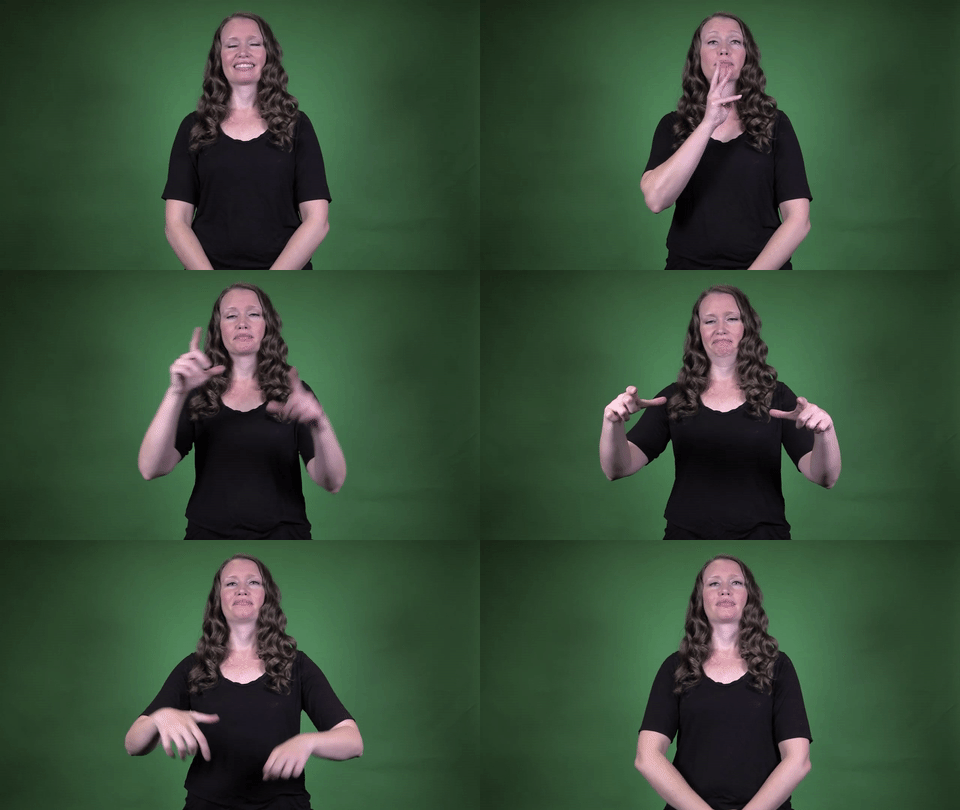
Sign for LAKE in ASL

YouTube player

Practice Activities:

Cultural Context:

Practice Activities

To master the sign for LAKE in ASL, learners should begin with mirror work. Stand in front of a mirror and slowly produce the sign while watching your handshape, facial expression, and movement. This helps ensure that the sign is both accurate and clear from the viewer’s perspective.

Another effective technique is to record yourself signing. Play the video back and compare it to trusted ASL resources. This allows you to self-correct and track your progress over time, especially when refining the movement and spatial placement of the sign for LAKE in ASL.

Use the sign in context by incorporating it into real or simulated conversations. For example, talk about places you’ve visited or plan to visit, such as a national park with a lake. This gives you real-world practice and helps reinforce memory through meaningful use.

Advanced learners can challenge themselves with receptive drills. Watch videos of native signers using the sign for LAKE in ASL and identify it in different sentence structures. Try speed drills, switching between similar geographical signs like river, ocean, and lake to develop agility and precision.

Group practice can also add value. Partner with another learner and describe travel scenarios or nature scenes using the sign for LAKE in ASL. Peer feedback and interactive signing build confidence and fluency.

SEO Cultural Context

In Deaf culture, nature-related signs like the sign for LAKE in ASL often come up in storytelling, travel conversations, or classroom discussions. These signs are more than vocabulary—they are part of how the Deaf community connects to the world visually and spatially.

The sign for LAKE in ASL typically combines two concepts: the sign for WATER and a classifier indicating a flat, wide area. This reflects ASL’s use of classifiers to convey shape, size, and spatial relationships, an important cultural and linguistic element in Deaf communication.

There may be regional variations in how the sign for LAKE in ASL is produced, particularly in how the classifier is formed after the WATER sign. Some signers may use two flat hands to represent a body of water, while others prefer a more abstract motion. This reflects the diversity within ASL and the importance of exposure to multiple signing styles.

In real-life Deaf conversations, the sign for LAKE in ASL is often used when discussing geography, travel, memories, or environmental topics. Whether you’re describing a camping trip or recounting a hike, this sign is essential for storytelling and vivid visual communication.

Deaf storytelling traditions often include vivid environmental descriptions. Learning the sign for LAKE in ASL helps learners participate more fully in these cultural narratives and understand how the Deaf community shares experiences through visual language.

Extended Definition

The sign for LAKE in ASL is a compound sign that starts with the sign for WATER, followed by a descriptive classifier. The sign for WATER uses a “W” handshape (formed by extending the index, middle, and ring fingers) tapped against the chin. After this, the hands move outward to show a wide, flat area representing the lake.

The classifier portion may vary slightly among signers. Commonly, two flat “B” hands move outward from a central point to show the surface of the lake. This spatial representation is intuitive, making the sign for LAKE in ASL highly iconic and visually descriptive.

It’s essential not to confuse the sign for LAKE in ASL with signs for other bodies of water. For example, the sign for RIVER also starts with WATER but includes a more narrow, winding motion to reflect the shape of a river. The sign for OCEAN or SEA usually includes a wave-like motion after WATER.

A common error is omitting the WATER component and only using the classifier. While this might be understood in context, it may not be as clear or accurate, especially for beginners or in formal settings. Always include the WATER sign to ensure clarity.

Another mistake learners might make is placing the hands too low or too high in the signing space. The sign for LAKE in ASL should be produced at chest level to reflect the horizontal nature of a lake’s surface. Keeping the movement smooth and symmetrical will add to the clarity of your sign.

Tips for Beginners

If you’re just starting out, don’t be discouraged if the sign for LAKE in ASL feels complicated at first. It involves combining two elements, but with consistent practice, it becomes intuitive. Start slowly and focus on mastering each part of the sign before blending them together.

Make sure your WATER sign is clear. Use the correct “W” handshape and tap it gently on your chin. From there, smoothly transition into the classifier by opening your hands and moving them outward as if outlining the lake’s surface.

Watch native signers to get a feel for the natural rhythm. Mimic their facial expressions, which add meaning and emotion to the sign. Facial grammar is key in ASL, especially when describing the size or beauty of a lake.

Avoid rushing through the motion. A hurried sign can lose its clarity. Take your time and aim for precision. Practice in front of a mirror or with a friend who can give constructive feedback.

Use visual associations to help reinforce the sign. Imagine a real lake—its calm, flat surface, surrounded by trees or mountains. Visual imagery helps solidify the meaning and improves recall. The sign for LAKE in ASL becomes more than a movement—it becomes a representation of a real-world place.

Connections to Other Topics

The sign for LAKE in ASL connects naturally with the sign for WATER, as it is foundational to the compound sign. Understanding WATER is essential for signing about any bodies of water, such as ocean, river, and pond.

Another related sign is RIVER. While it also starts with WATER, it uses a waving motion to indicate flow. Comparing the two helps learners see how classifiers change meaning based on shape and movement.

The sign for MOUNTAIN often appears alongside LAKE in conversations about nature or geography. Practicing both together can help learners describe scenic locations or travel plans in more detail.

POND is another useful connection. It is typically signed similarly to LAKE but may use smaller or more localized movement to show its smaller size. Comparing lake and pond helps learners grasp how classifiers convey size and spatial relationships.

You might also study CAMP or FISHING, which often come up in contexts where lakes are discussed. These signs enrich your vocabulary and allow for more vivid storytelling using the sign for LAKE in ASL.

Lengthy Summary

The sign for LAKE in ASL is a visually rich and culturally significant sign that combines the core concept of WATER with a classifier to show a wide, flat surface. It captures not just the idea of a lake, but also the shape and scale of it, reflecting ASL’s unique visual-spatial grammar.

This sign is commonly used in personal storytelling, travel narratives, and educational settings. Whether describing a weekend getaway or teaching about geography, the sign for LAKE in ASL adds depth and clarity to your communication. It is especially valuable in the Deaf community, where visual language is the primary means of connecting and sharing experiences.

Beginners should approach the sign step by step, mastering WATER first and then practicing the classifier. Using tools like mirrors, video recordings, and conversational practice helps reinforce the sign. Advanced learners benefit from receptive practice and using the sign in a range of contexts.

Understanding the cultural context of the sign for LAKE in ASL enriches your learning. It shows how ASL users describe the world, connect through stories, and share personal experiences. Regional variations remind us that ASL is a living language with flexible expression.

The sign also opens the door to related vocabulary and themes. Learning signs like RIVER, MOUNTAIN, and POND builds your ability to describe the world around you. It enhances your grammar, spatial awareness, and expressive skills in ASL.

Keep practicing and exploring ASL in meaningful ways. The more you use the sign for LAKE in ASL in real-world contexts, the more naturally it will become part of your signing vocabulary. Stay curious, keep signing, and let each new sign expand your understanding of this beautiful language .

Extended Definition:

Synonyms: pond, lagoon, reservoir, tarn, loch

Educational resources: Find related learning materials in our course bank!

Want more? Check out some of our popular learning activities on the homepage!

Need to look up a sign? Use our highly rated dictionary: https://aslinteractive.com/best-asl-dictionary/

Follow us on tiktok: https://www.tiktok.com/@aslinteractive. More social media links at the bottom of this page!

Long-tail Keywords: what is the sign for lake in ASL, how do you sign lake in ASL, ASL sign for lake

Categories:

tags: water-related signs, nature signs, geography signs, travel vocabulary, outdoor activities in ASL

Tips for Beginners:

Connections to Other topics:

Summary:

Want more? Check out some of our popular learning activities!

ASL Interactive Resources

ASLInteractive YouTube Channel

Follow us on tiktok: @aslinteractive.com

Follow us on Instagram: aslinteractive

Facebook page: aslinteractive

Facebook group: aslinteractive

LInkedIn: ASL Interactive LLC

Twitter: @ASL_interactive

*Some information on this page is AI-generated. AI can make mistakes. Please check the information.


Responses