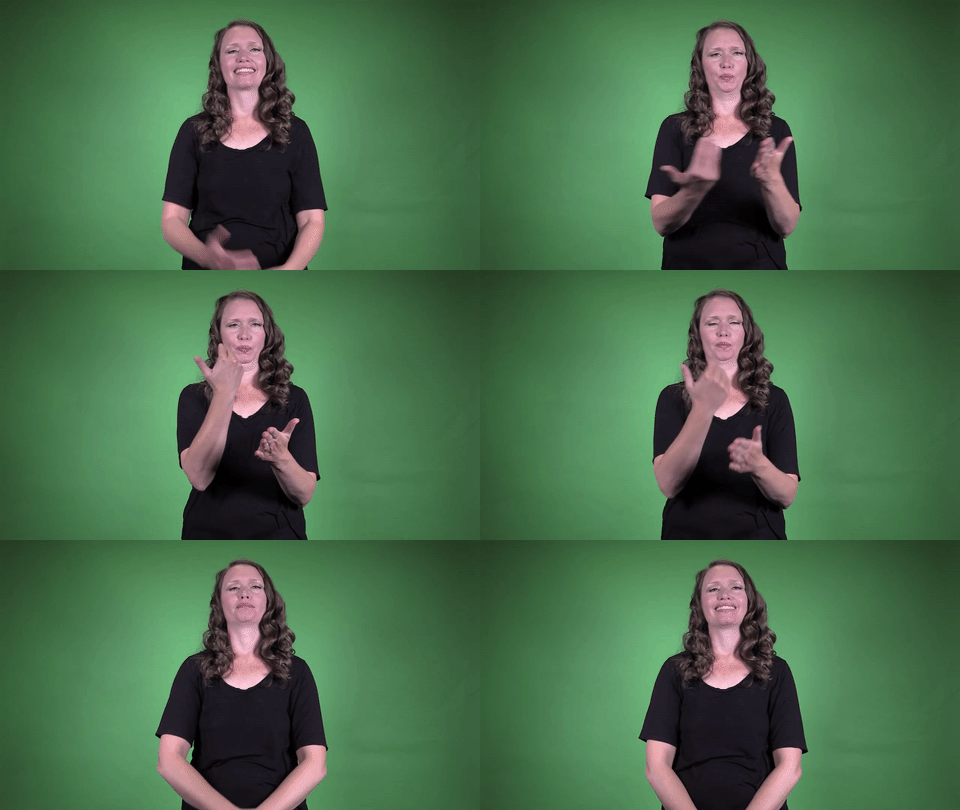
Definition: Recently created or obtained.
Sign for NEW in ASL
Practice Activities
Practicing the sign for NEW in ASL is essential to mastering its proper form, fluidity, and usage. One of the most effective ways to get started is by using a mirror. Stand in front of a mirror and sign slowly, focusing on handshape, palm orientation, and motion. This helps ensure you’re replicating the correct movement and positioning.
Recording yourself while signing can also be incredibly beneficial. Watch your recordings to self-evaluate and identify areas for improvement. Compare your video with native signers or certified ASL instructors to refine your technique. Seeing yourself sign can provide insight into how clear and accurate your version of the sign for NEW in ASL truly is.
Try incorporating the sign into everyday conversations. Use it naturally when discussing objects, ideas, or events that are recent or just beginning. For example, sign “new job,” “new friend,” or “new year” to reinforce context-based learning.
For those ready for more advanced drills, practice using the sign in varied sentence structures. Alternate between declarative, interrogative, and narrative contexts. You can also join ASL practice groups or online communities to engage in real-time dialogue that features the sign for NEW in ASL frequently and in dynamic settings.
SEO Cultural Context
Understanding the cultural context of the sign for NEW in ASL is vital for using it respectfully and appropriately. In Deaf culture, clarity and visual precision are highly valued. The sign itself reflects this emphasis by requiring controlled motion that distinctly conveys the concept of “new” without ambiguity.
The sign for NEW in ASL is commonly used when introducing new ideas, events, people, or objects. This could be during storytelling, social introductions, or educational settings. For example, a Deaf teacher might use it frequently when presenting new information in a classroom.
Regional variation in the sign for NEW in ASL is minimal, but some slight differences in motion or palm orientation may be observed in different parts of the United States. These variations are usually mutually intelligible and accepted within the community, reflecting the natural dialects found in any living language.
Deaf culture also places importance on context. The sign for NEW in ASL may be emphasized or de-emphasized depending on the situation. For instance, in formal storytelling, the sign may be used with more expressive facial grammar to underline the significance of the new element being introduced.
Extended Definition
The sign for NEW in ASL typically involves one hand (usually the dominant hand) scooping upward from the non-dominant palm. The non-dominant hand is held flat, palm-up, while the dominant hand curves slightly and moves upward and across the base hand as if something fresh or new is being brought in or emerging.
This motion visually represents something new appearing or being added, which aligns with the ASL emphasis on visual metaphor. It’s important to keep the motion smooth and deliberate to avoid confusion with similar signs.
A common mistake is confusing the sign for NEW in ASL with signs like CLEAN or PAPER. These signs can appear similar at a glance because they also involve contact between the hands. However, the direction of movement and the intention behind the sign are distinctly different. CLEAN involves a sweeping motion across the palm, while PAPER involves a tapping or brushing motion.
Another error is failing to maintain the correct handshape. The dominant hand should be slightly curved, not flat or stiff. Incorrect handshapes can cause misunderstandings and detract from the clarity of your message.
Tips for Beginners
If you’re just beginning to learn the sign for NEW in ASL, don’t worry—this is a great sign to start with because it’s both visually intuitive and frequently used. Start by watching videos of native ASL users to see the sign in action. Observe the fluidity and confidence with which they sign.
Practice slowly at first. Focus on the handshape and direction of movement. Many beginners mistakenly move too quickly or use rigid hand movements, which can make the sign less readable. Relax your hands and let the motion flow naturally.
Repetition is key. Incorporate the sign into your daily vocabulary by labeling newly introduced items or experiences. Whether it’s a new book, a new recipe, or a new friend, use the sign for NEW in ASL each time to reinforce your learning.
Don’t be discouraged by initial mistakes. Everyone learns at a different pace. The most important thing is consistency. Use flashcards, video drills, or ASL learning apps to keep the sign fresh in your mind and muscles.
Connections to Other Topics
The sign for NEW in ASL connects naturally with the sign for OLD, as they are often used in contrast. Understanding both helps with comparisons and descriptive language in ASL.
Another related sign is BEGIN or START, which is often used in similar contexts. While NEW refers to something recently introduced, BEGIN focuses on the action of starting something. These two signs often appear together in narratives or explanations.
The sign for BIRTHDAY or BORN can also be thematically connected. These signs often accompany NEW in discussions about life events or personal milestones, such as “new baby” or “new year celebration.”
Additionally, the sign for DIFFERENT is useful when discussing something that is new compared to something familiar. For instance, when comparing an old model of a phone with a new one, you might use NEW and DIFFERENT together.
The sign for CHANGE is another excellent companion to NEW. In many contexts, something new implies a change from a previous state. Practicing these signs together builds fluidity in conversation and storytelling.
Lengthy Summary
The sign for NEW in ASL is a foundational vocabulary word that offers a meaningful entry point into the language. Its clear, visual representation and frequent use across conversations make it essential for learners at all levels. By using controlled, upward motion from the non-dominant hand, the sign visually conveys the introduction of something new or recent.
In Deaf culture, the clarity of this sign supports the community’s emphasis on visual communication. It’s often used in educational, social, and narrative contexts, and while regional variations exist, the core structure of the sign remains consistent.
Learners benefit from diverse practice strategies, including mirror work, self-recording, contextual use, and advanced sentence drills. Watching native signers, engaging in community practice, and using the sign in everyday life all contribute to mastery.
Beginners should focus on avoiding common errors, such as incorrect handshape or confusing the sign with similar ones like CLEAN or PAPER. With repetition, patience, and encouragement, the sign for NEW in ASL becomes intuitive and expressive.
Connections to related signs like OLD, BEGIN, CHANGE, DIFFERENT, and BIRTHDAY help expand your vocabulary and understanding of how ASL builds meaning through visual metaphor and spatial grammar. These relationships deepen your ability to express complex ideas clearly and fluently.
Keep practicing the sign for NEW in ASL daily. Use it in real conversations, combine it with other signs, and seek feedback from fluent signers. The more you use it, the more natural it will feel. Every time you sign something new, you’re not just learning a word—you’re building a bridge to a rich and vibrant language community. ️
Synonyms: new, brand-new, fresh, recent, novel
Educational resources: Find related learning materials in our course bank!
Want more? Check out some of our popular learning activities on the homepage!
Need to look up a sign? Use our highly rated dictionary: https://aslinteractive.com/best-asl-dictionary/
Follow us on tiktok: https://www.tiktok.com/@aslinteractive. More social media links at the bottom of this page!
Long-tail Keywords: what is the sign for new in ASL, how do you sign new in American Sign Language, learn how to sign new in ASL
Categories:
tags: clothing in ASL, food signs in ASL, travel signs in ASL, beginner ASL vocabulary, new vocabulary in ASL
Want more? Check out some of our popular learning activities!
ASL Interactive Resources
ASLInteractive YouTube Channel
Follow us on tiktok: @aslinteractive.com
Follow us on Instagram: aslinteractive
Facebook page: aslinteractive
Facebook group: aslinteractive
LInkedIn: ASL Interactive LLC
Twitter: @ASL_interactive
*Some information on this page is AI-generated. AI can make mistakes. Please check the information.


Responses