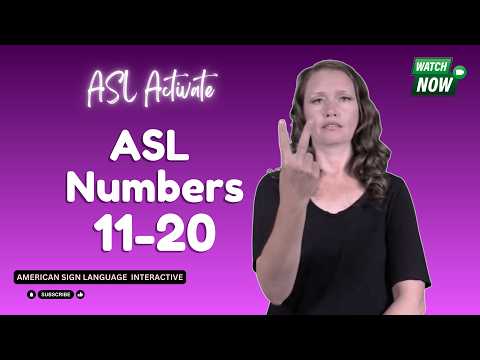
Sign for NUMBERS 11 THRU 20 in ASL | ASL Dictionary

Definition: The sequence of numbers from 11 to 20.

Sign for NUMBERS 11 THRU 20 in ASL

YouTube player

Practice Activities

To master the sign for NUMBERS 11 THRU 20 in ASL, learners can begin by using a mirror to watch their handshape and movement. This helps with self-correction and builds muscle memory. Practicing in front of a mirror allows you to compare your signing to video resources or live instruction, ensuring accuracy in finger motion and orientation.

Recording yourself while signing the numbers from 11 through 20 can help identify subtle errors in movement or rhythm. Replaying your videos will help you notice patterns in your signing and improve consistency. Try signing the sequence slowly at first, then gradually increase your speed while staying accurate.

Incorporate the sign for NUMBERS 11 THRU 20 in ASL into real-life contexts, such as stating your age, counting items, or sharing a phone number. Use them when playing games, keeping score, or practicing math problems in ASL. This adds a functional and engaging layer to your skill development.

Advanced drills for these numbers can include randomizing the order, signing backwards from 20 to 11, or signing in response to spoken prompts. Try speed drills with a timer, or practice translating written numbers into ASL quickly. These techniques help build fluency and confidence.

SEO Cultural Context

The sign for NUMBERS 11 THRU 20 in ASL is foundational for communication within the Deaf community. Numbers are used daily—for ages, addresses, classroom participation, and storytelling. Mastery of these signs is essential for both casual and formal interaction in ASL.

In Deaf culture, clear and expressive signing of numbers reflects respect for the language and its users. Sloppy or rushed number signs can lead to misunderstandings, so precise finger flicks and handshapes are culturally valued. These numbers are often among the first learned by Deaf children and ASL students, forming a crucial part of early language development.

There may be slight regional variations in how these numbers are signed, especially in speed, finger tension, or hand orientation. However, the core structure remains consistent across most ASL-speaking communities. Understanding and respecting these variations shows cultural awareness and adaptability.

The sign for NUMBERS 11 THRU 20 in ASL is frequently used in classroom settings, during introductions, and in daily conversations. Whether you’re telling someone your birthday, giving your child’s age, or reciting steps in a process, these numbers are indispensable. They also appear in ASL storytelling and poetry, where rhythm and clarity of number signs enhance artistic expression.

Extended Definition

The sign for NUMBERS 11 THRU 20 in ASL involves a sequence of distinct hand movements that build upon each other. Numbers 11 through 15 use repeated finger flicks with the palm facing inwards. For example, 11 is made by flicking the index finger up twice from a closed fist, while 12 uses two fingers. Each number from 11 to 15 has a unique combination of finger movement and positioning.

Numbers 16 through 19 often use a twisting motion that combines the base number (like 6 for sixteen) followed by a specific twist of the wrist. These are compound signs that require accurate hand configuration and motion flow. The number 20 is signed with a repeated pinch between the thumb and index finger, sometimes called the “snap” or “duck bill” movement.

A common error when learning the sign for NUMBERS 11 THRU 20 in ASL is dropping or misplacing the movement. For instance, flicking outward instead of inward for 11–15 changes the meaning or makes the sign unclear. With 16–19, failing to twist the wrist properly can lead to misinterpretation or confusion with other numbers.

It is also important to maintain a neutral facial expression unless the context calls for emphasis or emotion. Over-exaggeration or under-articulation of the signs can both lead to errors. Practicing slowly and with focus will help avoid these pitfalls.

Tips for Beginners

Learning the sign for NUMBERS 11 THRU 20 in ASL may seem intimidating at first, but consistent practice leads to quick improvement. Start by mastering each number individually before attempting to sign them in sequence. Pay close attention to hand orientation and the number of flicks or twists required.

Beginners often confuse the direction of the palm or forget the repeated motion required for 11 through 15. Use video references from trusted ASL resources and practice in front of a mirror to ensure accuracy. Don’t rush—clarity is more important than speed at this stage.

Another helpful tip is to group similar signs together. For example, 11 through 15 all involve finger flicks, while 16 through 19 involve similar wrist movements. This pattern recognition can make learning more intuitive. Repetition is key, and it’s okay to make mistakes—just be willing to correct them.

Make practice fun by turning it into a game or challenge. Use flashcards, sign while counting objects, or pair up with a friend or study buddy. Persistence and a positive attitude will help you master the sign for NUMBERS 11 THRU 20 in ASL over time.

Connections to Other Topics

The sign for NUMBERS 11 THRU 20 in ASL connects directly to the broader category of ASL numbers, including 1–10 and 21–100. Understanding the numbering system as a whole helps build fluency and enables more advanced communication. Once these numbers are mastered, learners can more easily grasp larger numbers and sequences.

Another related topic is age. Age signs in ASL often begin with the sign for a number followed by a specific location on the chin, indicating someone’s age. Mastering 11 through 20 allows you to express the ages of teens, a commonly discussed topic in school or family settings.

Time-related vocabulary also connects with these number signs. Telling time in ASL requires understanding of numbers and their quick, clear articulation. Knowing how to sign these numbers helps you express hours, minutes, and dates more effectively.

Counting and quantifying are central to many ASL conversations. From describing how many people are in a group to talking about quantities of items, these number signs are crucial. This also ties into classroom language, where students respond to questions, count aloud, or participate in math-based discussions in ASL.

Storytelling and ASL literature frequently use numbers for emphasis or rhythm. When telling a story in ASL, numbers may be used to indicate sequence, time, or repetition. Competence with the sign for NUMBERS 11 THRU 20 in ASL enhances your ability to engage with these rich cultural elements.

Lengthy Summary

The sign for NUMBERS 11 THRU 20 in ASL is an essential set of vocabulary that forms the foundation for numerical communication in American Sign Language. These signs are used in everyday interactions, from sharing your age and address to counting items or referencing dates. The numbers 11 to 15 use finger flicks with specific handshapes, while 16 to 19 use wrist-twisting movements, and 20 features a distinctive pinching motion.

Understanding the sign for NUMBERS 11 THRU 20 in ASL involves more than just memorizing shapes—it requires recognition of movement, palm orientation, and rhythm. Cultural norms within the Deaf community emphasize clarity and accuracy in signing, especially with numbers. Mis-signing a number can lead to confusion or even miscommunication in important settings like classrooms or social gatherings.

For beginners, it’s vital to start slow, use visual aids, and practice frequently. Mirror work, recorded sessions, and contextual signing all contribute to building fluency. Advanced learners can challenge themselves with speed drills and reverse-order signing to deepen their mastery.

This set of signs connects seamlessly with other ASL concepts, including age, time, counting, and storytelling. Mastering these numbers opens the door to more complex linguistic structures and deeper cultural engagement. Whether you’re learning ASL for personal, educational, or professional reasons, becoming confident in signing numbers 11 through 20 is a major milestone.

Keep practicing the sign for NUMBERS 11 THRU 20 in ASL daily. The more you integrate them into your signing routine, the more natural and expressive they will become. With time and effort, your confidence will grow, and your ability to communicate in ASL will expand. Stay motivated and keep signing!

Synonyms: eleven, twelve, thirteen, fourteen, fifteen, sixteen, seventeen, eighteen, nineteen, twenty

Educational resources: Find related learning materials in our course bank!

Want more? Check out some of our popular learning activities on the homepage!

Need to look up a sign? Use our highly rated dictionary: https://aslinteractive.com/best-asl-dictionary/

Follow us on tiktok: https://www.tiktok.com/@aslinteractive. More social media links at the bottom of this page!

Long-tail Keywords: what is the sign for numbers 11 through 20 in ASL, how to learn ASL numbers 11 to 20, how do you sign numbers from 11 to 20 in American Sign Language

Categories:

tags: numbers in ASL, ASL counting, American Sign Language numbers, learn ASL numbers, ASL basics

Want more? Check out some of our popular learning activities!

ASL Interactive Resources

ASLInteractive YouTube Channel

Follow us on tiktok: @aslinteractive.com

Follow us on Instagram: aslinteractive

Facebook page: aslinteractive

Facebook group: aslinteractive

LInkedIn: ASL Interactive LLC

Twitter: @ASL_interactive

*Some information on this page is AI-generated. AI can make mistakes. Please check the information.


Responses