Sign for OWL in ASL | ASL Dictionary

Definition: A nocturnal bird of prey with large eyes and a flat face.

Sign for OWL in ASL

YouTube player

Practice Activities

Learning the sign for OWL in ASL can be both fun and intellectually stimulating. Start with mirror work by standing in front of a mirror and practicing the handshape and movement. This helps you become aware of your facial expressions and the accuracy of your hand placement.

Recorded signing is another excellent tool. Record yourself signing the word and compare it to native ASL signers from reliable video dictionaries or online lessons. This allows you to self-correct and track your progress over time.

To reinforce retention, use the sign for OWL in ASL in context. For example, tell a story about animals, describe a nighttime scene, or talk about habitats. Inserting the sign naturally helps build fluency and builds confidence in using it during conversation.

Advanced learners can benefit from speed drills and expressive storytelling. Practice chaining signs like OWL, TREE, NIGHT, and FLY to build expressive narratives. You can also try fingerspelling OWL and then using the sign to reinforce recognition and receptive skills.

SEO Cultural Context

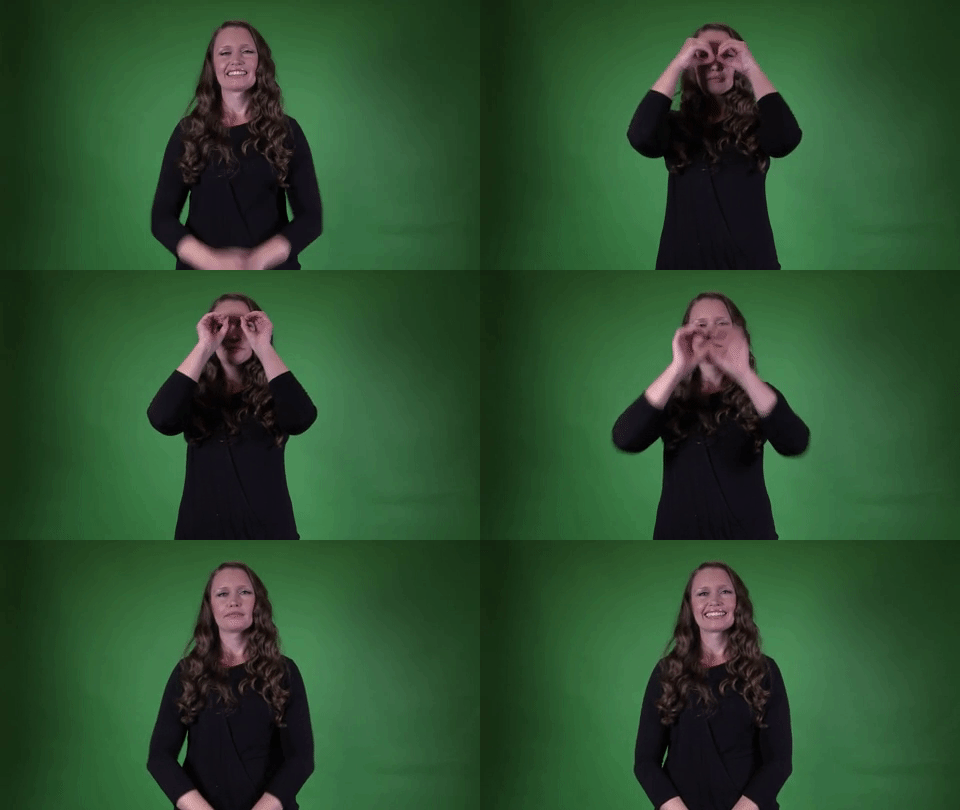
Understanding the cultural context of the sign for OWL in ASL deepens your appreciation of its use within the Deaf community. In ASL, animal signs often mimic a distinctive feature or behavior of the animal. The sign for OWL in ASL typically mimics the bird’s large, expressive eyes and the way it turns its head.

Deaf culture places a strong emphasis on visual storytelling, and animals like the owl are often used in folktales, educational materials, and children’s stories. The owl may symbolize wisdom, mystery, or nighttime, making it a useful sign in both casual and literary contexts.

There may be slight regional variations in how the sign for OWL in ASL is produced. In some areas, the sign may emphasize the bird’s head-turning motion more than the eye shape. As always, exposure to different signers within the Deaf community helps learners understand and respect these variations.

The sign is often used during storytelling, educational contexts, zoo visits, or when teaching children about animals. It’s also a frequent sign in ASL poetry and visual vernacular, where expressive movements are key to conveying emotion and meaning.

Extended Definition

The standard sign for OWL in ASL involves forming both hands into the letter ‘O’ shape and placing them around the eyes, mimicking the owl’s large, round eyes. Then, the hands twist or rotate slightly, mimicking the owl’s head movement. This iconic sign captures the essence of the animal through visual metaphor.

It’s important not to confuse the sign for OWL in ASL with signs for glasses or binoculars, which may also involve handshapes near the eyes. The key difference lies in the movement and context. The sign for OWL has a distinct rotation and intent, while other signs remain static or have different meanings.

Some learners mistakenly sign OWL using gestures that mimic wings or flying. While these gestures might resemble other bird signs, they do not accurately represent the owl. The sign for OWL in ASL is specific and standardized in most educational and conversational settings.

Related signs include BIRD, NIGHT, and TREE, as these often appear together in discussions or storytelling. Understanding these associations helps learners integrate OWL into broader ASL vocabulary more effectively.

Tips for Beginners

For those just starting to learn the sign for OWL in ASL, remember that patience and repetition are key. The motion of rotating your hands around your eyes may feel awkward at first. Take time to break the movement down slowly and focus on fluidity.

One common mistake is forming the wrong handshape. Make sure both hands are clearly in the ‘O’ shape and are placed evenly around the eyes. Another error is forgetting the slight twisting motion, which is essential to distinguish this sign from others.

Practice in front of a mirror and watch videos of native signers. Try to mimic not only the hand movements but also the facial expressions, which are crucial in ASL grammar and meaning. Don’t be afraid to exaggerate your facial expressions slightly when learning; it’s better to over-express than under-express in early practice.

Use the sign for OWL in ASL during real-life interactions or while watching animal videos. Signing along with what you see can reinforce both vocabulary and comprehension. Celebrate small wins and stay motivated—every sign you learn opens the door to deeper communication.

Connections to Other Topics

The sign for OWL in ASL connects naturally with the sign for BIRD, as both are part of the animal vocabulary in ASL. While BIRD is usually signed with a small motion near the mouth, OWL uses a more expressive movement around the eyes, making them visually distinct.

Another important connection is the sign for NIGHT. Owls are nocturnal animals, and combining OWL with NIGHT helps learners build descriptive sentences. For example, “I saw an OWL at NIGHT” becomes a simple but expressive sentence in ASL.

TREE is also a common companion sign, especially when describing where the owl is located. Signing TREE followed by OWL sets up spatial relationships in ASL, which is a foundational grammatical structure in the language.

The sign for FLY or FLYING can also be paired with OWL to describe movement. This is particularly helpful in narratives or visual storytelling, where OWL is not just a noun but part of an action scene.

Finally, the concept of ANIMAL in general is useful when categorizing OWL in teaching or conversation. Understanding the broader category helps learners organize their vocabulary and make thematic connections.

Lengthy Summary

Mastering the sign for OWL in ASL involves more than just learning a handshape. It’s about understanding visual representation, connecting signs in meaningful ways, and respecting the cultural context of ASL. The sign uses the iconic ‘O’ handshapes around the eyes with a twisting motion to symbolize the owl’s striking features.

Through practice activities like mirror work, recorded signing, and storytelling, learners can build fluency and confidence. Cultural context reveals how OWL fits into Deaf storytelling traditions and educational themes, enhancing its real-life usefulness. It’s a sign that is often used in children’s stories, visual poetry, and nature discussions.

A detailed understanding of the sign helps avoid common errors, such as confusing it with similar signs or missing the key movement. For beginners, strategic repetition, visual modeling, and contextual use are essential strategies for success. Encouragement and immersion are crucial—learning happens best when it’s both fun and meaningful.

The sign for OWL in ASL also connects with a wide range of other signs like BIRD, NIGHT, TREE, and FLY. These connections help learners expand their vocabulary and understand how ASL uses space and movement to build meaning. By recognizing these patterns, learners strengthen their overall communication skills.

As you continue your journey, remember that learning ASL is a process of visual thinking, cultural respect, and expressive creativity. Keep using the sign for OWL in ASL in your daily practice, storytelling, and conversations. Each time you sign it, you bring the language to life—so keep practicing, keep exploring, and most importantly, keep signing .

Synonyms: owl, nocturnal bird, hooter, raptor, strigiform

Educational resources: Find related learning materials in our course bank!

Want more? Check out some of our popular learning activities on the homepage!

Need to look up a sign? Use our highly rated dictionary: https://aslinteractive.com/best-asl-dictionary/

Follow us on tiktok: https://www.tiktok.com/@aslinteractive. More social media links at the bottom of this page!

Long-tail Keywords: what is the sign for owl in ASL, how do you sign owl in ASL, ASL sign for owl

Categories:

tags: owls and birds signs, animals in ASL, nocturnal animals in ASL, ASL nature vocabulary, bird species in sign language

Want more? Check out some of our popular learning activities!

ASL Interactive Resources

ASLInteractive YouTube Channel

Follow us on tiktok: @aslinteractive.com

Follow us on Instagram: aslinteractive

Facebook page: aslinteractive

Facebook group: aslinteractive

LInkedIn: ASL Interactive LLC

Twitter: @ASL_interactive

*Some information on this page is AI-generated. AI can make mistakes. Please check the information.


Responses