Practice Activities
To build confidence and fluency with the sign for REMEMBER in ASL, start with mirror work. Stand in front of a mirror and practice the handshape, location, and movement of the sign while watching yourself to ensure proper form. This helps reinforce muscle memory and visual accuracy. Record yourself signing in short video clips. Watch the playback to check consistency and alignment with native signers. Pay special attention to the non-manual signals and smoothness of the motion when signing the sign for REMEMBER in ASL. Use the sign frequently in real-life contexts. Whenever you talk about memory, past events, or reminders, include the sign in your conversations. For example, say “I remember my friend” or “Do you remember that day?” using the correct sign within a full ASL sentence. Engage in advanced drills with a language partner or instructor. Practice switching between similar signs like THINK, FORGET, and KNOW in rapid succession to build clarity and speed. Create practice flashcards with visual prompts to cue the sign for REMEMBER in ASL, reinforcing both comprehension and production. Join online ASL communities or local Deaf events where you can use the sign naturally. The more you see and use the sign for REMEMBER in ASL in authentic interactions, the faster it becomes second nature.
SEO Cultural Context
The sign for REMEMBER in ASL holds more than just linguistic value—it reflects how memory and reflection are expressed in Deaf culture. Used frequently in conversations about personal history, stories, or reminders, this sign connects to the cultural emphasis on storytelling and shared experiences in the Deaf community. In ASL, visual storytelling plays a central role. The sign for REMEMBER in ASL often appears when someone is recalling a vivid memory or connecting the present to the past. This makes the sign essential in narratives, especially when discussing generational knowledge or community events. Regional variation in the sign for REMEMBER in ASL is minimal, but some older signers or localized communities might incorporate slight differences in motion or facial expression. Still, the general handshape and movement remain widely understood across the signing population. Deaf culture values clarity and precision. Overusing or misusing signs like REMEMBER can lead to confusion or a loss of nuance. For example, confusing the sign for REMEMBER in ASL with the sign for THINK or KNOW might change the intent of a sentence. Understanding this sign in its cultural context ensures respectful and accurate communication.
Extended Definition
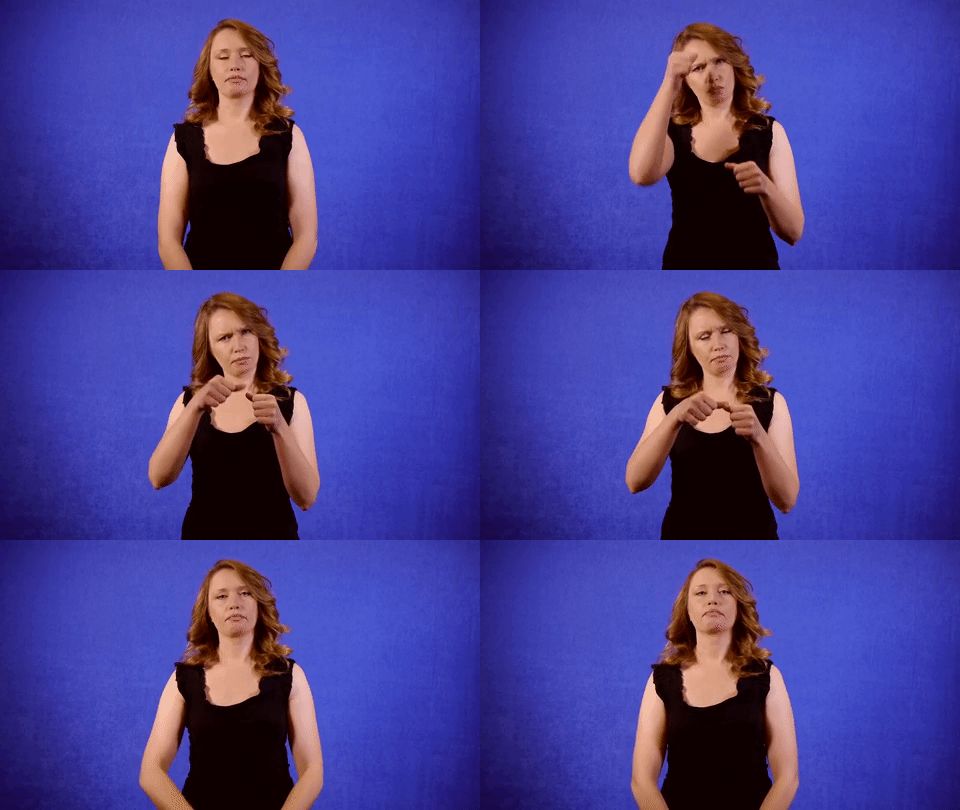
The sign for REMEMBER in ASL uses a flat “A” handshape on both hands. Start with the dominant hand at the forehead, and move it down to tap the thumb of the non-dominant “A” hand, which stays in front of the chest. The motion is smooth and deliberate, symbolizing the act of bringing something from the mind to the present. This sign metaphorically represents pulling a memory from the brain and connecting it to the now. The sign for REMEMBER in ASL is directional and spatially meaningful, often paired with facial expressions that reflect the emotional tone of what is being remembered. It’s important not to confuse this sign with similar ones like FORGET, which uses a wiping motion across the forehead, or THINK, which taps the forehead without involving a second hand. Beginners often mistake the movement or forget to use the correct handshape, especially the thumb placement. Some learners mistakenly use a bent handshape or change the orientation of the “A” hands, which alters the meaning or causes confusion. Practicing the sign for REMEMBER in ASL with careful attention to handshape and movement will help avoid these common errors and build confidence.
Tips for Beginners3>
If you’re just starting to learn the sign for REMEMBER in ASL, take your time mastering the handshape. The “A” hand is not just a fist—it requires a clear thumb placement and correct wrist angle. Practicing slowly and deliberately helps reinforce the correct form. Try not to rush the motion. Many beginners speed through the sign, which can make it unclear or sloppy. Focus on creating a clean, intentional movement from the forehead to the other hand. Watching fluent signers perform the sign for REMEMBER in ASL can help you refine your own technique. Avoid substituting other signs. It’s easy to accidentally use the sign for THINK or KNOW instead, especially if you’re translating directly from English. Instead, think in ASL structure and use the sign where a Deaf signer would naturally use it. Use video dictionaries and ASL learning apps to compare your version of the sign with native examples. Repetition is key—daily practice with the sign for REMEMBER in ASL will help build muscle memory and fluency. Celebrate small wins. Every time you recognize or accurately use the sign for REMEMBER in ASL in a new context, you’re making progress. Stay patient and consistent, and your skills will continue to grow.
Connections to Other Topics
The sign for REMEMBER in ASL connects naturally with the sign for FORGET. These two signs are often taught together because they represent opposite cognitive actions—retaining vs. losing memory. Practicing them side by side helps reinforce meaning and contrast. Another related sign is THINK. While THINK refers more generally to the process of cognition, REMEMBER specifically implies recalling something known. Comparing these signs can help deepen your understanding of how ASL conceptualizes mental processes. The sign for KNOW also shares a conceptual space with REMEMBER. Although KNOW is about being certain of information, REMEMBER implies bringing that information back into present awareness. Understanding the subtle differences enhances your ASL vocabulary. The sign for EXPERIENCE is another useful connection. Often, stories that involve the sign for REMEMBER in ASL also include references to past experiences. This makes it a natural part of narratives and personal storytelling in ASL. Finally, the sign for PAST is frequently paired with REMEMBER. When talking about events that happened before, signers often use PAST to set the time frame, followed by REMEMBER to introduce the memory. This grammatical pairing strengthens your ability to construct full sentences and stories in ASL.
Lengthy Summary
The sign for REMEMBER in ASL is a foundational part of expressing memory, reflection, and connection to past experiences. It uses a specific “A” handshape movement from the forehead to another “A” hand, symbolizing the mental process of recalling something important. Practicing this sign through mirror work, video recordings, and real-life interactions ensures accuracy and fluency. In Deaf culture, memory and storytelling are deeply valued. The sign for REMEMBER in ASL allows signers to share history, emotions, and lessons across generations. Understanding its cultural and linguistic importance helps learners use it respectfully and correctly. Beginners should focus on precision in handshape, location, and movement. Avoiding common mistakes like confusing similar signs or rushing the motion will improve clarity. Practice regularly, and reinforce your learning by connecting REMEMBER to related signs like FORGET, THINK, KNOW, and PAST. By mastering the sign for REMEMBER in ASL, you’re not just learning a word—you’re gaining access to a rich world of expression, narrative, and cultural connection. Keep practicing, stay curious, and use the sign every chance you get. With dedication and immersion, your ASL fluency will continue to grow . Synonyms: recall, recollect, retain, keep in mind, call to mind Educational resources: Find related learning materials in our course bank! Want more? Check out some of our popular learning activities on the homepage! Need to look up a sign? Use our highly rated dictionary: https://aslinteractive.com/best-asl-dictionary/ Follow us on tiktok: https://www.tiktok.com/@aslinteractive. More social media links at the bottom of this page! Long-tail Keywords: what is the sign for remember in ASL, how do you sign remember in ASL, remember meaning in American Sign Language Categories: tags: memory-related signs, ASL verbs, everyday signs in ASL, learning ASL grammar, ASL for beginners
Want more? Check out some of our popular learning activities!
ASL Interactive Resources
ASLInteractive YouTube Channel
Follow us on tiktok: @aslinteractive.com
Follow us on Instagram: aslinteractive
Facebook page: aslinteractive
Facebook group: aslinteractive
LInkedIn: ASL Interactive LLC
Twitter: @ASL_interactive
*Some information on this page is AI-generated. AI can make mistakes. Please check the information.
Responses