Practice Activities
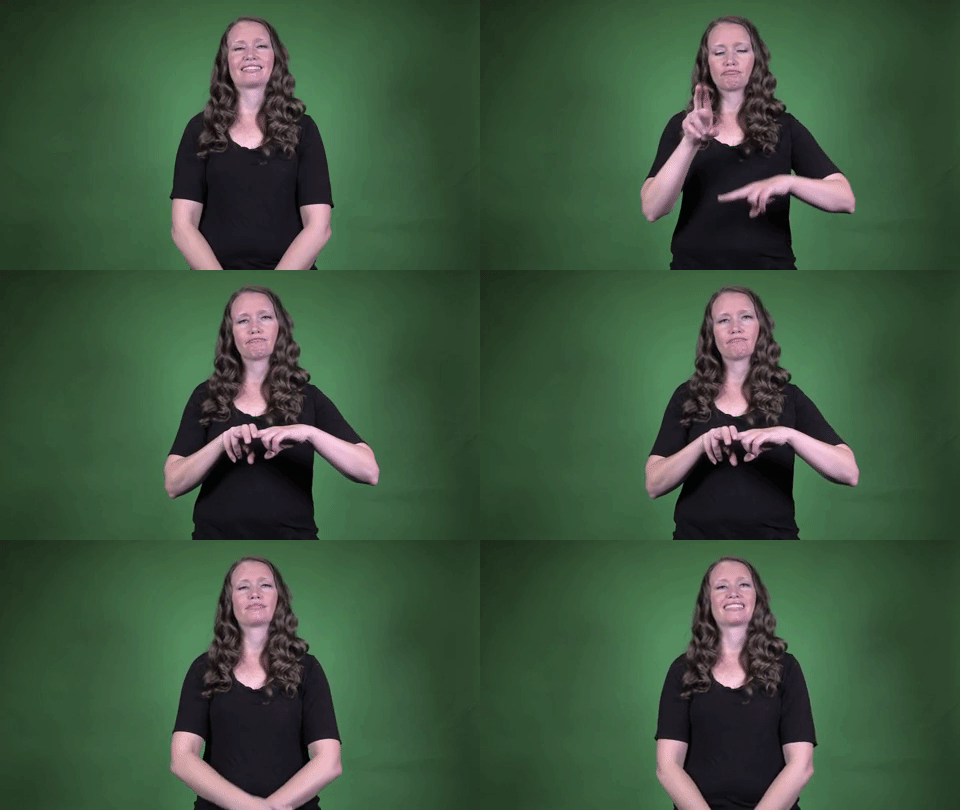
To master the sign for SIT in ASL, consistent practice is essential. Start with mirror work by standing in front of a mirror and observing your handshape, movement, and facial expressions closely. Make sure your dominant hand forms an “H” handshape and taps once on the non-dominant “H” handshape, which remains stationary in front of you. Record yourself while signing. This allows you to review and compare your production of the sign for SIT in ASL with fluent signers or instructional videos. You can slow down your playback to catch subtle hand movements and make corrections. Use the sign in context. As you go through your day, incorporate the sign for SIT in ASL into your routine. For example, when inviting someone to sit, or while describing actions in a story, sign the word naturally as part of your communication. Advanced learners can engage in drills by forming full sentences. Practice with phrases such as “Please sit,” “He sits down,” or “The child is sitting.” Repeating these in both expressive and receptive modes will build fluency in using the sign for SIT in ASL in meaningful conversation. Pair with a signing buddy or join online ASL meetups to use the sign in dialogue. This social interaction helps strengthen muscle memory and builds comfort in using SIT along with related vocabulary.
SEO Cultural Context
The sign for SIT in ASL is a foundational verb often taught early in ASL instruction. In Deaf culture, clear and respectful communication includes appropriate nonverbal cues. When signing SIT, cultural norms emphasize directness and clarity without unnecessary embellishment. The sign fits into many everyday scenarios, including classroom instructions, storytelling, and social interactions. For example, teachers in Deaf schools frequently use the sign for SIT in ASL when guiding students during activities or transitions. It is a common directive in both formal and informal settings. There may be slight regional variations in how the sign is produced, particularly in how sharply or softly the dominant hand taps the non-dominant hand. However, the core handshape and motion remain consistent across most dialects of ASL. Deaf culture values visual clarity, so the sign for SIT in ASL is purposefully quick and straightforward. It reflects the cultural emphasis on efficiency and visual grammar. Understanding when to sign SIT and how to pair it with appropriate facial expressions demonstrates cultural fluency as well as linguistic knowledge.
Extended Definition
The sign for SIT in ASL is formed using both hands in the “H” handshape. The dominant hand moves down to rest on top of the stationary non-dominant “H” hand, mimicking the action of someone sitting on a bench or chair. The movement is a single, quick tap downward. This sign is closely related to the noun form CHAIR in ASL, which uses a repeated tapping motion. A common mistake is confusing SIT with CHAIR due to their similar structure. Remember: SIT is signed with one tap, while CHAIR involves two taps. Another related sign is STAY, which also uses a downward motion but with a “Y” handshape and a different orientation. Mixing up these signs can change the meaning of a sentence entirely, so it’s important to distinguish them. Learners may accidentally use incorrect handshapes, such as forming “U” instead of “H,” or may tap too softly or too forcefully. Pay special attention to the angle and clarity of the motion when signing SIT to ensure it is understood. Facial expressions play a supporting role. In imperative contexts, such as giving a command, pair the sign for SIT in ASL with a firm facial expression. In storytelling, use neutral or expressive facial features to convey tone and context.
Tips for Beginners3>
If you’re just beginning your ASL journey, the sign for SIT in ASL is a great starting point. It’s simple, visual, and used frequently in both instruction and conversation. Begin by mastering the correct handshape—two “H” hands—and make sure your dominant hand moves while your non-dominant hand stays still. Many beginners try to mimic the gesture without understanding the underlying handshape. Be sure to focus on forming the correct “H” hand and positioning both hands properly. Practicing in front of a mirror helps catch these small but important details. Another common mistake is overemphasizing or underemphasizing the motion. The sign should be quick and clear—not exaggerated or sluggish. Practice finding the right rhythm and sharpness in your tap. Don’t get discouraged if it takes several attempts to get it right. ASL is a visual language, and like any language, it requires patience and repetition. Take your time and celebrate small improvements. Use flashcards showing the sign, or label areas in your house like a chair or bench to remind yourself to practice. The more you use the sign for SIT in ASL in real-life situations, the more natural it will become.
Connections to Other Topics
Learning the sign for SIT in ASL naturally connects with the sign for CHAIR. The two use the same handshape but differ in movement. Understanding this pair helps reinforce the distinction between ASL verbs and nouns. Another closely related sign is STAND. In contrast to SIT, STAND involves placing a “V” handshape (representing legs) on the flat palm of the non-dominant hand. Knowing both signs allows you to describe actions and transitions in movement during storytelling. The sign for WAIT often appears alongside SIT, especially in instructional settings. For example, a teacher might sign “SIT” followed by “WAIT” to help manage classroom behavior. Learning them together helps contextualize their use. Additionally, the sign for STAY connects thematically with SIT. Both signs can be used to give directions or describe states of being. Understanding how to sign these concepts helps learners form more complex sentences. Lastly, the sign for REST is often used in conjunction with SIT when discussing taking a break or relaxing. Connecting SIT with REST allows learners to describe physical states and emotions more effectively in ASL.
Lengthy Summary
The sign for SIT in ASL is a foundational and practical verb that appears frequently in everyday conversation, classroom settings, and storytelling. Learning it helps learners begin to form complete sentences and understand the structure of ASL grammar. With its clear visual representation of the action of sitting, the sign is intuitive once the correct handshapes and movements are mastered. Culturally, SIT is a sign that reflects the efficiency and precision valued in Deaf communication. Understanding how the sign fits into Deaf culture, including classroom norms and social interactions, adds depth to your learning. Recognizing regional variations and using appropriate facial expressions will elevate your fluency and show cultural respect. A clear distinction exists between SIT and related signs like CHAIR, STAND, and STAY. These connections enrich your vocabulary and allow for broader expression. For beginners, focusing on handshape, movement, and practice through mirror work, context-based signing, and partner drills will build confidence and muscle memory. Common beginner errors—such as using the wrong handshape or confusing similar signs—can be avoided through regular, mindful practice. Working with a signing partner, recording your practice, or attending ASL study groups are great ways to reinforce the sign for SIT in ASL and expand your comfort level. As you continue to grow your ASL skills, keep returning to core signs like SIT to strengthen your foundation. By incorporating the sign for SIT in ASL into daily routines, conversational practice, and expressive storytelling, you’ll become more fluent and confident in your signing abilities. Keep learning, keep practicing, and keep signing. The more you engage with signs like SIT in real-life contexts, the more natural they become. Your journey into ASL fluency starts with small, steady steps—so take a seat, sign SIT, and dive into the next stage of your learning ✋. Synonyms: sit, rest, perch, take a seat, settle Educational resources: Find related learning materials in our course bank! Want more? Check out some of our popular learning activities on the homepage! Need to look up a sign? Use our highly rated dictionary: https://aslinteractive.com/best-asl-dictionary/ Follow us on tiktok: https://www.tiktok.com/@aslinteractive. More social media links at the bottom of this page! Long-tail Keywords: what is the sign for sit in ASL, how do you sign sit in ASL, ASL sign for sit Categories: tags: basic ASL verbs, ASL for beginners, everyday ASL vocabulary, ASL action signs, Learn ASL online
Want more? Check out some of our popular learning activities!
ASL Interactive Resources
ASLInteractive YouTube Channel
Follow us on tiktok: @aslinteractive.com
Follow us on Instagram: aslinteractive
Facebook page: aslinteractive
Facebook group: aslinteractive
LInkedIn: ASL Interactive LLC
Twitter: @ASL_interactive
*Some information on this page is AI-generated. AI can make mistakes. Please check the information.
Responses