Practice Activities
Learning the sign for TABLE in ASL becomes much easier when you incorporate a variety of practice methods into your daily routine. One effective technique is mirror work. Stand in front of a mirror and repeatedly sign TABLE while observing your handshape, movement, and overall posture. This helps you self-correct and build muscle memory. Another useful activity is recording yourself. Use your phone or laptop to film short clips where you use the sign for TABLE in ASL in different sentences. Watching the playback lets you evaluate your sign clarity and consistency. Signing in context is crucial for retention. Try incorporating the sign for TABLE in ASL while describing the furniture in your room, setting the table, or telling a story involving meals or gatherings. This situational use makes the sign more meaningful and easier to remember. For more advanced learners, consider creating drills that involve multiple furniture-related signs. Alternate between signing TABLE, CHAIR, COUCH, and DESK in a timed sequence to increase your fluency and reduce hesitation. You can also sign with a partner or tutor. Practice short conversations where the sign for TABLE in ASL is used naturally, such as discussing where to sit, describing a room, or planning a dinner setup. These interactions reinforce both vocabulary and grammar in a real-world context.
SEO Cultural Context
In Deaf culture, the sign for TABLE in ASL is more than just vocabulary—it’s part of daily visual communication. Deaf individuals often use spatial referencing and classifiers to describe physical environments, making signs like TABLE central to clear and effective storytelling. The sign for TABLE in ASL mimics the flat surface of an actual table. It reflects ASL’s visual-spatial modality, where signs often look like what they represent. This iconic nature of many signs helps new learners grasp concepts more intuitively. While the sign for TABLE in ASL is widely understood across the United States and Canada, regional variations can exist. In some local communities, the sign may be modified slightly in terms of movement or hand placement, though the core concept remains consistent. This sign appears frequently in everyday conversations. Deaf individuals use it when discussing furniture, giving directions within a room, planning meals, or describing scenes. It also comes up in educational settings, especially when teaching spatial organization or classroom vocabulary. Understanding the cultural value of context-rich signs like the sign for TABLE in ASL enhances communication. It reminds learners that ASL is more than a language—it’s a visual, cultural, and community-based experience.
Extended Definition
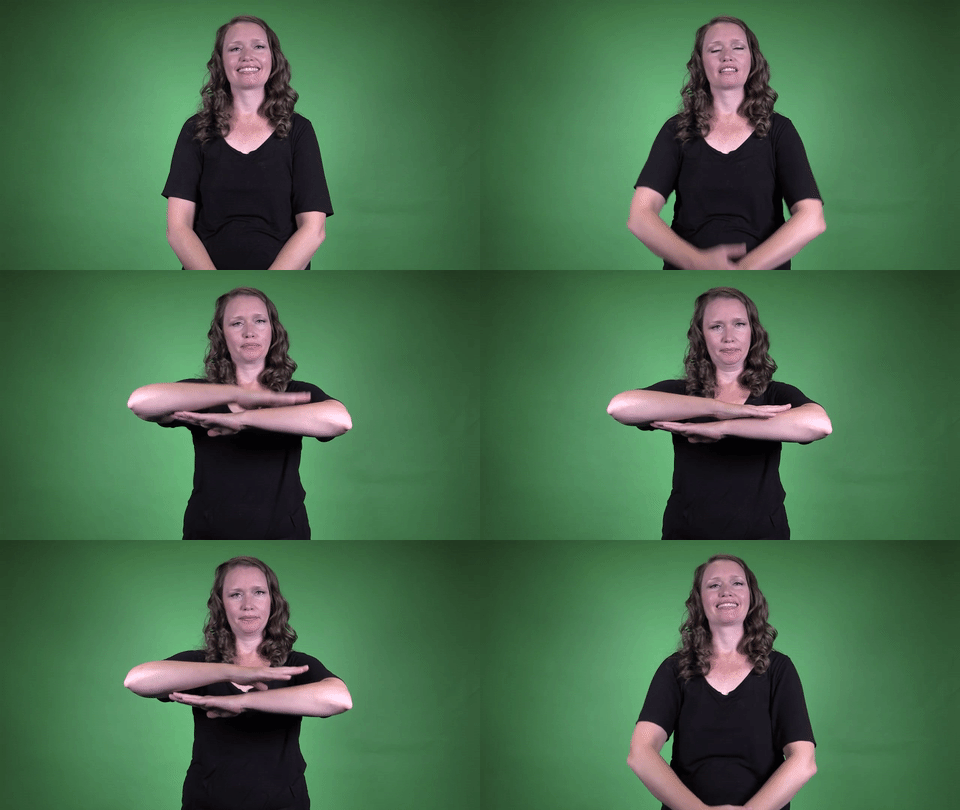
The sign for TABLE in ASL uses both arms to represent a flat surface, much like an actual table. Start with both hands in a B-handshape (fingers together, palm down). Place your dominant forearm over your non-dominant forearm, crossing them horizontally in front of your body. This movement visually depicts the flat top of a table. This sign is often confused with similar signs like DESK, which uses a similar arm-crossing motion but may vary in size or movement. One common error is placing the arms too low or too high, which can affect clarity. The key is to maintain a horizontal line that aligns with the concept of a tabletop. Another related sign is SHELF, which also involves horizontal space but uses different handshapes and positioning. Learners should be aware of these subtle differences to avoid communication breakdowns. The sign for TABLE in ASL is highly iconic, meaning its form resembles its meaning. This makes it easier to remember but also requires precision to differentiate it from similar signs. Always check for correct arm placement and movement when learning or teaching this sign.
Tips for Beginners3>
If you’re just starting to learn the sign for TABLE in ASL, you’re in luck—it’s a visually intuitive sign that can be mastered with consistent practice. Start by understanding the concept behind the sign: it represents a flat horizontal surface. Mimic that image with your arms to reinforce the visual connection. One common mistake is using the wrong handshape. Make sure both hands are in the B-handshape and your palms are facing down. Another frequent error is slouching or letting your arms droop, which makes the sign unclear. Keep your arms firm and level. Practice the sign in front of a mirror and repeat it slowly at first. Pay close attention to how your arms cross and where they are placed in space. Consistency is key when learning the sign for TABLE in ASL. Don’t be discouraged if you need to correct your form often in the beginning. ASL is a physical language, and your body needs time to adapt to new movements. Keep at it and celebrate your progress along the way.
Connections to Other Topics
The sign for TABLE in ASL connects naturally with other furniture-related vocabulary. One of the closest related signs is CHAIR, which is often taught alongside TABLE. CHAIR uses H-handshapes and tapping motions to represent sitting. Another useful connection is the sign for DESK, which can look similar to TABLE but may differ slightly in its size and context of use. Being able to distinguish between these helps improve clarity in furniture-related conversations. The sign for EAT is also frequently used with TABLE in context. You might sign both when describing a meal or setting a scene at the dinner table. This pairing helps reinforce thematic vocabulary. ROOM and KITCHEN are other related signs. Learners often describe rooms by listing furniture, making the sign for TABLE in ASL an essential building block in spatial descriptions. Finally, classifiers in ASL are closely connected to TABLE. Classifier “CL:3” or “CL:flat” can be used to describe items on a table or their arrangement. Understanding how to use classifiers with TABLE enhances your descriptive skills in ASL.
Lengthy Summary
The sign for TABLE in ASL is a foundational piece of vocabulary in American Sign Language, representing not only a common object but also a broader connection to spatial and contextual communication. This sign uses iconic imagery to create meaning, with both forearms crossing to depict a flat surface. Its visual form makes it accessible to beginners, yet it also plays a vital role in advanced conversations, spatial descriptions, and storytelling. In Deaf culture, signs like TABLE are essential for describing environments, giving directions, and setting scenes in narratives. The sign for TABLE in ASL is used in everyday discussions, from classroom settings to home life, and it often pairs with other core signs like CHAIR, EAT, and DESK. Understanding this sign means you’re gaining access to a wide range of conversational topics. For learners, regular and varied practice is key. Use mirrors, recordings, and real-life scenarios to reinforce the sign. Watch out for common mistakes, especially in handshape and arm placement. By connecting the sign for TABLE in ASL with related vocabulary and grammatical structures like classifiers, you enhance both your vocabulary and your ability to communicate naturally in ASL. Whether you’re a beginner just starting your ASL journey or an intermediate student building fluency, mastering the sign for TABLE in ASL is a rewarding step. Keep practicing, stay curious, and continue exploring the rich, visual world of American Sign Language. Synonyms: table, desk, countertop, surface, bench Educational resources: Find related learning materials in our course bank! Want more? Check out some of our popular learning activities on the homepage! Need to look up a sign? Use our highly rated dictionary: https://aslinteractive.com/best-asl-dictionary/ Follow us on tiktok: https://www.tiktok.com/@aslinteractive. More social media links at the bottom of this page! Long-tail Keywords: What is the sign for table in ASL, How do you sign table in ASL, ASL sign for table Categories: tags: table sign language, furniture in ASL, home-related ASL signs, ASL vocabulary for household items, American Sign Language dictionary furniture
Want more? Check out some of our popular learning activities!
ASL Interactive Resources
ASLInteractive YouTube Channel
Follow us on tiktok: @aslinteractive.com
Follow us on Instagram: aslinteractive
Facebook page: aslinteractive
Facebook group: aslinteractive
LInkedIn: ASL Interactive LLC
Twitter: @ASL_interactive
*Some information on this page is AI-generated. AI can make mistakes. Please check the information.
Responses