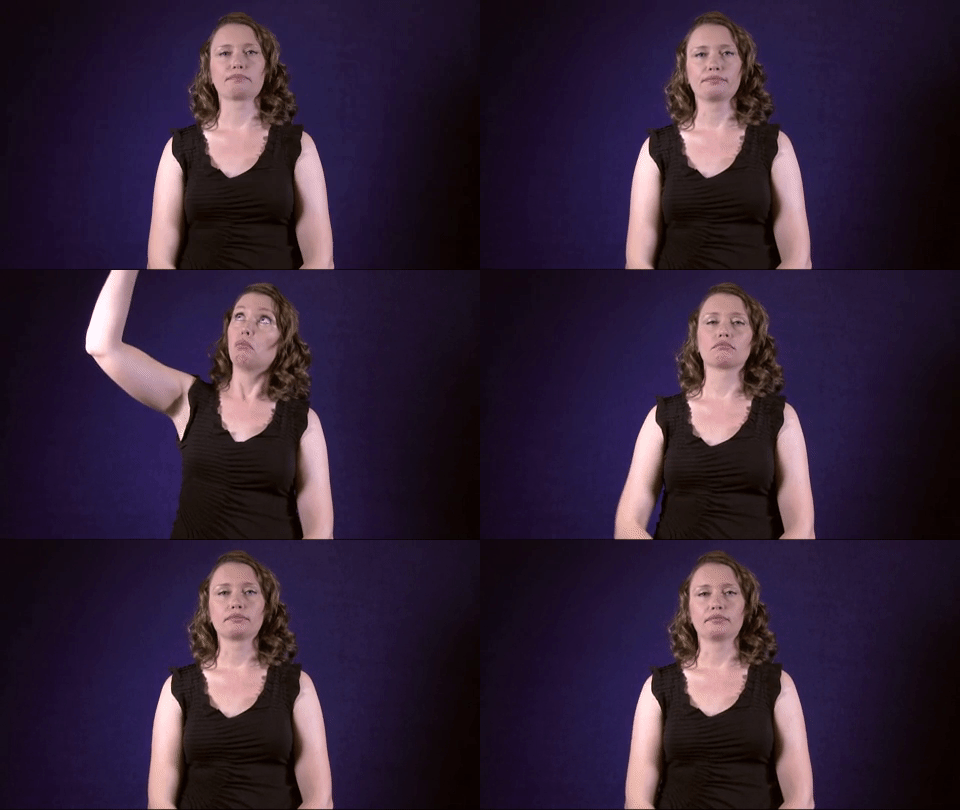
Sign for TALL in ASL | ASL Dictionary

Definition: Of great or more than average height. Sign for TALL in ASL
YouTube player

Practice Activities

To master the sign for TALL in ASL, consistent and varied practice is essential. Start with mirror work to ensure your hand position and movement are accurate. Stand in front of a mirror and sign slowly, paying attention to your facial expressions and the height at which your dominant hand moves. This helps reinforce spatial accuracy, which is key in ASL. Record yourself signing sentences that include the sign for TALL in ASL. Watching your videos allows you to catch subtle mistakes and develop more natural fluency. Try describing people or objects in your home using height comparisons, such as “my brother is tall” or “the building is tall.” Use the sign in real communication settings. If you’re part of an ASL class or Deaf community group, incorporate the sign for TALL in ASL into conversations. Ask classmates to describe themselves or others using height terms to reinforce your understanding. Advanced learners can create drills focusing on comparative and superlative forms. Practice signing phrases like “taller than” and “the tallest person.” Include other height-related signs to strengthen overall vocabulary and improve contextual use of the sign for TALL in ASL.

SEO Cultural Context

In Deaf culture, physical descriptions are often more direct and visual than in spoken English. The sign for TALL in ASL is commonly used when describing people, animals, or objects. It’s a respectful and neutral term when used properly, and it plays a key role in visual storytelling and daily conversation. The sign for TALL in ASL involves an upward motion that indicates vertical height. It’s often accompanied by facial expressions that match the degree of height being described. In some regional variations, the handshape or movement may slightly differ, but the general concept remains consistent. Understanding when and how to use the sign in social situations is important. For example, in introductions or when giving directions, describing someone as tall can help others recognize them in a crowd. It’s also a common modifier in narratives and jokes in Deaf storytelling, where visual imagery is essential.

Extended Definition

The sign for TALL in ASL typically uses a non-dominant flat hand held horizontally to represent the ground or a base level. The dominant hand, shaped in a bent “B” or flat hand, moves upward from that base to indicate height. The higher your dominant hand moves, the taller the object or person is perceived to be. It’s important not to confuse the sign for TALL in ASL with signs for “long” or “high.” These may have similar upward motions but are used in different contexts. For example, “long” often involves a directional movement along an object, while “tall” focuses on vertical height from a base point. Common errors include using the wrong handshape or misplacing the motion. Beginners might also forget to include appropriate non-manual markers, such as raised eyebrows when emphasizing height. These subtle features help convey the degree of tallness and improve clarity in communication.

Tips for Beginners

For those just starting to learn the sign for TALL in ASL, patience and repetition are key. Don’t rush the movement—focus on clarity and accuracy. Make sure your non-dominant hand stays steady as a reference point, and practice keeping your dominant hand’s motion smooth and controlled. A frequent beginner mistake is placing the sign too low or too close to the body. The sign for TALL in ASL should be performed in the neutral signing space in front of your torso. Avoid stiff motions; ASL is a fluid, expressive language that relies on natural movement. Use real-life references to make it easier. Think about someone tall that you know and associate the sign with that person. This kind of mental linking helps reinforce memory and lends meaning to your practice sessions.

Connections to Other Topics

The sign for TALL in ASL connects naturally with the sign for SHORT, as both are used to describe height. Practicing these signs together helps solidify contrastive structures in ASL and reinforces descriptive vocabulary. Another related sign is BIG, which can sometimes be confused with TALL. While TALL refers specifically to vertical height, BIG refers to overall size. Understanding the difference enhances your ability to describe people and objects more precisely. The sign for GROW or GROW-UP also relates, as it involves a similar upward motion. These signs often appear in narratives about childhood or changes over time, where height is part of the story. The sign for PERSON is important when you want to say “tall person.” ASL often combines descriptors with classifiers to describe human figures, so knowing how to modify signs like PERSON with attributes such as TALL adds depth to your signing skills. Finally, the use of classifiers, like CL:1 or CL:3, can be useful when describing tall items such as buildings or trees. These classifiers, combined with the concept of height, expand your visual storytelling abilities and your ability to convey spatial relationships.

Lengthy Summary

The sign for TALL in ASL is a foundational vocabulary word that allows you to describe height clearly and visually. Whether you’re talking about a tall person, a skyscraper, or a growing child, this sign is used frequently in everyday conversation and storytelling. Its structure—a base hand and a rising motion with the dominant hand—offers a simple yet powerful way to express size. In Deaf culture, clear descriptions are vital, and the sign for TALL in ASL fits beautifully into this visual linguistic system. It’s used in introductions, narratives, classroom settings, and casual dialogue. Understanding its proper use, regional variations, and common mistakes helps you build confidence and fluency in ASL. Practicing with videos, mirrors, and live conversation enhances your accuracy. Engaging with related signs like SHORT, BIG, and GROW expands your vocabulary and improves your ability to compare and contrast. Pairing the sign for TALL in ASL with classifiers and modifiers allows for detailed and expressive communication. Beginners should focus on accuracy before speed. Take time to understand the motion and incorporate facial expressions. Avoid confusing similar signs, and use real-life examples to reinforce learning. With consistent practice, you’ll be able to use the sign for TALL in ASL naturally and effectively in a wide range of settings. Keep signing, keep practicing, and don’t be afraid to make mistakes. The journey to fluency includes repetition, feedback, and cultural understanding. The sign for TALL in ASL is just one of many tools that will help you become a confident, expressive communicator in American Sign Language. Synonyms: high, towering, lofty, elevated, statuesque Educational resources: Find related learning materials in our course bank! Want more? Check out some of our popular learning activities on the homepage! Need to look up a sign? Use our highly rated dictionary: https://aslinteractive.com/best-asl-dictionary/ Follow us on tiktok: https://www.tiktok.com/@aslinteractive. More social media links at the bottom of this page! Long-tail Keywords: what is the sign for tall in ASL, how do you sign tall in ASL, ASL sign for tall Categories: tags: adjectives in ASL, height signs in ASL, size-related ASL signs, describing people in ASL, physical characteristics in ASL

Want more? Check out some of our popular learning activities!

ASL Interactive Resources

ASLInteractive YouTube Channel

Follow us on tiktok: @aslinteractive.com

Follow us on Instagram: aslinteractive

Facebook page: aslinteractive

Facebook group: aslinteractive

LInkedIn: ASL Interactive LLC

Twitter: @ASL_interactive

*Some information on this page is AI-generated. AI can make mistakes. Please check the information.  

Responses