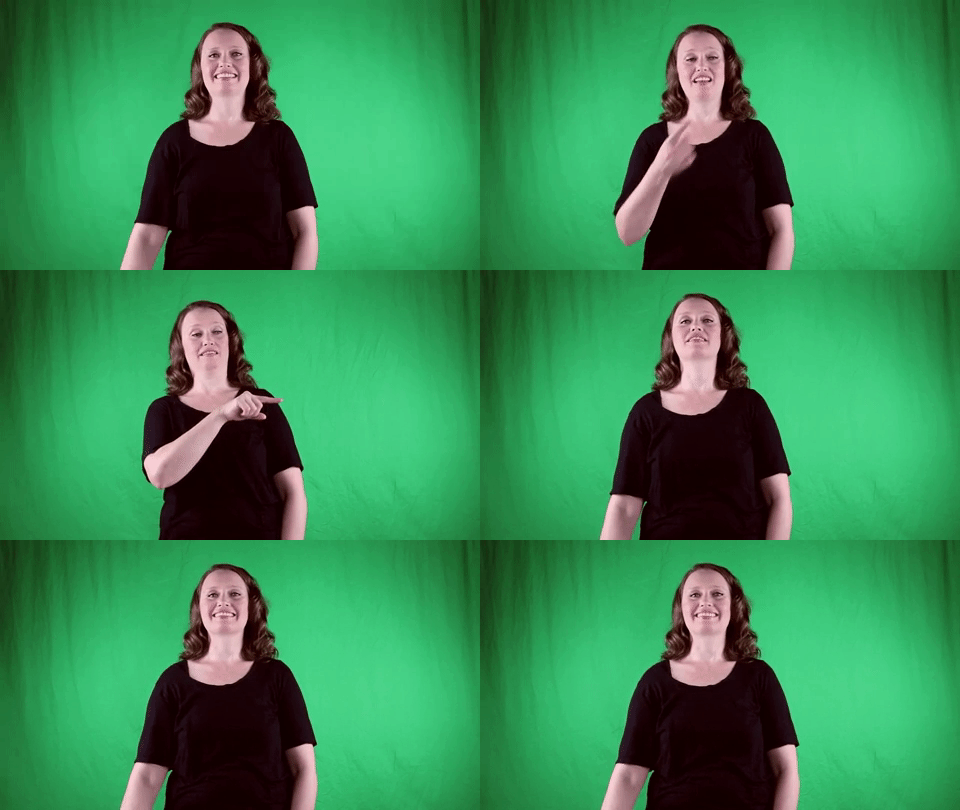
Sign for THEM in ASL | ASL Dictionary

Definition: Refers to other people or things. Sign for THEM in ASL
YouTube player

Practice Activities

To master the sign for THEM in ASL, start by practicing in front of a mirror. This helps you monitor handshape, palm orientation, and movement accuracy. Position your hand correctly in relation to an invisible group of people, as if you’re referring to a third party. The sign is directional, so your hand must point or move toward the space that represents “them.” Another effective technique is to record yourself signing. Watch the playback to catch subtle mistakes and improve facial expressions, which are a vital part of ASL grammar. Use slow-motion playback to analyze the flow of the sign for THEM in ASL and compare it to native signers if possible. Contextual signing is another great method. Use the sign in full sentences, such as “I gave it to them” or “I saw them yesterday.” Practicing in sentences reinforces understanding of the sign’s grammatical placement and flow. You can also role-play with a partner, assigning people to different spatial locations to help reinforce how to modify the sign directionally. For advanced learners, try drills that include shifting referential space. Set up multiple people in imaginary space and respond to prompts quickly, using accurate directionality. Another drill includes swapping roles with a partner and responding to spontaneous questions using the sign for THEM in ASL correctly, in real time.

SEO Cultural Context

Understanding the cultural background of the sign for THEM in ASL deepens your grasp of the language. In Deaf culture, the use of space to represent people or concepts is foundational. When you use the sign for THEM in ASL, you’re not just pointing arbitrarily—you’re creating a mental map of where people are in the conversation. Deaf communication often involves setting up these referential spaces early in a conversation. For example, if you’re talking about two people, you might indicate one on your left and one on your right. The sign for THEM in ASL will then move toward the side that represents those individuals. This use of space allows for fluid conversation and clarity. There are slight regional variations with this sign. Some communities may favor a more curved motion or supplement the sign with a subtle head tilt to indicate size of group or emphasis. However, the basic concept remains the same: using direction to indicate third-person plural. It’s also important to note that pointing in ASL is not considered rude. In spoken English, pointing can seem impolite, but in ASL it’s a grammatical necessity. When you use the sign for THEM in ASL, you’re following a linguistic rule rather than a social gesture. Respecting this cultural norm helps bridge gaps between Deaf and hearing communities.

Extended Definition

The sign for THEM in ASL is a directional pronoun. It generally involves pointing or making a short arc toward the spatial location of the group being referenced. The handshape is typically an extended index finger, and the palm remains neutral or slightly downward, depending on the signer’s natural style. This sign changes based on the context. If you’ve previously set up a group of people on your right side, then the sign for THEM in ASL will move toward that direction. If the group is on your left, adjust accordingly. You can also use a sweeping motion if referring to a large group, often placed in a wide arc across your visual space. Be careful not to confuse the sign for THEM in ASL with similar signs like YOU or US. Beginners often mistakenly use the wrong direction or forget to establish referents before using the sign. Without clear spatial referencing, the meaning may get lost or misunderstood. Related signs include HE, SHE, IT, and THEY. These all use similar pointing mechanisms but differ in direction and sometimes handshape depending on context. The sign for THEM in ASL is plural, so the motion usually indicates more than one person, often with a slight arc or sweep.

Tips for Beginners

If you’re just starting to learn the sign for THEM in ASL, take it one step at a time. Start by understanding how spatial referencing works. Practice setting up people in space during a conversation, even if you’re just practicing by yourself. Imagine your friends or family members positioned around you and use consistent directions when referring to them. A common mistake is using a flat hand or the wrong handshape. Stick with the index finger handshape unless you’re signing to a very large group and want to use a broader gesture. Another error is forgetting to establish the referent before using the sign. Make sure your conversation partner knows who “them” refers to before pointing. Also, don’t be shy about using facial expressions. ASL relies heavily on non-manual markers to convey tone, emphasis, and grammar. When you use the sign for THEM in ASL, support it with appropriate eye gaze and head movement. This adds clarity and fluency to your signing. Practice slowly and consistently. It’s okay to exaggerate the motion at first to build muscle memory. With time, your movements will become more natural and precise. Watching videos of native Deaf signers can also help you internalize the flow and rhythm of the sign for THEM in ASL.

Connections to Other Topics

One key connection is the sign for THEY in ASL. It is closely related to the sign for THEM in ASL, often using similar directional mechanics. Understanding one helps you learn the other more easily. Another related concept is referential indexing. This is the process of assigning people or objects to specific locations in your signing space. Once you’ve assigned someone a space, you can continually refer back to them with signs like THEM, HE, SHE, or WE. This spatial grammar is unique to ASL and crucial for fluency. Pronoun directionality is another important link. The sign for THEM in ASL belongs to a broader group of directional pronouns. These include YOU, ME, US, and others, all of which depend on accurate spatial execution. Mastering directionality helps you express complex ideas clearly and smoothly. Visual storytelling is another area where the sign for THEM in ASL plays a role. When narrating events or explaining situations involving multiple people, this sign helps guide the listener through your imagined scene. Using it correctly enhances the visual and spatial quality of your communication. Lastly, the concept of role shifting is deeply connected. When you act out multiple perspectives in a conversation, you often need to use directional signs like THEM to indicate who is speaking or being addressed. This skill is essential for interpreting and storytelling in ASL.

Lengthy Summary

The sign for THEM in ASL is more than just a point; it’s a dynamic directional sign that illustrates the beauty and logic of American Sign Language. By mastering it, you’re not only learning a useful pronoun but also diving into the spatial and referential structure that sets ASL apart from spoken languages. Practice is key. Whether you’re using a mirror, recording yourself, or practicing with a partner, each method helps you build confidence and precision. The sign changes based on where you’ve assigned “them” in your visual space. This spatial element is central to ASL grammar and reflects Deaf cultural norms of visual communication. Culturally, understanding how and why the sign for THEM in ASL is used shows respect for the language and its users. It’s not about pointing randomly—it’s about creating a visual map of your conversation. Regional variations and expressive movements add richness and depth to the sign, making it both functional and nuanced. Beginners should focus on handshape, direction, and referent setup. Avoid common errors like pointing to the wrong area or skipping the referent assignment altogether. Remember that clarity, consistency, and facial expressions are just as important as hand movements. The sign for THEM in ASL connects to a larger web of ASL concepts, including directional pronouns, visual storytelling, and spatial grammar. Understanding these connections improves your overall fluency and helps you engage in more complex conversations. Keep practicing. Use the sign in real contexts, build on it with related vocabulary, and observe how native signers use it in everyday conversation. The more you immerse yourself, the more natural it will become. Learning the sign for THEM in ASL opens doors to deeper communication and cultural understanding—so keep signing, keep exploring, and enjoy the journey . Synonyms: they, those individuals, that group, those people, the ones Educational resources: Find related learning materials in our course bank! Want more? Check out some of our popular learning activities on the homepage! Need to look up a sign? Use our highly rated dictionary: https://aslinteractive.com/best-asl-dictionary/ Follow us on tiktok: https://www.tiktok.com/@aslinteractive. More social media links at the bottom of this page! Long-tail Keywords: Categories: tags: pronouns in ASL, ASL grammar, ASL sentence structure, everyday signs in ASL, learning ASL basics

Want more? Check out some of our popular learning activities!

ASL Interactive Resources

ASLInteractive YouTube Channel

Follow us on tiktok: @aslinteractive.com

Follow us on Instagram: aslinteractive

Facebook page: aslinteractive

Facebook group: aslinteractive

LInkedIn: ASL Interactive LLC

Twitter: @ASL_interactive

*Some information on this page is AI-generated. AI can make mistakes. Please check the information.  

Responses