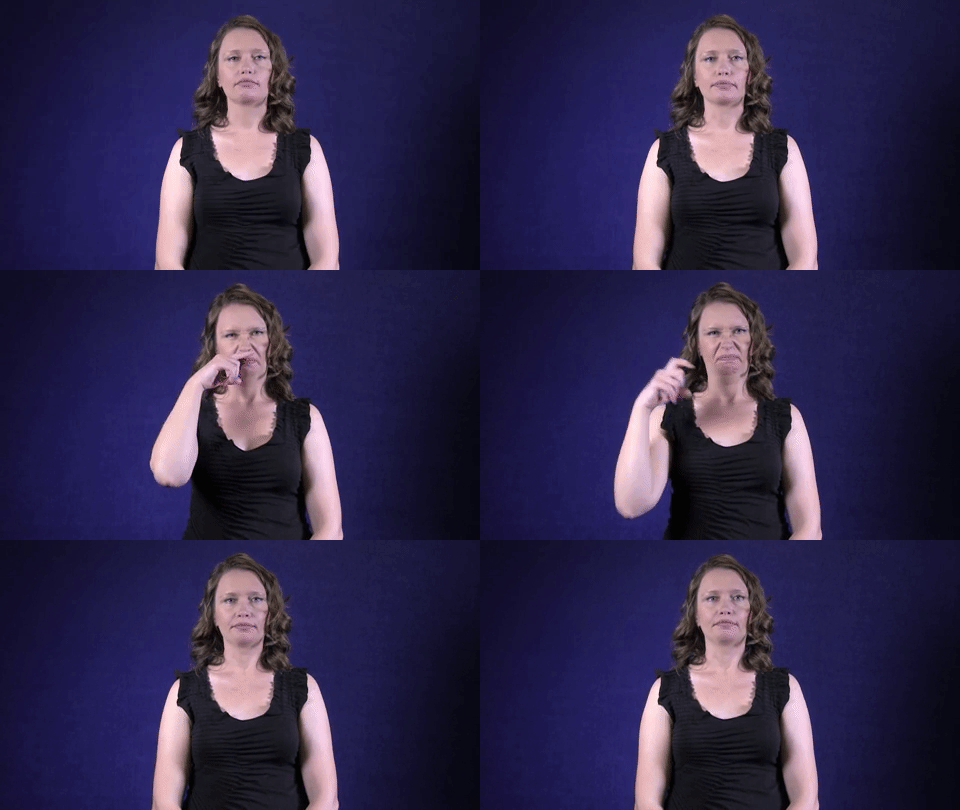
Sign for UGLY in ASL | ASL Dictionary

Definition: Unpleasant or repulsive, especially in appearance. Sign for UGLY in ASL
YouTube player

Practice Activities

To effectively learn the sign for UGLY in ASL, begin with regular mirror work. This helps you observe your own facial expressions, which are essential in American Sign Language. Since UGLY is often used with a specific non-manual signal—usually a squinted or scrunched facial expression—mirroring allows you to align your face and hand movements correctly. Record yourself signing the word in isolation and in sentences. Watching your playback lets you catch small errors in movement or facial expression that you might not notice in real time. Try signing full phrases like “That food was ugly” or “The weather looks ugly today” to build real-world fluency. Practice with a partner for feedback and natural conversation flow. Use the sign for UGLY in ASL during storytelling or descriptive exercises to reinforce vocabulary. You can also challenge yourself with speed drills, alternating between opposites like BEAUTIFUL and UGLY to build quick recall. Advanced learners can incorporate the sign into expressive narratives or ASL poetry. This pushes you to use the sign for UGLY in ASL with nuanced emotion, tone, and pace. You can also engage in receptive skills practice by watching ASL videos and identifying when and how the sign is used.

SEO Cultural Context

The sign for UGLY in ASL carries more than just a literal meaning—it reflects cultural perceptions and etiquette within the Deaf community. While the sign itself is widely understood across regions, tone and context are key. In Deaf culture, directness is common, but so is respect. Using the sign for UGLY in ASL should be approached with sensitivity, especially when referring to people. This sign is often used descriptively, not to insult, but to vividly convey a visual concept. For example, you might use it when describing a messy room, an unappealing meal, or a bad day. However, using the sign in reference to someone’s appearance should be handled carefully. Deaf culture emphasizes clarity and honesty, but also kindness and mutual respect. There can be slight regional variations in how the sign is executed. In most areas, the dominant index finger crosses the upper lip and pulls away while twisting, symbolizing a shift from neutral to negative appearance. In some regions, the motion might be more exaggerated or paired with a distinct facial expression. Understanding the cultural weight behind the sign for UGLY in ASL helps learners use it more appropriately. It’s not just about handshape and motion—it’s also about emotional tone and social context.

Extended Definition

The sign for UGLY in ASL is typically formed by placing your dominant index finger under your nose and then pulling it across the upper lip while transforming it into an “X” handshape. As the finger moves across, your facial expression should change to reflect distaste or unpleasantness. This sign is visually iconic, representing the idea of something turning sour or unattractive. This sign is not limited to physical appearance. It can also describe behavior, a situation, or an object. For example, a fight might be described as ugly, or a storm might be signed as ugly weather. The flexibility of the sign for UGLY in ASL makes it useful in a wide variety of contexts. Common errors include omitting the facial expression, which can change the meaning or render the sign unclear. Another mistake is using the wrong handshape—keeping the index finger extended too long or not transitioning into the “X” handshape can confuse viewers. Timing and coordination between hand movement and facial expression are essential. Related signs include DIRTY, GROSS, and BAD. While they share similar emotional tones, they are not interchangeable. Each sign has a specific meaning and context, and clarity is key to effective communication in ASL.

Tips for Beginners

If you’re just starting to learn the sign for UGLY in ASL, don’t be discouraged by the need for facial expressions. Non-manual signals are a core part of ASL grammar. Practice in front of a mirror to become more comfortable with expressing emotions visually. Avoid the common mistake of signing too quickly or without expression. Rushing can lead to unclear handshapes and missed facial cues. Take your time to form the sign with deliberate motion and coordinated expression. Use video resources to compare your signing with fluent signers. Pause and mimic handshape, motion, and face. Repetition is key. The more you practice the sign for UGLY in ASL, the more naturally it will come during conversation. Try pairing this sign with simple adjectives and nouns to build your vocabulary. For example, sign “ugly house,” “ugly shoes,” or “ugly feeling.” This helps you understand how the sign fits within ASL sentence structure. Remember, making mistakes is part of the learning process. Stay patient and consistent. Every time you use the sign for UGLY in ASL correctly, you’re reinforcing your fluency and building confidence in your expressive skills.

Connections to Other Topics

The sign for UGLY in ASL connects closely with other descriptive signs like BEAUTIFUL and PRETTY. Learning these opposites together helps solidify vocabulary and deepens your understanding of contrast in ASL grammar. Another related sign is DIRTY. While UGLY and DIRTY may seem similar in meaning, they are used differently. DIRTY is often used for physical cleanliness or metaphorically to express inappropriate content, whereas UGLY focuses on appearance or quality. The sign for BAD also shares emotional tone with UGLY. Comparing the signs for BAD, AWFUL, and UGLY can help learners refine their expressive choices and pick the most accurate term for a given situation. Facial expressions are critical in all of these signs, linking them through shared non-manual grammar. Practicing UGLY alongside other expressive signs allows learners to develop their ability to show emotion clearly and naturally. The sign for MONSTER or SCARY can also be taught in tandem. These signs often appear together in storytelling or descriptions of frightening or unattractive things. Learning them as part of a theme can make practice more engaging and memorable.

Lengthy Summary

Mastering the sign for UGLY in ASL involves more than memorizing a single motion. It requires understanding the visual, cultural, and emotional layers of the language. This sign uses a transformation of the index finger to an “X” handshape, combined with a strong facial expression, to communicate not just an idea but a feeling. The sign for UGLY in ASL is versatile, used to describe everything from a messy room to an unfortunate event. While it does include a physical motion, its full meaning only comes through when paired with the appropriate facial expression. This highlights the importance of non-manual signals in ASL grammar. Cultural context is essential. In the Deaf community, directness is balanced with mutual respect. While the sign for UGLY in ASL is commonly understood and used, it’s important to be mindful of how and when it’s used, especially in relation to people. Beginners can build confidence through consistent practice. Mirror work, video recording, and partner activities all support accurate and expressive signing. With time, learners will be able to use the sign naturally in conversations, descriptions, and storytelling. Connections to related signs like BEAUTIFUL, DIRTY, and BAD help enrich your vocabulary and understanding of expressive language. Together, these signs form a web of visual concepts that reflect human emotion and experience. As you continue your ASL journey, return often to signs like UGLY that challenge your expressive skills. Practice the sign for UGLY in ASL with purpose, and don’t be afraid to make mistakes. Each attempt brings you closer to fluency and a deeper appreciation for the richness of American Sign Language. Keep signing, keep learning, and keep growing . Synonyms: unattractive, unsightly, hideous, grotesque, unappealing Educational resources: Find related learning materials in our course bank! Want more? Check out some of our popular learning activities on the homepage! Need to look up a sign? Use our highly rated dictionary: https://aslinteractive.com/best-asl-dictionary/ Follow us on tiktok: https://www.tiktok.com/@aslinteractive. More social media links at the bottom of this page! Long-tail Keywords: Categories: tags: Appearance, Descriptions, Negative Traits, Emotions and Feelings, ASL Vocabulary

Want more? Check out some of our popular learning activities!

ASL Interactive Resources

ASLInteractive YouTube Channel

Follow us on tiktok: @aslinteractive.com

Follow us on Instagram: aslinteractive

Facebook page: aslinteractive

Facebook group: aslinteractive

LInkedIn: ASL Interactive LLC

Twitter: @ASL_interactive

*Some information on this page is AI-generated. AI can make mistakes. Please check the information.  

Responses