Practice Activities
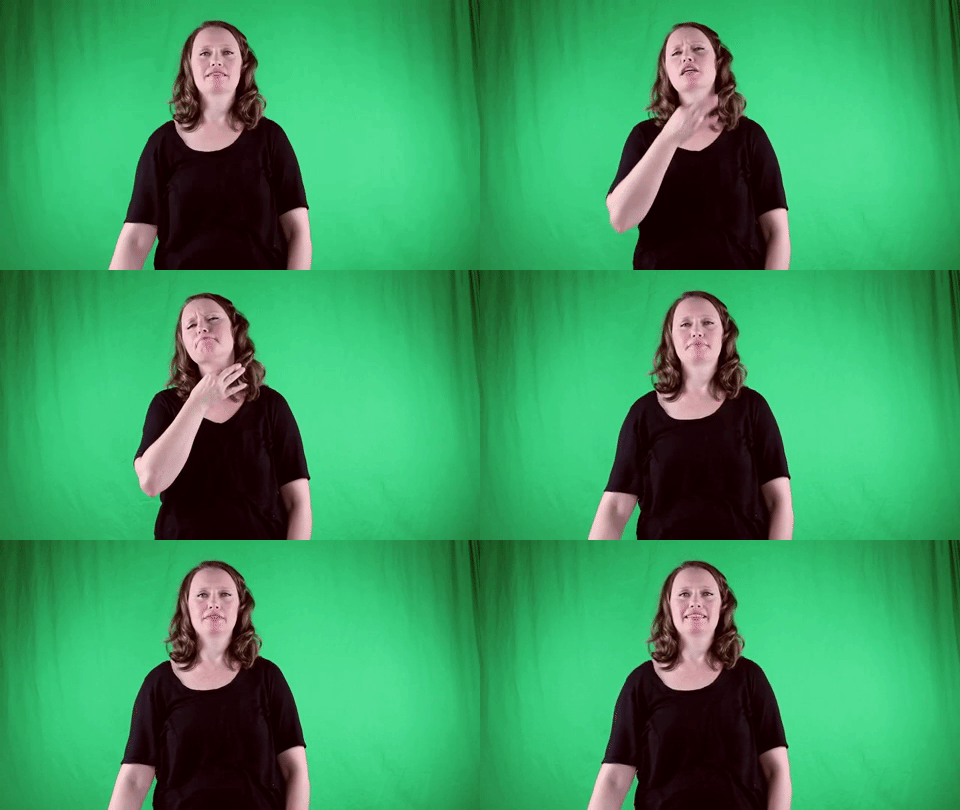
To build confidence using the sign for WONDER in ASL, start by practicing in front of a mirror. This allows you to check your facial expressions, which are critical in conveying the right tone. The sign for WONDER in ASL often includes a thoughtful or curious facial expression, so mirror work helps you coordinate hand movements with facial grammar. Record yourself signing the word in different sentences. For example, sign “I wonder what time it is” or “She wonders why he left.” Reviewing your recordings lets you identify consistency and natural fluidity. Use these videos to self-correct and track your progress over time. Practice real-life scenarios where the sign for WONDER in ASL is likely to occur. For instance, during storytelling, classroom discussions, or casual conversations, make a conscious effort to include the sign. This helps internalize its usage and improves your muscle memory. Advanced learners can challenge themselves with expressive drills. Try fingerspelling a question, then respond using the sign for WONDER in ASL within a full ASL sentence. This sharpens both receptive and expressive skills. You can also pair with a study partner to role-play scenarios that involve curiosity or uncertainty, such as solving a mystery or interpreting a puzzling situation.
SEO Cultural Context
In Deaf culture, expressing curiosity or internal thought processes is important for building deeper conversations. The sign for WONDER in ASL captures this sense of internal questioning and is often used when someone is pondering, speculating, or feeling uncertain. It is a visual doorway into a person’s thought process, making it a culturally rich sign. Facial expressions play a major role. When using the sign for WONDER in ASL, the eyebrows are usually raised slightly, and the eyes may look upward or to the side, mirroring the act of thinking. These non-manual markers are not optional—they’re essential for the sign to be clearly understood. There may be slight regional variations in how the sign is executed. Some communities may use a circular motion above the head with the index finger, while others may use a more subtle flick near the temple. Both are understood, but it’s always helpful to observe local usage to stay culturally respectful and accurate. Deaf signers often include the sign for WONDER in ASL when reflecting on events or thinking about the future. It’s also used in educational settings when asking students to think critically or analyze. This makes it a versatile and meaningful sign in both casual and formal contexts.
Extended Definition
The sign for WONDER in ASL generally involves making a small circular motion near the side of the forehead or temple using the index finger. This motion symbolizes the mental activity of wondering or speculating. The sign may be accompanied by a thoughtful facial expression to clearly convey the meaning. It’s important not to confuse the sign for WONDER in ASL with similar signs like THINK, QUESTION, or INTERESTING. While THINK and WONDER share a similar hand location near the head, WONDER includes a motion that signifies ongoing thought or uncertainty. QUESTION typically involves a question mark gesture and is more direct. Some learners mistakenly make the motion too large or place the sign too far from the face. This can lead to confusion, as location and movement are key features in ASL. The sign for WONDER in ASL should be controlled, clear, and paired with appropriate facial cues to be fully accurate. In compound or complex sentences, the sign can be used alongside other signs like IF, MAYBE, and SHOULD to express layered thoughts. For instance, “I wonder if I should go” combines the sign for WONDER with conditional grammar to express nuanced meaning. Understanding these layered expressions deepens your grasp of ASL grammar.
Tips for Beginners3>
If you’re just starting out, don’t worry about perfecting every detail right away. The most important part is understanding the concept behind the sign for WONDER in ASL. Think of moments when you’re genuinely curious or puzzled and try to reflect that feeling with your face and hands. A common beginner mistake is to use a flat facial expression while signing. Remember, the sign for WONDER in ASL loses its meaning without the proper non-manual signals. Practice raising your eyebrows slightly or looking thoughtfully to the side as you sign. Another tip for beginners is to watch fluent signers use the sign in real conversation. Observe how they time the movement with their facial expressions. Mimicking native signers helps you develop more natural and expressive signing habits. Don’t be discouraged if your sign doesn’t look exactly like the videos or models at first. Use slow-motion videos or ASL dictionary apps to break down the motion. Then, practice slowly and steadily increase your speed as you gain confidence with the sign for WONDER in ASL.
Connections to Other Topics
The sign for THINK is closely related to the sign for WONDER in ASL. Both involve the head area and represent cognitive processes, but THINK is more direct and static, whereas WONDER implies an ongoing or uncertain thought. Another related sign is CURIOUS. This sign often appears in conversations where someone is expressing interest or desire to know more. CURIOUS and WONDER are sometimes used together to convey deeper levels of intrigue or speculation. The sign for QUESTION is also connected. While QUESTION is used to directly ask something, the sign for WONDER in ASL reflects internal questioning. Understanding the difference enhances your ability to express a full range of thought-related ideas. The conditional sign IF often pairs with WONDER. For example, “I wonder if it will rain” uses both signs to communicate a conditional curiosity. This pairing helps learners grasp how abstract thinking is conveyed in ASL grammar. Lastly, the sign for MAYBE is a useful companion. MAYBE and WONDER often appear together in speculative sentences—like “Maybe she will come, I wonder.” Learning how these signs interact strengthens your overall fluency and understanding of conceptual relationships in ASL.
Lengthy Summary
Mastering the sign for WONDER in ASL opens up a world of expressive possibilities. It allows you to communicate curiosity, speculation, and internal dialogue in a visually rich and culturally appropriate way. From everyday musings to complex philosophical thoughts, the sign is a key tool in the ASL vocabulary. Practicing consistently is essential. Use mirror exercises, video recordings, and real-life applications to make the sign second nature. Pay close attention to the role of facial expressions, as they are integral to the meaning of the sign for WONDER in ASL. Without them, your message could be misunderstood or seem incomplete. Understanding the cultural context is just as important as learning the motion itself. In Deaf culture, showing your thought process visually is a sign of respect and engagement. The sign for WONDER in ASL is more than just a gesture—it’s a representation of your cognitive and emotional presence in a conversation. As you build your ASL skills, recognize how the sign connects with other concepts like THINK, CURIOUS, and MAYBE. These connections help create a network of understanding that supports deeper communication. Learning how to combine signs into full, expressive sentences enhances your fluency and confidence. For beginners, the journey may include a few stumbles, but every practice session brings you closer to fluency. Don’t rush the process. Focus on clarity, intention, and expressive accuracy. The more you practice the sign for WONDER in ASL, the more naturally it will become part of your expressive toolkit. Keep practicing, stay curious, and keep wondering—because every time you use the sign for WONDER in ASL, you’re not just learning a language, you’re learning to think and communicate in an entirely new way. Synonyms: Curiosity, Marvel, Awe, Interest, Speculate Educational resources: Find related learning materials in our course bank! Want more? Check out some of our popular learning activities on the homepage! Need to look up a sign? Use our highly rated dictionary: https://aslinteractive.com/best-asl-dictionary/ Follow us on tiktok: https://www.tiktok.com/@aslinteractive. More social media links at the bottom of this page! Long-tail Keywords: Categories: tags: wonder, ASL feelings and emotions, ASL questions, abstract concepts in ASL, American Sign Language dictionary
Want more? Check out some of our popular learning activities!
ASL Interactive Resources
ASLInteractive YouTube Channel
Follow us on tiktok: @aslinteractive.com
Follow us on Instagram: aslinteractive
Facebook page: aslinteractive
Facebook group: aslinteractive
LInkedIn: ASL Interactive LLC
Twitter: @ASL_interactive
*Some information on this page is AI-generated. AI can make mistakes. Please check the information.
Responses