Definition: On the opposite side.
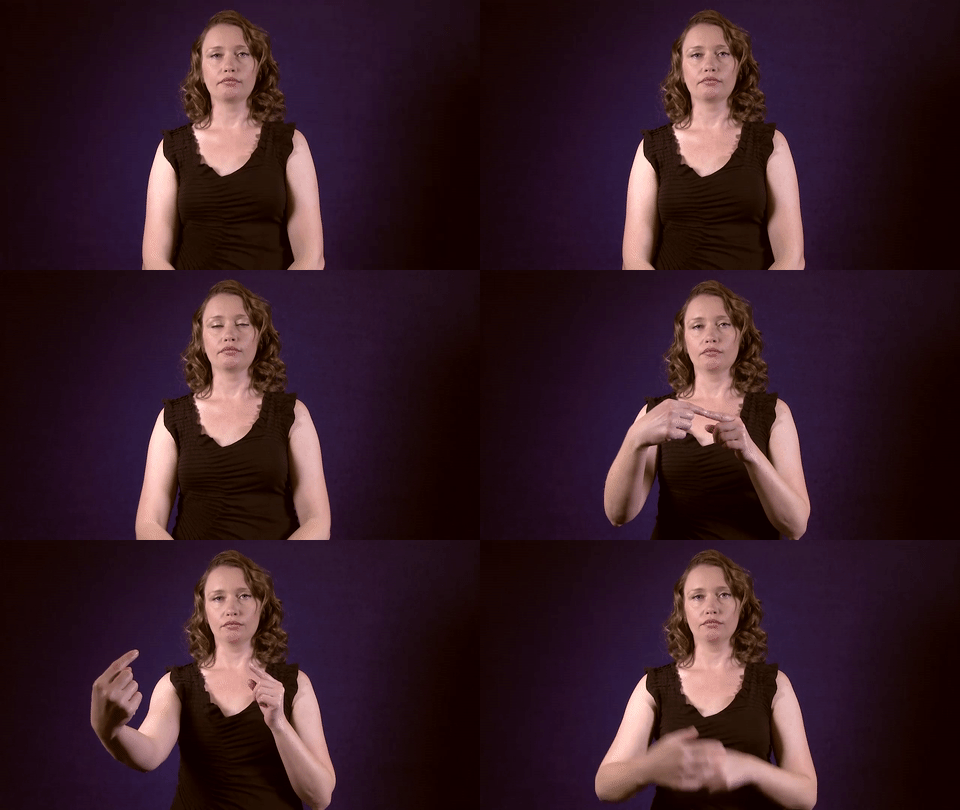
Sign for ACROSS FROM in ASL

Practice Activities:
Practice the sign for across from in ASL by signing it in front of a mirror. Start by holding your index fingers apart and then move one slightly away from the other as if showing two people facing each other. Repeat the motion smoothly to develop muscle memory.
Use the sign for across from in ASL with different nouns. Sign “ACROSS FROM” and then fingerspell or sign words like “store,” “school,” “park,” or “library.” This will help reinforce how to use it in practical conversation. Try creating three phrases describing real locations in your town.
Describe an imaginary neighborhood layout using ASL. Sign where buildings, houses, or landmarks are “across from” each other. For example, you might sign “My house ACROSS FROM the supermarket.” Challenge yourself to add more details each time you practice.
Partner with a friend and take turns describing a map or room setup using directions. One person signs a location, and the other must identify what is across from it. Use objects in the room and point to real-world examples while signing.
Create a short story using the sign for across from in ASL. Describe a situation, such as meeting a friend at a café that is across from the park. Include at least three different examples of things that are across from each other.
Go outside and find real examples of places that are across from each other. Sign and say them aloud, reinforcing the concept. For example, “The post office ACROSS FROM the coffee shop.” Practicing in real-life settings strengthens comprehension.
Watch ASL videos featuring directional signs and observe how native signers use spatial awareness. Imitate their placement and movement to improve fluency. Try incorporating additional directional signs like “NEXT TO” and “BEHIND” for a deeper understanding.
Cultural Context:
The sign for across from in ASL is commonly used to describe locations, directions, or spatial relationships. In American Sign Language, directional signs like the sign for across from in ASL help provide clear visual descriptions. This makes conversations about places and positions easier and more efficient.
When signing the sign for across from in ASL, facial expressions and body language can enhance clarity. ASL relies on visual and spatial communication, so using appropriate expressions strengthens the meaning. Understanding directional signs like the sign for across from in ASL is essential for clear and accurate conversation.
ASL is a unique visual language that conveys meaning through hand movements, facial expressions, and body positioning. The sign for across from in ASL is just one example of how spatial awareness plays a role in communication. Deaf and hard-of-hearing communities use these spatial signs naturally to describe relative locations.
Different ASL users may modify the movement or positioning of the sign based on context. The sign for across from in ASL may change slightly when referring to people versus buildings or objects. This flexibility makes ASL a dynamic and expressive language.
In Deaf culture, clear and direct communication is highly valued. The sign for across from in ASL helps ensure accurate descriptions in conversations about directions and locations. Context is crucial, and signing in a three-dimensional space allows for precise meaning.
Learning the sign for across from in ASL improves spatial awareness and signing fluency. It is a valuable term for giving directions or describing where something is located. Mastering this sign enhances conversations, especially when discussing navigation or positioning.
ASL learners benefit from practicing directional signs to become more confident in using space while signing. The sign for across from in ASL is a fundamental part of everyday conversations. Practicing with real-life examples can help reinforce understanding and accuracy.
American Sign Language depends on classifiers and non-manual markers to add detail. The sign for across from in ASL can be modified using classifiers to describe specific placements. Non-manual markers such as eye gaze or head movement further clarify the meaning.
ASL students can improve their communication by paying attention to how native signers use space to indicate locations. The sign for across from in ASL is an important term used frequently in discussions about geography, landmarks, and directions. Watching fluent signers demonstrate this sign can help learners grasp the correct movements.
Using ASL fluently involves understanding how spatial references work in signed conversations. The sign for across from in AS
Extended Definition:
The sign for across from in ASL is a useful directional sign that helps describe the location of objects or people relative to each other. This sign shows that something is positioned directly opposite or facing something else. It is commonly used when giving directions or explaining spatial relationships.
To sign across from in ASL, both index fingers start close together and then move apart in opposite directions. This movement represents two objects or people positioned across from one another. Facial expressions can add context, such as raising the eyebrows for a question or nodding slightly to confirm understanding.
The meaning of across from in ASL depends on the situation and the relationship between the two objects or people. It can describe locations in indoor and outdoor spaces, such as a table and a chair, two buildings, or two individuals facing each other. The sign helps make spatial descriptions clearer and easier to understand.
In conversations, the sign for across from in ASL is helpful for giving directions. For example, when explaining where a house is located, someone might indicate that it is across from a park or a store. This makes navigation and understanding directions more efficient in ASL communication.
Classifiers are often used alongside the sign for across from in ASL to give visual details about objects and their positions. Depending on the situation, handshapes can represent different types of structures or people to clarify the meaning. This improves the clarity of descriptions in signed conversations and storytelling.
This sign is a vital part of ASL spatial grammar and is commonly used in everyday interactions. It allows signers to describe locations quickly without extra words. Learning to use spatial concepts properly enhances fluency in ASL and makes communication more effective.
When teaching or learning ASL, practicing across from in ASL with real-world examples helps reinforce understanding. Signing about objects in a room, locations in a neighborhood, or seating arrangements strengthens ASL skills. Visualizing and physically demonstrating the sign make it easier to remember and use naturally.
Using across from in ASL with proper facial expressions and movement ensures clarity. A signer’s body language and eye gaze also contribute to accurate communication. These elements help in delivering precise descriptions and avoiding misunderstandings.
This sign is particularly useful in various settings, such as workplaces, schools, or social environments. Deaf and hard-of-hearing individuals often use it to discuss layouts, seating plans, or how things are organized. The ability to describe space accurately is an important skill in both personal and professional life.
Having
Synonyms: opposite, facing, in front of, directly across, confronting
Educational resources: Find related learning materials in our course bank!
Want more? Check out some of our popular learning activities on the homepage!
Need to look up a sign? Use our highly rated dictionary: https://aslinteractive.com/best-asl-dictionary/
Follow us on tiktok: https://www.tiktok.com/@aslinteractive. More social media links at the bottom of this page!
Long-tail Keywords: what is the sign for across from in ASL, how do you sign across from in ASL, ASL sign for across from
Categories:
tags: directions, prepositions, locations, spatial concepts, navigation
Parameters
*Handshape*:
The sign for ACROSS FROM in ASL uses index fingers on both hands, pointing toward each other. The dominant hand starts closer to the body, while the non-dominant hand remains stationary. The dominant index finger moves forward, passing the non-dominant finger, symbolizing movement from one side to another. This motion effectively conveys the meaning of “across” in spatial terms. The sign for ACROSS FROM in ASL is useful when describing locations or directions.
*Palm Orientation*:
The palm orientation for the sign for ACROSS FROM in ASL involves both hands in an upright position, with the index fingers extended. The palms face each other as the index fingers start close together and then move away in opposite directions. This movement represents the concept of distance or separation between two points, reinforcing the meaning of ACROSS FROM in ASL. The positioning of the palms remains neutral, ensuring clarity in the sign.
*Location*:
The sign for ACROSS FROM in ASL is located in the neutral space in front of the signer’s body. Both hands are generally placed near chest level, with index fingers pointing outward. The movement involves shifting one hand forward while the other stays in place, representing the idea of two things facing each other. This location helps convey the spatial relationship between objects or people in a clear and visual manner.
*Movement*:
To sign for ACROSS FROM in ASL, start with both index fingers extended, while the remaining fingers are curled into the palm. Position the fingertips of both index fingers so they lightly touch, facing each other. Then, move one hand slightly forward while keeping the other hand in place. This movement represents separation or opposition. The sign for ACROSS FROM in ASL visually conveys the concept of two things being opposite each other.
*Non-Manual Signals*:
When signing the sign for ACROSS FROM in ASL, maintain a neutral or slightly raised brow to indicate spatial relationships. Your eyes should follow the movement of your hands to emphasize the directional aspect. A slight head shift can help clarify the placement of objects or people in relation to one another. If emphasizing contrast or comparison, a brief pause or a subtle forward lean can add clarity. Keep facial expressions natural but purposeful.
*Prosody, Dominant/Non-Dominant Hand*:
The sign for ACROSS FROM in ASL uses both hands. The non-dominant hand is in a bent ‘B’ shape, palm facing inward and held steady in front of the body. The dominant hand starts in the same shape but positioned slightly behind the non-dominant hand. The dominant hand then moves forward past the non-dominant hand, illustrating the concept of something being across from another. This motion clearly represents spatial opposition.
Tips for Beginners:
When learning the sign for ACROSS FROM in ASL, focus on keeping your hand movements clear and controlled. The sign uses two index fingers pointing forward, starting side by side and then moving away from each other in opposite directions. Make sure the movement is smooth and symmetrical to indicate the concept of being across from something.
One common mistake is not maintaining a consistent hand shape throughout the motion. If the fingers bend or the hands lose alignment, it can confuse the meaning. Always keep your index fingers straight and ensure the movement is intentional and confident. Practicing in front of a mirror can help you refine your accuracy.
Hand positioning is essential because tilting too much can alter the sign’s meaning. Keep your hands at chest level and move them outward in a straight horizontal line. If the movement is too small or too exaggerated, the concept of being across from something might not be clear.
Facial expressions add context in ASL, so consider the scenario in which you’re using the sign for ACROSS FROM in ASL. A neutral expression works for describing locations, while slight emphasis in the eyes and eyebrows can indicate importance or contrast. Always ensure that your face complements the message you’re signing.
When using the sign in conversation, make sure to follow it with additional descriptors for clarity if needed. For example, signing ACROSS FROM and adding a directional point helps specify locations. Observing fluent ASL users will help you see how the sign naturally fits into everyday signing.
Practice signing in different contexts, like describing seating arrangements or buildings. Repetition builds muscle memory, making the motion feel natural over time. The more you incorporate the sign for ACROSS FROM in ASL into daily signing practice, the more fluid and confident your movements will become.
Connections to Other topics:
The sign for ACROSS FROM in ASL relates closely to spatial concepts, which are fundamental in ASL grammar. Many location-based signs rely on directional movement and hand positioning to convey meaning. For example, signs like NEXT TO, BEHIND, and IN FRONT OF use similar spatial relationships to indicate relative positioning. These spatial distinctions are important in everyday conversations, such as giving directions, describing room layouts, or explaining relationships between objects and people.
This sign also connects to classifiers, which play a major role in ASL description and storytelling. Classifiers can be used to show objects or people moving across from one another and can enhance the meaning of the sign for ACROSS FROM in ASL. For instance, a classifier representing a person can be placed on one side, while another hand shows movement across a space, reinforcing the concept non-manually. Mastering spatial concepts through classifiers helps ASL users build more visually rich and accurate descriptions in various contexts.
The concept of opposites is another related topic. The sign for ACROSS FROM in ASL can be linked to directional signs like OPPOSITE and FACE-TO-FACE. These signs are useful when discussing comparisons or contrasts, such as stating that two ideas, locations, or even beliefs are across from each other figuratively. This is important in academic and philosophical discussions, where ASL users may describe contrasting viewpoints.
Additionally, the sign is valuable in conversational and situational contexts that involve placement or seating arrangements. When discussing where two people are seated in a room or how buildings are positioned relative to each other, the sign for ACROSS FROM in ASL provides crucial spatial information. This makes it especially useful in discussions about maps, travel, and architecture, fostering clear and accurate communication.
Summary:
The sign for ACROSS FROM in ASL conveys a spatial relationship between two points, emphasizing separation with an implied connection. This sign is frequently used to describe locations, giving precise spatial information in conversations. It is often essential for navigation, directions, and describing where one thing is situated relative to another.
To produce the sign for ACROSS FROM in ASL, both hands are typically in a modified index finger or “1” handshape, positioned palm-down or at a neutral angle. One hand remains stationary while the other moves outward to indicate distance or opposition. The movement is subtle, showing a transition from one side to another, reinforcing the directional meaning.
This sign can vary slightly depending on the context, such as using facial expressions to indicate exact proximity. If discussing a very close location, a smaller movement may be used, while a broader movement can emphasize a greater separation. Signers often modify the sign’s movement to match the real-world relationship between the two referenced points.
In ASL, spatial relations are often visually mapped to reflect reality, which is why the sign for ACROSS FROM in ASL aligns conceptually with how space is perceived. This mapping allows signers to create a linguistic representation of the relative positioning of objects. It also helps in storytelling and explanations where clear spatial descriptions are necessary.
Grammar plays a crucial role in using the sign for ACROSS FROM in ASL correctly. Since ASL follows a topic-comment structure, the locations being referenced often appear earlier in the sentence. If talking about two buildings, for example, a signer might establish one with classifiers before using the ACROSS FROM sign to show their relationship.
Directional verbs are frequently combined with the sign for ACROSS FROM in ASL to provide additional meaning. For instance, if communicating that one person walked from one side to the other, a movement verb may follow, clarifying the transition. This integration of space and movement is a key feature of ASL’s expressiveness.
Facial expressions and non-manual markers complement the sign for ACROSS FROM in ASL to clarify intent. Raised eyebrows can indicate a question about location, while a squint might show a signer is focusing carefully on the spatial arrangement. These subtle modifications add layers of meaning, making ASL highly expressive.
The sign for ACROSS FROM in ASL is closely related to signs depicting spatial opposition, such as opposite, side-by-side, and near. Depending on the placement and movement, a signer can modify the concept to reflect different types of separation. Understanding these nuances enhances fluency and precision.
The cultural significance of the sign for ACROSS FROM in ASL is especially relevant in Deaf-friendly spaces such as schools, communities, and advocacy settings. Signing accurate location descriptions is vital for accessibility and safety. For instance, when providing instructions or emergency guidance, clarity in spatial relations is crucial.
Learning the sign for ACROSS FROM in ASL helps signers incorporate spatial descriptions naturally into their communication. Since ASL is a visual language, thinking about locations and relationships in three dimensions rather than linear sequence improves fluency. Using space effectively is a central part of becoming a proficient signer.
Many ASL learners initially struggle with spatial placement, but mastering concepts like the sign for ACROSS FROM in ASL builds confidence. Practicing with real-world locations, maps, or even drawn representations can strengthen understanding. Role-playing scenarios where one describes locations further reinforces retention of this important sign.
Linguistically, the sign for ACROSS FROM in ASL highlights ASL’s reliance on physical space to convey meaning. Unlike spoken English, where prepositions establish relationships through word order, ASL directly represents spatial configurations. This gives ASL a distinct advantage in communicating layouts more precisely than spoken languages.
Applied linguistics reveals how native signers instinctively integrate the sign for ACROSS FROM in ASL with other spatial terms. They do not consciously need to “translate” from English but rather think spatially, using classifiers and directional verbs fluidly. Studies of ASL fluency show that spatial references develop early among native signers.
For interpreters, correctly using the sign for ACROSS FROM in ASL ensures smooth communication when conveying spatial instructions. Misrepresenting spatial details can lead to confusion, making precision essential. Professionals in interpreting fields regularly practice visualizing space and reproducing it authentically in ASL.
The broader theme surrounding the sign for ACROSS FROM in ASL is the importance of spatial language in cognition. Research in cognitive linguistics suggests that people who use signed languages develop enhanced spatial reasoning skills. This is particularly useful in careers requiring strong spatial awareness, such as architecture or design.
ASL storytelling benefits from an accurate representation of space, making the sign for ACROSS FROM in ASL an essential tool. Narratives often involve characters and objects positioned relative to each other, requiring clear spatial distinctions. Skilled storytellers master spatial representation to bring their narratives to life.
In Deaf spaces
Want more? Check out some of our popular learning activities!
ASL Interactive Resources
ASLInteractive YouTube Channel
Follow us on tiktok: @aslinteractive.com
Follow us on Instagram: aslinteractive
Facebook page: aslinteractive
Facebook group: aslinteractive
LInkedIn: ASL Interactive LLC
Twitter: @ASL_interactive
*Some information on this page is AI-generated. AI can make mistakes. Please check the information.
Responses