
Definition: The entire day.
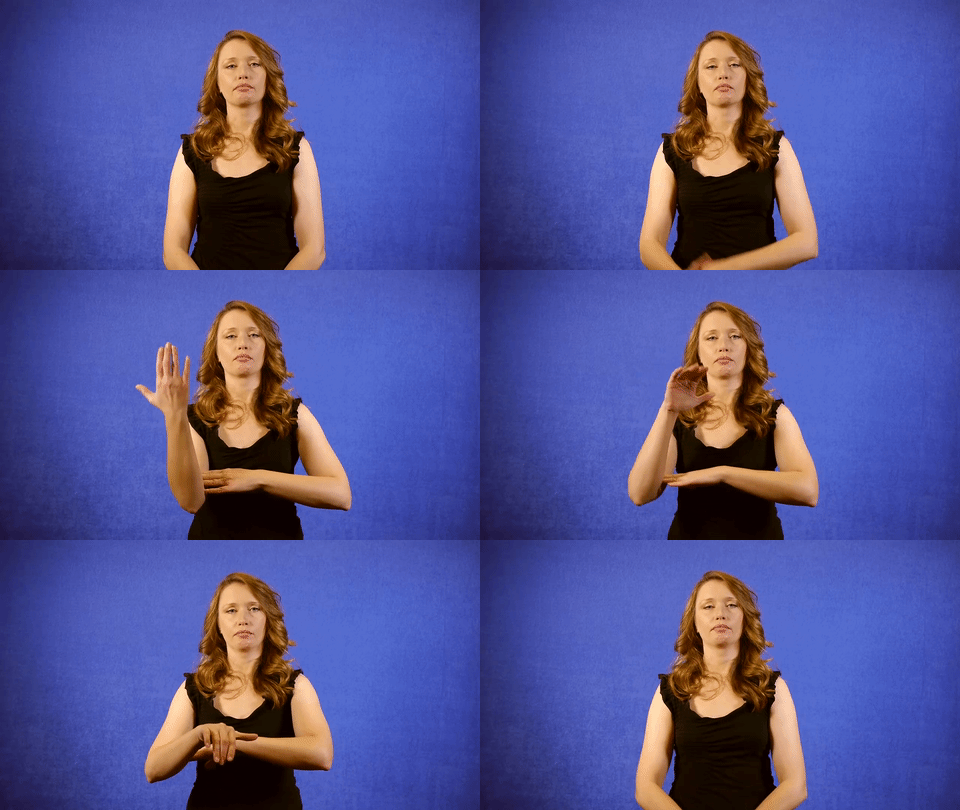
Sign for ALL DAY in ASL

Practice Activities:
To practice the sign for all day in ASL, start by signing it slowly and smoothly in front of a mirror. Pay attention to the movement of your dominant hand as it arcs across your non-dominant arm. Repeat the motion several times while saying “all day” in your head to build muscle memory.
Use the sign for all day in ASL in simple sentences. Try signing “I slept all day” or “We worked all day” while emphasizing the time reference. Create short personal stories where you describe a day-long event, such as a trip to the beach or a long study session. Practice retelling these experiences in ASL to solidify understanding.
Engage in interactive activities with a partner. One person asks a question like “How long were you at the park?” and the other responds using the sign for all day in ASL. Another fun exercise is to describe an event using multiple time-related signs like morning, afternoon, and all day to compare durations.
Sign along with everyday conversations by incorporating time signs naturally. Watch ASL videos or stories that use time-related expressions and pause to imitate the sign for all day in ASL. Record yourself signing different sentences and review them for clarity and fluency.
For storytelling practice, narrate a day-long adventure using ASL. Describe what happened throughout the day and emphasize the ending by signing all day to indicate duration. This can also be done as a group activity where each participant adds a new part to the shared story.
By frequently incorporating the sign into daily conversations, structured exercises, and storytelling, you’ll build confidence in using the sign for all day in ASL fluently and accurately. Keep refining your movements and enjoy the learning process.
Cultural Context:
In American Sign Language, the sign for all day in ASL is commonly used to express the passage of an entire day from morning to night. This concept is important in conversations about daily routines, work schedules, and special events. The sign for all day in ASL helps signers communicate the duration of activities without needing additional context.
Deaf culture places a strong emphasis on clear time references, making the usage of all day in ASL an essential part of storytelling and everyday conversations. Whether discussing a long road trip, a work shift, or a family gathering, this sign provides an easy way to indicate that something lasted throughout the entire day. Signers often pair this phrase with facial expressions to add emphasis or emotion.
The sign for all day in ASL is often used to describe lengthy periods of time in personal stories and narratives. Deaf storytellers use this sign to explain how long certain events took place, adding richness and detail to their communication. This makes it useful in both casual and formal ASL conversations where time duration is an important factor.
In educational settings, students learning ASL use the sign for all day in ASL when discussing school schedules or study habits. Teachers also introduce this sign early in ASL instruction to help learners understand how to express extended time frames effectively. Mastering this sign allows beginners to have more natural and fluent conversations.
In the workplace, the ability to use all day in ASL is valuable for meetings, deadlines, and work schedules. Deaf employees and interpreters rely on clear signs to convey how long a task or shift will last. This helps improve communication between Deaf professionals and their colleagues, ensuring clarity in discussions about time management.
Social interactions also frequently include the sign for all day in ASL when discussing fun activities such as shopping, festivals, or vacations. Friends and family members use the sign to describe long outings or full-day events. This makes it an essential part of conversational ASL when planning or recalling shared experiences.
The sign for all day in ASL can also be used to express emotions about a long period of time. Whether someone is tired after working all day or excited about an event that lasted for hours, facial expressions help convey the tone of the message. This reinforces the visual and expressive nature of ASL as a language.
Storytelling, an important tradition in Deaf culture, frequently incorporates all day in ASL to add time references to narratives. Personal experiences, historical accounts, and humorous anecdotes become more engaging
Extended Definition:
The sign for all day in ASL is a useful phrase to describe something lasting the entire day. This sign is commonly used in both casual and formal conversations in American Sign Language. Understanding how to correctly produce this sign will help improve fluency and comprehension.
To sign for all day in ASL, you start by placing your dominant hand in a flat position with the palm facing outward. Then, slowly move your hand in an arc from one side to the other, mimicking the movement of the sun across the sky. This motion visually represents the passing of time throughout the entire day.
Native ASL users often incorporate this sign into daily conversations to describe events, schedules, or the duration of an activity. You can use the sign for all day in ASL when talking about work, school, travel, or other prolonged experiences. It’s a versatile sign that enhances descriptions and helps clarify the length of time involved.
Facial expressions and body language are important when signing for all day in ASL. Slight modifications in expression can indicate whether the day was enjoyable, boring, or tiring. Expressing the right emotions alongside the sign helps convey the intended meaning clearly.
This sign is commonly used in conversations about routines and activities. For example, you might say you were outside all day, working all day, or studying all day. This makes it a practical and frequently used phrase in ASL.
When using the sign for all day in ASL in sentences, it’s often combined with other time-related signs for clarity. Adding signs for morning, evening, or specific activities can provide more context. This allows for more detailed descriptions of daily experiences and schedules.
Variations of this sign exist in different signing communities. Some signers may use a slightly different movement or handshape, depending on regional dialects. However, the general concept remains the same, making it easily understood across ASL users.
This sign is also useful for storytelling and narration in ASL. It helps to establish time frames in narratives and provides context for events. Using it effectively can enhance communication and storytelling skills.
As with many ASL signs, practice is essential to mastering the accuracy of the movement. Watching videos, practicing with a fluent signer, or using a mirror can help improve the execution of the sign. Repetition builds confidence and ensures correct usage in conversations.
Learning the sign for all day in ASL is a valuable addition to anyone’s ASL vocabulary. It allows for more fluent
Synonyms: throughout the day, the entire day, all day long, from morning till night, for the whole day
Educational resources: Find related learning materials in our course bank!
Want more? Check out some of our popular learning activities on the homepage!
Need to look up a sign? Use our highly rated dictionary: https://aslinteractive.com/best-asl-dictionary/
Follow us on tiktok: https://www.tiktok.com/@aslinteractive. More social media links at the bottom of this page!
Long-tail Keywords: what is the sign for all day in ASL, how do you sign all day in ASL, learn the ASL sign for all day
Categories:
tags: Time, Everyday activities, Language Learning, Verbs, Days of the week
Parameters
*Handshape*:
The sign for ALL DAY in ASL uses a flat ✋ handshape. The dominant hand starts near the dominant side and moves in a large arc, ending palm-down on the non-dominant arm, which is held horizontally. This movement represents the passage of time across a full day. The non-dominant hand remains stationary while the dominant hand moves smoothly, emphasizing the duration. This sign visually illustrates the concept of an entire day, making it easy to understand.
*Palm Orientation*:
The palm orientation for the sign for ALL DAY in ASL starts with the dominant hand in an open flat shape, palm facing outward or slightly upward. As the hand moves in a large arc from one side to the other, the palm remains in an open position, maintaining the outward orientation. This motion visually represents the passage of time across an entire day, reinforcing the meaning of the sign for ALL DAY in ASL. ☀️
*Location*:
The sign for ALL DAY in ASL takes place in the neutral space in front of the body. The dominant hand starts near the shoulder with the palm facing outward and moves in an arc downward until it rests in the non-dominant hand, which remains in a flat position. The movement represents the sun crossing the sky over the course of a day. This sign is typically done at chest level and moves smoothly across the signing space.
*Movement*:
To produce the sign for all day in ASL, extend your dominant hand flat with the palm facing sideways. Place the dominant hand’s fingertips near your non-dominant side and move it in an upward, circular motion, ending with the palm resting horizontally on your non-dominant hand. This movement represents the passing of a full day. The gesture is fluid and continuous, resembling the arc of the sun moving across the sky.
*Non-Manual Signals*:
When signing the sign for ALL DAY in ASL, maintain a relaxed facial expression unless emphasizing duration, in which case slightly raise your eyebrows or tilt your head. A small head nod may accompany the slow, sweeping movement of the dominant hand to indicate the passage of time. If emphasizing an extended period, you can purse your lips or slightly open your mouth as if saying “mm” to reinforce the meaning.
*Prosody, Dominant/Non-Dominant Hand*:
The sign for ALL DAY in ASL uses the dominant hand in a flat “B” shape, moving in a smooth arc from one side to the other. The non-dominant arm remains stationary, positioned horizontally as a reference point. As the dominant hand moves in a semi-circle, it symbolizes the passage of time from morning to evening. This movement visually represents the concept of something lasting the entire day. The sign for ALL DAY in ASL is fluid and expansive, emphasizing duration.
Tips for Beginners:
When learning the sign for ALL DAY in ASL, focus on smooth, controlled movement. Your dominant hand should start near the side of your head and make a slow, sweeping motion down to rest on your non-dominant arm, which is held horizontally. This movement represents the passage of time from morning to evening, so keeping it fluid is important for clarity.
Beginners sometimes rush the movement or make it too stiff, which can make the sign unclear. Practice keeping a steady pace and ensuring that your dominant hand moves in a semi-circular motion rather than a straight line. Watching native signers can help you refine the motion and make it more natural.
Proper hand placement is crucial when signing ALL DAY in ASL. If your non-dominant arm is too low, the meaning may be lost or confused with similar signs. Keep your non-dominant arm stable and horizontal while moving the dominant hand smoothly.
Maintaining facial expressions that reflect the intended meaning can reinforce the sign. If you’re referring to a long, exhausting day, a tired expression adds depth to your signing. In contrast, if you’re talking about a relaxing all-day event, a neutral or happy expression will complement the sign effectively.
As you practice, use a mirror or record yourself to check for accuracy. Pay attention to the movement arc, hand positioning, and your overall flow. Practicing in front of fluent signers or receiving feedback from instructors can also help you master the sign for ALL DAY in ASL.
Connections to Other topics:
The sign for ALL DAY in ASL connects to other time-related vocabulary, such as MORNING, AFTERNOON, and NIGHT. These signs all describe periods of the day and help communicate events in a chronological sequence. The sign for ALL DAY in ASL is similar in movement to the sign for ALL NIGHT, but the latter moves downward rather than across, showing the passage of time from evening to morning.
This sign is often used in combination with concepts like WORK, SCHOOL, or SLEEP to indicate extended durations. For example, signing WORK followed by the sign for ALL DAY in ASL expresses the idea of working the entire day. Similarly, combining STUDY with this sign conveys that someone studied throughout the day without breaks.
The sign for ALL DAY in ASL is also useful when discussing habits or activities that last for long periods. It can modify other signs, reinforcing the idea of duration. For example, signing RAIN followed by this sign shows that it rained continuously all day, as opposed to short periods of rain. This structure allows for natural expressions of time and duration in ASL.
Concepts related to time, such as FOREVER, ALWAYS, and ALL NIGHT, share similar elements with the sign for ALL DAY in ASL. The sweeping arm movement often indicates an extended period, providing a visual representation of time passing. Understanding these connections helps learners sign more fluidly and accurately express the length of events.
This sign also appears in storytelling and daily conversations, emphasizing long-lasting experiences. If someone wants to describe waiting for something or someone for many hours, they might use the sign for ALL DAY in ASL to strengthen the message. It enhances natural dialogue and provides clarity when discussing the duration of various activities.
Summary:
The sign for ALL DAY in ASL is a fluid and descriptive motion that visually represents the passage of time over the course of a day. To sign it, the dominant hand begins in a flat-B shape, with the palm facing sideways. The arm moves in a large arc, starting from one side and sweeping across the body horizontally toward the other side.
The movement of the dominant hand in the sign for ALL DAY in ASL mimics the apparent movement of the sun across the sky. This visual representation aligns with the way ASL often relies on conceptual imagery to depict time, actions, and spatial relationships. Because ASL is a visual language, signs that describe time are often linked to natural cycles.
This sign is closely related to the sign for DAY in ASL, with the primary difference being the length of the movement. While DAY typically has a shorter arc with a forearm resting on the non-dominant arm, ALL DAY extends the motion, symbolizing a full cycle from morning to night. This distinction helps clarify whether an event lasts a short or long duration.
When using the sign for ALL DAY in ASL in a sentence, context is crucial. The facial expressions and movement intensity may adjust depending on whether the signer is emphasizing a long duration or simply providing neutral information. A slower, exaggerated movement can indicate an unusually long or exhausting day, adding emotional nuance.
Grammatically, ASL often places time indicators at the beginning of a sentence. If someone wants to say, “I worked all day,” they might sign the time marker first, followed by the verb and subject. This structure helps establish chronological context before conveying the main action of the sentence.
The sign for ALL DAY in ASL embodies an efficient linguistic structure that eliminates the need for multiple English words. Instead of signing “morning to night” or “from sunrise to sunset,” ASL condenses the meaning into a single, sweeping motion. This principle of linguistic economy is a hallmark of ASL grammar.
In conversation, the sign for ALL DAY in ASL can be emphasized or modified with subtle non-manual markers. If someone wants to express extreme fatigue, they might pair the sign with a weary facial expression. Slight variations in signing speed or effort can subtly shift the tone of communication.
ASL’s syntax incorporates spatial awareness, and the sign for ALL DAY in ASL benefits from this feature. For example, incorporating directional motion or role-shifting can clarify how one’s experiences unfolded during the entire day. This ability to visually frame time makes ASL dynamic and expressive.
The cultural significance of the sign for ALL DAY in ASL extends beyond simple time measurement. In Deaf culture, storytelling is an important tradition, and time-related signs frequently create vivid settings. This sign allows storytellers to quickly establish the span of a full-day narrative while engaging the audience visually.
Because ASL is not a direct translation of English but its own distinct language, the sign for ALL DAY in ASL does not require the auxiliary verb “was” or prepositions like “for.” Instead, the sign alone conveys the concept succinctly. This difference highlights how ASL relies on a visual-spatial approach rather than linear sequencing.
Many time-related signs in ASL follow a thematic consistency related to natural cycles. For instance, WEEK follows a movement that visually represents a calendar structure, while MONTH slides down in a way that mimics measuring time. The sign for ALL DAY in ASL fits within this larger pattern of organizing time-based concepts through movement.
This sign is versatile and can be adapted for different contexts. Changing the non-manual markers can convey different moods, such as annoyance, exhaustion, or enjoyment. This reflects ASL’s efficiency, where emphasis is achieved through modifications rather than adding more signs.
In formal or academic discussions, the sign for ALL DAY in ASL may be useful when discussing historical events, work shifts, or nature’s cyclical patterns. In informal contexts, it often appears in everyday conversation when describing routines or particularly long days. This adaptability makes it a staple of ASL conversation.
The linguistic structure of ASL prioritizes clarity and efficiency, and the sign for ALL DAY in ASL exemplifies this by condensing a complex idea into a single, fluid motion. This reflects a broader principle of signed languages, which rely on movement, space, and conceptual imagery for communication.
The history of ASL’s development likely influenced signs related to time measurement. Early signers may have adapted natural gestures, such as pointing to the sky or mimicking the day’s progression. Over time, these gestures became standardized, forming the recognizable structure of the sign for ALL DAY in ASL.
Sign language linguistics reveal interesting insights into how the sign for ALL DAY in ASL functions differently from similar phrases in spoken languages. While spoken languages require tonal variations or adjectives to emphasize duration, ASL uses movement length and facial expressions to encode the same
Want more? Check out some of our popular learning activities!
ASL Interactive Resources
ASLInteractive YouTube Channel
Follow us on tiktok: @aslinteractive.com
Follow us on Instagram: aslinteractive
Facebook page: aslinteractive
Facebook group: aslinteractive
LInkedIn: ASL Interactive LLC
Twitter: @ASL_interactive
*Some information on this page is AI-generated. AI can make mistakes. Please check the information.
Responses