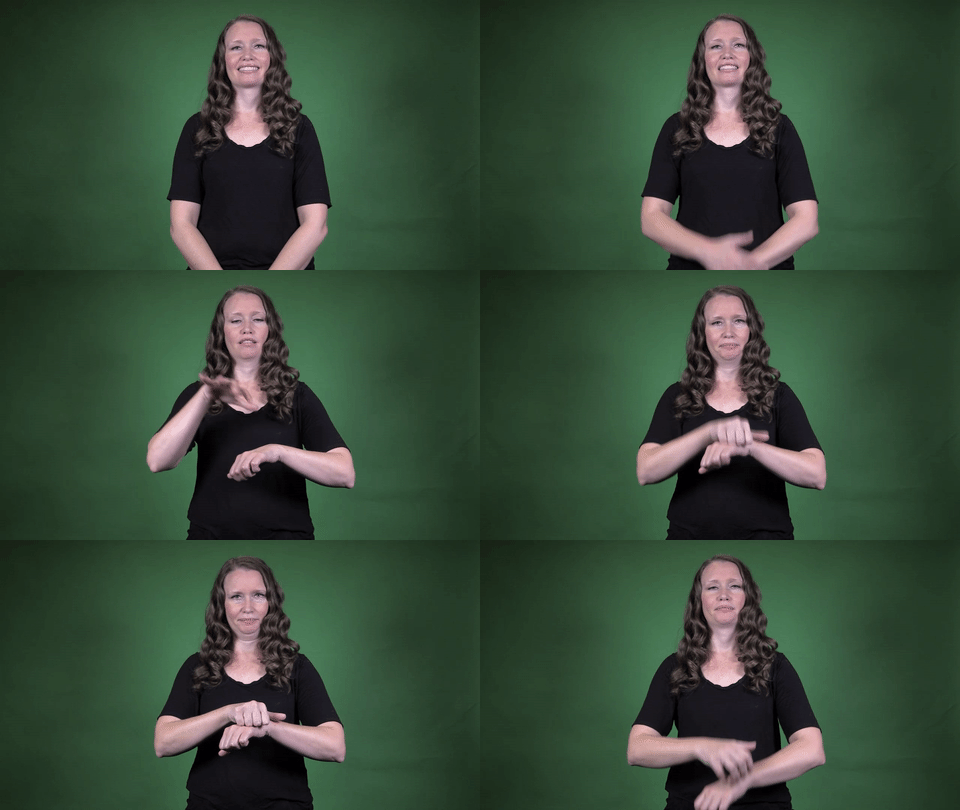
Definition: An arrangement to meet someone.
Sign for APPOINTMENT in ASL

Practice Activities:
To practice the sign for appointment in ASL, start by signing it repeatedly in isolation. Focus on maintaining smooth circular hand movements and proper placement of the dominant hand over the non-dominant fist. Try signing it slowly at first, then gradually increase speed while keeping clarity and precision.
Next, incorporate the sign for appointment in ASL into simple sentences to build fluency. Practice signing phrases like “I have an appointment tomorrow” or “When is your appointment?” Record yourself signing and compare your accuracy to reference videos or a mirror.
Create a storytelling exercise where you describe a day filled with different appointments. Explain where you need to go and at what time, using the sign for appointment in ASL naturally in the sequence. This will help reinforce its meaning within real-world contexts.
Pair up with a practice partner and role-play a conversation about scheduling an appointment. One person can take on the role of a receptionist, while the other tries to schedule an appointment for a doctor’s visit, a haircut, or a meeting. Exchange roles so both partners get equal practice.
For independent practice, watch signed conversations or vlogs where the sign for appointment in ASL appears. Take note of how signers use it in context and try mimicking their signing style and facial expressions. This will help reinforce natural usage.
Create a calendar or planner and use ASL to “talk through” your schedule. Sign about upcoming appointments using appropriate non-manual signals to show urgency, excitement, or delay. This will build fluency while making the practice relevant to daily life.
Finally, challenge yourself by signing full dialogues using appointment-related vocabulary, like time signs, days of the week, and locations. Engaging in interactive practice activities will deepen your understanding and natural use of the sign.
Cultural Context:
The sign for appointment in ASL is commonly used in both personal and professional contexts. Whether scheduling a doctor’s visit, a work meeting, or a social gathering, knowing how to use this sign correctly helps facilitate clear communication in the Deaf community. Mastering this sign ensures smoother interactions when discussing commitments and planned events.
In Deaf culture, time management and punctuality are highly valued. Using the sign for appointment in ASL shows respect for others’ schedules and commitments. It helps avoid miscommunication when discussing plans and setting up important events.
This sign is often used in conversations about work, healthcare, and social activities. For example, when scheduling an appointment with a doctor, dentist, or counselor, using the sign can clarify dates and times without confusion. It is also helpful in workplaces where scheduling meetings and conferences is a regular part of communication.
Learning the sign for appointment in ASL is especially important for interpreters, healthcare workers, and service providers. Many Deaf and hard-of-hearing individuals rely on professionals who understand basic ASL, including this essential sign. The ability to sign appointment can make interactions smoother and more inclusive for everyone.
Parents and educators also find this sign useful when teaching Deaf children about organization and scheduling. It helps children understand the concept of planning and keeping track of obligations. Reinforcing the sign in daily routines supports language development and time management skills.
Technology has also influenced how the sign for appointment in ASL is used. With video calls and online scheduling tools becoming more common, signing appointment clearly ensures accuracy in digital communication. This makes it easier to confirm commitments and avoid scheduling conflicts.
Understanding and using the correct placement, movement, and facial expressions when signing appointment helps ensure clarity. In ASL, facial expressions play a key role in emphasizing urgency or flexibility. Practicing the sign in different contexts helps improve signing fluency and comprehension.
By learning the sign for appointment in ASL, both Deaf and hearing individuals can foster better communication and mutual understanding. Whether in personal or professional settings, using this sign correctly strengthens connections and ensures smooth interactions. It is a valuable part of ASL vocabulary that enhances everyday communication.
Extended Definition:
The sign for appointment in ASL is a commonly used sign in American Sign Language to discuss scheduled meetings, set plans, and organize events. It is useful in both personal and professional settings, making it an essential vocabulary word for fluent communication. Understanding how to correctly produce this sign enhances clarity and ensures effective conversations in ASL.
To sign appointment in ASL, start by forming both hands into the letter “A” handshape. Then, circle the dominant hand over the non-dominant hand before placing it on top. This movement visually represents the idea of setting or scheduling something in place, reinforcing its meaning.
This sign is often used when discussing meetings, doctor visits, work schedules, or planned events. It helps people coordinate with others and express the necessity of being available at a specific time. Knowing the sign for appointment in ASL makes conversations smoother and eliminates confusion about scheduled commitments.
Context plays a vital role in how the sign is used in different situations. When signing about a professional meeting, facial expressions may indicate the level of importance or formality. If using the sign in a casual context, a relaxed facial expression helps match the conversational tone.
ASL emphasizes visual clarity, so practicing the correct movement and placement of the hands is crucial. Signing too quickly or with incorrect handshapes may lead to miscommunication. Observing native ASL users and practicing regularly can help improve fluency and accuracy with this sign.
Adding time indicators such as “tomorrow” or “next week” can help specify when an appointment is scheduled. The sign for appointment in ASL alone communicates the idea of a scheduled meeting, but combining it with a time-related sign adds precision. This method ensures that the conversation remains clear and well-structured.
Non-manual markers, including facial expressions or slight head nods, can add emphasis to the sign. For example, raising the eyebrows can indicate confirmation, while a questioning look might suggest asking if the appointment is still scheduled. These subtle elements help convey meaning effectively in ASL.
The sign for appointment in ASL differs from signs related to spontaneous gatherings or casual plans. Unlike signs for general meetings or get-togethers, the movement of this sign emphasizes something pre-arranged. Using the correct sign minimizes confusion and ensures that the intended message is clearly understood.
Learning ASL vocabulary related to scheduling, such as days of the week or specific times, can further enhance communication. Pairing the sign for appointment with other related
Synonyms: meeting, session, consultation, engagement, reservation
Educational resources: Find related learning materials in our course bank!
Want more? Check out some of our popular learning activities on the homepage!
Need to look up a sign? Use our highly rated dictionary: https://aslinteractive.com/best-asl-dictionary/
Follow us on tiktok: https://www.tiktok.com/@aslinteractive. More social media links at the bottom of this page!
Long-tail Keywords: what is the sign for appointment in ASL, how do you sign appointment in American Sign Language, ASL sign for appointment
Categories:
tags: Time, Appointments and Scheduling, Everyday Activities, Verbs, Events
Parameters
*Handshape*:
The sign for appointment in ASL uses both hands in distinct handshapes. The dominant hand forms an “A” shape, while the non-dominant hand also takes an “A” shape but remains stationary. The dominant hand moves in a circular motion above the non-dominant hand before settling on top of it. This sign visually represents the idea of scheduling or setting an appointment. The sign for appointment in ASL effectively conveys the concept of planning a set time for an event.
*Palm Orientation*:
The sign for APPOINTMENT in ASL uses both hands in a circular motion. The dominant hand, with the palm facing downward, moves in a circular motion above the non-dominant hand, which has the palm facing sideways or slightly upward. The dominant hand then closes into a fist as it makes contact with the back of the non-dominant hand. This movement represents the idea of setting aside time for an event or commitment.
*Location*:
The sign for appointment in ASL is produced in the neutral space in front of the body. The dominant hand moves in a controlled circular motion before coming to rest on the non-dominant fist. This sign is typically formed at chest height, ensuring clear visibility for the receiver. Keeping the hands within this neutral signing area helps maintain fluidity and clarity in communication.
*Movement*:
To perform the sign for APPOINTMENT in ASL, form both hands into the “F” handshape. Hold the nondominant hand steady in front of you with the palm facing inward. With the dominant hand, position it slightly higher and in front of the nondominant hand. Rotate the dominant hand in a small circular motion before bringing it down to gently tap the nondominant hand. This movement symbolizes scheduling or setting a time for a meeting or event. ⏳
*Non-Manual Signals*:
When using the sign for APPOINTMENT in ASL, maintain a neutral or slightly focused facial expression. Your eyebrows may lower slightly if posing a question related to scheduling, or your eyes may widen to indicate importance. Mouth movements can reflect emphasis, such as a slight pursing of the lips to signal seriousness ️. If expressing urgency, your head may tilt slightly forward. Keep eye contact to convey engagement when discussing a scheduled event.
*Prosody, Dominant/Non-Dominant Hand*:
The sign for APPOINTMENT in ASL uses both hands. The non-dominant hand is in a loose fist, positioned in front of the body with the palm facing down. The dominant hand, also in a fist, moves in a small circular motion above the non-dominant hand before landing on top of it. This movement symbolizes scheduling or setting a time. The sign for APPOINTMENT in ASL clearly conveys the concept of arranging a meeting or commitment.
Tips for Beginners:
When learning the sign for APPOINTMENT in ASL, focus on keeping the handshapes clear and the movement controlled. The sign uses both hands, with the dominant hand forming an “A” handshape and making a circular motion before landing on the non-dominant “A” handshape. Ensure that your motion is fluid but deliberate, emphasizing the natural downward connection to reinforce the concept of scheduling or reserving time.
One of the most common pitfalls beginners face when signing APPOINTMENT is making the circular motion too large or too fast, which can make the sign look unclear. Keep the movements small and precise to maintain legibility. Another mistake is not bringing the dominant hand directly onto the non-dominant hand in a clean motion—if your aim is off, the sign may appear sloppy.
Pay attention to your facial expression when using the sign for APPOINTMENT in ASL, as context matters. For example, if you’re making an urgent or important appointment, you might add seriousness to your expression. If it’s a casual appointment, a neutral look suffices. Sign language is highly expressive, and facial expressions enhance the meaning of the sign.
Practice in front of a mirror or record yourself to see if your movements are clear. Signing too stiffly can make your motions appear unnatural, so relax your hands and wrists. If you struggle with coordination, slow down and focus on each step before trying to increase speed.
Try using the sign for APPOINTMENT in ASL in daily conversations to reinforce retention. Ask a friend when their next appointment is or practice setting up mock scenarios. The more frequently you use the sign, the more natural it will feel, helping you build confidence and accuracy.
Connections to Other topics:
The sign for APPOINTMENT in ASL connects closely to the concepts of scheduling, commitments, and organization. This sign shares similarities with TIME, MEETING, and PLAN, which all relate to structuring events in the future. Many ASL users incorporate facial expressions or contextual signs to clarify whether the appointment is serious, mandatory, or casual.
This sign is also related to the signs for CALENDAR and SCHEDULE, both of which help describe time management. Knowing these signs allows for more precise conversations about appointments, making it easier to express when something is booked or available. Additionally, signs like REMIND and OBLIGATION further clarify how appointments function within daily routines.
In ASL, compound signs and phrases are often used to specify the type of appointment. For example, combining the sign for APPOINTMENT in ASL with DOCTOR, DENTIST, or BUSINESS helps clarify what kind of engagement is scheduled. These combinations reduce ambiguity and create a more fluid conversation.
Another connection is the relationship between the concepts of reservation and meeting. The sign for RESERVE can be used in situations where an appointment requires advance booking, such as a restaurant reservation. The sign for MEETING shares similarities with APPOINTMENT but often refers to gatherings of multiple people rather than one-on-one engagements.
Facial expressions and contextual clues help modify the meaning of an appointment in a conversation. A casual expression may indicate flexibility, while a more serious or stressed expression could indicate urgency. These non-manual markers are essential for making the discussion of appointments more natural and expressive in ASL.
Summary:
The sign for appointment in ASL is based on a movement that suggests gathering or securing something in place. To form the sign, both hands are shaped into the letter “A.” The dominant hand moves in a circular motion above the non-dominant hand before landing directly on top of it. This movement conveys the idea of setting something in position, which mirrors the concept of arranging a meeting or scheduling a time.
The sign for appointment in ASL captures the concept of making a commitment to meet at a scheduled time. The circular movement of the dominant hand reflects the idea of an arrangement being prepared before settling into place. This visual metaphor aligns with how appointments are decided upon before being officially set. The contact between the two hands serves to reinforce the idea of finalizing and securing something.
This sign is widely used in professional, medical, and personal settings where scheduling commitments is necessary. In contexts such as work or doctor’s visits, using this sign effectively conveys an expectation of structure and planning. In casual conversations, it can imply making plans with a friend or organizing a meeting. The consistent visual representation allows deaf and signing individuals to express commitments with clarity.
Grammatically, the sign for appointment in ASL functions as a noun, though its meaning can shift subtly depending on context. If signed with a slower, wider movement, it can emphasize the process of making an appointment rather than simply referring to one. Raising the eyebrows while signing it can indicate a question, such as “Do you have an appointment?” Adjustments in facial expressions and rhythm help convey varying shades of meaning.
The sign for appointment in ASL is related to other scheduling-related signs such as “schedule,” “meeting,” and “calendar.” The sign “schedule” visually represents an organized structure, often used when discussing planned events. “Meeting” involves a more dynamic motion, mirroring the gathering of people. The sign for “calendar” uses hand shapes that mimic the structure of a month grid, reinforcing concepts of time management.
Linguistically, the sign for appointment in ASL demonstrates the importance of iconicity, where the movement and handshape visually represent its concept. The use of circular motion followed by contact provides a physical analogy to the action of arranging something. Like many ASL signs, its efficiency allows for clear and concise conveyance of meaning without the need for additional words or markers. This showcases the language’s spatial and visual efficiency in communication.
Culturally, the concept of appointments is significant in both the Deaf community and the broader society. The ability to communicate scheduling efficiently is essential for doctor visits, business meetings, and personal interactions. Since Deaf individuals depend on interpreters or video relay services for many formal appointments, access to scheduling discussions is crucial. The sign for appointment in ASL plays a vital role in ensuring smooth communication in these contexts.
In the workplace, the sign for appointment in ASL is an important tool for professional interactions. Employers and employees using ASL rely on this sign to arrange times for meetings, deadlines, and work-related events. Understanding when and how to use this sign ensures smooth scheduling and coordination in professional environments. This reinforces the necessity of accessible communication systems for the Deaf community.
In medical and legal settings, being able to sign appointment clearly is essential for navigating structured consultations. Whether seeing a doctor, lawyer, or specialist, Deaf individuals need to communicate upcoming visits with ease. The healthcare system often depends on precise scheduling, making the ability to sign this concept accurately a crucial skill. Interpreters and ASL users frequently employ this sign to ensure appointments are set and understood correctly.
This sign aligns with broader themes of time management and personal responsibility. Commitments such as appointments structure daily life and impact productivity. When discussing future plans, this sign conveys the importance of keeping track of scheduled events. The ASL sign for appointment serves as a bridge between practical commitments and efficient communication.
The efficiency of the sign for appointment in ASL highlights the language’s ability to encapsulate meaning through movement. Unlike English, which relies on multiple words to describe the action of scheduling an appointment, ASL expresses the concept in one succinct motion. This visual and kinetic representation enhances understanding across different contexts. This is another example of how ASL visually streamlines complex ideas.
When modifying the sign, the speed and intensity of the movement can add nuance to meaning. A slow, deliberate motion can indicate a formal, structured appointment, such as with a professional. A quicker, informal motion might imply a more casual arrangement, such as meeting a friend. The subtle variations in movement allow for dynamic expression based on context.
Nonmanual markers also play a significant role in modifying the meaning of the sign for appointment in ASL. Raising the eyebrows and tilting the head slightly can form a question. Furrowing the brows can express frustration about a missed or forgotten appointment. These facial expressions add depth and specificity to the conversation.
The importance of time-based concepts in AS
Want more? Check out some of our popular learning activities!
ASL Interactive Resources
ASLInteractive YouTube Channel
Follow us on tiktok: @aslinteractive.com
Follow us on Instagram: aslinteractive
Facebook page: aslinteractive
Facebook group: aslinteractive
LInkedIn: ASL Interactive LLC
Twitter: @ASL_interactive
*Some information on this page is AI-generated. AI can make mistakes. Please check the information.
Responses