Definition: The expression or application of human creative skill.
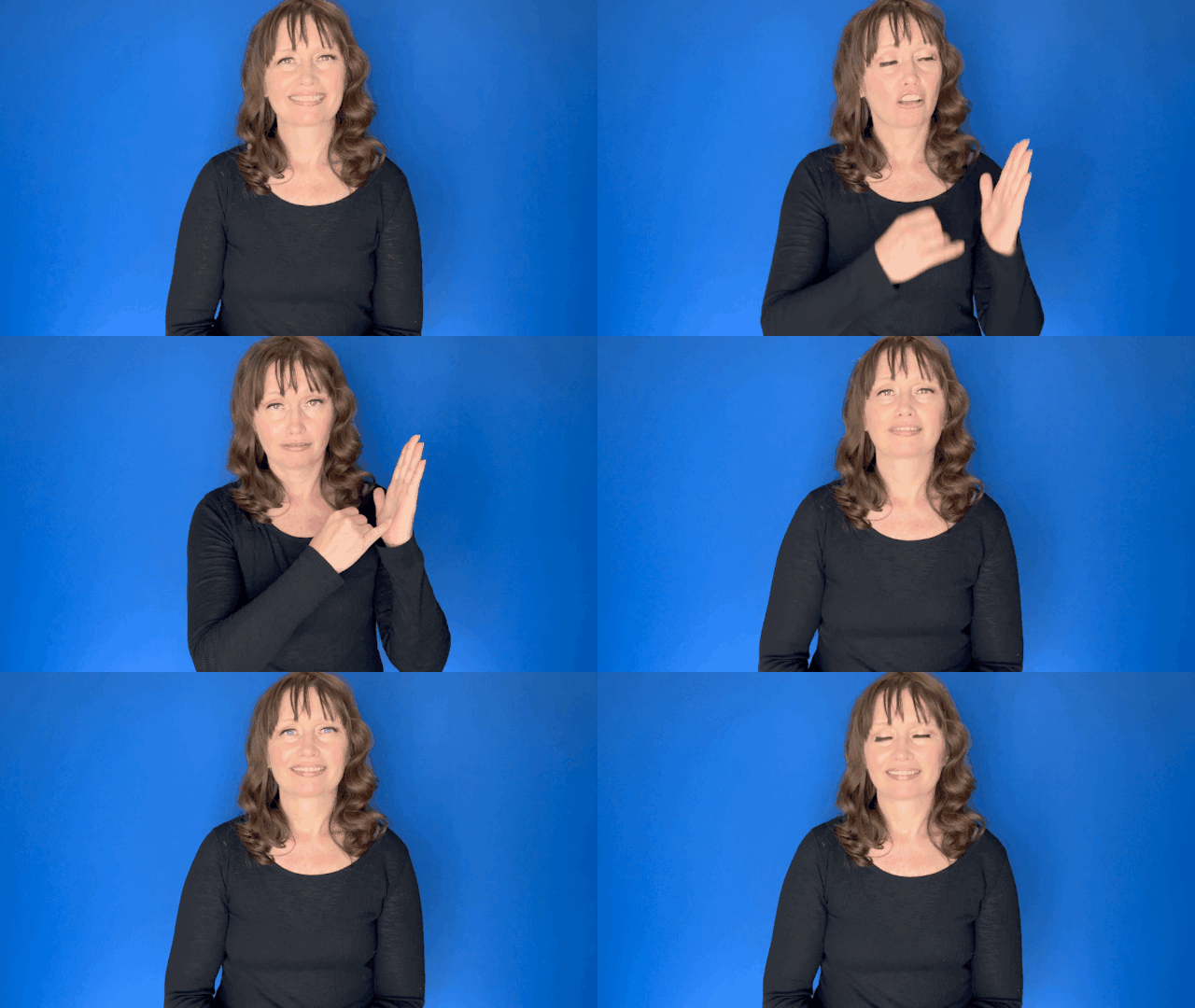
Sign for ART in ASL

Practice Activities:
To practice the sign for art in ASL, begin by signing it repeatedly in front of a mirror to check handshape and movement. Focus on making the dominant hand smoothly trace a curvy line down the non-dominant palm. Try using a slow, deliberate motion at first, then gradually increase your natural signing speed.
Use the sign for art in ASL in different contexts by forming sentences. For example, sign “I LOVE ART,” “ART CLASS FUN,” or “MY FRIEND GOOD AT ART.” Practice fingerspelling “art” before using the sign to reinforce recognition and recall. Record yourself signing these sentences and compare them with reference videos or mirror reflections.
Engage in storytelling by describing different types of artwork while using the sign for art in ASL. Talk about painting, drawing, or sculpture with a friend who also signs. You can say “I LIKE TO PAINT ART” or “MY SCHOOL HAS ART COMPETITION” and encourage the listener to respond with related signs.
Create a skit showing an artist at work. Pretend to hold a paintbrush or sculpt clay while incorporating the sign for art in ASL. Narrate your creative process using signs like “I MAKE BEAUTIFUL ART” or “ART TAKES TIME.” If practicing with a partner, take turns being the artist and the observer.
Play a guessing game where one person describes art-related objects using signs while the other tries to guess. Use supporting signs like “COLORS,” “DRAW,” or “CREATE.” This activity encourages fluency and expands your vocabulary while reinforcing the use of the sign for art in ASL.
Cultural Context:
American Sign Language is a rich and expressive language that reflects the culture and creativity of the Deaf community. The sign for art in ASL captures the essence of artistic expression through movement and visual representation. It symbolizes creativity, imagination, and the ability to communicate ideas through different artistic mediums.
Art has always held an important place in Deaf culture, from visual arts to performance arts like storytelling and poetry. The sign for art in ASL allows Deaf artists to express their passion, whether through painting, sculpture, or other creative forms. This unique sign embodies the idea that art is a universal language that transcends spoken words.
Deaf artists have contributed significantly to the world of fine arts, bringing attention to the beauty of visual storytelling. The sign for art in ASL connects to this rich history, emphasizing the importance of artistic identity within the Deaf community. From galleries to community events, Deaf artists use sign language to share their unique perspectives with the world.
Theater and performance art play a vital role in Deaf culture, using visual storytelling to create powerful and expressive works. The sign for art in ASL represents not just traditional art forms but also dance, drama, and digital art. These expressive arts play an essential role in communicating experiences, emotions, and perspectives in a way that resonates with both Deaf and hearing audiences.
Signed poetry and storytelling are art forms that have developed uniquely within the Deaf community. The use of movement, facial expressions, and handshapes brings stories to life in ways that spoken languages cannot replicate. The sign for art in ASL reflects this visual and kinetic creativity, emphasizing the role of sign language in artistic expression.
Deaf art is deeply tied to themes of identity, culture, and the shared experience of being part of the Deaf world. Whether through paintings depicting Deaf history or performances that explore Deaf struggles and triumphs, the sign for art in ASL connects these creations to the community. Art serves as a way to preserve Deaf heritage and educate others about Deaf culture.
Technology has also expanded opportunities for Deaf artists to showcase their work globally. Digital art, social media, and virtual exhibitions allow Deaf creators to share their talents beyond physical spaces. The sign for art in ASL continues to evolve, adapting to new forms of artistic expression while staying rooted in cultural tradition.
Learning the sign for art in ASL is not just about vocabulary; it’s about understanding the value of creativity in Deaf culture. It opens doors to appreciating Deaf artists, supporting their work,
Extended Definition:
The sign for art in ASL is a visually expressive movement that represents creativity and artistic expression. This sign is commonly used by Deaf and hard-of-hearing individuals to describe various forms of artistic work, including painting, drawing, and other visual arts. It is an essential part of American Sign Language, helping to convey the concept of art in everyday conversations.
To sign for art in ASL, the dominant hand typically moves in a flowing motion over the non-dominant hand, mimicking the action of an artist’s tool on a canvas. The way this sign is performed can vary slightly depending on regional signs or personal signing styles. Understanding this sign allows for clearer communication when discussing creative topics.
Art holds a significant place in Deaf culture, with a rich history of Deaf artists using various mediums to express their experiences. The sign for art in ASL helps connect individuals within the Deaf community to discussions about creativity, design, and personal expression. Using this sign correctly showcases respect for ASL and its visual storytelling power.
When learning the sign for art in ASL, it’s helpful to watch videos or practice with fluent signers. Using clear movements ensures that the sign is understood and accurately conveys the intended meaning. Practicing this sign along with other related vocabulary can improve fluency in ASL.
In educational settings, the sign for art in ASL is frequently used in classrooms, workshops, and discussions about creativity. Teachers and students use this sign when talking about art history, techniques, and the creative process. It enables seamless communication in both mainstream and Deaf education programs.
Artists within the Deaf community often incorporate ASL and visual storytelling into their work. The sign for art in ASL allows artists and audiences to engage in meaningful conversations about creativity. By using this sign, individuals can recognize and appreciate the contributions of Deaf artists.
Exploring ASL vocabulary related to art can enhance discussions about different artistic styles and techniques. Learning how to sign related words, such as painting, design, and sculpture, can expand a signer’s ability to describe artistic concepts. The sign for art in ASL serves as a foundation for more detailed conversations about visual expression.
Using the sign for art in ASL is a great way to connect with the Deaf community and participate in conversations about creativity. Whether discussing famous works of art or personal projects, this sign plays a key role in communication. Practicing and using this sign in everyday interactions can deepen understanding and appreciation of ASL.
By incorporating
Synonyms: Artwork, masterpiece, creation, craft, composition
Educational resources: Find related learning materials in our course bank!
Want more? Check out some of our popular learning activities on the homepage!
Need to look up a sign? Use our highly rated dictionary: https://aslinteractive.com/best-asl-dictionary/
Follow us on tiktok: https://www.tiktok.com/@aslinteractive. More social media links at the bottom of this page!
Long-tail Keywords: what is the sign for art in ASL, how do you sign art in ASL, ASL sign for art
Categories:
tags: art in ASL, American Sign Language art, signing art vocabulary, ASL sign for art, learn art in ASL
Parameters
*Handshape*:
The sign for ART in ASL uses a dominant hand in the “I” handshape, with the pinky extended while the other fingers are curled into the palm. The non-dominant hand is open, palm facing inward, resembling a canvas. The dominant hand moves downward in a wavy motion across the non-dominant palm, mimicking the action of painting. This sign visually represents creativity and artistic expression.
*Palm Orientation*:
The palm orientation for the sign for ART in ASL involves the non-dominant hand being held steady with the palm facing sideways or slightly upward. The dominant hand, shaped in an “I” handshape, moves downward in a wavy motion as if drawing or creating a design. The palm of the dominant hand typically stays facing outward or slightly inward as it moves, mimicking the action of an artist painting or carving.
*Location*:
The sign for ART in ASL is typically produced in the neutral space in front of the body. The dominant hand moves downward in a wavy motion, mimicking the act of painting on a surface. The non-dominant hand is held in a vertical position to represent a canvas. This location helps convey the concept of creativity and artistic expression. Ensuring the correct placement enhances clarity and accuracy when using the sign for ART in ASL.
*Movement*:
Using your dominant hand, form the “I” handshape (with the pinky extended). Place the pinky side lightly against the open non-dominant palm, which faces upward. Move the dominant pinky in a wavy, downward motion across the palm, mimicking the flow of a brush on a surface. The sign for art in ASL represents creativity and artistic expression, visually suggesting the act of painting or drawing. Keep the motion fluid and natural.
*Non-Manual Signals*:
When using the sign for art in ASL, maintain a neutral or slightly focused facial expression . Depending on context, slight eyebrow movements can indicate emphasis or clarification. If explaining or describing, a gentle head tilt may be used. Eye gaze should follow the dominant hand’s movement to enhance clarity. Avoid exaggerated mouth movements unless needed for context. Keeping a relaxed posture while signing helps make the sign for art in ASL fluid and natural.
*Prosody, Dominant/Non-Dominant Hand*:
The sign for ART in ASL uses the dominant hand in an “I” handshape while the non-dominant hand is held flat, palm facing the body. The dominant hand moves downward in a small, wavy motion as if drawing or painting on the non-dominant palm. This motion represents creativity and artistic expression. The sign for ART in ASL visually conveys the action of creating visual artwork, making it an intuitive and effective representation of the concept.
Tips for Beginners:
When learning the sign for ART in ASL, focus on precise hand movements for clarity. This sign involves your non-dominant hand forming a flat palm while your dominant hand moves in a wavy motion as if painting on the surface. Ensure your dominant hand follows a smooth, flowing path rather than making rigid or choppy movements.
A common mistake beginners make is keeping their movements too small or hurried, which can make the sign unclear. Take your time to practice fluid motions so it resembles an artistic stroke. Keep your non-dominant hand steady, as a shaky base can make the sign harder to read.
It’s helpful to practice in front of a mirror to check hand positioning and movement. Watch experienced signers or ASL dictionary videos to refine your accuracy. Finger and wrist flexibility are key to making the gesture look natural. If your wrist feels stiff, try relaxing your hand before signing.
Context also matters when using the sign for ART in ASL. This sign typically refers to visual arts, so if you mean performing arts, you may need an additional qualifier. Expanding your vocabulary around related terms like “painting” or “drawing” can enhance communication clarity.
Be mindful of your facial expressions, as ASL relies on non-manual markers to add meaning. A neutral or slightly engaged expression fits well with this sign, while an enthusiastic face can emphasize passion for art. Practicing expressive sign language will help improve fluency overall.
Finally, repetition is key! Sign in different lighting conditions and angles to ensure visibility for your audience. By consistently practicing, you’ll build muscle memory and make the sign for ART in ASL look natural and confident in conversation.
Connections to Other topics:
The sign for ART in ASL connects to many creative and expressive themes, making it relevant to discussions about drawing, painting, design, and aesthetics. This sign is visually related to signs for PAINT and CREATE, both of which emphasize movement and handshape to represent artistic processes. Signing ART fluidly helps to differentiate it from more specific techniques like SKETCH or SCULPT, which may involve variations in handshape or motion to reflect specific forms of artistic work.
This sign is also frequently used when discussing different forms of ART, such as VISUAL ART, DIGITAL ART, or PERFORMING ARTS. When talking about an artist, the sign for ART can be compounded with the AGENT marker, creating ARTIST, which follows a similar structure as TEACHER or ACTOR. Variations in context may also involve combining ART with different action signs, like ART MAKE or LOVE ART, which help create more descriptive phrases about artistic skills and passions.
The sign for ART in ASL also connects to academic discussions, as it frequently appears in phrases about ART CLASS or ART SCHOOL. The sign for DESIGN incorporates similar motion patterns but utilizes a different handshape to indicate graphic or structured artistry. This relationship between ART and DESIGN highlights how ASL differentiates between fine arts and more technical creative disciplines, making terminology clear in educational and vocational settings.
ART can also be connected to discussions about self-expression, creativity, and imagination, which are key concepts in storytelling and cultural expression within the Deaf community. When describing different types of ART, classifiers are often useful to indicate size, texture, or movement, adding visual depth to ASL conversations. These connections make the sign for ART in ASL particularly useful for discussions ranging from hobbyist interests to professional careers in creative fields.
Summary:
The sign for ART in ASL is a visually expressive representation of creativity. It typically involves the dominant hand’s pinky finger moving down the non-dominant open palm, as if painting or carving. This motion conveys the essence of artistic creation, reflecting the act of drawing, designing, or crafting something by hand.
The dominant hand usually takes the shape of an “I” hand, with the pinky extended while the remaining fingers remain folded. The non-dominant palm faces inward or slightly tilted, representing a canvas or surface. This movement mimics an artist applying brushstrokes or carving a piece of work, encapsulating the core idea of artistic expression.
There are slight variations of the sign for ART in ASL based on context. Some signers modify the movement to emphasize different artistic modes, such as drawing or sculpting. Regional differences and personal styles can also affect the way the sign is executed, though the general concept remains intact.
The sign for ART in ASL is efficient because it is strongly iconic. The movement visually represents common artistic activities such as painting or sketching. ASL often incorporates such iconic representations to make meaning intuitive, which helps language learners grasp concepts quickly.
This sign can be modified to fit specific phrases, such as “graphic art” or “digital art.” To specify particular forms, signers may combine the base sign with other descriptive aspects. The adaptability of this sign aligns with ASL’s general tendency to create meaning through combinations and classifiers.
Grammatically, the sign for ART in ASL may be used as a noun to refer to the subject itself. However, when expressing “artistic” as an adjective, the sign may be paired with additional descriptive signs. For example, signing “ART CREATIVE” can indicate an artistic style or an imaginative approach.
The linguistic structure of the sign for ART in ASL links directly with how ASL classifies objects and activities. The motion is a classifier-based representation, where the moving pinky acts as a tool, demonstrating direct interaction with a surface. ASL frequently utilizes such classifiers to create visually-rich descriptions.
The concept of ART is deeply woven into Deaf culture, as visual expression plays a crucial role in communication. Deaf artists often emphasize strong visual storytelling, making the sign for ART in ASL particularly significant. This connection reinforces the powerful role of artistic representation within the Deaf community.
Many Deaf artists focus on themes of identity and communication in their artwork. Through paintings, sculptures, and digital media, they explore the intersection of Deaf experience and expression. The sign for ART in ASL is a gateway to these deeper cultural discussions.
De’VIA, or Deaf View/Image Art, is an artistic movement that directly incorporates Deaf cultural experiences. The representation of visual art within ASL reflects this emphasis on highly visual communication. Using the sign for ART in ASL within this context conveys both personal and collective identities.
When teaching ASL, instructors often use iconic signs like ART to highlight language acquisition principles. New learners benefit from signs with strong visual correspondence because they are easier to remember. This helps reinforce the relationship between ASL and spatial-visual cognition.
Sign variations for ART can also indicate specific art-related disciplines such as sculpture, painting, or digital design. These may be expressed by incorporating classifiers to describe shapes, tools, or artistic media. Such flexibility in ASL ensures detailed and nuanced descriptions of creative fields.
The sign for ART in ASL is also important when discussing education. Schools use this sign when referring to art classes, creative programs, or specialized fine arts curricula. Differentiating between fine art, graphic design, or performance art sometimes requires additional clarification beyond the base sign.
ASL poetry and performance art elevate visual storytelling within the Deaf community. Many Deaf artists incorporate signed performance into their expression, strengthening the link between language and creativity. The use of space, body movement, and classifiers parallels traditional artistic techniques.
Historically, manual representations of art have existed in various sign languages around the world. The sign for ART in ASL shares similarities with other visual representations across different signed languages. This connection reinforces the idea that visual languages naturally adopt expressive methods to represent artistic creation.
In a broader linguistic sense, the cognitive process behind signing ART reflects ASL’s rich use of spatial awareness. The way the pinky moves along the palm suggests a form of embodiment in communication. This further supports research linking sign language to visual-spatial thinking.
Related signs like DRAW, PAINT, and CREATE share conceptual similarities with ART. These signs often employ classifier-based motions, demonstrating how ASL describes artistic processes. Each variation highlights the specific techniques or methods used in making artistic creations.
Applied linguistics explores how signs such as ART influence second language acquisition in ASL learners. The visual, mnemonic nature of the sign makes it an effective tool for classroom instruction. Research suggests that such iconic signs enhance comprehension in students learning ASL as
Want more? Check out some of our popular learning activities!
ASL Interactive Resources
ASLInteractive YouTube Channel
Follow us on tiktok: @aslinteractive.com
Follow us on Instagram: aslinteractive
Facebook page: aslinteractive
Facebook group: aslinteractive
LInkedIn: ASL Interactive LLC
Twitter: @ASL_interactive
*Some information on this page is AI-generated. AI can make mistakes. Please check the information.
Responses