
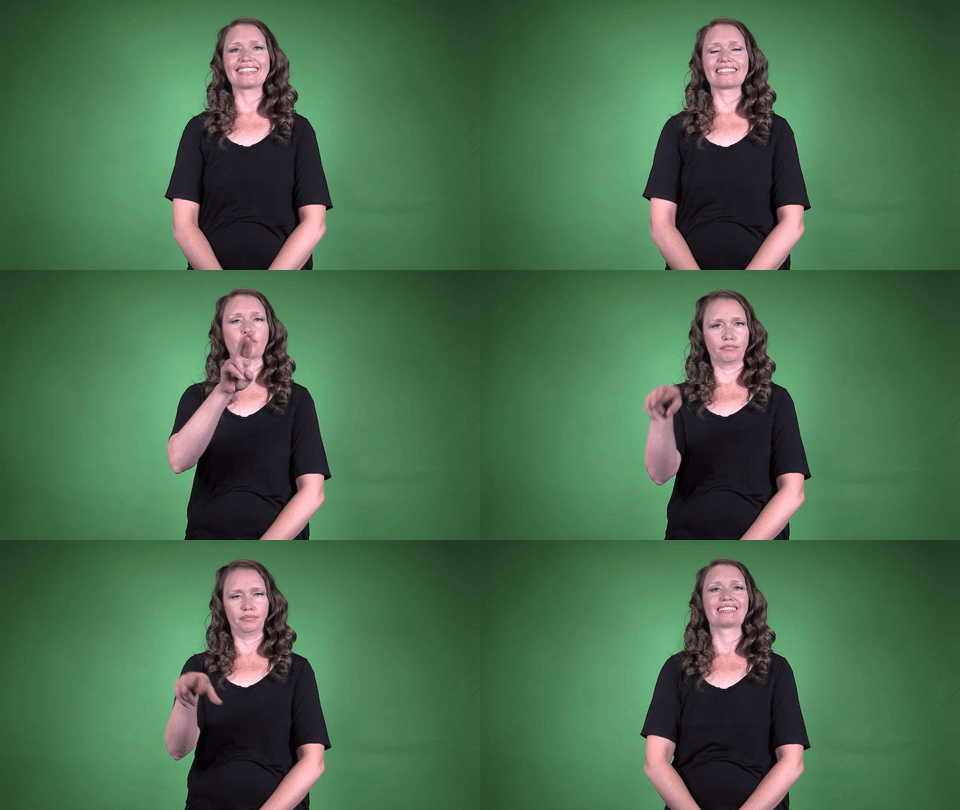
Definition: A room with a toilet and sink.
Sign for BATHROOM in ASL

Practice Activities:
Begin practicing the sign for BATHROOM in ASL by using it in isolation. Stand in front of a mirror and alternate between the correct dominant handshape (the letter “T”) and the correct wrist movement—shaking it side to side near your chest. Focus on maintaining a relaxed wrist while making the motion twice. Repeat this practice several times until it becomes fluid.
Next, incorporate the sign for BATHROOM in ASL into simple one-word responses. For example, pretend a friend asks you where the bathroom is and respond only with the sign. Practice this with a partner taking turns asking and answering the question nonverbally. Use facial expressions to show urgency, confusion, or politeness in different versions of the interaction.
Try expanding into complete ASL sentences. Use phrases like “WHERE BATHROOM?” “BATHROOM NEED ME” or “BATHROOM WHERE GO?” Record yourself signing these phrases and review them for accuracy in handshape and movement. You can also work with a peer to create short skits where one of you needs to urgently find a bathroom, and the other provides directions using location signs and gestures.
Storytelling is another great way to practice. Create a short narrative about being at a concert or a park and suddenly needing to find a bathroom. Incorporate signs for locations, people, and feelings, making sure to use the sign for BATHROOM in ASL multiple times. If possible, act out the story with facial expressions and directional signs for an immersive practice experience.
Looking around real-world environments for bathrooms provides daily practice opportunities. Point to actual signs in buildings and sign BATHROOM to reinforce the connection. This repetition in context will help you retain not just the form of the sign, but also when and how to use it effectively.
Cultural Context:
Understanding the sign for bathroom in ASL goes beyond just mastering a basic vocabulary word. In American Sign Language (ASL), cultural context plays a huge role in how signs are used and understood within the Deaf community.
The sign for bathroom in ASL is one of the most essential signs for everyday communication. Whether you’re navigating a school, restaurant, airport, or public space, this sign is crucial for asking where the facilities are. Because of its frequent use, it’s often one of the first signs taught to beginners and children learning ASL.
In Deaf culture, clarity and directness are highly valued. When using the sign for bathroom in ASL, there’s no need for long-winded explanations. A simple and clear sign is both respectful and efficient. Non-manual markers, such as facial expressions, also come into play. A polite but urgent look can suggest immediacy, especially in situations where finding a bathroom quickly is important.
Location and body language can help reinforce your message. If you’re in a crowded setting or trying to get someone’s attention from a distance, the sign for bathroom in ASL can be accompanied by a gentle wave or soft tap to alert the person. This is especially important because Deaf culture tends to avoid yelling or loud interactions and prefers visual or physical signals.
Teaching children the sign for bathroom in ASL helps encourage early independence. In schools with Deaf students or inclusive classrooms, the sign is regularly used during transitions or restroom breaks. Parents who learn the sign with their children also feel more connected and can support their child’s needs without the use of spoken language.
In public or professional settings, using the sign for bathroom in ASL demonstrates cultural awareness and inclusivity. For service workers, educators, and healthcare professionals, knowing signs like bathroom can significantly improve communication with Deaf individuals. It creates a more welcoming environment and shows that you value accessibility.
It’s also worth noting that the sign for bathroom in ASL has a regional consistency, making it recognizable across many parts of the United States. However, understanding that slight variations might exist due to local Deaf communities is key to respectful communication. In such cases, observing and adapting to the local version of the sign is encouraged.
The sign for bathroom in ASL is a great example of how a simple gesture carries important cultural and social context. It’s closely tied to personal autonomy, daily routines, and respectful interactions within the Deaf community. Watching how native signers use the sign in conversations or interpreting scenarios gives deeper insight into how it’s naturally used.
Whether you’re
Extended Definition:
The sign for bathroom in ASL is a common and essential part of everyday communication in American Sign Language. Whether you’re learning ASL for personal use, academic study, or professional reasons, knowing how to sign basic needs like bathroom is a priority. The sign is useful in conversations at home, school, or public places where expressing the need to use the bathroom quickly is important.
To make the sign for bathroom in ASL, hold up the dominant hand in the letter “T” handshape (with the thumb between the index and middle fingers) and shake it slightly side to side. This motion is simple but clear and easily recognizable among ASL users. Because this is a high-frequency sign, it’s important to use correct facial expressions and body language to help reinforce the meaning, especially in busy or noisy environments.
The sign for bathroom in ASL is sometimes interchangeably used with the sign for toilet, since they share the same motion and handshape. In many contexts, especially informal ones, the words bathroom and toilet are used similarly, and the ASL sign reflects this reality. However, in formal or healthcare settings, it’s often useful to clarify whether someone is asking for a restroom or needing medical attention related to the bathroom.
ASL is a visual language, and signs can slightly vary depending on the region, age group, or cultural background. That said, the sign for bathroom in ASL remains consistent across most ASL dialects, making it easily understood by the broader Deaf community. It’s one of the first signs taught to children and beginners because of how essential it is to daily living.
Teaching children the sign for bathroom in ASL can be a helpful part of early potty training. It gives them a non-verbal way to communicate their needs before they can speak fluently. Parents, guardians, and educators often use this sign regularly to reinforce communication and independence in young learners.
When using the sign for bathroom in ASL in a sentence, it can be combined with other basic signs like “where” or “go” to create simple but effective statements or questions. For example, someone might sign “bathroom where?” to ask where the restroom is located. This flexible usage makes the sign a great tool for navigating daily environments.
In environments like airports, hospitals, or schools, being able to quickly communicate the need to find a restroom can help reduce stress and prevent unnecessary confusion. For Deaf and Hard of Hearing individuals, having access to others who understand the sign for bathroom in ASL promotes
Synonyms: restroom, toilet, lavatory, washroom, powder room
Educational resources: Find related learning materials in our course bank!
Want more? Check out some of our popular learning activities on the homepage!
Need to look up a sign? Use our highly rated dictionary: https://aslinteractive.com/best-asl-dictionary/
Follow us on tiktok: https://www.tiktok.com/@aslinteractive. More social media links at the bottom of this page!
Long-tail Keywords: what is the sign for bathroom in ASL, how to sign bathroom in American Sign Language, what is the ASL sign for bathroom
Categories:
tags: Facilities and other locations/needs, Housing, Everyday activities, Chores, Describing Residence
Parameters
*Handshape*:
The handshape for the sign for BATHROOM in ASL uses the “T” handshape, where the thumb is placed between the index and middle fingers. This configuration resembles the ASL letter “T” and is essential for conveying bathroom, toilet, or restroom.
To produce the sign for BATHROOM in ASL, hold the “T” handshape in front of the body and give it a small side-to-side twist from the wrist. This twisting motion helps distinguish the sign clearly and consistently in everyday conversation.
*Palm Orientation*:
The palm orientation for the sign for BATHROOM in ASL involves the palm facing outward, away from the signer. The dominant hand forms the letter “T” handshape, and shakes side to side at about chest level.
This outward-facing palm remains consistent throughout the movement. When performing the sign for BATHROOM in ASL, make sure your fingers are upright and the thumb is positioned across the fingers, maintaining the “T” formation.
*Location*:
The sign for BATHROOM in ASL is typically made near the side of the body, slightly in front of the dominant shoulder. The handshape for this sign uses the letter “T” handshape, and the motion occurs at about chest level.
This location helps maintain visibility while ensuring the sign is easy to produce in a natural communication space. The sign for BATHROOM in ASL remains close to the torso without obstructing facial expression or sightlines.
*Movement*:
To make the sign for BATHROOM in ASL, form the hand into the letter “T” handshape by making a fist and placing the thumb between the index and middle finger. Hold the “T” handshape upright near the side of your dominant shoulder.
Then, shake the “T” handshape side to side slightly, about two to three times. This small back-and-forth motion is key to recognizing the sign for BATHROOM in ASL .
*Non-Manual Signals*:
Non-manual signals for the sign for BATHROOM in ASL typically include a neutral or slightly questioning facial expression, especially if used in a question like “Where is the bathroom?” Raise your eyebrows slightly to indicate a yes/no question and maintain eye contact with the listener.
The sign for BATHROOM in ASL is often used in contexts where location or urgency is implied, so your facial expression should match the context. Slight urgency or discomfort may be reflected with tightened lips or widened eyes. Use appropriate head movement or body shift to show the sign’s intent clearly.
*Prosody, Dominant/Non-Dominant Hand*:
For the sign for BATHROOM in ASL, use your dominant hand in the “T” handshape (fist with thumb between index and middle fingers). Hold the “T” hand in front of your body near the dominant side and shake it side to side lightly, similar to a twisting motion . The non-dominant hand is not used. The sign for BATHROOM in ASL is quick and intuitive, often used to ask for or give directions.
Tips for Beginners:
When learning the sign for BATHROOM in ASL, it helps to understand the context in which it’s used. The sign is made by forming the letter “T” from the ASL alphabet (a fist with the thumb between the index and middle fingers) and shaking it side to side at the wrist. This movement is similar to the way people wave to get attention, which makes it easy to associate with a commonly needed location.
For beginners, hand shape and wrist movement matter a lot. Make sure your “T” hand is clear and not mistaken for an “A” or “S.” If your thumb isn’t sticking out between the fingers properly, the sign can be misread or lost in communication. Keeping the motion subtle but deliberate helps reinforce clarity without being overly dramatic.
Practice in a mirror or film yourself signing to make sure your fingers are in the right position. Compare your video to trusted ASL resources or native signers. The sign for BATHROOM in ASL is often performed near chest level—not too high or too low—which is also important to keep in mind for visibility.
Many learners confuse this sign with the sign for “toilet” or assume they need to spell out the whole word. In casual conversation, the sign for BATHROOM in ASL often covers both meanings, so understanding cultural norms and regional variations can be helpful. Watch for non-manual signals like facial expressions to support meaning.
Lastly, remember that ASL is a full language with its own grammar and culture. Learning how to naturally incorporate the sign for BATHROOM in ASL into basic conversations will help you remember and use it effectively. Practice asking and answering questions using the sign in appropriate situations to build fluency and confidence.
Connections to Other topics:
The sign for BATHROOM in ASL typically involves shaking a “T” handshape, referencing the “Toilet” sign. This sign is foundational in everyday ASL and connects directly with common vocabulary used in locations like schools, public buildings, and homes. Because it conveys something essential to daily life, it often appears when teaching environmental or directional signs related to facilities.
This sign is closely related to the concept of location within ASL. Combining BATHROOM with directional signs, such as LEFT, RIGHT, or DOWNSTAIRS, creates compound phrases like “BATHROOM LEFT” or “BATHROOM DOWNSTAIRS,” which are helpful in providing guidance or navigating spaces. These compound structures mirror linguistic features in spoken English where prepositions are used to indicate place.
In conversation, the sign for BATHROOM in ASL may also appear in context with signs like EMERGENCY, NEED, or GO, producing such combinations as “NEED GO BATHROOM” or “EMERGENCY BATHROOM,” conveying urgency. It demonstrates how ASL efficiently builds new meanings through juxtaposition of core vocabulary rather than distinct conjugation or syntax rules.
The sign also connects to signs for hygiene and self-care, such as SHOWER, TOILET, WASH, or CLEAN. It often shows up in routines or schedule-related dialogues, indicating practical daily events. Because of this association, it’s an excellent vocabulary target when discussing morning routines, procedural tasks, or giving instructions.
Since the sign for BATHROOM in ASL is a common, everyday term, it also helps learners understand classifiers and non-manual signals when used with expressions of urgency or humor. These connections reveal how even basic vocabulary forms the backbone of fluent, expressive signing, bridging internal states, physical locations, and time-related contexts .
Summary:
The sign for BATHROOM in ASL is closely tied to both everyday communication and cultural interactions in Deaf spaces. In its most common form, it is made by forming the dominant hand into the letter “T”, and then shaking it side to side slightly at about shoulder height. This derives directly from the fingerspelled word for “toilet”, creating a practical and recognized sign rooted in fingerspelling origins.
The handshape used in the sign for BATHROOM in ASL mimics the ASL alphabet letter “T”, where the thumb is positioned between the index and middle fingers, forming a precise and distinct symbol. When shaken side to side, the motion evokes attention or a question-like gesture, helping convey the concept effectively. This single motion and handshape work together to establish clarity and efficiency in communication.
Grammatically, the sign for BATHROOM in ASL serves both as a noun and a question depending on facial expressions and body positioning. If the sign is made with raised eyebrows or accompanying body shifts, it can act as a question asking for the bathroom location. Without these non-manual markers, it simply names the room itself.
ASL relies heavily on context and non-manual signals to guide meanings. The sign for BATHROOM in ASL, when embedded in a sentence, can vary slightly depending on urgency, politeness, or formality. The sign remains the same, but facial expressions and pacing offer layers of meaning.
This sign is culturally rich because access to bathrooms in public and private spaces has often been a talking point in Deaf accessibility advocacy. Clear signage, visual alerts, and the ability to ask for a bathroom quickly and without confusion is crucial. The sign becomes part of inclusive interaction.
For children learning ASL, the sign for BATHROOM in ASL is often among the first signs they learn, due to its essential nature in daily routines. It empowers young signers with the ability to express basic needs independently. This builds early language confidence and promotes social autonomy.
Linguistically, the sign is an example of initialized signs in ASL, where the handshape corresponds to the first letter of an English-based word. Critics of initialized signs argue they reflect English interference, yet signs like this persist due to their clarity and efficiency. The practicality of using a letter shape often overrides theoretical purity for many users.
ASL differs from Signed Exact English, and while SEE may have signs that attempt to match English word-for-word, the sign for BATHROOM in ASL maintains economy and fluency in Deaf conversations. It exhibits ASL’s affinity for compact expression. With just one handshape and motion, the sign encapsulates a full idea.
Related signs include TOILET, which uses the same “T” handshape movement, and sometimes is used interchangeably or more formally in certain situations. The sign for BATH also appears in conversations about hygiene and health, though it uses a different motion involving scrubbing the chest with both “A” handshapes. BATHROOM connects more with location than the action.
From a spatial grammar perspective, users might index or point after signing BATHROOM to indicate a specific direction or room. This extends the linguistic idea of politeness and orientation with pragmatic information within ASL syntax. The spatial organization mirrors the real world layout in physical environments.
In teaching environments, the sign for BATHROOM in ASL is often paired with signs like WHERE, PLEASE, or EXCUSE. These combinations encourage polite expressions of need, especially for students or workplace settings. Social expectations are encoded right into the language through combinations like these.
Culturally, the sign provides access and dignity. Whether in an interpreted setting, medical appointment, or classroom, using the sign for BATHROOM in ASL allows for a discrete, clear, and direct communication tool. It often avoids the need for full voice requests or assistance.
In DeafBlind or tactile signing contexts, the sign for BATHROOM in ASL still uses the “T” handshape but may be tactually modified by different spatial orientation. The motion is still preserved which helps maintain its identity and recognizability. This adaptability showcases ASL’s visual and tactile flexibility.
In conversations about public facilities and design, the sign for BATHROOM in ASL becomes a symbol of meaningful access. Having the sign clearly labeled in public spaces, or having staff familiar with it, is increasingly seen in inclusive businesses. ASL signage in restrooms contributes to greater visibility and normalization.
Applied linguistics helps evaluate how quickly and effectively learners retain essential vocabulary like BATHROOM. Due to the frequency and functional value, retention rates are high once the context of use is understood. Learners often associate the sign with physical need, increasing memory scaffolding.
Neurolinguistic studies suggest signs associated with bodily functions or urgent needs are processed with stronger priority in both hearing and Deaf brains. This gives the sign for BATHROOM in ASL a form of neurocognitive
Want more? Check out some of our popular learning activities!
ASL Interactive Resources
ASLInteractive YouTube Channel
Follow us on tiktok: @aslinteractive.com
Follow us on Instagram: aslinteractive
Facebook page: aslinteractive
Facebook group: aslinteractive
LInkedIn: ASL Interactive LLC
Twitter: @ASL_interactive
*Some information on this page is AI-generated. AI can make mistakes. Please check the information.
Responses