
Definition: A close companion v2.
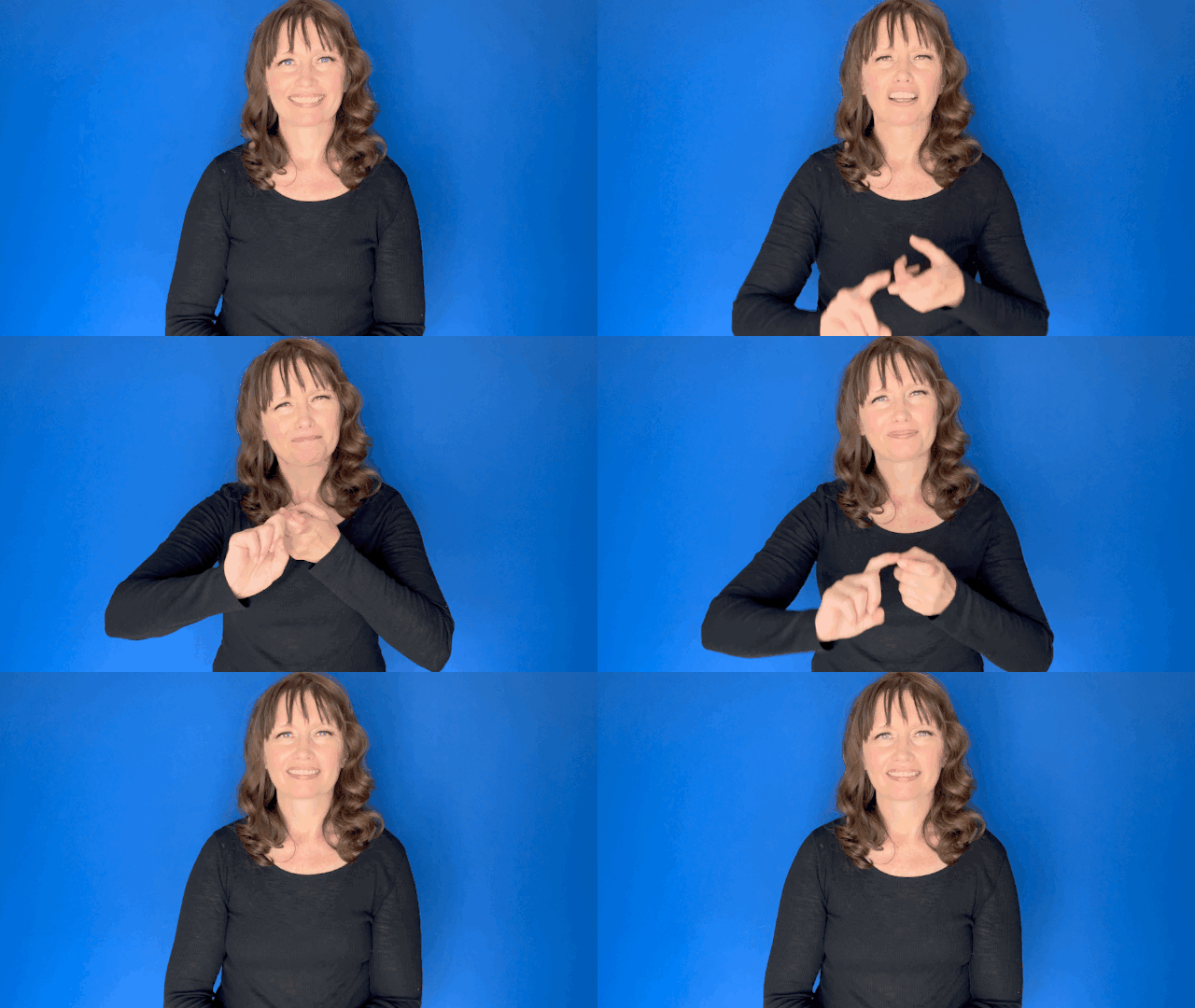
Sign for BEST FRIEND 2 in ASL

Practice Activities:
Start by practicing the sign for BEST FRIEND 2 in ASL in front of a mirror. Focus on your facial expressions and clarity of movement. Repeat the sign slowly and then at a conversational speed to develop fluency.
To apply the sign in context, create a list of your top three best friends and sign short sentences like, “She is my best friend,” “My best friend lives in Chicago,” or “I met my best friend in school.” This helps reinforce vocabulary and sentence structure while focusing on clarity and expression.
Next, use storytelling to deepen your understanding. Share a simple story about how you met your best friend. Use the sign for BEST FRIEND 2 in ASL throughout the story, and add supporting signs like MEET, SCHOOL, HAPPY, or TOGETHER. Record yourself and take note of consistency in handshape and placement.
Try a partner activity where one person asks, “Who is your best friend?” and the other responds with specific details using the sign. Then switch roles. This interaction helps build confidence in conversational use and recognizes how the sign fits naturally in dialogue.
Use flashcards or an app where you can view the sign for BEST FRIEND 2 in ASL and recall the meaning quickly. Time yourself to build speed while keeping movements deliberate.
For creative practice, draw or select a picture of you and a friend, then describe the moment in ASL using the sign. This combines visual memory with expressive skills for more advanced recall.
Lastly, watch Deaf creators or sign language videos that include the sign for BEST FRIEND 2 in ASL. Mimic their signing and try to follow along, pausing when needed. This offers authentic examples of the sign used in real-life contexts and provides a model to emulate .
Cultural Context:
The sign for BEST FRIEND 2 in ASL offers insight into how Deaf culture honors close personal relationships. In American Sign Language, signs can evolve and vary slightly depending on context, personality, and region. The sign for BEST FRIEND 2 in ASL reflects a different nuance or style than the first version, signifying the diversity and expressive richness of ASL.
In Deaf culture, friendships are highly valued, especially because communication plays such a central role in community building. The sign for BEST FRIEND 2 in ASL communicates not only the idea of a best friend but can also show emotional intensity or the history behind the bond. Signing this version with confidence and the right facial expressions makes it more meaningful.
The importance of recognizing nuanced signs like BEST FRIEND 2 in ASL goes beyond vocabulary. It reflects how ASL users express personal experience, affection, and even humor. Facial expressions and body movements often add deeper layers to the meaning, especially when distinguishing between different signs for the same English word.
ASL is more than just hand shapes—it’s also about the cultural context. The sign for BEST FRIEND 2 in ASL might be used among teens or in casual settings more than in formal introductions. Its usage reveals how language in the Deaf community often prioritizes emotional expression and social connection.
Deaf individuals might have life-long best friends with whom they share a unique visual language filled with personal signs and inside jokes. The sign for BEST FRIEND 2 in ASL can become one of those signs, used repeatedly in conversations, photos, and conversations through video chat or vlogs.
It’s common to see the sign for BEST FRIEND 2 in ASL paired with smiling or even playful facial expressions during storytelling. Sign language vloggers and creators often use this sign in their videos to talk about important people in their lives. This adds a layer of personality that’s hard to capture in only written or spoken words.
Variations in the sign for BEST FRIEND 2 in ASL can also reflect regional differences. Just like with spoken English, ASL has dialects, and terms of endearment like best friend may be signed differently in different Deaf communities. Being aware of these differences shows respect and a deeper understanding of Deaf culture.
Understanding the cultural meaning behind the sign for BEST FRIEND 2 in ASL helps learners become more fluent, not just in hand movements but in communicating respectfully and effectively in diverse social settings. It’s important to learn the sign and also practice the emotional delivery and non-man
Extended Definition:
The sign for BEST FRIEND 2 in ASL represents a close and special connection between two people. This version of the sign is often used to show a deeper or second level of best friendship. It’s a way to visually represent someone who is extremely important in your life, almost like family.
To perform the sign for BEST FRIEND 2 in ASL, you typically use a variation that builds on the standard BEST FRIEND sign. This version may incorporate different handshapes or movements to emphasize the unique closeness shared between best friends. Because regional and personal variations exist, you might see slight differences depending on the signer.
The meaning behind the sign for BEST FRIEND 2 in ASL goes beyond the literal. It expresses trust, loyalty, and shared experiences. Within the Deaf community, friendship holds strong value, and this sign communicates that strong emotional bond clearly and visually.
Using the sign for BEST FRIEND 2 in ASL shows a richer understanding of ASL grammar and cultural nuances. ASL isn’t just about direct word-for-word translation. It’s about conveying emotion, context, and relational depth through your hands, facial expressions, and body language.
When you use the sign for BEST FRIEND 2 in ASL in conversations, storytelling, or social interactions, it adds warmth and personality to your signing. Children and learners of ASL often enjoy using this sign when talking about the special people in their lives. It helps build both vocabulary and emotional expression.
You may see this sign used on social media, in educational videos, or even in songs interpreted in ASL. The flexibility of ASL allows signs like BEST FRIEND 2 to be adapted across different contexts while maintaining their emotional significance. It’s a beautiful part of expressive language in ASL storytelling.
The sign for BEST FRIEND 2 in ASL is great for learning about compound expressions in American Sign Language. It encourages users to go beyond the basics and explore how signing can reflect more complex ideas about relationships. This helps expand fluency and cultural awareness at the same time.
Learning how to sign best friend terms, including BEST FRIEND 2, is a great step for both beginners and advanced signers. Understanding how to use and interpret variations like BEST FRIEND 2 demonstrates respect for Deaf culture and communication styles. It also highlights the dynamic nature of ASL as a living language.
Whether you’re learning ASL for work, school , or personal growth, mastering different ways to express friendship can be empowering and heartwarming
Synonyms: close companion, trusted confidant, loyal friend, bosom buddy, bestie
Educational resources: Find related learning materials in our course bank!
Want more? Check out some of our popular learning activities on the homepage!
Need to look up a sign? Use our highly rated dictionary: https://aslinteractive.com/best-asl-dictionary/
Follow us on tiktok: https://www.tiktok.com/@aslinteractive. More social media links at the bottom of this page!
Long-tail Keywords: what is the sign for best friend in asl, how do you sign best friend in asl, asl sign for best friend
Categories:
tags: relationships, people, language learning, introductions, friendship
Parameters
*Handshape*:
The handshape for the Sign for BEST FRIEND 2 in ASL involves using both index fingers. Start with one index finger in an upright position, and hook it with the other index finger forming an “X”-like connection. This linked movement shows a strong bond, symbolizing the close relationship of best friends.
This variation emphasizes the closeness between two people in a visual, symbolic manner. The Sign for BEST FRIEND 2 in ASL relies on a simple but expressive configuration that clearly represents the concept of deep friendship.
*Palm Orientation*:
For the sign for BEST FRIEND 2 in ASL, the palm orientation starts with both hands in the index finger shape, also known as the “1-handshape.” One hand’s palm faces inward toward your body while the other hand forms a hooking motion around it, palm facing outward. This palm orientation supports the motion of linking fingers, symbolizing a close connection and reinforcing the meaning of best friend.
As the sign for BEST FRIEND 2 in ASL is produced, the change in palm orientation from inward to outward helps emphasize two people joined in friendship. The combination of hook-like movement and specific hand direction conveys the concept of a strong personal bond. This sign’s clear palm positions are essential for accurate expression.
*Location*:
The sign for BEST FRIEND 2 in ASL is produced near the upper chest area or slightly out from the center of the torso. It takes place in the neutral space in front of the body, typically just below the shoulder level. This allows for clear hand movement and visibility.
When signing the sign for BEST FRIEND 2 in ASL, the signer keeps the motion within comfortable reach without crossing the arms or moving too far from the body, ensuring a natural presentation of the concept.
*Movement*:
To perform the sign for BEST FRIEND 2 in ASL, start by forming both index fingers from each hand and cross them at the middle, like an X . The dominant hand should rest on top of the non-dominant finger. Then, bounce the crossed fingers slightly up and down once or twice to indicate a close and special relationship.
The sign for BEST FRIEND 2 in ASL shows a deep bond and higher level of connection than a casual friend. The movement expresses strong emotional closeness, with the crossing of fingers symbolizing intertwined lives or unbreakable ties.
*Non-Manual Signals*:
Facial expression plays a key role when showing closeness in the sign for BEST FRIEND 2 in ASL. A warm, happy expression, possibly with a slight smile , reinforces the emotional connection conveyed by the sign.
Raised eyebrows can accompany the movement, especially if the sign appears in a question or conversational context. The sign for BEST FRIEND 2 in ASL should be delivered with positive energy to emphasize trust and affection.
*Prosody, Dominant/Non-Dominant Hand*:
The sign for BEST FRIEND 2 in ASL uses the dominant hand to form a hook shape with the index finger, while the non-dominant hand mirrors this motion. The two hooked fingers interlock, resembling close companionship or bonding.
This sign highlights the closeness that defines a friendship. Facial expression plays an important role in conveying the emotional meaning tied to the sign for BEST FRIEND 2 in ASL .
Tips for Beginners:
When learning the sign for BEST FRIEND 2 in ASL, it’s helpful to first be comfortable with the basic signs for BEST and FRIEND separately. This version often involves linking your index fingers together twice, mimicking a tighter bond between friends. Be sure your movements are purposeful and smooth. The motion and hand position should clearly communicate closeness and connection to keep the meaning intact.
Facial expression plays a big role when signing BEST FRIEND 2 in ASL. Since the concept of a best friend conveys warmth and trust, a friendly and enthusiastic facial expression will reinforce the sign’s intent. Try practicing this sign in a mirror to align your hands and facial cues. Over time, this helps develop confidence and expressive clarity.
One common mistake beginners make when performing the sign for BEST FRIEND 2 in ASL is doing the finger-link too quickly or sloppily. This can change the meaning or obscure the sign entirely. Ensure your index fingers are clearly hooked and the double motion is crisp and evenly spaced. Repetition and slow-paced practice will reinforce muscle memory over time.
Try practicing the sign within the context of full sentences, like “She is my best friend” or “That’s my best friend.” This makes it easier to remember and use in conversation. Signing with a partner can also strengthen accuracy and comfort with flow.
Remember that regional variations may exist, so it’s great to check with a Deaf mentor or community member for local preferences. The more exposure you get to natural ASL communication, the more polished your version of the sign for BEST FRIEND 2 in ASL will become. ✨
Keep your hands relaxed, movements intentional, and expressions true. With regular practice and patience, you’ll improve quickly.
Connections to Other topics:
The sign for BEST FRIEND 2 in ASL connects closely to the concept of relationship-based vocabulary in American Sign Language. Friendship-related signs often incorporate meaningful handshapes, proximity, and movement that reflects emotional closeness. This version of BEST FRIEND may use interlocking or tapping fingers to show a deep bond, distinguishing it from more general signs like FRIEND or GOOD FRIEND.
This sign also relates to compound signs that express emotions or social relationships. For example, the concepts of LOVE, TRUST, or RESPECT can be used in conjunction with BEST FRIEND in ASL to create nuanced visual phrases like “I trust my best friend” or “She is my most respected friend.” When combining these ideas, signers often rely on facial expression and body shifting to convey intensity or affection.
The sign for BEST FRIEND 2 in ASL can also be analyzed alongside pronoun use and classifiers to add clarity in storytelling. Imagine a narrative where two characters have grown apart—telling that story would require using directional verbs, indexing, and shifting between the past and current sign for best friend, highlighting the depth of previous connections. This sign can appear frequently in narratives and vlogs where people share personal relationships.
Learners often find that mastering signs like BEST FRIEND 2 helps improve their understanding of idiomatic ASL. Related idiomatic signs like CLOSE-TO or BONDED can add emotional weight and animation to a signed conversation. These signs together enhance fluency and expressiveness.
Additionally, this sign is part of a wider category of social connection vocabulary alongside signs for FAMILY, PARTNER, and ROOMMATE. In social contexts, these signs often exist in meaningful sequences that reflect someone’s support network. Learning the sign for BEST FRIEND 2 in ASL builds a helpful foundation for signing about many other life relationships.
Summary:
The sign for BEST FRIEND 2 in ASL uses a distinct variation of the standard BEST FRIEND sign. It involves interlocking the index fingers of both hands twice quickly, symbolizing a close and inseparable bond. This variation emphasizes a stronger connection than just FRIEND, showcasing a unique, tighter relationship.
In terms of handshape, both hands are in the “1” handshape, which is simply the extended index finger. The movement is quick and firm, conveying energy and closeness. The contact between fingers is significant—it mimics the idea of two people bonded at the core.
The facial expression that accompanies the sign for BEST FRIEND 2 in ASL often includes a warm smile or raised eyebrows. These expressions are important in ASL as they contribute emotional tone. Without appropriate facial grammar, the depth of the relationship might be lost or misunderstood.
Timing and rhythm matter. If the fingers interlock too slowly, the sign risks becoming unclear or may be perceived as a different term altogether. ASL relies on sharp distinctions to preserve meaning, especially in signs that use similar handshapes.
This variation may be preferred by younger signers or within communities that emphasize relational closeness more explicitly. Like regional spoken dialects, ASL also includes community-specific variations. The BEST FRIEND 2 version is sometimes more common in teen and young adult signing groups.
Grammatically, the sign for BEST FRIEND 2 in ASL is typically used as a noun. It can also be topicalized in a sentence to highlight emotional importance or specificity. For instance, one might start with “my BEST FRIEND 2” and follow with an emotion-driven anecdote in ASL storytelling form.
It connects symbolically with the concept of lifelong attachment, much like an unbreakable string between two hearts. This metaphor plays out visually through the fingertip connection. ASL is a visual language, and its metaphors are often direct and physical.
Culturally, best friendships carry significant weight in the Deaf community. With a culturally strong emphasis on interpersonal trust and shared experiences, labeling someone as BEST FRIEND 2 implies deep loyalty. It’s more than just companionship—it can mean shared advocacy, lived experiences, and emotional lifelines.
In linguistic terms, the sign for BEST FRIEND 2 in ASL belongs to the subset of iconic signs. Its form mirrors the concept it represents. ASL often uses this mirroring technique to reflect qualities like closeness, unity, or separation.
The movement in this sign is bidirectional. The fingers don’t just tap; they entwine and maintain temporary connection, then release. This rhythm mimics the closeness with individual agency—mirroring the healthy dynamics of friendship.
There are related signs that help when discussing relationships. FRIEND, BEST FRIEND (non-variation), CLOSE FRIEND, and LOVER all exist in ASL and carry different subtle meanings. Context and facial grammar help distinguish emotional levels.
The sign for FRIEND alone uses the same handshapes but without the double tap or emphasis. BEST FRIEND 2 boosts meaning through doubling and tighter finger motion. This builds out the sign lexicon into shades of connection.
Applied linguistics regarding ASL demonstrates how classifiers, including this “1” handshape, function metaphorically. Here, the classifiers show people, especially the self and others. In this sign, two “1” handshapes create visual unity between two people.
Children acquiring ASL from early ages recognize signs that carry emotional weight through repetition and consistency. Signs like BEST FRIEND 2 become benchmarks for understanding personal relationships. They are usually learned alongside family or classmate-related vocabulary.
Variations like this are a form of richness in ASL communication. They allow flexibility of expression and increased communicative depth without invoking extra signs or fingerspelling. This saves cognitive energy and increases fluency.
When teaching the sign for BEST FRIEND 2 in ASL, instructors often stress the contrast between FRIEND and BEST FRIEND 2 so students can gauge emotional levels appropriately. Teaching involves more than just the sign—it includes situational appropriateness as well.
Interpreters often grapple with how to interpret BEST FRIEND 2 accurately in contexts that do not align culturally with that label. The depth the sign communicates might not have an equivalent in spoken English. This is one of the challenges of interpretation between languages.
Emojis like or are functionally similar in digital spaces when representing friendship. ASL brings that visual analogous expression into real-time face-to-face interaction. The immediacy of that shared visual symbol is powerful.
The lexical neighborhood of this sign also includes signs like LOVE, SUPPORT, and ALWAYS. These signs are sometimes used in combination to deepen meaning. For example, “BEST FRIEND 2 ALWAYS SUPPORT” would layer the meaning compactly on the hands.
Linguistically, the double-interlocking movement is a reduplication pattern—a common morphology in ASL. Reduplication often signifies intensity, repetition, or fondness. This principle is seen in many
Want more? Check out some of our popular learning activities!
ASL Interactive Resources
ASLInteractive YouTube Channel
Follow us on tiktok: @aslinteractive.com
Follow us on Instagram: aslinteractive
Facebook page: aslinteractive
Facebook group: aslinteractive
LInkedIn: ASL Interactive LLC
Twitter: @ASL_interactive
*Some information on this page is AI-generated. AI can make mistakes. Please check the information.
Responses