Definition: Birth as in arrive
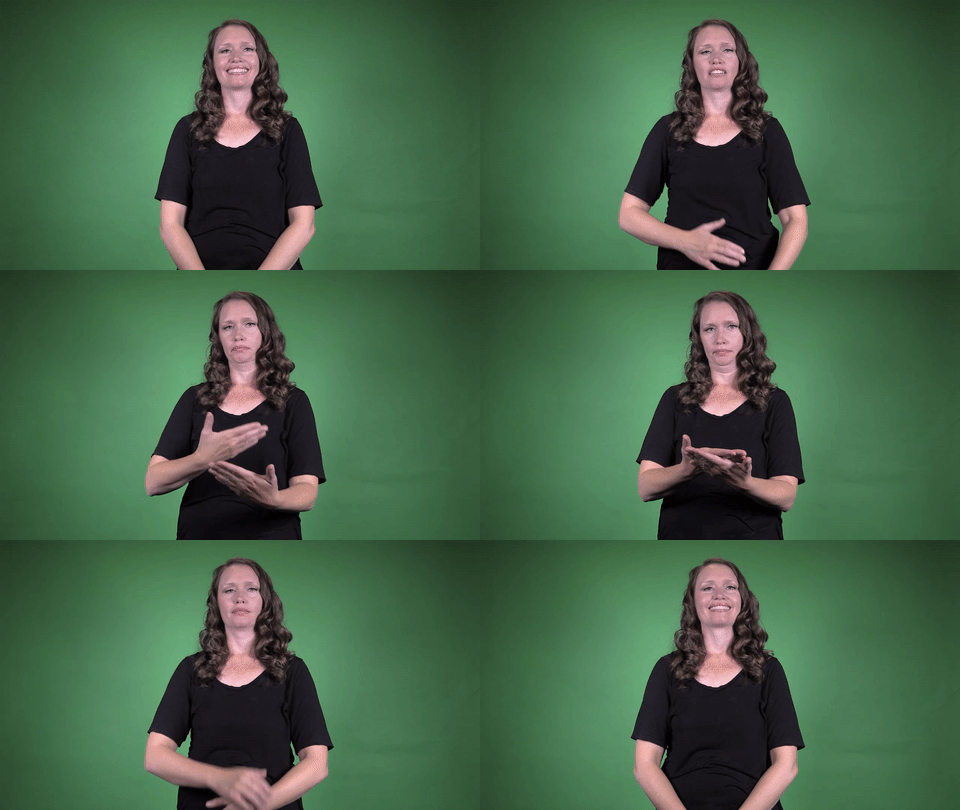
Sign for BORN 2 in ASL

Practice Activities:
Start by practicing the sign for BORN 2 in ASL in isolation. Stand in front of a mirror and repeat the sign slowly and deliberately, watching your handshape and movement. Repeat the sign ten times, then switch hands and try again to develop muscle memory.
Next, create a list of personal or famous birth events. Sign simple sentences like “I was born in California” or “She was born in winter.” Practice these with different subjects and locations to help reinforce your overall clarity and fluency using the sign for BORN 2 in ASL.
Have a partner quiz you using flashcards with family relationships or dates. When shown a card like “brother – 1990,” respond with full sentences using the target sign. This encourages quick recall and integration in real-life sentences.
Use storytelling to strengthen your expressive skills. Create a short narrative about a character’s birth and early life. Include as many relevant signs as possible, such as FAMILY, HOSPITAL, DOCTOR, and YEAR, combined with the sign for BORN 2 in ASL.
In a classroom or group setting, play charades where one person acts out a birth-related scene, and others identify and sign the sentence using the correct vocabulary. This game develops interpretation skills and builds confidence using the sign in spontaneous settings.
Record a short video diary where you recount where and when you were born. Watch the playback to assess posture, fluidity, and accuracy of the sign for BORN 2 in ASL. Repeat the activity monthly to track progress and build comfort with autobiographical signing.
To expand vocabulary, pair the sign with similar life-event signs such as MARRY, GRADUATE, and DIE. Create timeline sequences in ASL, explaining when someone was born and key milestones after. This helps reinforce chronological structures in storytelling.
Cultural Context:
In American Sign Language (ASL), it’s important to understand the cultural context behind certain signs, especially those like sign for BORN 2 in ASL. This sign may appear simple at first glance, but depending on the context and who is using it, it can carry different nuances, connections to community identity, and generational relevance.
The sign for BORN 2 in ASL often comes up in conversations about Deaf identity and generational belonging. In some communities, BORN 2 can refer to being born into a Deaf family or being born into Deaf culture and using ASL as a first language. Generational labeling like this holds deep cultural meaning, and the way the sign is used can show pride, tradition, and language heritage.
ASL is a rich and expressive language that conveys more than just English translations. When discussing the sign for BORN 2 in ASL, people often bring in facial expressions, body placement, and other visual features that give the sign more meaning. It’s not just about the handshape—it’s about the experience, the context, and the community around the signer.
Deaf culture values storytelling and passing down knowledge visually through generations. Using the sign for BORN 2 in ASL may be part of sharing one’s background or family connections within the Deaf world. The number 2 in this phrase can imply a second-generation Deaf individual or someone born into an existing Deaf family structure.
Knowing how to properly use the sign for BORN 2 in ASL helps prevent miscommunication and shows respect for Deaf culture. Just as in spoken languages, fluency in ASL involves understanding the subtleties of meaning that come through cultural experience. Certain signs carry personal, historical, and communal associations that aren’t immediately obvious to beginners.
In social settings, using the correct version of the sign for BORN 2 in ASL can help signal connection or solidarity with heritage language users. It is a way to show that you recognize the layered identity of those who grow up within Deaf culture. For many, the term BORN 2 is a proud identifier rather than just a chronological fact.
Understanding the deeper context of signs like sign for BORN 2 in ASL makes learning the language more authentic. ASL learners and teachers alike benefit from learning how certain phrases tie into life stories, relationships, and values held by members of the Deaf community. The meaning of BORN 2 can change slightly depending on individual or family background.
It’s not uncommon to see
Extended Definition:
The sign for born 2 in ASL refers to the second variation of the American Sign Language sign used to express the concept of being born, particularly in more specific or contextual situations. This version might be used when differentiating between multiple meanings or sentence structures that involve the term “born.” The sign for born 2 in ASL can help clarify messages in storytelling or narratives, especially when discussing past events related to birth or origin.
In most cases, the sign for born 2 in ASL uses a directional motion, showing a person or thing emerging or coming into existence. It can also reflect the passive nature of birth, with the signer indicating position or direction relative to another noun or established space in ASL grammar. This variation allows for more flexibility and clarity when signing about events that involve being born in a literal or metaphorical sense.
The ASL sign for born 2 may appear similar to the first variation but can include a slightly altered handshape or movement. Modifying hand placement or orientation helps distinguish between different types of birth contexts, such as a country of birth, time period, or description of someone’s origins. Watch for non-manual markers, facial expressions, and contextual clues that often accompany this variation.
Learning the sign for born 2 in ASL is especially useful for advanced ASL users or interpreters who often need to adapt their signing to fit formal, educational, or narrative environments. It enhances the signer’s ability to express complex ideas surrounding birth, including historical references, fictional stories, or biographical details.
It’s helpful to compare the sign for born 2 in ASL with similar concepts such as begin, start, or come-into-being. Each has a unique sign and context, but becoming familiar with how they differ can lead to clearer and more accurate communication. Because ASL is a highly contextual and visual language, being able to switch between signs based on meaning is essential for fluency.
When taught in ASL classes or courses, the sign for born 2 is often introduced after the basic form is mastered. Understanding how and when to use it ensures that language learners can express themselves more naturally. It also supports clearer communication with deaf or Hard of Hearing communities when discussing personal background, heritage, or life events.
On social media and video platforms, native ASL users may demonstrate different styles of the sign for born 2 in ASL. This exposure can help learners refine their own technique and recognize regional or individual variations in signing. Always consider the
Synonyms: born, birthed, brought into the world, delivered, came into existence
Educational resources: Find related learning materials in our course bank!
Want more? Check out some of our popular learning activities on the homepage!
Need to look up a sign? Use our highly rated dictionary: https://aslinteractive.com/best-asl-dictionary/
Follow us on tiktok: https://www.tiktok.com/@aslinteractive. More social media links at the bottom of this page!
Long-tail Keywords: what is the sign for born in asl, how do you sign born in asl, asl sign for born
Categories:
tags: Family, Occasions, Life milestones, Birth, Relationships
Parameters
*Handshape*:
The handshape used in the sign for BORN 2 in ASL involves a flat, open dominant hand (B-handshape), palm facing upward, representing the surface or ground. The non-dominant hand, also flat with fingers together and palm down, glides underneath the dominant hand, mimicking the motion of something being born or emerging. This gesture reflects the meaning of the sign for BORN 2 in ASL clearly and effectively.
*Palm Orientation*:
For the sign for BORN 2 in ASL, the palm orientation of the non-dominant hand is typically flat, facing toward the body with the fingers pointing toward the opposite side. The dominant hand starts with the palm facing down and slides under the non-dominant hand in a forward motion, simulating the action of being born.
This specific palm movement is essential for clearly expressing the sign for BORN 2 in ASL. The direction and angle of both palms help convey the concept accurately and naturally in conversation.
*Location*:
The sign for BORN 2 in ASL is typically located in the lower torso area. One dominant hand is held palm-up near the stomach or slightly below, while the other hand moves over and past it in a downward motion, resembling a figure being delivered or coming out.
This location emphasizes the concept of coming out from the body, aligning naturally with the meaning behind the sign for BORN 2 in ASL. The movement begins in front of the abdomen and ends just below, making the lower front part of the torso the key area for accurate placement.
*Movement*:
The movement for the sign for BORN 2 in ASL begins with your dominant hand held flat, palm facing up, while your non-dominant hand is also flat and horizontal, palm facing down. Your dominant hand moves under the non-dominant hand, as if passing through or being “born” from beneath it.
This smooth underhand motion visually represents emergence or being born. The sign for BORN 2 in ASL uses this gesture to emphasize transition or arrival in a spatial and conceptual way.
*Non-Manual Signals*:
The non-manual signals for the sign for BORN 2 in ASL typically include a calm and neutral facial expression, often with a slight downward gaze to mirror the directional movement of the sign. The head may gently tilt forward to emphasize the concept of emerging or coming into existence.
When using the sign for BORN 2 in ASL, it’s important to maintain a composed and natural demeanor. Avoid exaggerated expressions unless providing contrast or narrative context, as the sign relies more on the movement than facial emphasis.
*Prosody, Dominant/Non-Dominant Hand*:
The sign for BORN 2 in ASL uses both hands with a clear movement that shows the action of being born. The non-dominant hand is held palm-up flat, representing a surface like a mother or a location. The dominant hand, also flat, moves under the non-dominant hand from behind and emerges forward and up, symbolizing birth.
When signing the sign for BORN 2 in ASL, the dominant hand executes the motion while the non-dominant hand remains static. This prosody helps convey the idea of emergence and transition, reinforcing the visual aspect of the sign.
Tips for Beginners:
When learning the sign for BORN 2 in ASL, it’s important to visualize the concept of something emerging or coming into existence. The dominant hand represents the subject that is being born, and it should glide over the base of the nondominant hand, which acts like a flat surface or platform. Think of the dominant hand as “coming out from under” the nondominant hand—this motion mirrors the idea of birth or emergence.
One helpful tip is to keep both hands in a natural, relaxed position and avoid overly stiff movements. Many beginners struggle with making the motion too robotic or confusing the orientation of the hands. To avoid this, practice in front of a mirror and watch how smoothly your dominant hand moves over and past the other hand. Smoothness helps the motion look more fluent and native.
It’s common for learners to turn the dominant hand the wrong way or to create too much space between the hands. To increase accuracy in the sign for BORN 2 in ASL, make sure the nondominant hand stays horizontal and the dominant hand rests its palm downward before sliding palm-side-down over it. Keep the motion tight and deliberate — exaggerated motions can confuse the meaning.
Context also matters. The sign for BORN 2 in ASL may be used differently depending on the tense or grammar of the sentence. Adding facial expressions or appropriate non-manual markers will help clarify whether you mean someone has just been born or were referring to a birth in the past.
Finally, don’t stress about mastering it immediately. Repetitive, mindful practice and observing fluent signers will help build confidence. Try using the sign in simple sentences when telling your story, like saying where you were born. Keep signing regularly, and you’ll see improvement quickly!
Connections to Other topics:
The sign for BORN 2 in ASL is commonly connected to concepts like childbirth, beginnings, and transitions. It shares similarities with signs for START, BEGIN, and LIFE, which can be useful when contextualizing early stages or origins within a broader narrative. This association helps reinforce the timeline-related aspect of the sign when used in storytelling or describing biographical events.
In compound forms, the sign for BORN 2 in ASL can merge with HOME to discuss birthplace, as in phrases like “born at home” or “born in [location].” It also links with the sign for YEAR in timelines or life history structures, playing a role in telling age or sequencing events. Typically, you’ll see it used in educational settings where personal histories or family trees are discussed.
The concept of being born is also integral when discussing identity and cultural background. In Deaf culture, referring to being born Deaf or born into a Deaf family uses the sign for BORN 2 in ASL as a core element. This helps underscore Deaf identity and heritage and is often paired with the sign for DEAF or GROW-UP to indicate lifelong experience.
Linguistically, the directional movement involved in this sign illustrates spatial mapping—a key strategy in ASL storytelling. It often visually conveys emerging from one source into a new state, which allows learners to grasp abstract narratives more tangibly. This kind of metaphorical layering deepens understanding and fluency.
Additionally, the sign for BORN 2 in ASL may be used metaphorically in religious or philosophical contexts, such as “born again,” by combining it with AGAIN. This highlights its adaptability in a range of discussions, linking physical events with metaphorical or ideological transformations. ✨
Summary:
The sign for BORN 2 in ASL uses a smooth, sweeping motion that reflects the action of birth or emergence. The dominant flat hand (palm up) represents the baby while the non-dominant flat hand (also palm up) represents the womb or place of origin.
To perform the sign, the dominant flat hand slides under the non-dominant flat hand and arcs upward slightly as if passing through or being delivered. This motion evokes the image of a baby emerging into the world, making it metaphorically intuitive and visually descriptive.
Within Deaf culture, the concept of being born holds layered meaning. It may be used literally, such as in discussing one’s date or place of birth, but also metaphorically, such as being born into Deaf culture or awareness .
The sign for BORN 2 in ASL provides an elegant representation of transition and new beginnings. It often appears in narratives where life histories are shared, especially during storytelling or Deaf cultural exchanges.
This specific sign version may vary slightly by region or context. However, the sweeping underhand motion remains central to its configuration, keeping the meaning apparent in most settings.
Grammatically, the sign functions as a verb in ASL sentence structure. For example, “I born California” would be an appropriate structure, often followed by additional context like year or circumstances.
The sign for BORN 2 in ASL may be paired with time indicators. Combining it with signs for YEAR or the number of the birth year provides fuller context. Sign order follows standard ASL grammar rather than English order.
It is not uncommon for signers to include facial expressions matching sentiment. If someone expresses joy in recalling a birth, they may show a gentle smile, enhancing the emotional tone and meaning of the sign.
There’s a close connection between this sign and other signs for creation, beginning, or origin. Signs like BEGIN, GROW-UP, or START are semantically similar and often appear within the same utterances when detailing timelines or development.
Applied linguistics perspectives on this sign highlight the spatial representation of abstract concepts. The motion underneath the hand symbolizes emergence, valuable in analyzing iconicity in sign language.
Children acquiring ASL often enjoy this sign for its easy visualization. It aligns strongly with gesture-like movement, aiding early language acquisition and conceptual grounding in time-related signs .
From a historical linguistic standpoint, the sign for BORN 2 in ASL might have evolved from earlier gestural forms. Over time, Deaf communities standardized such signing into the version commonly found across North America today.
In the context of Deaf identity, the word “born” takes on sociocultural meanings. A person may describe themselves as “Deaf born” not just genetically, but in terms of cultural belonging and upbringing within the Deaf world.
This use of the sign in an identity context adds emotive power. It highlights the multifaceted notion of birth—not just physical, but cultural and linguistic—which is especially meaningful in a minority language context like ASL.
There’s a natural beauty in how the sign for BORN 2 in ASL reflects deeper meanings beyond biological birth. It gracefully layers representation into motion and elevates storytelling to a form of embodied history.
Considering its usage in signed narratives, the sign often marks transitions from one life stage to another. When recounting personal history, Deaf individuals may use it to denote turning points or introductions to language and communication.
There’s also a poetic symbolism in using space to show place of origin. Some signers incorporate additional classifiers to indicate where a person was born, giving visual structure to biographical accounts.
In language development research, signs like BORN 2 are essential for sequencing events. They play a primary role in helping signers master temporal markers and event chronology in visual-spatial modality.
The natural rhythm of the sign fits well in poetry and signed storytelling. ASL poets often use this sign with stylized or exaggerated motion to emphasize themes of emergence or transformation ✨.
Sociolinguistically, the sign might be adapted slightly in different communities. Variants may include changes in palm orientation or emphasis, yet the core imagery remains mutually intelligible across dialects.
The sign for BORN 2 in ASL also appears in religious contexts, particularly in signed versions of narratives about birth, renewal, or spiritual awakening. In such settings, it can take on deeply symbolic connotations.
Its usage in educational settings is clear and frequent. Teachers use the sign during introduction activities, history lessons, or when discussing famous figures and their early lives.
More broadly, signs like BORN 2 help define a cognitive framework for time and origin. They assist signers in mapping personal and shared histories in structured, visually-accessible formats.
When learning about culture through language, this sign acts as a visual bridge. It connects concept to gesture, fostering deeper understanding of both literal and metaphorical beginnings within the Deaf community.
Phonologically, the sign for BORN 2 in ASL uses basic handsh
Want more? Check out some of our popular learning activities!
ASL Interactive Resources
ASLInteractive YouTube Channel
Follow us on tiktok: @aslinteractive.com
Follow us on Instagram: aslinteractive
Facebook page: aslinteractive
Facebook group: aslinteractive
LInkedIn: ASL Interactive LLC
Twitter: @ASL_interactive
*Some information on this page is AI-generated. AI can make mistakes. Please check the information.
Responses