
Definition: A rectangular container v2.
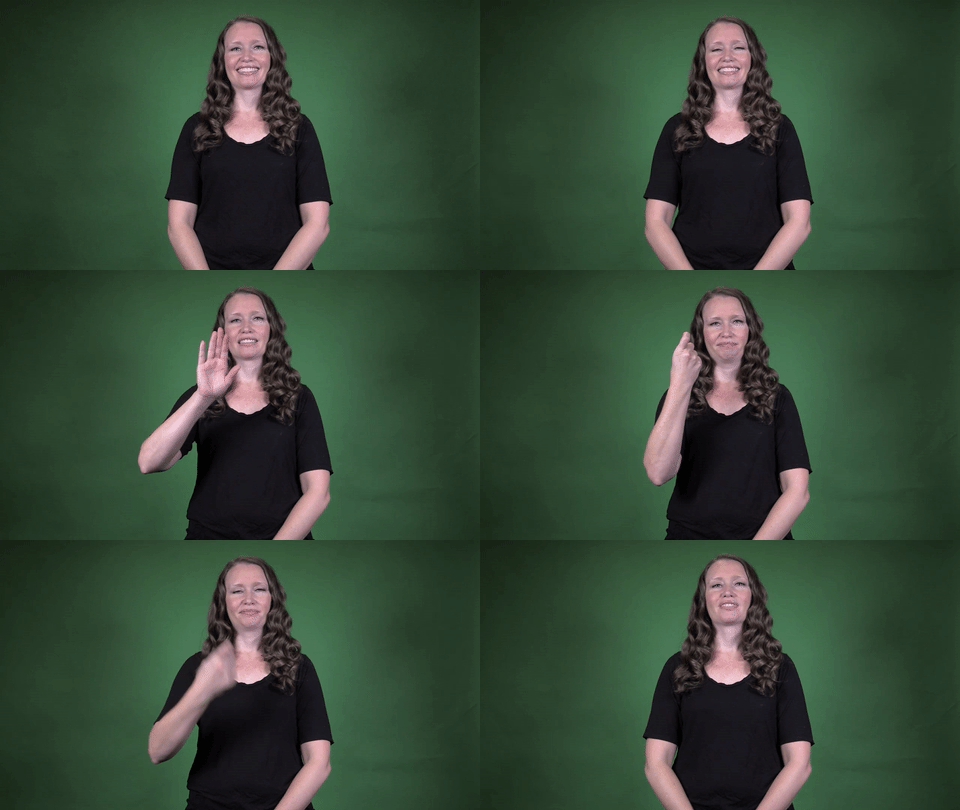
Sign for BOX 2 in ASL

Practice Activities:
To practice the sign for BOX 2 in ASL, begin with isolated signing by standing in front of a mirror and forming the shape of a 3D box in the air. Use both hands in flat B shapes, moving them in space to outline the corners as if showing the height, width, and depth of an invisible box. Practicing in front of a mirror helps align your movements symmetrically.
Next, do repetition drills. Sign the word ten to twenty times in a row, slowly at first, then increase speed as your confidence grows. Make sure each corner of the box looks clear and consistent with your hand shapes and movement. Record yourself and compare with videos or instructor demos online.
Use the sign for BOX 2 in ASL in short phrases. Try “big box,” “heavy box,” or “open box.” Sign these combinations with facial expressions that match the meaning. Make the “heavy box” look like it takes effort, and “big box” with exaggerated size to show contrast.
Create simple sentences like “I have a box” or “Put the box on the table.” Practice signing them slowly, then ask a partner to sign them back or quiz you by signing a sentence and having you respond appropriately. This back-and-forth builds fluency and comprehension.
Use storytelling prompts that include a box in the narrative. For example, sign a short story about receiving a mystery box in the mail—what’s inside? Where did it come from? This kind of creative storytelling helps deepen your memory of the sign for BOX 2 in ASL in a fun, engaging context.
For partner or group practice, try a guessing game. One person acts out a scene using the sign for BOX 2 in ASL, and the other guesses what’s happening. This allows for real-world ASL use and supports greater retention of vocabulary through interaction.
Cultural Context:
In American Sign Language, the sign for BOX 2 in ASL plays a role not just in communication, but also in providing visual clarity when describing objects, sizes, and spaces. The concept of a box can appear across various contexts, from conversations about moving and storage to educational settings or even when telling stories. The sign for BOX 2 in ASL helps deaf and hard-of-hearing individuals engage in detailed, descriptive dialogue.
ASL uses space around the signer to represent ideas physically, and signing BOX 2 in ASL relies on shaping that space with your hands, mimicking the dimensions of a box. There’s a strong cultural connection between how ASL visualizes concepts and how Deaf people experience and express their world. Signing BOX 2 in ASL means more than labeling an object—it represents interaction with the environment in a deeply visual and spatial way.
Within the Deaf community, ASL storytelling often includes signs like BOX 2 in ASL to enhance imagery and comprehension. The ability to clearly show what type of box is being referred to adds depth and understanding to a conversation. This visual precision supports accessibility while preserving cultural norms around detailed expression.
In everyday conversations, the sign for BOX 2 in ASL could be used when discussing tasks like shipping, packing, or building. These discussions become clearer and richer when space and handshapes are combined in meaningful ways. It demonstrates the core ASL value of seeing language as something more than just words—it’s motion, form, and intent.
The Deaf community places a high value on shared understanding and visual storytelling, and signs like BOX 2 in ASL support this practice. Whether in classrooms, homes, or workplace settings, this sign helps the interaction feel natural and culturally appropriate. It strengthens community connection through the use of highly visual descriptors.
Learning the correct sign for BOX 2 in ASL is also important in bridging communication between Deaf and hearing individuals. Interpreters, educators, and family members benefit from being able to express shapes and sizes accurately. Understanding and using signs like BOX 2 in ASL preserves respect for Deaf culture while promoting language accessibility.
Visual-verbal expression is central to ASL, and that’s what makes signs such as BOX 2 in ASL so essential. It’s not only the concept of a box—it’s the way it’s shaped, where it’s placed, how big it is, and what’s in it—all captured visually. These rich, layered details help promote the cultural idea in the Deaf
Extended Definition:
The sign for BOX 2 in ASL is a commonly used variation in American Sign Language to describe or refer to a box-shaped object. This variation adds clarity when distinguishing it from the more basic sign for box, especially in contexts where multiple signs for box are being used or compared. Knowing the sign for BOX 2 in ASL can help when discussing shapes, packaging, or storage containers in more complex conversations.
To produce the sign for BOX 2 in ASL, both hands are generally shaped like the letter B, and they are positioned to show the outline or shape of a box in three-dimensional space. The movement and placement of the hands can indicate the relative size of the box, making this sign both descriptive and functional for daily communication. This version may involve slightly more spatial movement compared to more basic signs.
ASL includes multiple ways to sign the word box, depending on the type, context, or how descriptive one needs to be. The sign for BOX 2 in ASL offers a more specific or alternative way to express the idea when trying to show dimensions or clarify exact usage. It can be useful in educational settings, construction contexts, or artistic discussions.
When learning the sign for BOX 2 in ASL, practicing it with proper handshapes and visual space is important for accurate communication. This helps your audience understand the kind of shape you’re referring to, especially if it’s different from a standard box. It’s a more visually representative version of the concept, staying true to the visual nature of ASL.
Using the sign for BOX 2 in ASL can enhance your ability to describe real-world items like shipping boxes , toy boxes, or storage bins. It’s practical for conversations involving packing, organizing, or identifying specific shapes in a classroom or work setting. By using this version, you make conversations more detailed and expressive.
The sign for BOX 2 in ASL is appropriate for both formal and informal ASL usage. Whether you’re interpreting, teaching, or simply communicating, this sign helps make sure the concept of a box is understood clearly in the specific context you’re discussing. It’s especially helpful when demonstrating how something fits inside a box or explaining design specifications.
This sign fits into a broad category of ASL signs for shapes and objects, making it part of foundational vocabulary for learners and fluent users alike. Understanding the regional or community-based preferences for this version can also help in social and academic environments. Like many signs in ASL, the sign for BOX 2 in
Synonyms: Understood. Please provide the content that you would like me to generate synonyms for.
Educational resources: Find related learning materials in our course bank!
Want more? Check out some of our popular learning activities on the homepage!
Need to look up a sign? Use our highly rated dictionary: https://aslinteractive.com/best-asl-dictionary/
Follow us on tiktok: https://www.tiktok.com/@aslinteractive. More social media links at the bottom of this page!
Long-tail Keywords: what is the sign for box in ASL, how do you sign box in American Sign Language, ASL sign for box
Categories:
tags: Objects, Language Learning, Activities, Classroom Picture, Commands
Parameters
*Handshape*:
The handshape used in the sign for BOX 2 in ASL involves both hands forming flat “B” handshapes , palms facing each other. The fingers are held together, with thumbs extended along the sides.
This handshape mimics the sides of a rectangular object, helping to visually frame the concept of a box. The sign for BOX 2 in ASL relies on the consistent use of these symmetrical handshapes to clearly depict the shape and structure of a box.
*Palm Orientation*:
The palm orientation for the sign for BOX 2 in ASL involves both hands held in a flat “B” handshape, with palms facing each other. The hands are positioned to represent the front and sides of a box.
During the sign for BOX 2 in ASL, the palms stay mostly perpendicular to the ground, shifting slightly as the signer moves the hands inward and outward to show the shape. This clearly visualizes the dimensions of a box .
*Location*:
The sign for BOX 2 in ASL is produced in the neutral signing space directly in front of the torso, about chest level. Both hands are used, starting with open B-shaped hands and moving to create the outline of a rectangular box.
This placement helps visually represent the concept while keeping the sign clearly visible. The location stays steady, making the sign for BOX 2 in ASL easy to understand and consistent in conversation.
*Movement*:
The sign for BOX 2 in ASL uses both hands in a “B” handshape, held in front of the chest. The hands move outward and slightly apart to indicate the front and side of a box, creating a rectangular shape in the air .
To complete the sign for BOX 2 in ASL, the hands then return inward, mimicking the opposite edges. The movement clearly outlines the concept of a three-dimensional box, emphasizing size and structure.
*Non-Manual Signals*:
When demonstrating the sign for BOX 2 in ASL, maintain a neutral facial expression to reflect the factual nature of describing an object. Slight eye squinting may help you focus on the imaginary shape being formed with your hands.
Make sure your gaze follows your hands as they outline the box shape, helping convey clarity during the sign for BOX 2 in ASL. Head nodding slightly can indicate affirmation or confidence in your description.
*Prosody, Dominant/Non-Dominant Hand*:
The sign for BOX 2 in ASL uses both the dominant and non-dominant hands in flat b-handshapes. Start with palms facing each other in front of your chest, about shoulder-width apart. Move hands slightly outward and then down, outlining the shape of an imaginary box .
Both hands mirror each other’s movement to show the three-dimensional shape, emphasizing the concept clearly. The sign for BOX 2 in ASL is commonly used when illustrating spatial relationships or referencing containers.
Tips for Beginners:
When learning the sign for BOX 2 in ASL, start by practicing the handshape and movement slowly. This sign typically involves forming both hands into flat “B” handshapes, with palms facing each other about shoulder-width apart. Then, draw the shape of a box in the air by bringing your hands together and apart along the four corners of a square shape. Make sure your movements are clear and deliberate to visually represent the outline of a box.
One tip for getting the sign for BOX 2 in ASL right is to keep your elbows relaxed. Beginners sometimes stiffen their arms or exaggerate the square too much, which takes away from the natural fluidity. Also, resist the urge to curve your hands—flat handshapes are key for an accurate representation. Practicing your lines to be straight and proportionate can make a big difference in how clearly your sign is understood.
It’s helpful to practice the sign in front of a mirror so you can check that the box shape is symmetrical. Sign with medium-sized motion—not too big or small—to stay consistent with general ASL grammar. Always keep the sign within your signing space, which is roughly from your chest to your forehead and shoulder to shoulder.
Another pitfall to avoid is confusing the sign for BOX 2 in ASL with signs for other shapes or objects. Because this sign is spatial, its meaning can quickly be lost if your movements aren’t clean. Try watching native signers and mimic how they shape the box. Focus on the corners and be aware of your hand angles for accuracy.
Finally, practice using the sign in real contexts, like labeling items or describing packages . Integrating the sign naturally into your signing vocabulary builds fluency and confidence over time.
Connections to Other topics:
The sign for BOX 2 in ASL connects closely with spatial awareness and categorization, both fundamental concepts in American Sign Language. This sign emphasizes three-dimensional space and can be used to describe not only literal containers but also conceptual boxes, such as areas, frames, or boundaries. It’s commonly used in visual storytelling and classifiers to establish spatial locations.
Learners will find that mastering the sign for BOX 2 in ASL supports understanding signs like ROOM, HOUSE, and BUILDING, since they share the idea of enclosed or defined space. The BOX 2 variation may depict a slightly different dimension or shape, helping to distinguish size and volume when comparing objects or environments. This subtle change allows signers to be more descriptive and nuanced in their communication .
The sign also plays a role in compound expressions like GIFT-BOX or SHOE-BOX, where it combines with signs for items contained within or associated with boxes. These compound signs improve clarity and allow for more fluid conversation. For example, using the sign for BOX 2 in ASL along with GIFT makes the idea of a wrapped present more visually precise in context.
In thematic contexts, such as conversations about moving, storage, shipping, or organizing, BOX 2 appears alongside signs such as STACK, PILE, or LABEL. These connections build vocabulary around everyday tasks and practical experiences, enhancing communication in domestic, educational, or industrial settings .
Understanding the sign for BOX 2 in ASL also prepares learners for broader classifier use, especially CL: B (flat surfaces) and CL: C (measuring container size). Engaging with these classifiers improves overall sign fluency by enhancing spatial reasoning. With practice, learners will see how the concept of a box applies to abstract thinking, such as “thinking outside the box,” which might be expressed more figuratively through expressive means in ASL.
Summary:
The sign for BOX 2 in ASL captures the concept of a container with dimensional sides. This version of the sign is typically executed with both open B-hands held in front of the body, palms facing one another. From there, the hands outline a 3D square or rectangle shape in the air, emphasizing the object’s structure.
This specific variation, BOX 2, differs slightly from other general versions of the sign for box. It may indicate boxes with additional features, like depth, packaging design, or specific sizes. Subtle differences in hand movement, shape, or hand placement can shift the message depending on context.
ASL users often modify the sign for BOX 2 in ASL by adjusting hand positions to fit the specific box they mean. For example, pointing to a small area and using smaller motions indicates a tiny box, whereas broader arm movements signal a large one. These adjustments are a natural part of ASL’s classifier system.
ASL classifiers allow signers to depict shapes, sizes, and spatial relationships vividly. The sign for BOX 2 in ASL connects strongly with the classifier category, especially the CL:B handshape. This allows for rich spatial descriptions in storytelling and daily conversation.
Culturally, boxes hold symbolic value in Deaf spaces. They can represent containment, restriction, or personal space. In visual artwork or storytelling, hands outlining a box might metaphorically indicate barriers or defined expectations.
The sign also blends well into narratives that involve ordering, moving, gifting, or storage. The motion helps build visual scene setup, essential in signed narratives. The consistent, spatial nature of ASL makes signs like BOX 2 versatile tools.
Grammatically, the sign for BOX 2 in ASL usually functions as a noun. It doesn’t require movement change to convert it into a verb because actions involving a box are typically added as separate signs. For instance, OPEN-BOX, MOVE-BOX, or STORE-BOX follow the original sign.
Nevertheless, the concept of a box is often embedded in compound signs. These compounds can streamline meaning, such as in BOX-SHAPE or BOX-LABEL. ASL leans on spatial logic for these constructions, allowing seamless layering of ideas.
The sign’s structure reflects ASL morphology at work. The static handshape signaled by the B-hands is essentially a lexical unit. When the hands move to indicate depth or proportion, morphology adds variation in meaning.
Applied linguistics also sees the sign as a strong example of embodied cognition—language expressed through spatial awareness. The human brain processes the visual and kinesthetic input of BOX 2 with ease because it maps onto real-world experience. You gesture what you see.
Children acquiring ASL learn to understand solid shapes like boxes through visual-tactile contexts. Deaf children benefit from real-object connections, where pointing to an actual box and then signing builds semantic connections. The spatial nature of BOX 2 helps with conceptual anchoring.
There is cross-linguistic variability across signed languages in depicting containers. Irish Sign Language or British Sign Language may differ in outlining objects such as boxes. However, the use of space remains a universal among signed languages when expressing containment.
The sign for BOX 2 in ASL can also double as part of role-shifting practice. A signer mimicking stacking or unpacking boxes may use the sign as a prop during spatial narration. The box becomes a marker of activity—lifting, organizing, labeling.
In science or math contexts within ASL, BOX 2 can represent geometry or storage concepts. Teachers often sign it when talking about volume or packaging. Real-world applications in teaching highlight ASL’s strength in visualizing abstract content.
The movement in BOX 2 demonstrates iconicity—hand motions closely resemble the outline of a physical object. This is a hallmark of many ASL nouns. The shape-matching supports cognition and communication alike.
Signers sometimes use facial expressions with BOX 2 to frame implied dimensions or emotional tone. A tighter mouth and squinted eyes may show a compressed box, while a relaxed expression might show an ordinary package. The coupling of non-manual signals enhances interpretation.
The sign fits neatly into visual storytelling by Deaf creators. In ASL poetry and performance, serving as a representation of spatial or symbolic enclosure, it supports broader messages about identity, expectations, or revelation. The box closes or breaks open, and stories unfold.
Sociolinguistically, the sign for BOX 2 in ASL also shows how variation enters community language. Different regions or generations may modify the sign slightly. Deaf communities adapt signs to specific occupations or local norms—like types of shipping boxes in warehouses.
Deaf artists may use BOX 2 during expressive moments to depict isolation or discovery. The imagined space that this sign builds becomes a tool for storytelling and conceptual framing. There’s beauty in watching boxes be drawn in air with purpose.
From a typological angle, BOX 2 emphasizes boundedness—a specific type of form. It teaches that ASL
Want more? Check out some of our popular learning activities!
ASL Interactive Resources
ASLInteractive YouTube Channel
Follow us on tiktok: @aslinteractive.com
Follow us on Instagram: aslinteractive
Facebook page: aslinteractive
Facebook group: aslinteractive
LInkedIn: ASL Interactive LLC
Twitter: @ASL_interactive
*Some information on this page is AI-generated. AI can make mistakes. Please check the information.
Responses