Definition: Categories 2.
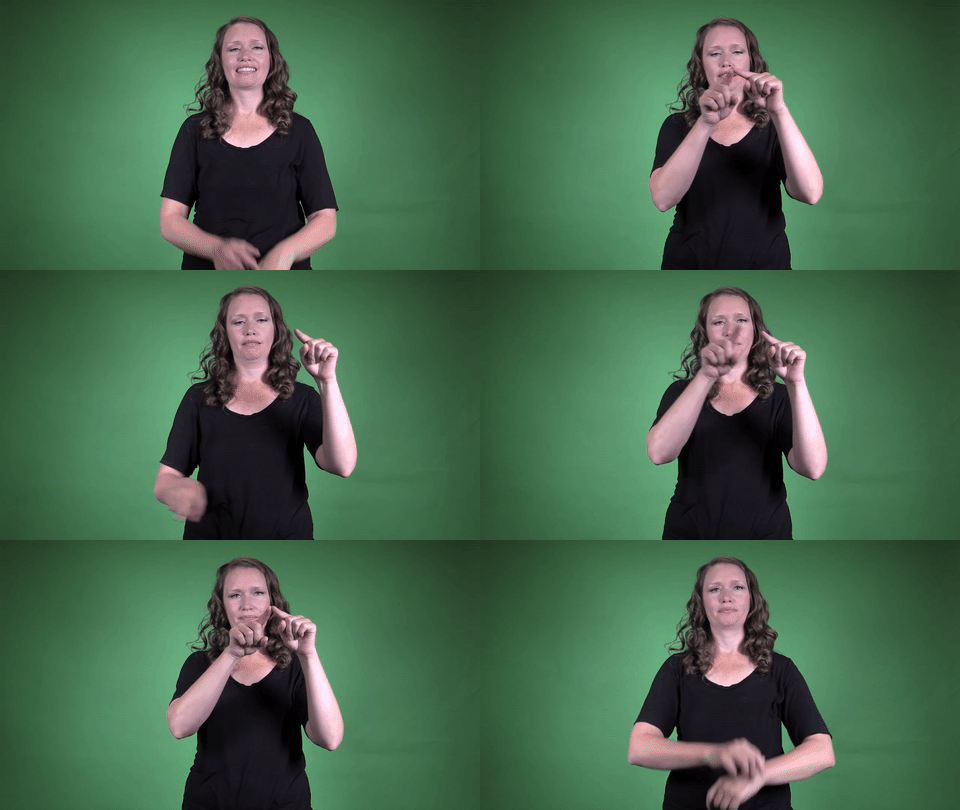
Sign for CATEGORIES 2 in ASL

Practice Activities:
To practice the sign for CATEGORIES 2 in ASL, begin by signing it repeatedly in front of a mirror to build muscle memory and ensure correct handshape and movement. Focus on the symmetrical movement of both hands as you visually group items into categories. Say the English word in your head or aloud as you sign to reinforce meaning.
Use flashcards with different groups of items, such as fruits, vehicles, or school supplies. After flipping over a card, challenge yourself to sign the specific category it belongs to using the sign for CATEGORIES 2 in ASL. This exercise helps you associate the sign with real-world groupings.
Create example sentences that use the concept of sorting or grouping. For example: “I like all kinds of music categories,” “The teacher asked us to put the books into categories,” or “Each shelf is for a different category of food.” Practice signing each sentence slowly, emphasizing the sign for CATEGORIES 2 in ASL in the appropriate place.
Partner activities are also great for building fluency. One partner can name items and the other signs the category. For instance, if one says “Apples, bananas, oranges,” the other can respond using the correct sign. Take turns to stay engaged and creative.
For storytelling, describe a trip to the library where you sorted books by genre. Use the sign for CATEGORIES 2 in ASL when talking about arranging mystery novels, sci-fi, and biographies. This kind of storytelling allows learners to internalize the sign through meaningful context.
Try a scavenger hunt at home. Group objects you find and sign about the groupings you create. Using the sign for CATEGORIES 2 in ASL in real-world scenes enhances retention and comprehension, making it a part of your regular vocabulary.
Cultural Context:
In American Sign Language (ASL), the sign for CATEGORIES 2 reflects how Deaf culture organizes and understands information visually. The concept of grouping ideas, things, or concepts into categories is important in both academic and everyday conversations in ASL. This visual language relies on spatial awareness and clarity to express different types or levels within a group.
When using the sign for CATEGORIES 2 in ASL, signers often draw on cultural norms about how lists, groups, or sets are communicated. In Deaf culture, sharing information is a valued practice, and clear categorization helps maintain that clarity. Grouping ideas clearly helps Deaf individuals navigate topics efficiently, especially in educational settings or community discussions.
The sign for CATEGORIES 2 in ASL might be used when discussing types of food, groups of animals, classes of objects, or any concept that can be sorted or divided. For example, a teacher in a Deaf classroom might use the sign for CATEGORIES 2 to help students sort vocabulary into related themes. The ability to visually and spatially organize concepts is a key part of how ASL works.
In Deaf culture, visual clarity is not just a language feature—it’s a cultural preference. Visual organization supports learning and inclusive interaction, especially in group settings. Using a sign like CATEGORIES 2 in ASL reflects that shared value of organizing knowledge in a way that’s easy to see and understand without sound.
The use of the sign for CATEGORIES 2 in ASL can also support storytelling or information sharing. Deaf individuals often use categories to give structure to narratives or discussions. Whether it’s sorting character types in a story or explaining job roles in a meeting, CATEGORIES 2 in ASL helps assign meaning efficiently.
ASL is deeply ingrained with cultural habits, and signs like CATEGORIES 2 evolve from community needs and practices . Deaf storytellers, educators, and professionals use this sign to sequence information for better understanding. This fits into the broader cultural focus on accessibility and equal communication.
In group conversations or presentations, the sign for CATEGORIES 2 in ASL helps maintain flow and logic. This reflects how Deaf spaces prioritize visual attention and clear idea transitions. It’s not uncommon to see this sign used alongside classifiers or directional verbs to build complex explanations.
Overall, the sign for CATEGORIES 2 in ASL represents more than just a word—it reflects a cultural approach to organization, communication, and learning. Its use in both casual and academic settings shows how the Deaf community has adapted
Extended Definition:
The sign for categories 2 in ASL refers to the second concept or level of classification within American Sign Language. This can be part of a structured learning approach where signs are grouped into themes or types, helping users understand relationships between different concepts. In this context, categories 2 often includes more specific or complex vocabulary than the first level.
To sign categories 2 in ASL, you generally start by signing the concept of “category” using the hands in a C-shape movement to show classification or grouping. Then you follow this with the number 2, shown by holding up two fingers. This combination helps clarify that you’re referring to the second tier or group of category signs. Always pay attention to facial expressions and sign placement, as these aspects add meaning.
ASL learners benefit from understanding categories because it helps organize the language logically. The sign for categories 2 in ASL supports this by allowing learners to break down vocabulary into manageable sections. This is particularly useful in educational settings or when teaching ASL as a second language.
In practice, teachers and students may use the sign for categories 2 in ASL when identifying more detailed or subject-specific vocabulary. For instance, if the first category included general signs like food and weather, then categories 2 may branch into specific topics like fruits, vegetables, or meteorological terms. This structured organization is a helpful memory tool for both new and fluent signers.
The concept of categorization in ASL isn’t just academic; it mirrors how native signers naturally group signs in daily conversation. By using the sign for categories 2 in ASL, you’re embracing a natural language strategy used to improve communication. Grouping helps not only with learning but also with recalling signs quickly during conversations.
Some curriculum models in ASL use levels or phases to guide learners. The sign for categories 2 in ASL fits perfectly within these models, guiding users into more refined or detailed sign groups. These models can include visual aids, flashcards, or interactive lessons that align with the grouped classification.
It’s also useful in bilingual settings, where signers are learning English and ASL together. Understanding and using the sign for categories 2 in ASL makes it easier to cross-reference vocabulary between the languages. This is especially useful for interpreters, educators, and bilingual households.
Different regional dialects may have slight variations of the sign for categories 2 in ASL. It’s essential to observe local signers or rely on trusted resources to make sure your usage is
Synonyms: Classification, Groupings, Divisions, Types, Classifications
Educational resources: Find related learning materials in our course bank!
Want more? Check out some of our popular learning activities on the homepage!
Need to look up a sign? Use our highly rated dictionary: https://aslinteractive.com/best-asl-dictionary/
Follow us on tiktok: https://www.tiktok.com/@aslinteractive. More social media links at the bottom of this page!
Long-tail Keywords: What is the sign for Categories in ASL?, How do you sign Categories in ASL?, Categories in ASL translation
Categories:
tags: Objects in the Classroom, Activities, Language Learning, Commands, Classroom Picture
Parameters
*Handshape*:
The handshape for the sign for CATEGORIES 2 in ASL uses both hands in open “5” handshapes . The fingers are spread apart and held naturally, not stiff. These handshapes represent different items or ideas being grouped or sorted.
For the sign for CATEGORIES 2 in ASL, the hands move apart slightly in a sorting motion, mimicking the action of separating elements into groups. This visual aspect supports the concept of organization or classification.
*Palm Orientation*:
The palm orientation for the Sign for CATEGORIES 2 in ASL involves both hands starting in a flat “5” handshape. Palms face inward toward each other as they move apart in a horizontal arc. This motion suggests separating items into distinct groups, aligning with the idea of category division.
In the Sign for CATEGORIES 2 in ASL, the hands do not rotate or twist but maintain a steady inward-facing palm position throughout the movement. This emphasizes order and classification in a visual-spatial manner .
*Location*:
The sign for CATEGORIES 2 in ASL is produced in the neutral space directly in front of the torso, slightly below shoulder level. Both hands are positioned at chest height and remain within the signing space close to the body.
For this version of the sign for CATEGORIES 2 in ASL, specific hand shapes and movements define the meaning, but the location remains consistent in the central signing space. This area allows for clear visibility and differentiation of grouped concepts.
*Movement*:
The sign for CATEGORIES 2 in ASL starts with both hands in flat “C” handshapes facing each other about shoulder-width apart. The palms face inward. The hands then move toward each other, closing the gap while maintaining their curved shape, as if gathering similar items into groups.
This motion mimics sorting or organizing various elements, a key idea in the sign for CATEGORIES 2 in ASL ️. The movement is deliberate and smooth, emphasizing the idea of grouping or classification.
*Non-Manual Signals*:
When performing the sign for CATEGORIES 2 in ASL, maintain a focused and neutral facial expression to indicate an objective grouping of items. Slight brow furrowing can help express organization or classification, matching the concept behind the sign.
Using a calm and thoughtful demeanor supports the grouping intent of the sign for CATEGORIES 2 in ASL ️. Avoid exaggerated emotions, as the sign is more analytical and structured in nature.
*Prosody, Dominant/Non-Dominant Hand*:
The sign for CATEGORIES 2 in ASL uses both hands in a claw-like “5” handshape. The dominant and non-dominant hands start with palms facing each other in front of the body, with some space between the hands. They then move apart horizontally in a parallel motion, emphasizing the separation or grouping of items.
This movement mimics the concept of organizing or sorting, which fits the meaning of the sign for CATEGORIES 2 in ASL. The prosody may include a slight pause or head nod to emphasize division or classification.
Tips for Beginners:
When learning the sign for CATEGORIES 2 in ASL, it’s important to focus on clarity and precision. This sign typically begins with both hands in the “claw” or “curved 5” handshape, palms facing each other, held at about chest level. The hands then move apart slightly, showing the concept of organizing or grouping items into distinct parts, which represent categories.
New learners might struggle with maintaining symmetrical handshapes and consistent spacing between the hands. Take time to practice in front of a mirror to ensure your hand movements are even and clear. Using a mirror also helps check facial expressions, which should show focus or clarity—this reinforces the meaning of the sign for CATEGORIES 2 in ASL within a conversational setting.
Application of the sign is critical. Try using it when discussing different topics or organizing information in ASL narratives. This real-life usage will make the structure of the sign more natural in context. When using directional signs before or after this one, make smooth transitions to increase fluency.
Avoid confusing this sign with similar signs like “group” or “class” unless contextually appropriate. These signs can be visually similar to the sign for CATEGORIES 2 in ASL, so it’s essential to use proper spacing, handshape, and movement accuracy. Don’t rush the motion—move your hands deliberately and with controlled rhythm.
Another helpful tip is to practice the sign along with other organizational terms in ASL to build semantic associations. This deepens your understanding of how the sign fits within a broader conversation. Watching native signers or fluent interpreters using the term naturally can also broaden your perspective on slight variations depending on context.
Lastly, remember that consistent practice enhances muscle memory. The more familiar your hands become with the formation and movement, the more confident you’ll feel expressing the sign for CATEGORIES 2 in ASL. ✅
Connections to Other topics:
The sign for CATEGORIES 2 in ASL connects closely to conceptual grouping and classification, which is fundamental in both spoken and signed languages. It helps frame how ideas are sorted and described, tying in with signs like GROUP, LIST, TYPE, and ORGANIZE. Each of these signs not only complements the concept of CATEGORIES but also often appears in similar educational, academic, or professional settings.
This sign can blend naturally into compound ideas such as FOOD CATEGORIES, where one can discuss types like FRUIT, VEGETABLE, or MEAT. Similarly, it plays well with roles like JOB CATEGORIES, which include classifications such as MEDICAL, EDUCATION, or TECH. By using the sign for CATEGORIES 2 in ASL as a foundation, learners can expand to express more complex and abstract thoughts clearly.
In educational contexts, the sign for CATEGORIES 2 in ASL is great for teaching children to sort, compare, and find similarities. This is useful with signs like SAME and DIFFERENT, helping to promote logical thinking and vocabulary expansion. The sign also has links with the idea of CHART or LIST in visual representation, which are common in presentations or classroom environments.
Socially and culturally, this sign supports discussions around identity, representation, and inclusivity. One might use the sign in sentences like SPORTS CATEGORIES or MUSIC CATEGORIES when discussing preferences or cultural elements. It brings structure to how Deaf individuals describe systems and hierarchies in the world around them.
Understanding the sign for CATEGORIES 2 in ASL provides a gateway to learning about classification systems in various domains. It allows for expressive combinations in narratives, academic discussions, and everyday categorizations. As learners work with more context-driven signs, the idea of categories becomes a key building block in mastering language fluency and conceptual grouping.
Summary:
The sign for CATEGORIES 2 in ASL involves both hands forming the modified “C” handshape. Palms face each other, about shoulder-width apart, and then come together in a sort of grouping motion. It invokes the image of bringing items into separate yet related clusters.
This version of the sign for CATEGORIES 2 in ASL emphasizes classification, showing how things are sorted into types by characteristics. It’s often used in both academic and casual contexts when people talk about organizing ideas or items.
Linguistically, this sign is linked to the broader concept of spatial organization in ASL. The way space is used reinforces the meaning, with each category occupying a separate location marked by the hands.
The sign reflects a core principle of ASL’s visual modality—placing information in space. It allows signers to refer back to each category using indexical pointing, thus reinforcing cohesion in discourse.
Grammatically, this sign is a noun. But depending on context and by changing facial expression or rhythm, it can serve to emphasize function or categorization in action, suggesting its dynamic use in conversation.
There is a close relationship between this sign and other sorting-related signs like GROUP, LIST, and TYPE. These signs can be easily sequenced or combined depending on how much specificity the signer wants to convey.
The sign for CATEGORIES 2 in ASL embodies an abstract concept, which makes its successful visualization impressive. ASL often tackles abstract ideas with signs that metaphorically evoke the concept.
From a cultural standpoint, categorization is important in Deaf culture because clarity and precision in visual communication are highly valued. ASL signers often use signs like this to clearly break down complex ideas.
Teachers and interpreters use the sign for CATEGORIES 2 in ASL frequently in educational settings. Whether teaching science, literature, or math, the ability to express grouped concepts visually supports deeper understanding.
The sign can also appear in legal or technical terminology when summarizing multiple classifications or types of evidence or procedures. This shows its utility across disciplines.
In signed languages, classifiers serve a different purpose, so it’s important not to confuse those with the sign for categories. Classifiers show shape or movement, whereas this sign conceptualizes classification or grouping.
The handshape in this sign—a modified “C”—is itself a linguistic signal. Its curvature represents boundaries or containers, enhancing the mental map of separated groupings.
This variation of the sign is possibly derived from classifier structures visually extended into fixed signs. Over time, frequent use leads to standardization, making it readily recognized among fluent signers.
Students learning ASL often struggle with abstract signs like the sign for CATEGORIES 2 in ASL. But once mastered, it greatly enhances one’s ability to deal with theoretical or classificatory talk in conversations.
From an applied linguistics perspective, this sign reveals how categorization varies across cultures and languages. Hearing people rely on verbal lists, while ASL users rely on spatial distinction.
In multilingual Deaf settings, users might switch between this sign and the fingerspelled word (FS)CATEGORY. That depends on familiarity, audience, and desire to emphasize or slow the pace of conversation.
The process of categorizing is crucial in many domains such as cognitive development and AI. The sign for CATEGORIES 2 in ASL connects to such discussions by providing a way to represent abstract segmentation visually.
Facial expressions can further modify the intensity or clarity with which different categories are introduced. Furrowing the brow, for instance, can provide emphasis or hint at deeper analysis.
Among storytellers, the sign plays a role in distinguishing character groups or plot segments. For example, in folktales, humans might be in one category while magical animals are in another.
The sign for CATEGORIES 2 in ASL also links closely with the visual rhetoric of Deaf presentations. Speakers will often physically place different pieces of information on different sides of their signing space.
ASL has the advantage of being inherently multimodal—using hand, facial, and body movements to convey layers of meaning. This sign is particularly enriched by these dimensions.
The sign allows signers to represent pluralism of thought clearly, marking group divisions without ambiguity. It emphasizes visual order, a value highly prized in signed discourse.
The broader theme of how human languages express grouping and classification extends into cognitive science. ASL contributes uniquely to this exploration because of its non-linear way of handling semantic clusters.
The sign pairs well with spatial indexing and eye gaze. A signer can assign a category to the right side and later refer to it simply by eye- or head-shifting.
Sociolinguistically, the use of signs for organizational concepts like CATEGORIES helps bridge gaps between signed and spoken academic language. It provides access to advanced conceptual frameworks.
In interpreting, precise rendering of this sign is crucial. It helps convey clarity when categorization is fundamental to the message, such as in meetings or teaching contexts.
Deaf professionals in science and tech might use the sign for CATEGORIES
Want more? Check out some of our popular learning activities!
ASL Interactive Resources
ASLInteractive YouTube Channel
Follow us on tiktok: @aslinteractive.com
Follow us on Instagram: aslinteractive
Facebook page: aslinteractive
Facebook group: aslinteractive
LInkedIn: ASL Interactive LLC
Twitter: @ASL_interactive
*Some information on this page is AI-generated. AI can make mistakes. Please check the information.
Responses