
Definition: To make or become different.
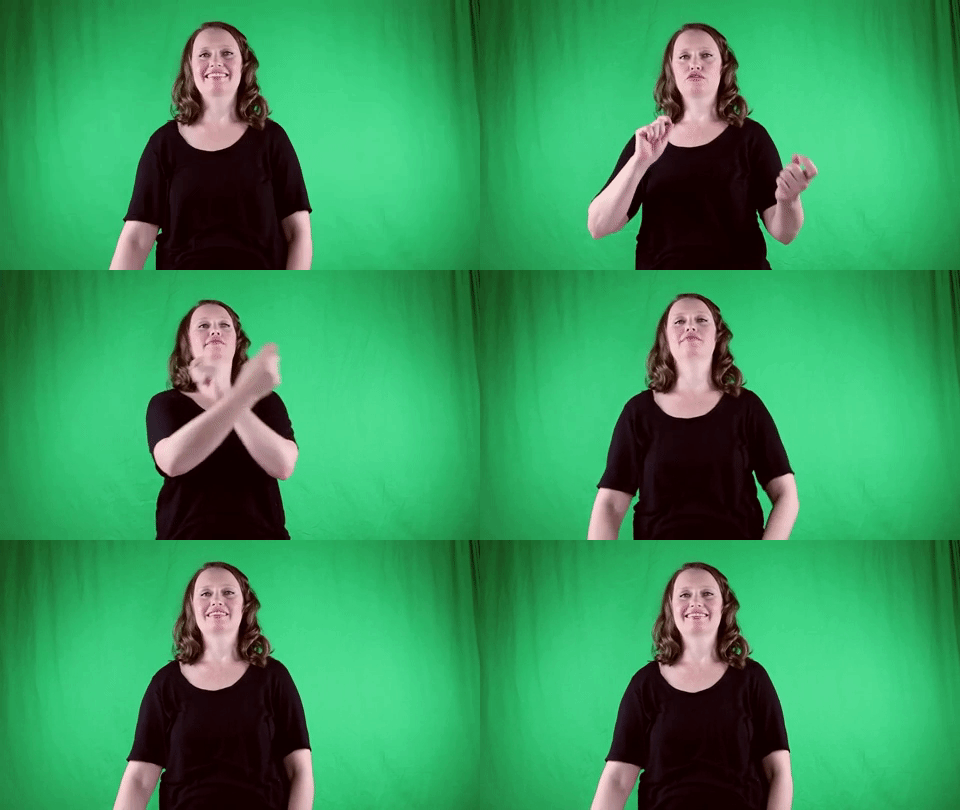
Sign for CHANGE in ASL

Practice Activities:
Begin by practicing the sign for CHANGE in ASL in front of a mirror to ensure correct handshape and movement. Repeat the sign slowly and then gradually increase speed while maintaining clarity. Focus on the X-handshape on both hands and the twisting motion near the wrists. Try switching between the sign in isolation and using it within short phrases like “need change” or “time to change.”
Use flashcards with vocabulary that commonly pairs with the sign for CHANGE in ASL such as weather, clothes, direction, or opinion. Hold up a card and sign a sentence like “The weather changed” or “I changed clothes.” This builds fluency and helps connect usage to real-life contexts. You can also create a gesture-to-sign matching game where one person performs a gesture for a scenario and the other signs an appropriate sentence that includes the sign for CHANGE in ASL.
Partner up for a practice activity where one person narrates a story while the other listens and identifies when to insert the sign for CHANGE in ASL. Swap roles and challenge each other with varied topics such as travel, daily routines, or past events. Encourage the use of facial expressions to add emotion, like surprise or frustration, depending on what is changing in the story.
Write a short paragraph or visual story about a person who experiences changes at work or home and sign it out. Include signs for events like moving, growing up, or a change in plans. This encourages constructing longer narratives while reinforcing repeated use of the sign for CHANGE in ASL.
End each session by reviewing your signed examples on video. Pay attention to rhythm, clarity, and how naturally the sign for CHANGE in ASL appears in your sentences. Self-assessment will deepen retention and improve expressiveness.
Cultural Context:
In American Sign Language, the sign for CHANGE in ASL represents more than just the transformation of objects or ideas. It also reflects shifts in societal norms, values, and identities. This sign carries cultural weight within Deaf communities, as change is often a deeply personal and collective experience.
The sign for CHANGE in ASL is frequently used when discussing advocacy and progress within the Deaf community. It is a common term in conversations around education rights, interpreter access, and Deaf representation. The sign embodies not just transformation, but the ongoing efforts to build a more inclusive world.
In Deaf history, the concept of change is vital. The fight for equal rights, the recognition of ASL as a legitimate language, and the technological advancements that impact communication have all brought about significant changes. When signing CHANGE in ASL, there is often a deeper emotional context tied to community experience.
ASL storytelling also incorporates the sign for CHANGE in powerful ways. Deaf poets and performers use the sign to express personal growth, social awareness, and emotional shifts. This makes the sign both a linguistic and artistic tool, enriching the cultural dialogue within ASL spaces.
Within conversations, the sign for CHANGE in ASL can imply subtle shifts or major life transitions. Topics like job changes, moving homes, or changes in relationships often require this sign. Because ASL is a visual language, the context and intensity of the sign can be clearly conveyed through facial expressions and body movement.
The sign is especially relevant in educational settings, where discussions about political change or social reform often include the sign for CHANGE in ASL. Teachers encourage students to explore what change means in different contexts—historical, personal, or community-based. This helps young signers connect with the broader Deaf cultural experience.
In Deaf activism, the sign for CHANGE in ASL is both symbolic and practical. It represents a call to action, a demand for justice, or a signal of evolving perspectives. Protest banners, social media videos, and community organizing events often include the sign as part of the broader visual language of change.
The word “change” takes on added depth when interpreted through ASL. It isn’t just a linguistic translation; it’s a cultural marker for evolution, growth, and the Deaf experience. Whether talking about changing weather, changing mindsets, or cultural transformation, the sign is a bridge between communication and meaning.
Learning the sign for CHANGE in ASL can help hearing people better understand Deaf culture and the values it represents. It opens up deeper conversations about inclusion, accessibility
Extended Definition:
The sign for change in ASL is a dynamic and commonly used concept that appears in conversations across many topics. Whether you’re talking about lifestyle adjustments, weather transformations, or a switch in plans, knowing how to sign change in ASL helps you communicate effectively in real-life situations.
To produce the sign for change in ASL, start by making two fists with your hands. Position one hand over the other with the palms facing down. Then, rotate the fists in opposite directions so that their positions switch. This movement represents the idea of something becoming different or altering its form. The motion is smooth and deliberate, helping convey the natural process of transition or modification.
The sign for change can also be modified slightly to express variations in meaning. For example, changing tone or speed can signal whether the change is urgent, gradual, or hypothetical. In conversation, facial expressions often enhance the meaning, especially when indicating emotional or unexpected changes.
This sign is used in a variety of contexts. If you’re talking about a change in the weather, you might sign weather and then change. If someone switches jobs, you might sign work and then add the sign for change in ASL. This adaptability makes the sign a valuable part of your ASL vocabulary.
The concept of change is also important in storytelling. When sharing narratives, especially personal stories or news, the sign for change in ASL helps build tension or show progress. It provides visual clarity when describing how people, environments, or situations evolve over time.
In daily life, you might sign change to talk about changing clothes, plans, moods, or settings. You could say something like “I need to change” using the sign in a short phrase. Pairing it with verbs or nouns that relate to the subject makes your sentence more complete and easier to understand.
During classroom discussions, the sign for change in ASL is often used in subjects like science, history, or social studies to show how things develop or transform. It’s common in lessons about climate change , historical events , or technological progression . Teachers and students alike rely on this sign to explain complex ideas in a visual way.
In group conversations or meetings, the sign can indicate shifting topics or revising decisions. It shows flexibility and awareness of ongoing processes. Knowing how to use this sign properly increases your fluency and makes your communication clearer.
The sign for change in ASL connects strongly with themes of growth, transition, and adaptation. Addressing these themes visually helps Deaf and hard
Synonyms: alter, modify, adjust, transform, revise
Educational resources: Find related learning materials in our course bank!
Want more? Check out some of our popular learning activities on the homepage!
Need to look up a sign? Use our highly rated dictionary: https://aslinteractive.com/best-asl-dictionary/
Follow us on tiktok: https://www.tiktok.com/@aslinteractive. More social media links at the bottom of this page!
Long-tail Keywords: what is the sign for change in ASL, how do you sign change in ASL, change in American Sign Language
Categories:
tags: Change, Verbs, Commands, Everyday Activities, Major Decisions
Parameters
*Handshape*:
The handshape used in the sign for CHANGE in ASL involves both hands forming the “X” handshape , with the index fingers bent and other fingers tucked in. These X hands represent items or ideas that are being switched or altered.
To form the sign for CHANGE in ASL, bring the hands together in front of the body, cross them at the wrists, then rotate and switch their positions. This crossing and rotating motion visually illustrates the concept of transformation or change.
*Palm Orientation*:
For the sign for CHANGE in ASL, both hands form “X” handshapes, and the palms generally face each other with a slight downward angle. During the movement, the hands twist so that their positions switch, often with the right hand ending on top. The palm orientation adjusts subtly with this twist, but they continue to face mostly inward toward each other throughout the sign.
This palm orientation is crucial for conveying the correct meaning of the sign for CHANGE in ASL. Maintaining this clear inward angle ensures that the twisting motion, symbolizing transformation or alteration, is visually distinct.
*Location*:
The sign for CHANGE in ASL is performed in the neutral space directly in front of the torso, slightly below the chest. Both hands begin in the “X” handshape and are positioned near each other at chest level.
This location allows for clear visibility and comfortable movement during the twist motion that conveys transformation. Using the upper torso area ensures the sign for CHANGE in ASL is easily distinguished from signs with similar handshapes.
*Movement*:
The sign for CHANGE in ASL involves both hands in the X-handshape. Start by holding the dominant hand over the non-dominant hand, both pointing slightly outward and downward. Then twist both hands in opposite directions so that their positions swap, moving the dominant hand to the bottom and the non-dominant to the top.
This twisting motion symbolizes transformation or modification. The sign for CHANGE in ASL effectively conveys the concept of something becoming different or undergoing a shift.
*Non-Manual Signals*:
The non-manual signals for the sign for CHANGE in ASL typically include a neutral to mildly serious facial expression, indicating the concept of alteration or transformation. Depending on context, an inquisitive or concerned look may accompany the sign if asking about change or emphasizing a significant shift. Eyebrows may be slightly raised when posing a question, and lips might be pressed lightly, enhancing the meaning of the sign for CHANGE in ASL.
*Prosody, Dominant/Non-Dominant Hand*:
The sign for CHANGE in ASL uses both hands in an “X” handshape. The dominant hand is placed over the non-dominant in a crossed position, then both hands twist to switch positions—now the dominant is on the bottom. This twisting motion shows a transformation or shift, effectively conveying the meaning behind the sign for CHANGE in ASL ️.
Both hands move together in a synchronized, fluid motion. This symmetry is important to clearly convey the concept expressed by the sign for CHANGE in ASL.
Tips for Beginners:
When learning the sign for CHANGE in ASL, it’s essential to focus on precision and symmetry. The basic motion involves both hands in the X-handshape (index fingers bent), with the dominant hand crossing over the non-dominant near the wrists, then flipping positions. Keep your movements fluid and deliberate, avoiding fast or sloppy motions that can confuse the meaning.
One common beginner mistake is not aligning the hands correctly or using inconsistent handshapes. Make sure that both hands form the same shape and move in sync. If your hands don’t match or move out of coordination, the sign can lose meaning or become unclear. Practicing in front of a mirror can help improve symmetry and control.
To master the sign for CHANGE in ASL, pay close attention to the wrist rotation and palm orientation. After the initial crossing, your wrists should rotate smoothly, switching the top and bottom hand without jerking or pausing. This motion reflects the concept of transformation or shift, so it needs to be executed cleanly to convey the idea effectively.
Another key tip is to incorporate facial expressions that match the context. The sign for CHANGE in ASL can refer to physical changes, mood shifts, or changes in plans, so your expression should reflect whether the change is positive, negative, or neutral. ASL relies heavily on non-manual signals, and the right facial expression enhances meaning and clarity.
When practicing, try using the sign in full sentences to build fluency. Pair it with time concepts or descriptors so you get used to how it fits in conversation. For example, try signing “plans change” or “weather change” to reinforce the sign in context.
Lastly, be patient and consistent. The sign for CHANGE in ASL is straightforward but relies on coordinated movement and smooth transitions, which can take time to master. Keep practicing with others or your reflection to build confidence and accuracy.
Connections to Other topics:
The sign for CHANGE in ASL is closely related to the concept of transformation, transition, or modification. It shares movement elements with other signs that involve exchange or shifting, such as SWITCH and TURN-AROUND, which helps learners see commonalities in handshape and motion, especially the twisting motion with “X” handshapes. This makes it easier to recognize how concepts tied to evolving or switching are physically represented in ASL.
In compound or idiomatic phrases, the sign for CHANGE in ASL often appears directionally to denote whose change it is or what is being changed. For example, in CHANGE-MIND, the sign incorporates the sign for MIND and wraps in the CHANGE motion to represent a shift in thinking or decisions. Similarly, CHANGE-PLAN links action to mental or logistical scheduling, helping to build layers of meaning through sign compounds.
The sign for CHANGE in ASL also intersects with time-based signs, like FUTURE and PAST, when talking about trends or transitions over time. You might see a sentence where someone signs “CHANGE OVER TIME” or “CHANGE SOCIETY” to talk about cultural or historical shifts, showcasing how abstract concepts are conveyed in a visual-spatial language.
There are also visual and conceptual ties between the sign for CHANGE in ASL and economic terms like EXCHANGE, MONEY-CHANGE, or CONVERT, especially in financial or business contexts. These signs often apply the same twisting motion to reflect the transactional aspect of change. In digital or technology discussions, CHANGE-SETTINGS or SYSTEM-CHANGE are more technical but still connected by the core movement root of the CHANGE sign.
Understanding these links helps broaden vocabulary and supports fluent incorporation into conversations about growth, adaptation, or transformation . Practicing how the sign for CHANGE in ASL is modified in location, direction, or speed depending on topic enhances expressive clarity.
Summary:
The sign for CHANGE in ASL involves both hands in the X-handshape, with one hand on top of the other. The hands then rotate as if switching positions, symbolically representing transformation or a shift. This movement captures the essence of the word both literally and conceptually.
In ASL, positional changes often denote conceptual shifts, and the sign for CHANGE in ASL embodies this principle. The interchange of hand positions draws a visual parallel to the idea of transformation. This makes it not only functional but deeply iconic, embodying meaning in both motion and form.
The sign for CHANGE in ASL appears across many contexts. It can describe environmental changes, personal development, financial exchanges, or shifts in mood or attitude. Like many ASL signs, its flexibility in meaning is grounded in context and sentence structure.
Grammatically, the sign for CHANGE in ASL acts similarly to English verbs. It can function as a transitive or intransitive verb depending on the surrounding linguistic markers. It may also be modified by facial expressions or non-manual signals to match time tenses or emotional tone.
In richer sentence structures, the sign can be intensified or altered through repetition to convey more complex ideas. For example, signing it multiple times with faster movement can reflect rapid or dramatic change. Slower or single movements might suggest gradual transitions.
The cultural significance of the sign for CHANGE in ASL extends into Deaf identity and advocacy. CHANGE is a recurring theme in matters of social justice, accessibility, and language rights within the Deaf community. When talking about systemic reform or personal empowerment, the sign gains layered meaning.
This is especially powerful in storytelling and performance within Deaf culture. Poets, actors, and activists often use the sign for CHANGE in ASL in striking, creative ways. Its visual clarity allows for emotionally charged expressions in visual vernacular or ASL poetry.
From a linguistic standpoint, the sign aligns with principles of iconicity in sign languages. Iconicity refers to how sign formation reflects the concept it represents. In this case, the rotating movement of X-handshapes mimics the idea of something being reversed or altered.
This sign also ties into broader patterns seen across different natural sign languages. Many sign languages use twisting or rotating movements to signify transformation or action. This suggests conceptual parallels across visual-gestural linguistic systems.
In terms of applied linguistics, the sign for CHANGE in ASL is a teaching tool for demonstrating verb modification and compound formation. It is often taught alongside signs like GROW, DEVELOP, or BECOME to show semantic progression. These connections help build learners’ fluency and conceptual depth.
There are related signs that frequently intertwine with the sign for CHANGE in ASL. For instance, EXCHANGE also involves a movement of objects or ideas between parties but may focus more on mutual action. The sign for CONVERT shares a similar handshape but differs in intensity and focus.
Morphologically, the sign for CHANGE in ASL stands as a primary root verb and can be modified to express nominal or adjectival forms. Adding the agent marker, for example, forms the term CHANGER, referring to a person who changes something. This mirrors how English builds words from base forms.
Its placement in a sentence often determines its relationship to other signs, functioning like the verb pivot in ASL syntax. The sign may come before or after nouns or time indicators depending on emphasis or subject focus. This flexibility reveals important distinctions in ASL grammar.
Deaf educators discuss CHANGE frequently in the classroom to emphasize adaptation and self-advocacy. Students in bilingual Deaf schools learn the sign early as part of developing narrative and cognitive skills. It helps frame discussions around growth and transformation.
The sign for CHANGE in ASL also appears in many urban and political discussions within the Deaf community. Deaf organizations advocating for policy reform may use the sign symbolically in visual campaigns or public statements. It becomes a rallying sign in these moments.
In storytelling traditions, the sign for CHANGE in ASL adds dramatic tension or resolution to narratives. It may symbolize a character’s personal evolution, or a shift in a group’s fortunes. In such uses, a performer’s emotional expression elevates the sign’s interpretive impact.
Technologically, as ASL becomes more represented in media and virtual platforms, the sign for CHANGE in ASL continues evolving in clarity and use. ASL content creators use it in vlogs, skits, or educational videos to convey everything from minor life updates to sweeping societal critiques.
In interactions that mix spoken language and ASL, interpreters often rely on context to match the sense of “change” in English to the right ASL sign. While CHANGE is a core verb, English’s many shades of “change” sometimes require specifying within ASL using classifiers or added detail.
The tactile nature of the sign also adapts well in Protactile communication used by DeafBlind individuals. Describing CHANGE in this context emphasizes distinct, tactile elements in hand movement and pressure. Such adaptations ensure
Want more? Check out some of our popular learning activities!
ASL Interactive Resources
ASLInteractive YouTube Channel
Follow us on tiktok: @aslinteractive.com
Follow us on Instagram: aslinteractive
Facebook page: aslinteractive
Facebook group: aslinteractive
LInkedIn: ASL Interactive LLC
Twitter: @ASL_interactive
*Some information on this page is AI-generated. AI can make mistakes. Please check the information.
Responses