Definition: A mark indicating verification.
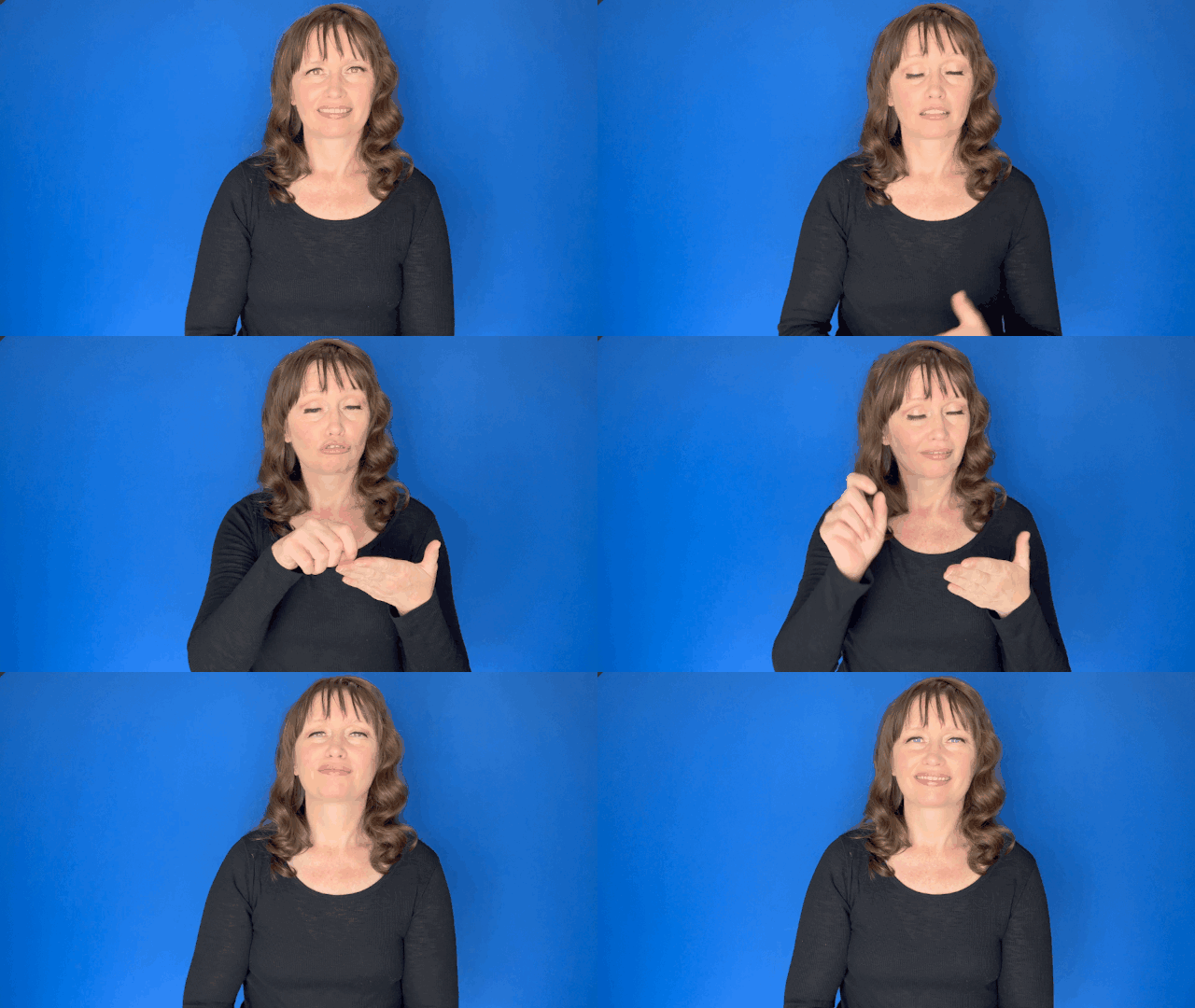
Sign for CHECK MARK 2 in ASL

Practice Activities:
To effectively practice the sign for CHECK MARK 2 in ASL, begin by working with a mirror and repeating the sign several times. Focus on precision in movement and hand orientation, ensuring it mirrors the correct motion for this version. You can alternate practicing both the sign for CHECK MARK 2 in ASL and the standard check mark to visually internalize the difference between them.
Incorporate the sign into simple declarative statements, such as “homework — finished — check mark” or “list — completed — check mark.” Pairing the sign with common daily expressions will help reinforce its practical use. Use flashcards with visual symbols where you identify each one and sign accordingly, using the check mark when appropriate.
Engage in a role-play activity with a partner where one person acts as a teacher or supervisor checking off tasks. As they list assignments or chores, you respond with the sign for CHECK MARK 2 in ASL to confirm completion. This helps embed the sign in natural conversational settings. Try reversing roles to get more interactive practice.
Storytelling is a great way to integrate new signs. Create a simple story or sequence about preparing for a birthday party, packing for a trip, or grocery shopping. Include checklists as part of the storyline and use the sign for CHECK MARK 2 in ASL to indicate when each task is done .
For solo practice, write out a daily to-do list and go through it in front of a mirror, signing a check mark at each accomplished task. This adds a real-world connection to your signing practice and builds fluency. Understanding how and when to use the sign for CHECK MARK 2 in ASL will make it easier to recall and produce it naturally during conversations or presentations.
Cultural Context:
In American Sign Language (ASL), the sign for CHECK MARK 2 carries both practical and symbolic meaning. The check mark is universally recognized as a symbol of completion, agreement, or correctness, and in Deaf culture, visual representations are crucial, making this sign particularly valuable in communication.
The sign for CHECK MARK 2 in ASL is commonly used in classroom settings, workplace interactions, and everyday routines where confirmation or acknowledgment is necessary. Whether it’s a student signing that their homework is done or a team member signaling approval on a task, this sign plays an important role in visual dialogue. It reinforces the idea of organization, approval, and progress.
CHECK MARK 2 in ASL may vary slightly depending on regional dialects or personal signing styles, which adds to the richness and diversity of the language. Just as spoken languages have accents and local expressions, ASL adapts signs to context and usage. This flexibility helps the language stay relevant and responsive to social needs, including digital and academic environments where check marks are frequently displayed.
Within Deaf and signing communities, the use of visual representations like CHECK MARK 2 in ASL connects strongly with the culture’s emphasis on clarity and affirmation. The gesture of a check mark combines simplicity with deep communicative function, offering an easy way to express confirmation or verify accuracy without needing spoken words or written text.
The sign for CHECK MARK 2 in ASL is also increasingly relevant in digital communication, especially in situations like online classes or video calls where Deaf individuals use ASL to interact in real-time. As more digital tools use check marks to indicate completed actions, having a culturally specific and visually appropriate way to represent that in ASL is essential. It ensures that the Deaf community maintains full access to common symbols used in technology and education.
Using the sign for CHECK MARK 2 in ASL also helps build inclusivity in environments where visual cues are important. Whether in a mainstream classroom or a Deaf-led setting, the sign supports understanding and accessibility. In many cases, it encourages the use of visual learning techniques that benefit both Deaf and hearing individuals.
CHECK MARK 2 in ASL reflects the cultural importance placed on non-verbal communication. Unlike spoken languages that rely heavily on sound, ASL uses hand shapes, facial expressions, and movement to convey layers of meaning. The check mark is a great example of how Deaf culture transforms a simple visual element into a powerful communication tool.
Understanding the sign for CHECK MARK 2 in ASL also opens up greater social understanding.
Extended Definition:
The sign for check mark 2 in ASL is a visual gesture used to represent the symbol commonly seen as a confirmation or approval. In American Sign Language, this sign may vary slightly depending on context, but it typically mimics the action or appearance of making a check mark in the air with your dominant hand.
The check mark is often used for affirmation, completion of a task, or marking something as correct. So, the sign for check mark 2 in ASL is useful in academic, professional, or casual settings where you may be discussing tasks, goals, lists, or approvals.
To express the sign for check mark 2 in ASL, signers usually draw a quick downward and upward tick with the index finger. This movement resembles writing a check mark on paper. Facial expression can also add meaning — like a nod or a satisfied look — to emphasize approval or completion.
In the classroom, this sign can be used when acknowledging a student’s correct answer or when confirming that homework was done. Teachers and students alike benefit from using a visual sign for check mark 2 in ASL, especially when communication needs to be silent or fast.
In daily life, you might use this sign when listing chores, errands, or steps in a recipe. If you finish a task, you can sign the check mark to visually confirm it’s done without saying a word. It’s a quick, universally understood gesture within Deaf and signing communities.
Digital platforms, mobile apps, and printed lists often use check marks to show status or completion. The sign for check mark 2 in ASL fits naturally into these tech-influenced conversations, especially when describing screen elements in accessible design or discussing notifications and updates.
In Deaf culture, visual and context-specific signs are common and adapt well to new symbols like emojis, tech icons, and modern interfaces. Since many check mark designs differ visually, some Deaf individuals may show different versions of the sign for check mark 2 in ASL depending on the situation or who they’re communicating with.
You may also encounter this sign used symbolically during meetings, group activities, or while giving presentations to indicate decisions or highlight points. Its quick execution allows signers to maintain focus and flow during communication.
While the core motion for the sign for check mark 2 in ASL remains the same, slight changes in hand placement or added gestures can personalize the sign. Some may include a quick thumbs-up after the check mark to double down on expressing approval or success .
Whether
Synonyms: Checkmark, Tick, Verified, Approved, Mark
Educational resources: Find related learning materials in our course bank!
Want more? Check out some of our popular learning activities on the homepage!
Need to look up a sign? Use our highly rated dictionary: https://aslinteractive.com/best-asl-dictionary/
Follow us on tiktok: https://www.tiktok.com/@aslinteractive. More social media links at the bottom of this page!
Long-tail Keywords: what is the sign for check mark in ASL, how to sign check mark in American Sign Language, ASL sign for check mark
Categories:
tags: Checkmark, Commands, Language Learning, Classroom, Everyday Activities
Parameters
*Handshape*:
The handshape used in the sign for CHECK MARK 2 in ASL typically involves a dominant hand forming a modified bent-V or loosely closed X shape. The fingers are slightly bent, resembling a writing or drawing motion. This mimics the physical act of making a check mark ✔️ on paper.
In the sign for CHECK MARK 2 in ASL, the motion of the dominant hand creates the illusion of drawing a check by tracing a quick downward and then upward arc, emphasizing accuracy and confirmation.
*Palm Orientation*:
For the sign for CHECK MARK 2 in ASL, the palm orientation typically faces downward or slightly forward, depending on the movement used. The dominant hand traces a quick ✔️ shape, often with the index finger extended while the rest of the fingers are tucked in.
Palm orientation remains consistent throughout the gesture to convey clarity. When executing the sign for CHECK MARK 2 in ASL, ensure the hand maintains steady direction and movement for accurate recognition.
*Location*:
The sign for CHECK MARK 2 in ASL is typically produced in the neutral space in front of the torso, slightly off-center to the dominant side. This location allows for clear visibility of the quick downward and upward hand movement that mimics the shape of a check mark ✔️.
Using neutral space in the sign for CHECK MARK 2 in ASL ensures that the gesture remains unobstructed and easily recognizable, enhancing clarity and understanding during communication.
*Movement*:
The sign for CHECK MARK 2 in ASL mimics the shape of a check mark using the dominant hand. Start with the index finger extended from an “L”-handshape, then move the finger downward diagonally to the left and sharply flick it upward to the right, as if drawing a check mark ✔️ in the air.
Keep the motion fluid and deliberate to clearly represent the concept. The sign for CHECK MARK 2 in ASL may vary slightly depending on regional usage, but the visual portrayal of the check symbol remains key.
*Non-Manual Signals*:
The non-manual signals involved with the sign for CHECK MARK 2 in ASL typically include a slight nod of affirmation accompanied by a focused or satisfied facial expression. Eyebrows remain neutral or slightly raised to convey confirmation or correctness, enhancing the overall meaning of a completed or approved task ✔️.
When using the sign for CHECK MARK 2 in ASL, the signer may also exhibit a subtle smile or a look of accomplishment, depending on the context. These visual cues help convey that something has been verified or accepted.
*Prosody, Dominant/Non-Dominant Hand*:
The sign for CHECK MARK 2 in ASL typically uses the dominant hand in a bent V-handshape, mimicking the action of drawing a check mark in the air. The dominant hand starts at the upper left and moves diagonally down to the right, then curves upward slightly, following the shape of a check mark.
The non-dominant hand is not used in this sign, keeping the prosody clear and focused on the dominant motion. This sign for CHECK MARK 2 in ASL clearly represents marking something as complete or approved✅.
Tips for Beginners:
When learning the sign for CHECK MARK 2 in ASL, it’s important to remember that this version typically uses a visual gesture mimicking the shape of a check mark. This often involves starting with the dominant hand in an index finger point and tracing a check shape downward and to the side. Consistency in the movement and angle helps ensure that the check mark is recognized clearly in context. Keep the motion smooth, with a slight arc, emulating how a check mark might appear on paper.
One helpful tip is to practice the sign in front of a mirror. This allows you to see if you are making the check mark clearly and at a slight angle, which is key for visual accuracy. Over-exaggerating the motion at first can help lock in muscle memory before you begin to refine it for fluid daily use.
Don’t confuse the sign for CHECK MARK 2 in ASL with signs for “correct” or “okay.” While they might involve similar hand shapes or positioning, the key feature of CHECK MARK 2 is the stylized motion that mimics writing the mark. Try practicing with different speeds to find the most natural and clear tempo.
In real-life usage, especially when marking tasks as complete in classroom or workplace settings, keeping the sign concise and visually distinct matters. If you’re using the sign during a presentation or on a video call, be sure your motion is within the camera frame and visible to your audience.
Beginners may tend to make the mark too small or too abrupt. Instead, aim for clear space and motion to maintain clarity. Remember, ASL is a visual language, and movement precision is essential. Regularly watching fluent signers and practicing the sign for CHECK MARK 2 in ASL in common sentence structures will increase your fluency and comfort using it naturally.
Connections to Other topics:
The sign for CHECK MARK 2 in ASL connects closely with signs that convey concepts like approval, correctness, and completion. It is often associated with the sign for FINISH or RIGHT, which help contextualize its meaning in sentences. This link strengthens understanding of how positive affirmation is communicated visually in ASL grammar.
In real-life contexts, the sign for CHECK MARK 2 in ASL may appear in educational or goal-setting environments where tasks are being checked off or marked complete . It can be incorporated into signed expressions like TASK FINISH CHECK MARK 2, combining multiple sign meanings for clearer communication. This compound approach enhances fluency and mirrors natural ASL storytelling methods.
The concept of verification or validation also ties into this sign. Signs such as APPROVE, VALID, and CORRECT can be used in similar contexts, depending on the intent and tone. These connections help signers navigate subtle differences in meaning while signing about evaluation or success.
As a visual counterpart to a written checkmark, this sign bridges language with symbolic concepts. Learners benefit by associating the sign for CHECK MARK 2 in ASL with visual literacy, such as recognizing symbols in digital platforms ✅. This visibility in both print and tech-savvy spaces enriches the sign’s usage across generations and settings.
In academic and workplace discussions, this sign may align with performance reviews, quality checks, or task lists. This proves valuable for professional interpreters or Deaf professionals needing to engage in structured dialogue. Compound phrases using this sign can include CHECK MARK 2 GOAL MEET or LIST FINISH CHECK MARK 2, reinforcing goal completion with spatial grammar elements.
By pairing the sign for CHECK MARK 2 in ASL with conceptually related signs and classifier use, learners can deepen their expressive skills in ASL narratives. This connection makes the sign multifunctional in both formal and informal communication.
Summary:
The sign for CHECK MARK 2 in ASL conveys a specific visual gesture, referencing the distinct shape of a check mark rather than the concept of approval broadly. This variation emphasizes the action of drawing a check mark with the dominant hand, usually mimicking the motion of writing or marking. It leans heavily into iconicity, where the movement illustrates the physical act.
In this version, the dominant hand typically uses the index finger extended and may draw a small “V” shape in the air or on the palm of the non-dominant hand. Sometimes the movement is done on an imaginary surface, referencing the act of ticking off an item. This helps communicate that a task or goal has been completed.
The sign for CHECK MARK 2 in ASL is context-dependent and primarily appears in educational, organizational, or office-related conversations. For example, a teacher might use it when indicating a student got something correct on an assignment. In meetings, someone might sign it while reviewing agendas or completed tasks.
Grammatically, this sign works as a noun or verb depending on context. As a verb, it could mean “to mark” or “to check something off.” As a noun, it simply refers to the mark itself, an abstraction of the written tick shape.
This variation distinguishes itself from a thumbs-up or general gestures used to indicate correctness or approval in casual ASL. While those signs reflect broader cultural affirmations, the sign for CHECK MARK 2 in ASL narrows the meaning to a literal evaluation mark. This makes it functionally unique in environments rich with assessment and organization.
The form of the hand may shift slightly depending on the signer’s comfort or clarity. Some users prefer to drag the tip of the extended index finger sharply as they mimic the shape. Others may modify the sign to be more fluid if they are integrating it into rapid conversation.
From a linguistic perspective, the sign for CHECK MARK 2 in ASL demonstrates how spatial movement can iconicize physical writing gestures. This supports theories within sign language linguistics regarding gesture-driven classifiers and mapping ideas visually. Such signs often blur the boundary between gestures and formalized lexical items.
In analyzing this sign from an applied linguistics point of view, it helps teach learners how writing-related tasks are conceptualized in ASL. This can be useful in educational settings where visuals must pair directly with written processes, such as writing, annotating, or grading. The sign thus occupies a functional bridge between language and action.
The gesture relies on ASL’s spatial grammar, in which the horizontal plane often symbolizes written surfaces like paper or screens. Signing in this plane gives the visual cue that something is being annotated or physically marked. This grounds the representation in familiar cognitive schemas.
The sign for CHECK MARK 2 in ASL may also appear in conversations involving checklists, such as scheduling, project management, or personal organization. In such contexts, the sign may be iterated several times to mark off multiple virtual items. This repetitive use makes the sign dynamic and productive in daily discourse.
Adding this sign expands vocabulary for ASL signers who need to distinguish between different types of feedback. Someone may use CHECK MARK 2 as part of a contrast with an X-mark, illustrating distinction between right and wrong answers explicitly. This semantic flexibility adds deeper layers to interactions.
The cultural relevance of a check mark in western societies, including American Deaf culture, is rooted in education. The check mark often represents success, validation, and accuracy. Incorporating this into ASL signing reflects how visual language absorbs and reflects the dominant culture’s written conventions.
In Deaf culture, which heavily values visual communication, signs like CHECK MARK 2 are practical and intuitive. They provide rapid tools for marking correctness, completion, or recognition, often during group interactions or community workshops. Their visual clarity ensures streamlined comprehension.
In ASL discourse, signs like CHECK MARK 2 help construct narratives of achievement or progress. For example, when listing goals or discussing completed work, this gesture brings a sense of visual closure. This aids in structuring conversations, particularly within academic or professional contexts.
Some signers may adapt the sign depending on the setting—more exaggerated for teaching children, or subtler in business scenarios. Such adaptability makes CHECK MARK 2 a versatile item in the expressive toolkit of ASL users. With continuous use, it can even become stylized to the user’s signing habits.
Comparatively, the sign for CHECK MARK 2 in ASL offers more illustrative meaning than fingerspelling C-H-E-C-K or M-A-R-K. While fingerspelling remains precise, this sign adds rhetorical force by representing the physical action. It gives visual immediacy that fingerspelling alone can’t convey.
Technology also plays a role in how this sign gains prominence. As digital interfaces rely heavily on check marks—think forms, apps, to-do lists—ASL adopts accordingly. Youth and adult signers alike integrate these references, reinforcing the relevance of the gesture.
This sign also
Want more? Check out some of our popular learning activities!
ASL Interactive Resources
ASLInteractive YouTube Channel
Follow us on tiktok: @aslinteractive.com
Follow us on Instagram: aslinteractive
Facebook page: aslinteractive
Facebook group: aslinteractive
LInkedIn: ASL Interactive LLC
Twitter: @ASL_interactive
*Some information on this page is AI-generated. AI can make mistakes. Please check the information.
Responses