Definition: Free from clutter.
Sign for CLEAR in ASL

Practice Activities:
To practice the sign for CLEAR in ASL, begin by signing it repeatedly in front of a mirror. Focus on the movement from the hands being clasped to spreading open, which visually represents something becoming free of obstruction. Maintain relaxed hands and smooth motion each time.
Once you’re comfortable with the isolated motion, move on to using the sign for CLEAR in ASL within basic phrases. Sign short sentences like “sky clear,” “the water is clear,” or “I want a clear answer.” These examples help ground the sign in different contexts, focusing on clarity both physically and in meaning.
Partner up with another learner and take turns describing things that can be clear—glass, intentions, instructions, or weather. Have your partner guess what you’re describing using only signs. This helps build awareness of how the sign for CLEAR in ASL can be applied in various situations.
Try storytelling using short narratives. Describe a situation where something was confused, then became clear. For example, “I didn’t understand the math problem, but the teacher explained—now it’s clear.” This encourages the natural use of the sign inside a narrative.
As a solo activity, use flashcards that include adjectives like “cloudy,” “dirty,” or “blurry” on one side, and challenge yourself to sign the opposite using CLEAR and matching contextual signs. This enhances your understanding of the language’s range and allows for critical thinking.
Record yourself using the sign for CLEAR in ASL in several contexts and review the video for clarity and accuracy. This self-assessment helps identify inconsistencies in facial expressions and hand movements.
Practice fingerspelling related words like “glass” or “clean” to reinforce spelling skills, then sign complete phrases with CLEAR. These layered activities will help deepen your confidence and fluency with the vocabulary.
Cultural Context:
In American Sign Language (ASL), the sign for CLEAR in ASL doesn’t just communicate clarity — it visually expresses a sense of openness, transparency, and understanding. This sign carries both functional and cultural meaning, showing how the Deaf community values effective visual communication. Understanding the sign for CLEAR in ASL provides deeper insight into how language is shaped by visual and cultural context.
Within the Deaf community, the sign for CLEAR in ASL is often used to convey that something is easily understood. Whether it’s explaining a concept, expressing emotions, or giving directions, the word “clear” shows that everything is accessible and straightforward. This reflects the cultural emphasis on direct and effective communication in ASL.
The visual nature of ASL gives the sign for CLEAR in ASL a strong and vivid feel. It typically mimics the idea of removing something cloudy or foggy, making a view unobstructed. This visual metaphor connects deeply with the way Deaf individuals experience the world—through precise, visual input.
Clarity is a value emphasized in Deaf culture, not only in conversation but in relationships, learning, and accessibility. The sign for CLEAR in ASL supports this cultural focus, allowing users to affirm when messages are fully understood. Seeing someone use this sign can bring comfort and affirmation that communication is flowing smoothly.
In educational settings, the sign for CLEAR in ASL is especially important. Teachers, interpreters, and students often use this sign to check comprehension. It allows Deaf students to advocate for themselves in learning environments in a way that is both respectful and empowered.
Deaf culture also thrives on shared storytelling, which demands that narratives are conveyed with clarity and purpose. In ASL storytelling, a signer might pause and sign “clear” if they want to ensure that their audience is following the story. The sign for CLEAR in ASL becomes key to keeping visual stories engaging and understandable.
The use of CLEAR in social situations may extend beyond its dictionary definition. A friend might use the sign for CLEAR in ASL to indicate emotional clarity or resolution after a tough conversation. This meaningful use reflects how ASL can express not just facts, but feelings and connections.
In family or community discussions, particularly those involving important decisions, CLEAR is a powerful sign. It reassures participants that opinions and information have been understood. This reinforces the collective and supportive nature of Deaf interactions.
When someone asks if what they said is clear, they are inviting feedback. Using the sign for CLEAR in ASL to respond shows active participation,
Extended Definition:
The sign for clear in ASL represents the idea of clarity, transparency, or something becoming understandable. It can refer to a physical appearance, like a clear sky or clear glass, or something less tangible, like a clear explanation or a clear decision. This sign helps express that something is free of confusion or obstruction.
To produce the sign for clear in ASL, the movement typically involves both open hands starting together and then moving apart while opening up, indicating something becoming visible or free from obstruction. The motion can also reflect the disappearing of cloudiness or confusion, making way for understanding. Facial expressions help convey the intensity of the meaning, especially when using the sign in an emotional or abstract context.
The sign for clear in ASL is often used when talking about communication. If a speaker is easily understood, someone might say their explanation was clear. This is also helpful in educational settings, such as when a teacher ensures their message is received clearly by Deaf or hard of hearing students.
In visual descriptions, the sign for clear in ASL is useful when talking about weather conditions, like a clear day or clear skies ️. It’s also applicable when discussing materials, like clear glass or water. The use of this sign can give depth to expressive, descriptive language in ASL, adding detail that visual thinkers appreciate.
When it comes to emotions, the sign for clear in ASL is commonly used to show relief or resolution. For example, someone might use it after resolving a conflict or making a difficult decision, indicating the mind is now clear. In these situations, body language and facial expressions add layers of meaning to the sign, highlighting peace or understanding.
You’re likely to encounter the sign across different types of conversations, from casual chats to academic discussions. The versatility of the sign for clear in ASL makes it essential for everyday communication. Whether describing a person, an object, or an idea, it helps convey that something is easy to see or comprehend.
Parents teaching their Deaf children often use the sign for clear during early language development. It helps build vocabulary around visibility, understanding, and emotions. In this context, repetition of the sign ensures the child links the visual movement to real-world clarity or comprehension.
In storytelling and ASL poetry, performers use the sign for clear in dramatic ways. It adds richness to narratives, especially in scenes involving discovery, change, or emotional shifts. Its visual clarity makes it a favorite in expressive performance art.
For interpreters working in professional settings, the sign for clear
Synonyms: transparent, obvious, evident, plain, unambiguous
Educational resources: Find related learning materials in our course bank!
Want more? Check out some of our popular learning activities on the homepage!
Need to look up a sign? Use our highly rated dictionary: https://aslinteractive.com/best-asl-dictionary/
Follow us on tiktok: https://www.tiktok.com/@aslinteractive. More social media links at the bottom of this page!
Long-tail Keywords: how to sign clear in ASL, what is the ASL sign for clear, clear in American Sign Language
Categories:
tags: Commands, Language Learning, Verbs, Everyday Activities, Basic Grammar
Parameters
*Handshape*:
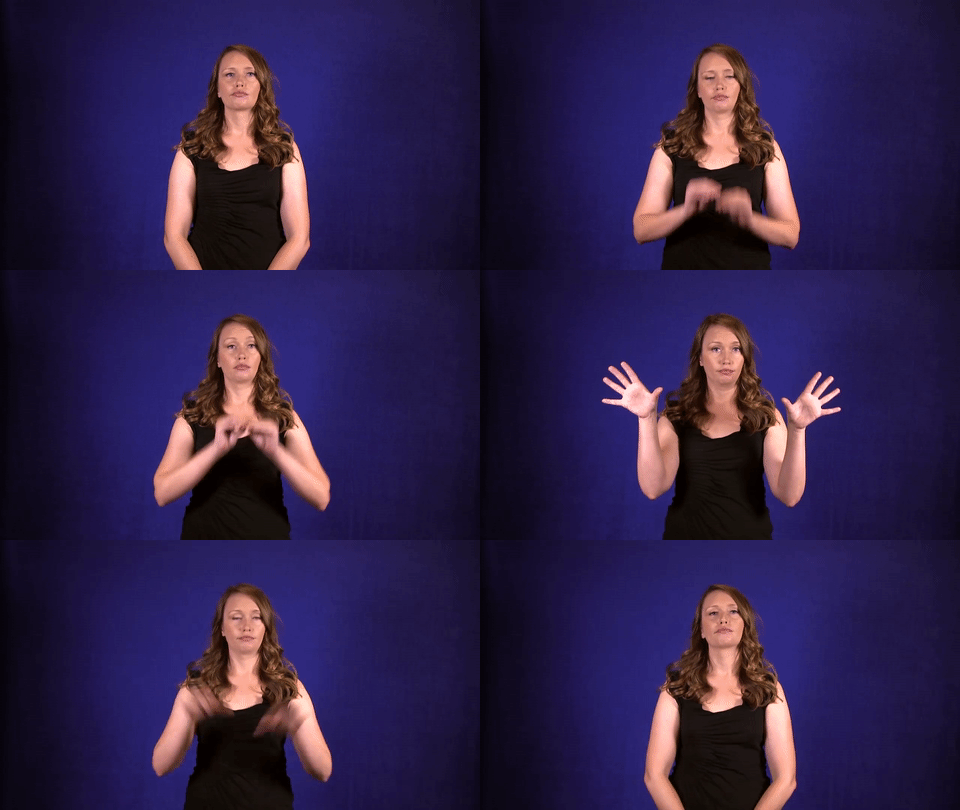
The sign for CLEAR in ASL uses open 5-handshapes on both hands. The dominant hand starts in front of the nondominant hand with the fingertips touching. As the movement occurs, the fingers spread and move apart in a quick, outward motion.
This motion creates a visual representation of something becoming transparent or unobstructed, matching the meaning of the sign for CLEAR in ASL. The open handshape emphasizes the clarity and visibility associated with the concept.
*Palm Orientation*:
The palm orientation for the sign for CLEAR in ASL begins with both hands in front of the body, slightly curved with fingertips touching lightly. Palms initially face each other, then rotate outward as the hands move apart smoothly, resulting in open palms facing forward.
This movement and position symbolize clarity or removal of obstruction. The sign for CLEAR in ASL uses open-palmed, relaxed gestures to represent the concept of something becoming visually or conceptually unobstructed.
*Location*:
The sign for CLEAR in ASL is produced in the neutral space in front of the body, around chest to upper chest level. This area allows for clear visual representation when the hands move apart to convey the concept of clarity or something becoming see-through.
When performing the sign for CLEAR in ASL, make sure the movement stays within a comfortably visible zone without extending too far from the torso. This common signing space ensures that the sign remains easily understood by viewers.
*Movement*:
To produce the sign for CLEAR in ASL, begin with both hands in the closed 5-shape, palms facing each other and fingertips touching in front of your chest. Then, smoothly separate the hands outward while simultaneously changing them into open 5-hands, as if something foggy is becoming transparent.
The movement expresses the concept of clarity or transparency. The sign for CLEAR in ASL visually conveys something becoming unobstructed or easy to understand. ✨
*Non-Manual Signals*:
The non-manual signals for the sign for CLEAR in ASL often include a relaxed and attentive facial expression, signaling resolution or understanding. Eyebrows may raise slightly to show clarity or realization depending on the context.
Eyes should remain focused on the movement, reflecting intention and directness. A neutral or slightly uplifted mouth posture enhances the meaning of the sign for CLEAR in ASL, emphasizing the concept of something being transparent or easy to comprehend. ✨
*Prosody, Dominant/Non-Dominant Hand*:
The sign for CLEAR in ASL uses both hands in open “5” handshapes. The dominant hand is placed palm-down over the non-dominant hand, palm-up. With a smooth sweeping motion, the dominant hand glides up and slightly forward, symbolizing transparency or clarity.
Facial expression should reflect the concept of something becoming easy to understand. The sign for CLEAR in ASL visually represents a clearing or unveiling, enhancing the meaning through hand movement and expression. ✨
Tips for Beginners:
When learning the sign for CLEAR in ASL, it’s important to focus on precision and fluidity. This sign relies heavily on smooth hand movement and facial expressions to emphasize the idea of something becoming free from obstruction or confusion. Practicing in front of a mirror can greatly help you track the exact motion and angle of your hands.
One of the most common mistakes beginners make with the sign for CLEAR in ASL is making the motion too quickly or stiffly. This can lead to a sign that looks more like a different concept. Instead, work on making the movement fluid and slightly slower so the meaning remains intact. Don’t forget—facial expressions matter a lot in ASL. A relaxed, neutral face can reinforce the idea of clarity or understanding.
It’s also essential to ensure your starting handshape is correct. For this sign, you start with two open hands, slightly cupped, with fingertips touching in front of you, and then separate them outward in a clean, sweeping motion. Practicing this separation in a smooth way will make the sign more visually clear to your conversation partner.
Repetition is key. Try using the sign for CLEAR in ASL in different sentence contexts like “The sky is clear” or “Now it’s clear.” This helps reinforce your understanding of both the sign and its usage. Get feedback from fluent signers or use video recordings to track your progress over time .
Lastly, remember that consistency is more important than speed. If you rush your motions, your audience may not understand what you’re trying to convey. Being calm and intentional will help your version of the sign for CLEAR in ASL stand out and be clearly understood by others .
Connections to Other topics:
The sign for CLEAR in ASL is closely related to concepts such as understanding, vision, and transparency. It often serves as both a literal and metaphorical sign, making it applicable in varied contexts like “clear sky,” “clear mind,” or “to clarify.” Because ASL is a visual language, the idea of clarity naturally extends into many expressions tied to perception and comprehension.
The sign for CLEAR in ASL also connects with signs like UNDERSTAND, EXPLAIN, and TRANSPARENT. These signs often appear together in contexts where a person is trying to make something comprehensible. For example, a teacher might sign EXPLAIN FOLLOWED-BY CLEAR to emphasize a point that needs to be fully understood. The ability to sequence signs appropriately allows for greater depth and precision in communication.
In compound phrases, the sign for CLEAR in ASL can be combined with THINK to suggest “clear-headed” or with MIND to reference a “clear mind.” It can be adapted into different contexts like CLEAN/CLEAR-UP when talking about organizing or decluttering a space. Sometimes it blends with TIME to emphasize “a clear schedule,” showing its flexibility in conceptual combinations.
There’s also a conceptual connection to FEELINGS and EMOTIONS in ASL. The sign for CLEAR may be used alongside signs such as CALM or PEACEFUL to indicate emotional clarity or relief. This makes it a useful sign when discussing mental health or mindfulness topics, often accompanied by non-manual markers to convey subtle emotional states.
The visual and abstract flexibility of the sign for CLEAR in ASL helps learners connect it with both concrete situations and more philosophical or emotional ideas. This makes the sign not only foundational in daily conversations but also essential for deeper discourse in ASL. Integration of this sign across contexts trains learners to think in ASL structure while expanding their expressive range.
Summary:
The sign for CLEAR in ASL is visually expressive and conceptually rich. It often begins with both hands in a flat “O” handshape, palms touching or close together in front of the face or chest. Then, the hands move apart slightly while opening into a spread “5” handshape, symbolizing clarity unfolding or something becoming understandable.
This motion metaphorically represents a fog lifting or something becoming visually and mentally obvious. The gesture captures both visual and abstract notions of clarity, making it useful in various contexts. This iconicity aligns with many ASL signs, where physical actions visually signify abstract ideas.
Culturally, clarity is a valued trait in the Deaf community. Clear signing and communication reflect respect and effective interpersonal connection. The concept behind the sign for CLEAR in ASL is not just about vision but also about intellectual or emotional understanding.
Grammatically, the sign functions primarily as an adjective but can serve adverbial or even verb-like roles depending on how it’s used. For example, one might say something is “clear” in description or indicate that someone “cleared up” confusion. In varying contexts and sentence types, the sign’s placement and movement may shift subtly.
ASL is not a linear language in the way English is. The spatial and gestural grammar of ASL allows for the sign for CLEAR in ASL to occupy identification, clarification, or even transitional functions within a narrative or discourse. For example, it can act as a transition in storytelling, symbolizing a new understanding or scene change.
The sign also conveys emotional transparency. When someone is “clear” in motive or intention, this ASL sign might be used to indicate emotional openness or honesty. In this way, it straddles visual clarity and ethical clarity.
Semantically speaking, it overlaps with signs such as “understand,” “obvious,” or “reveal,” depending on the context and how it is signed. Each of these shares an adjacency in meaning but remains distinct in handshape or motion, making the ASL lexicon both precise and richly textured.
In discussions where legal, moral, or critical clarity is needed, such as in debates or storytelling within the Deaf community, the sign for CLEAR in ASL gains weight. It doesn’t just describe something—it often affirms or validates the integrity of an idea. It helps anchor a narrative toward resolution or conclusion.
The motion outward from the center is critical in emphasizing the clearing action. Just as smoke disperses or glass is wiped free of fog, the sign’s motion encodes the passing of confusion or ambiguity. The visual metaphor reinforces how human cognition works: perceiving clarity in expanding or illuminating ways.
Children acquiring ASL naturally grasp this sign as a metaphor and action. Language acquisition studies show that concrete to abstract mappings—like the sign for CLEAR in ASL—are integral to both cognitive and linguistic development in signing children. It’s one of the ways that bodily action shapes conceptual growth.
In applied linguistics, such signs are studied to understand embodied cognition. The brain processes visual-manual language differently than spoken language, especially when meaning is tied to visual-spatial representation. The sign for CLEAR in ASL exemplifies this embodiment—how an abstract concept can be understood physically.
Relatedly, educators use the sign as scaffolding for explaining comprehension. In Deaf education, the sign for CLEAR in ASL may be utilized when a student demonstrates understanding, or when a teacher encourages clearer behavior or thinking. It reinforces both academic and social clarity.
Signs that are visually close include “open-up,” “clean,” or “light.” All of these share handshape or movement traits with CLEAR, yet semantic context clearly distinguishes the meanings. ASL learners often navigate these distinctions through context, facial expression, and movement subtleties.
In poetic or performing arts in ASL, performers use the sign for CLEAR in ASL to signify revelation or climax. A poem might build emotionally, reaching the sign for CLEAR as a visual crescendo. It can signal not just visual clarity, but existential transformation.
Deaf storytelling embraces such visual and layered signs. In narrative arcs, characters sometimes “gain clarity,” and the sign marks the twist or moment of insight. It becomes a cultural anchor point between confusion and revelation within the uniquely visual frame of ASL storytelling.
Beyond the ASL classroom, CLEAR is also used metaphorically in political or social commentary. Activists signing about access, truth, or justice may use CLEAR to reinforce messages around visibility, honesty, or unambiguous rights. Here, the sign moves beyond dictionary definition into social commentary.
Technology and captioning tools have adopted signs like CLEAR as shorthand or emphasis in media translations. For Deaf audiences, seeing accurate and expressive signing—including signs like CLEAR—elevates the accessibility and depth of information. Signs that carry such potent metaphors contribute heavily to viewer comprehension.
The sign’s subtle variations are also worth noting. In casual conversation, the motion may be quicker or smaller. In formal contexts or when
Want more? Check out some of our popular learning activities!
ASL Interactive Resources
ASLInteractive YouTube Channel
Follow us on tiktok: @aslinteractive.com
Follow us on Instagram: aslinteractive
Facebook page: aslinteractive
Facebook group: aslinteractive
LInkedIn: ASL Interactive LLC
Twitter: @ASL_interactive
*Some information on this page is AI-generated. AI can make mistakes. Please check the information.
Responses