Definition: A state in the U.S.
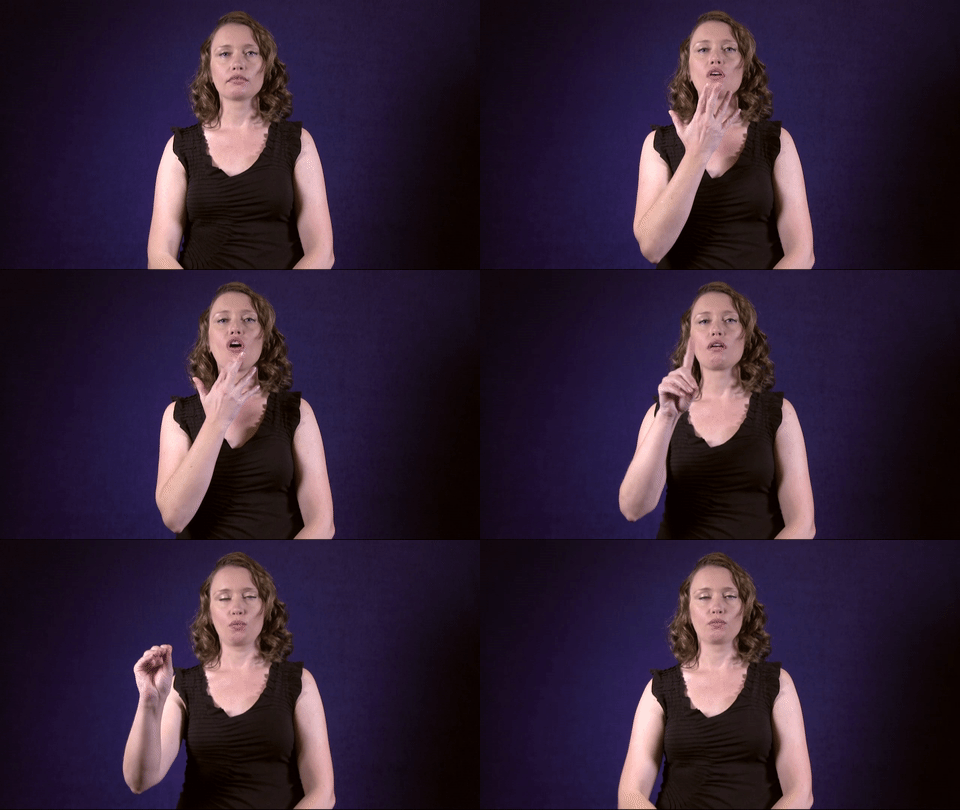
Sign for COLORADO 2 in ASL

Practice Activities:
To practice the sign for COLORADO 2 in ASL, start with isolated repetition. Stand in front of a mirror and repeat the sign five to ten times, paying close attention to your handshape, palm orientation, and movement. This variation typically begins by signing the state abbreviation C-O-L-O using the ASL fingerspelled alphabet, followed by a sign that represents “mountains” to reflect Colorado’s geography.
Try incorporating the sign into basic sentences. Practice phrases like “I am visiting Colorado,” “Colorado is beautiful,” and “My friend lives in Colorado.” This allows you to become fluent with the transition from fingerspelling to concept-based signing. Record yourself doing these sentences and compare with a model video if available.
Practice with a partner if possible. One person can ask location-based questions such as “What state do you want to visit?” and the other answers using the full sign for COLORADO 2 in ASL. Then switch roles to build familiarity and fluency through repetition. Use visual cues like maps and point to Colorado as you sign to reinforce meaning.
Use storytelling to practice embedding the sign naturally. Create a short story involving a trip to Colorado. For example, describe arriving in Colorado, hiking in the mountains, and seeing wildlife. Use visual descriptors and spatial referencing in the story to make it more engaging.
Use flashcards with state names, including the sign for COLORADO 2 in ASL. Go through the flashcards daily, practicing recognizing and producing the signs. Include time-based drills where you sign as many state names as possible in one minute to improve speed and recall.
To reinforce learning, watch ASL videos about U.S. geography and locate when and how the sign for COLORADO 2 in ASL appears. Mimic the signs as you watch to deepen your muscle memory and comprehension.
Cultural Context:
The sign for COLORADO 2 in ASL represents not just a U.S. state, but also a region known for its cultural diversity, stunning natural landscapes, and unique identity. When using the sign for COLORADO 2 in ASL, you’re expressing more than just geography—you’re acknowledging a place with deep indigenous roots, vibrant Hispanic communities, and a rich outdoor lifestyle.
In American Sign Language, regional signs can vary based on local Deaf communities. The sign for COLORADO 2 in ASL is one of these variations, reflecting how language evolves across different areas. This version may be more common in certain parts of the United States, particularly in and around Colorado itself.
Colorado is home to several Deaf schools and a strong Deaf community, especially in cities like Denver. Over time, this has influenced which sign variations are more widely adopted within the state. The sign for COLORADO 2 in ASL connects communication with culture, serving as a symbol of inclusion and accessibility within Colorado’s Deaf and signing populations.
The sign for COLORADO 2 in ASL often incorporates visual elements that represent the region’s mountains or natural features . Geography can play a big role in how signs develop, as visual language often mirrors physical characteristics. That makes the sign more intuitive to locals and people familiar with the state’s iconic Rocky Mountains.
Because American Sign Language thrives on context, signs for places like Colorado can have multiple versions based on who is using the sign and where they learned it. The sign for COLORADO 2 in ASL might be used more frequently by native Deaf Coloradoans or by interpreters who work in that region and want to match local signing styles.
Cultural identity in Colorado involves more than just location—it reflects values and traditions unique to the state. Whether it’s the Indigenous tribes whose lands include parts of Colorado, or the modern cosmopolitan culture found in cities like Boulder and Colorado Springs, the sign for COLORADO 2 in ASL symbolizes both unity and diversity within these communities.
ASL often uses classifiers and visual representations to convey meaning. The sign for COLORADO 2 in ASL may show a movement or handshape that suggests interaction with nature, such as mountains or wide landscapes. This visual storytelling helps ASL users instantly associate the sign with the state’s well-known terrain and vibe.
Understanding the sign for COLORADO 2 in ASL also means appreciating how Deaf culture interacts with mainstream culture. In Colorado, this might involve Deaf hikers exploring the Rockies, ASL
Extended Definition:
The sign for COLORADO 2 in ASL is a variation of the sign used to represent the state of Colorado in American Sign Language. This version is commonly found in regional dialects or among signers who use more descriptive visual cues. To produce the sign for COLORADO 2 in ASL, begin by signing “color,” using the wiggling fingers of your dominant hand in front of your chin, then smoothly transition into the sign for “area” or use the fingerspelled abbreviation “CO” in a stylized motion.
This version highlights a different visual approach and may be more visually descriptive than the basic sign. It captures the essence of Colorado’s colorful landscape and broad territory. Because there are multiple accepted ways to sign states, the sign for COLORADO 2 in ASL helps support more dynamic and expressive communication.
When choosing between the primary version and the sign for COLORADO 2 in ASL, context matters. Some interpreters or native signers prefer this version in formal settings or storytelling scenarios. It allows for more visual nuance and may connect more closely with the deaf community’s storytelling traditions.
This sign may appear in regional variants across the western United States where there’s more ASL influence from native Coloradans. It is especially popular when used in educational settings or when clarifying a location within dialogues. Since American Sign Language is not a uniform language across all areas, this version offers a richer way to refer to Colorado.
Learning the sign for COLORADO 2 in ASL can enhance your vocabulary as you engage with friends or communities from Colorado. It’s also useful when traveling, doing school presentations, or teaching about U.S. geography in ASL classrooms. Having multiple ways to express the same state builds a deeper understanding of language diversity in ASL.
Since signs evolve over time, the sign for COLORADO 2 in ASL reflects both culture and geography. Just like regional accents in spoken English, sign variants express regional identity. The way this sign incorporates elements like “color” or stylized abbreviation adds an artistic touch to everyday communication.
Signing COLORADO 2 in ASL also helps reinforce fingerspelling fluency. By connecting the ‘CO’ abbreviation with a more visual intro like “color,” this sign serves as a bridge between abstract and concrete signs. That makes it a helpful transition for beginner to intermediate signers working on fluency.
Some people may ask why there are multiple versions, but these variations exist to give users expressive options. The sign
Synonyms: Colorado, CO, Colorado State, Coloradan, Centennial State
Educational resources: Find related learning materials in our course bank!
Want more? Check out some of our popular learning activities on the homepage!
Need to look up a sign? Use our highly rated dictionary: https://aslinteractive.com/best-asl-dictionary/
Follow us on tiktok: https://www.tiktok.com/@aslinteractive. More social media links at the bottom of this page!
Long-tail Keywords: What is the sign for Colorado in ASL?, How do you sign Colorado in ASL?, ASL sign for Colorado
Categories:
tags: Colorado, Cities, States, Locations, Geography
Parameters
*Handshape*:
The handshape for the Sign for COLORADO 2 in ASL begins with a closed “C” hand. This shape is held near the dominant shoulder, representing the abbreviation for Colorado. The fingers are curved while the thumb is extended, forming the general structure of the letter “C”.
In the Sign for COLORADO 2 in ASL, the hand then transitions smoothly into an “O” handshape, mirroring how the state abbreviation “CO” would be signed. Each letter is fingerspelled clearly, maintaining distinct shapes throughout the motion.
*Palm Orientation*:
For the sign for COLORADO 2 in ASL, the palm orientation begins with the dominant hand in the “C” handshape. The palm typically faces outward, away from the signer. As the movement progresses, the palm may slightly shift to maintain clarity in forming the shape or motion associated with the location.
When performing the sign for COLORADO 2 in ASL, ensure the palm orientation remains visible to the viewer for accurate recognition. This consistent outward palm helps differentiate it from similar location-based signs in American Sign Language.
*Location*:
The sign for COLORADO 2 in ASL is located in the front of the body, around the upper chest or shoulder level. The movement typically starts near the dominant side and is visible in the viewer’s central field of vision, making it easy to distinguish.
For the sign for COLORADO 2 in ASL, the location allows for clear articulation of the handshape and motion, ensuring that the concept of the state is visually accessible to the receiver. This placement supports fluid transitions between geographic signs or related travel vocabulary. ️
*Movement*:
The sign for COLORADO 2 in ASL involves starting with the dominant hand in the “C” handshape, placed at the side of the mouth, similar to the beginning of the sign for “color.” From there, the hand moves slightly forward and downward in a short arc, ending in a waving motion or fluttering the fingers, mimicking the beauty of mountains or nature.
This movement in the sign for COLORADO 2 in ASL visually represents the scenic elements associated with the state. The fluid and expressive motion adds a poetic flair, enhancing the visual impact of the sign.
*Non-Manual Signals*:
The non-manual signals for the sign for COLORADO 2 in ASL involve a neutral or slightly raised eyebrow, maintaining a calm and composed facial expression. The mouth typically stays relaxed, with no mouthing unless fingerspelling is involved.
For clarity and recognition, the sign for COLORADO 2 in ASL may be paired with a slight head nod forward to emphasize the place name. Make sure the gaze remains focused and attentive throughout the signing process. ️
*Prosody, Dominant/Non-Dominant Hand*:
The sign for COLORADO 2 in ASL uses a fingerspelled approach, starting with the hand in a relaxed position. The dominant hand fingerspells the abbreviation “C-O-L-O” using clear, distinct letters near the upper chest area. The movement should be smooth but deliberate, helping the audience easily recognize the state name.
Since the sign for COLORADO 2 in ASL ends in a visual flourish rather than finishing the full state name, it’s commonly paired with contextual signs about the state. The non-dominant hand remains at rest or neutral while the dominant hand performs the fingerspelling sequence .
Tips for Beginners:
When learning the sign for COLORADO 2 in ASL, remember that this version of the sign is fingerspelled. That means you’ll need to practice your ASL alphabet handshapes, fluid transitions between letters, and clarity in signing each letter C-O-L-O-R-A-D-O. Take your time ensuring your hand stays steady and each letter is easily distinguishable, especially the repeated O’s and the R that can often get muddled.
A common issue beginners face with the sign for COLORADO 2 in ASL is speed. Many people try to rush through fingerspelling out of nervousness, but clarity is much more important than speed. Start slow and spell each letter clearly. With repetition and muscle memory, your speed will improve naturally over time ⏱️.
Positioning is important too. Keep your dominant hand in your signing space, roughly shoulder height, and don’t drift too far away from your body. Your hand should remain visible and centered to keep the sign legible. Make sure your non-dominant hand doesn’t interfere or distract from your fingerspelling.
Be mindful not to over-exaggerate hand movements. Overemphasis can lead to misshaped letters and confusion. Smooth, controlled movements will always appear more natural and confident in ASL. Beginners sometimes tense up, but shaking out your hands beforehand can reduce stiffness and help your fingers move more freely .
Practice fingerspelling the sign for COLORADO 2 in ASL in front of a mirror or record yourself. Watching your signing can help detect small inconsistencies you might not notice otherwise. Also, try fingerspelling it as part of phrases or sentences to develop fluency.
Lastly, don’t be hard on yourself. Even fluent signers stumble on fingerspelling. Consistent daily practice and exposure, like watching others sign on video or in person, will help you master the sign for COLORADO 2 in ASL .
Connections to Other topics:
The sign for COLORADO 2 in ASL is directly connected to place-name signs, which often evolve from abbreviations or iconic references. In this version, the sign blends the short form of the state’s name, often derived from common usage or regional preferences. Learning the sign for COLORADO 2 in ASL helps learners recognize how regional signs differ slightly across communities, promoting adaptability in communication.
This sign also relates to signs for other U.S. states that use abbreviated forms or combine elements like colors, landmarks, or abbreviations. For instance, signs for CALIFORNIA, TEXAS, or NEVADA may use initials or geographic references. Understanding the structure behind the sign for COLORADO 2 in ASL strengthens knowledge about how locations are signed across ASL, which is useful for building fluency in conversations that involve travel, geography, or personal background.
In compound signs, the sign for COLORADO 2 in ASL might appear as part of phrases like COLORADO UNIVERSITY or COLORADO SPRINGS. In those cases, additional modifiers are added, such as signs for SCHOOL or specific city markers like MOUNTAIN or SPRING. This illustrates how individual location signs can serve as base signs for constructing larger, location-based expressions.
This sign can also be a reference point for learning more about fingerspelled place names versus lexicalized or iconic versions. While some choose to fingerspell COLORADO, others use a localized or shortened sign, as in the case of COLORADO 2. This dynamic highlights differences in signing styles between native and newer signers, as well as between regions.
Practicing the sign for COLORADO 2 in ASL also connects to lessons in classifiers and mapping. ASL uses spatial referencing when describing travel routes or comparisons between states, so knowing how to sign a state like COLORADO fluently will be helpful when discussing U.S. geography or travel plans in sign language.
Summary:
The sign for COLORADO 2 in ASL is a variation used by some signers across different regions of the United States. Instead of relying on a simple abbreviation or the commonly fingerspelled state name, this version incorporates a more visual or symbolic gesture that connects with iconic imagery associated with the state.
In this variation, the sign combines “COLOR” followed by a gesture that mimics mountains or terrain, symbolically referencing the Rocky Mountains. The movement might involve a dominant hand in a curved or arched motion after the sign for “COLOR,” representing the mountainous landscape that defines much of Colorado’s geography.
This version emphasizes the physical and cultural landscape of Colorado, not just its linguistic label. It reflects a broader ASL tendency to incorporate environmental or visual elements to define place names, enhancing contextual immediacy.
The use of mountain imagery in the sign for COLORADO 2 in ASL also underscores how Deaf communities prefer vivid, iconic representations. Instead of strictly adhering to English orthography, signers often choose forms that are visually related to the referent, offering a richer communicative experience.
ASL doesn’t have one standard sign for each state; rather, multiple variants often exist. The sign for COLORADO 2 in ASL exemplifies how signs evolve based on community preference and geographical influence, especially when a location has distinctive natural landmarks.
Compared to the fingerspelled version or the alternative that abbreviates the name, this sign communicates a deeper visual metaphor. It’s not only about naming the state but capturing a sense of the place, which is linguistically and culturally valuable.
This choice of sign reveals insights into how geographic nouns can function in ASL. Rather than simply copy a spoken or written form, signers draw from shared imagery, contributing to a more direct and sensory-based language.
The sign for COLORADO 2 in ASL may also meet differing needs within the Deaf community. For educational contexts, it introduces students to elements of topography while also functioning as a linguistic tool, integrating content knowledge with language development.
There can also be a performative aspect to this sign. Using visuals like terrain gestures enlivens storytelling and presentations, making it especially popular among interpreters, educators, and public storytellers who need a dynamic way to refer to the state.
From an applied linguistics standpoint, this sign encourages students of ASL to think creatively about language production. They are invited to see beyond the alphabet and view geography as something they can illustrate with their hands.
In cultural discussions within the Deaf community, the sign for COLORADO 2 in ASL might help differentiate between signs used by different generations or by Deaf individuals from urban versus rural settings. This sign variation reflects the diversity within the language ecosystem of ASL itself.
Just like lexical signs continue to be shaped by evolving usage, signs like this one are not static. They undergo subtle shifts over time, influenced by media exposure, community leadership, and institutional instruction.
There’s also a conversation around standardization. While fingerspelling offers a uniform way to represent state names, signs like COLORADO 2 in ASL resist that urge, preserving regional uniqueness and visual creativity ️.
Linguistically, multisign constructions in ASL—that is, combining one sign with another to refer to proper nouns—are central to the grammar. The combination seen in COLORADO 2 in ASL showcases this method clearly.
This approach may also reinforce the ASL tendency toward iconicity. Signed languages place more value on what something looks like or evokes than on how it is spelled. Hence, signs like this have longevity within certain communities and cultures.
Even though ASL is not a written language in the conventional sense, when documented in dictionaries or language guides, signs like COLORADO 2 in ASL challenge the notion of a fixed form. They blur the line between name and description.
There is also an important pedagogical component. ASL students are often introduced to both fingerspelled and visual variations, encouraging flexibility and comprehension. Seeing diverse forms in practice strengthens overall fluency.
The sign for COLORADO 2 in ASL invites discussions about cultural semiotics within the Deaf community. It is a prime example of how signers view language not merely as a symbolic system but as a meaningful, lived embodiment of space and culture.
Related signs might include UTAH, NEW MEXICO, and WYOMING, which also have regionally influenced gesture-based versions. When seen in sequence, such signs reflect how the region’s landscape and cultural heritage are represented differently in ASL.
In terms of grammar, this sign usually fits into sentences as a proper noun. However, its composition—containing two visual parts—may require brief pauses or role-shifting when used fluently in narratives.
For example, in a sentence like “I’m from Colorado,” the COLORADO 2 variation may be produced more slowly or with emphasis to capture its full form and visual impact. This method enhances clarity in conversation and adds
Want more? Check out some of our popular learning activities!
ASL Interactive Resources
ASLInteractive YouTube Channel
Follow us on tiktok: @aslinteractive.com
Follow us on Instagram: aslinteractive
Facebook page: aslinteractive
Facebook group: aslinteractive
LInkedIn: ASL Interactive LLC
Twitter: @ASL_interactive
*Some information on this page is AI-generated. AI can make mistakes. Please check the information.
Responses