Definition: A concept 2.
Sign for CONCEPT 2 in ASL

Practice Activities:
To effectively learn the sign for CONCEPT 2 in ASL, begin by practicing the sign in isolation. Stand in front of a mirror and repeat the sign several times, ensuring your handshape, palm orientation, and facial expression are accurate. Record yourself and compare with a reliable ASL dictionary video for consistency.
After working on the sign alone, integrate it into short phrases and simple sentences. Try sentences like “That concept is difficult” or “I understand your concept.” Practice signing these with a clear subject and object to improve fluency and comfort with sentence structure.
Expand to more complex sentence use and storytelling. Create a short paragraph about a time you learned a new concept. For example, talk about a science or math idea that was confusing at first but clicked later. Include signs for feelings, learning, and clarity along with the sign for CONCEPT 2 in ASL.
Engage in a dialogue activity with a learning partner. One person can describe an abstract idea like freedom or justice, while the other interprets and asks questions using the sign for CONCEPT 2 in ASL within their responses. This helps simulate real conversations you might have in academic or opinion-based discussions.
Flashcard drills can also aid memory. On one side, write a phrase that includes a concept, and on the other, sketch or describe the sign. Use these in a timed drill to build speed and retention. ✨
Practice identifying when to use the sign for CONCEPT 2 in ASL versus other related signs like “idea,” “theory,” or “notion.” Create a list of sentences that use these terms and decide which sign fits best. Discuss your choices with an advanced signer or instructor for feedback.
End sessions with a reflective journal entry in which you sign to the camera, summarizing what you’ve practiced. Use the sign for CONCEPT 2 in ASL throughout your reflection to build confidence and reinforce usage.
Cultural Context:
The sign for CONCEPT 2 in ASL is more than just a handshape or movement—it’s a reflection of how Deaf culture captures abstract ideas through visual language. Understanding the sign for CONCEPT 2 in ASL involves tapping into the way Deaf individuals conceptualize and express complex thoughts. ASL uses spatial awareness and visual metaphors, making this sign especially rich with meaning.
In American Sign Language, signs like the sign for CONCEPT 2 in ASL don’t exist in a vacuum. They’re used within specific social and cultural frameworks that affect their interpretation. Language, in any culture, adapts to the needs and values of its users, and ASL is no different. That’s why understanding context is key to fully grasping the sign’s purpose.
The sign for CONCEPT 2 in ASL is often used in educational settings, especially when discussing theoretical topics. It helps connect ideas in ways that are meaningful and accessible to visual language users. This is important because it supports equal access to academic and philosophical subjects for Deaf students.
Usage of the sign for CONCEPT 2 in ASL can vary slightly depending on regional dialects and communities within the Deaf world. What stays consistent, however, is the cultural emphasis on clarity and visual intelligibility. ASL grammar and structure make it easy to build on concepts visually, so signs like this one play a key role in communication efficiency.
Many ASL users incorporate facial expressions and body movements when using the sign for CONCEPT 2 in ASL. This adds emotional depth and clarifies the kind of concept being discussed. These non-manual features are a core part of ASL and often carry as much weight as the handshape itself.
In Deaf culture, the ability to express abstract thought through signs like the sign for CONCEPT 2 in ASL is a source of pride. It showcases ASL as a complete and rich language, capable of conveying the same depth found in spoken languages. Rather than relying on literal translations, ASL embraces metaphor and spatial arrangement to convey deeper meaning.
The American Deaf community values education, advocacy, and shared knowledge. The sign for CONCEPT 2 in ASL supports these values by allowing users to participate in complex conversations. Whether in a classroom, professional meeting, or casual discussion, this sign contributes to inclusivity and understanding.
Another critical cultural point is the role of storytelling and explanation in ASL. The sign for CONCEPT 2 in ASL is useful in narratives, helping build a
Extended Definition:
The sign for CONCEPT 2 in ASL reflects a deeper or alternative layer of meaning compared to the primary sign for concept. In American Sign Language, multiple signs may exist for a single English word depending on the context, topic, or even region. This variation helps communicate ideas with greater accuracy, and CONCEPT 2 is one example of that diversity.
When using the sign for CONCEPT 2 in ASL, it’s important to consider the context in which you’re discussing ideas or theories. This particular sign might be more appropriate in academic discussions, philosophy, or complex reasoning where abstract thinking is involved. It distinguishes itself with its visual cue for more advanced or structured thinking.
The movement and handshape of the sign for CONCEPT 2 in ASL are intentionally different from other variations. This keeps communication clear, especially when discussing nuanced or detailed subject matter. Like many signs in ASL, small shifts in location or movement can change the entire meaning.
ASL signs evolve based on community use and contextual demand, which is why CONCEPT 2 in ASL is especially helpful when engaging in professional or educational environments. Whether you’re explaining a scientific theory or talking about mental constructs, this version offers a precise visual language tool.
When teaching or learning ASL, recognizing variations like the sign for CONCEPT 2 in ASL supports fluency and comprehension. Learners benefit from understanding when to apply each version, and native signers appreciate the richer expression afforded by multiple signs. Crossword puzzles, games, or academic discussions are great places where this sign might appear.
The sign for CONCEPT 2 in ASL is a perfect example of how ASL can offer layered meanings within a single term. Signs like this enhance conversations by allowing individuals to describe not just ideas, but also how developed or structured those ideas are. This makes ASL a dynamic and responsive language, ideal for all types of discourse.
Always take note of facial expressions and body language while using the sign for CONCEPT 2 in ASL. ASL is a visual language where non-manual markers are crucial to meaning and tone. A thoughtful expression can add clarity and depth to this specific sign use.
This sign often appears in classroom discussions, lectures, workshops, and even in debates where conceptual understanding is key. For instance, educators might use the sign for CONCEPT 2 in ASL while outlining thesis statements or exploring abstract concepts in lessons. It centers on the structure and complexity of an idea rather than the idea itself.
Digital
Synonyms: Please provide the concepts for which you need five synonyms each.
Educational resources: Find related learning materials in our course bank!
Want more? Check out some of our popular learning activities on the homepage!
Need to look up a sign? Use our highly rated dictionary: https://aslinteractive.com/best-asl-dictionary/
Follow us on tiktok: https://www.tiktok.com/@aslinteractive. More social media links at the bottom of this page!
Long-tail Keywords: what is the sign for concept in ASL, how do you sign concept in American Sign Language, ASL sign for concept explained
Categories:
tags: ASL Concept 2, American Sign Language Concept 2, Concept 2 ASL meaning, how to sign Concept 2 in ASL, Concept 2 ASL translation
Parameters
*Handshape*:
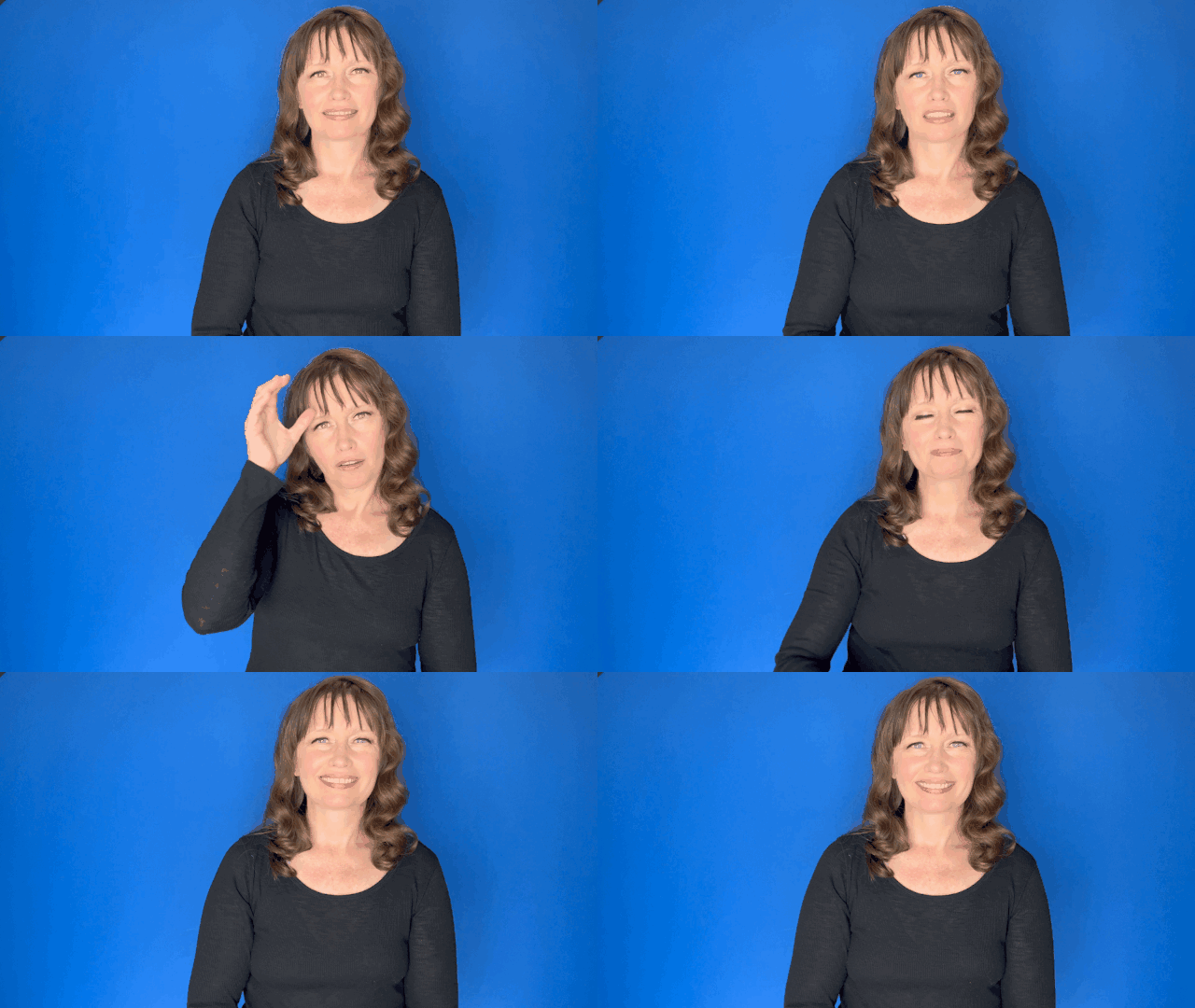
The handshape for the sign for CONCEPT 2 in ASL uses the dominant hand in a loose “C” shape. The fingertips of the “C” hand start near the side of the forehead and move outward, away from the head in a small arc. This motion represents the emergence or formation of an idea or concept .
In the sign for CONCEPT 2 in ASL, the non-dominant hand is not typically used. The “C” handshape reflects the nature of the abstract idea being expressed. This handshape helps differentiate sign for CONCEPT 2 in ASL from similar idea-related signs.
*Palm Orientation*:
The palm orientation for the sign for CONCEPT 2 in ASL generally faces inward toward the signer, with the hand starting near the temple. As the movement progresses, the palm may rotate slightly outward to indicate the flow of an idea or notion, enhancing clarity.
In some contexts, the palm orientation may remain vertical throughout the motion, depending on signing style or regional variation. This nuanced palm adjustment helps clarify the meaning behind the sign for CONCEPT 2 in ASL.
*Location*:
The sign for CONCEPT 2 in ASL is produced in the neutral signing space right in front of the upper chest area, slightly away from the body. This placement ensures clear visibility and maintains a neutral tone appropriate for conveying abstract ideas.
When signing the sign for CONCEPT 2 in ASL, your hands remain at chest height, with movement directed slightly forward, emphasizing the idea’s development or emergence from the mind into shared space.
*Movement*:
To sign the Sign for CONCEPT 2 in ASL, begin with your dominant hand in a flattened “C” handshape near the forehead. Move the hand slightly outward and away from the forehead in a small arc, indicating an abstract idea emerging from the mind.
This movement symbolizes something forming or developing intellectually. The Sign for CONCEPT 2 in ASL uses smooth, deliberate motion to convey a mental idea becoming tangible.
*Non-Manual Signals*:
When signing the sign for CONCEPT 2 in ASL, maintain a neutral facial expression, slightly raised eyebrows, and focused eyes. This shows that you’re discussing a general or abstract idea instead of something concrete.
Subtle head tilt forward suggests attentiveness or an explanation is coming. Keep your mouth relaxed or slightly pursed as if saying “mm” occasionally during the sign for CONCEPT 2 in ASL to reinforce critical thinking or defining a term.
*Prosody, Dominant/Non-Dominant Hand*:
The sign for CONCEPT 2 in ASL uses the dominant hand in an open “C” handshape placed near the forehead, palm facing inward. The hand then moves slightly outward and forward as if pulling an idea from the head, symbolizing a thought or notion forming. The non-dominant hand remains at rest during this movement, as the dominant hand performs the motion smoothly and confidently .
This directional motion and handshape reflect the abstract nature of the sign for CONCEPT 2 in ASL, implying a mental process. Facial expression should remain neutral or slightly inquisitive to appropriately match the intended meaning.
Tips for Beginners:
When learning the sign for CONCEPT 2 in ASL, it’s important to start by clearly understanding how the sign differs slightly in movement or location compared to the general sign for “concept.” These small variations are often used to add emphasis or clarify a particular type of concept during more advanced conversations. Pay close attention to handshape and palm orientation, as these subtle details can shift the meaning.
One of the most effective ways to practice the sign for CONCEPT 2 in ASL is to pair it with real-life visual examples. Watch ASL videos or vlogs where Deaf signers use this variant in context. Try mimicking their rhythm and spatial use of sign space. Practicing in front of a mirror can also help you correct any unintentional motions that might cloud your message.
Common pitfalls to avoid include confusing this version of the sign with similar abstract signs like “idea” or “thought.” These signs may look similar, especially to beginners, but differ in palm direction, location near the head, or movement. To gain clarity, pause videos and break down each part of the motion. Repetition is key—don’t be afraid to sign slowly at first.
Another helpful tip is to fingerspell the word the first few times if you’re unsure whether your version of the sign is regionally accepted. This especially helps in mixed signing communities, as sign variations can be regional or context-driven. Ask Deaf peers for feedback to ensure you’re understood.
Finally, be patient with yourself. The sign for CONCEPT 2 in ASL involves abstract thinking, so don’t expect it to click instantly. Use it in small conversations to reinforce muscle memory. The more you apply it, the more intuitive it will become .
Connections to Other topics:
The sign for CONCEPT 2 in ASL builds directly upon the general idea of abstraction and thought, which ties into broader signs like THINK, IDEA, and UNDERSTAND. In ASL, many signs that deal with cognition or mental processes share similar locations around the head or temple, emphasizing their meaning through spatial and iconic representation. As such, the sign for CONCEPT 2 in ASL naturally links with signs used in education, philosophy, and analytical contexts .
This sign often overlaps with the sign for THEORY when discussing complex ideas or frameworks. It is also useful in academic or debate settings, where signs for HYPOTHESIS or PRINCIPLE might be used in similar ways. The visual connections help reinforce how language and thought interrelate in ASL, offering learners a more holistic view of abstract communication.
When forming compound concepts or talking about derived ideas, the sign for CONCEPT 2 in ASL can combine with others such as CREATE, MODIFY, or DEVELOP. For example, in a discussion about curriculum development, one might sign DEVELOP + CONCEPT to indicate formulating educational ideas. This highlights how the language allows users to build nuanced expressions using established roots .
Moreover, signs like CONCEPT 2 support transitions into figurative or metaphorical discussions, connecting to EXPRESS, MEANING, or SYMBOL. These associations are crucial when interpreting literature, poetry, or conducting analysis in higher-level discourse. The abstract nature of this sign makes it flexible and applicable across subjects like science, history, and theology.
Learners of ASL benefit from understanding how the sign for CONCEPT 2 in ASL functions within this web of related signs. It doesn’t exist in isolation but is part of a network of signs that represent deep thinking, structured frameworks, and intellectual exploration. This contextual knowledge enhances fluency and insight.
Summary:
The sign for CONCEPT 2 in ASL typically utilizes the dominant hand in a modified C-shape. The gesture starts near the forehead and moves outward, reflecting an abstract idea leaving the mind. This visual metaphor captures the essence of intangible or mental constructs.
This version of the sign for CONCEPT 2 in ASL may indicate a secondary layer of meaning or categorization of thought, such as a sub-theme or related issue. It can be used in both academic and casual conversations. Context drives the distinction between this variation and the base sign for “concept.”
Grammatically, the sign for CONCEPT 2 in ASL functions as a noun and can be incorporated into more complex sentence structures. ASL depends heavily on spatial referencing, so the position and direction of this sign may shift to align with topics discussed. Nonmanual markers like raised eyebrows or head tilts often accompany the sign in yes/no questions or emphasis.
The sign for CONCEPT 2 in ASL carries semantic weight. It’s not just about mental abstraction but could reflect deeply integrated cultural notions such as identity, belief systems, or social constructs. This becomes especially relevant when discussing topics within Deaf culture or social theory.
Culturally, the Deaf community places great value on clear conceptual representation. The sign for CONCEPT 2 in ASL supports this by providing a visual, accessible way to discuss abstract ideas. Its use signals precision in intellectual discourse, a hallmark of Deaf academic expression.
The origin of this sign format stems from ASL’s use of space and metaphorical embodiment. By beginning the sign near the head, it reflects mental origin. The outward transition denotes the externalization or sharing of thought, aligning the physical sign with cognitive action.
Linguistically, the movement and handshape of the sign for CONCEPT 2 in ASL follow common ASL phonological patterns. This includes symmetry in handshape use and fluid movement directionality. These features assist with legibility and ease of recognition.
One interesting feature is how the palm orientation can affect the meaning. If the palm faces outward more prominently, it emphasizes dissemination or sharing of the concept. A downward tilt may suggest internal processing or reserved thoughts.
In a classroom, the sign for CONCEPT 2 in ASL might help differentiate between a primary idea and supporting ideas. Educators might use directional variances to help track complex ideas across discussions. This visually reinforces cognitive mapping for Deaf learners.
In English, words like idea, notion, theory, or principle can get collapsed in ASL depending on context. However, maintaining the logical clarity of a concept in ASL often requires spatial memory and classification strategies. The sign for CONCEPT 2 in ASL supports hierarchical cognition.
In applied linguistics, especially in bilingual ASL-English settings, accurate sign variation is crucial. The sign for CONCEPT 2 in ASL might be preferred in academic interpretation to distinguish main concepts from ideological frameworks or secondary elements. Interpreters make these choices based on audience and content clarity.
There are related signs such as THINK, IDEA, THEORY, and BELIEF, each contributing nuance to discussions involving cognition. THINK starts at the forehead, similarly emphasizing mental origins. THEORY may include circular motion to represent ongoing processing or systems.
The sign for IDEA often uses the pinky touching the forehead and popping outward. By contrast, the sign for CONCEPT 2 in ASL uses a C-handshape, reinforcing the image of structured thought. This handshape connotes formation and container-like boundaries, indicating concept cohesion.
Applied linguistics reveals how these sign variants assist discourse framing and reduce ambiguity. For instance, translating complex English texts into ASL often requires signs like CONCEPT 2 to avoid repetition and support argument structure. This keeps the audience engaged and focused.
In semantically dense situations, signers might layer space, body shifts, and eye gaze with the sign for CONCEPT 2 in ASL. These elements provide cohesion and semantic richness missing in linear spoken language. Such multimodal communication increases interpretive nuance.
Frames of reference are also critical. ASL uses what’s called classifiers and referential indexing to elaborate on ideas. The sign for CONCEPT 2 in ASL may begin a spatial elaboration involving nested or comparative ideas, especially when presenting alternatives.
The bilingual brain may process this layered expression through dual-channel activation: visual-spatial in ASL and auditory-symbolic in English. Code-switching between these systems requires agile mapping, and signs like CONCEPT 2 help scaffold that switch.
In visual vernacular storytelling, the sign for CONCEPT 2 in ASL might assume a more dramatic or symbolic form. Performers could use exaggerated movement or facial expressions to communicate a character’s inner reflections or ideological turning points.
The C-handshape offers base compatibility with other signs like CLASS, CATEGORY, or STRUCTURE. This facilitates inter-sign transitions and makes the language rhythmically and visually consistent. These phonological alignments enhance signer fluency.
In academic ASL presentations
Want more? Check out some of our popular learning activities!
ASL Interactive Resources
ASLInteractive YouTube Channel
Follow us on tiktok: @aslinteractive.com
Follow us on Instagram: aslinteractive
Facebook page: aslinteractive
Facebook group: aslinteractive
LInkedIn: ASL Interactive LLC
Twitter: @ASL_interactive
*Some information on this page is AI-generated. AI can make mistakes. Please check the information.
Responses