Definition: A conclusion 1.
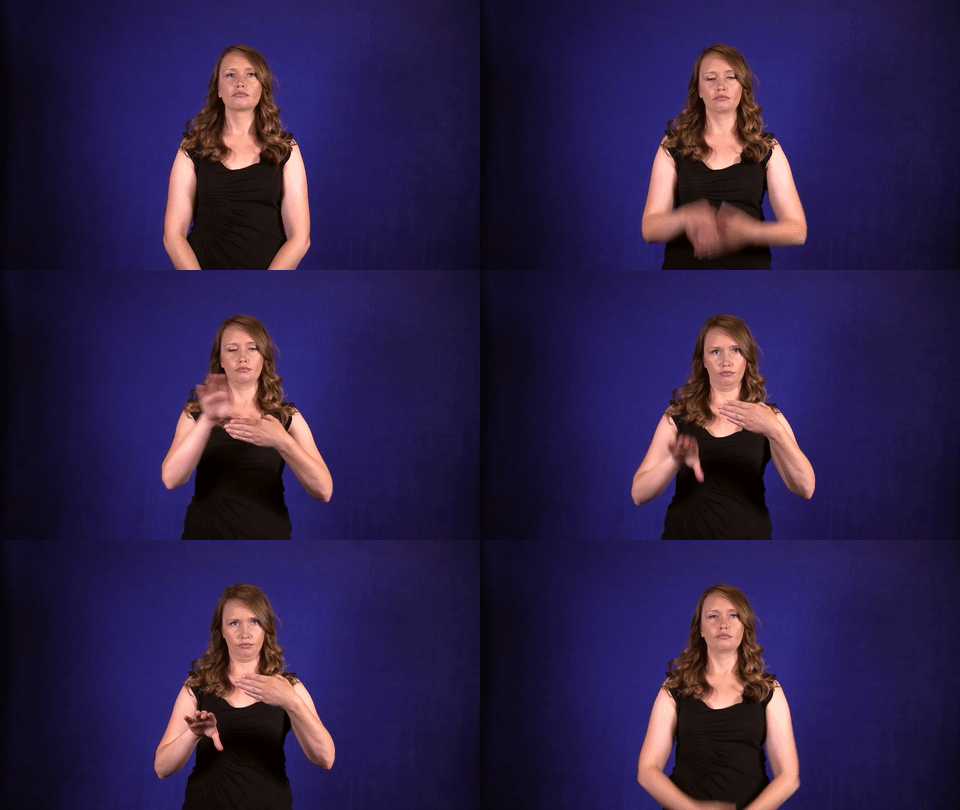
Sign for CONCLUSION 1 in ASL

Practice Activities:
Start by practicing the sign for CONCLUSION 1 in ASL in front of a mirror to check your handshape and movement. Repeat the sign slowly, then increase your speed while maintaining clarity. Try signing it five times in a row without letting your hand relax in between—this builds muscle memory and fluency.
Incorporate the sign into simple ASL sentences to develop context. For example, sign “ME THINK LONG TIME, FINALLY REACH CONCLUSION,” or “DISCUSSION FINISH, NOW CONCLUSION.” Practice saying these aloud as you sign to tie meaning to the movement. This helps reinforce understanding and fluent expression.
Use flashcards to practice. On one side, write the English word “conclusion,” and on the other, describe the sign or draw a diagram. Mix these in with cards of other signs you’re working on so you can practice recognition and recall in a mixed context.
Create storytelling prompts that require the use of the sign for CONCLUSION 1 in ASL. For instance, tell a short story about a mystery that ends with you finding out the truth—be sure to include the sign when you reach the ending. This encourages narrative skills and natural use of the vocabulary.
If possible, pair with another learner and take turns explaining a process—like cooking, a science experiment, or solving a problem—and each person must sign the conclusion. Partners can give each other feedback on accuracy and fluency.
Watch short ASL videos or vlogs and identify how native signers use the concept of conclusion. Pause and practice signing what you see. Try to mimic their speed and facial expression to improve expressiveness and accuracy.
To test yourself, sign a few complex thoughts using the sign for CONCLUSION 1 in ASL and record them. Review to see if your sign is clear and placed correctly in the sentence.
Cultural Context:
In American Sign Language, the sign for conclusion 1 in ASL represents more than just the end of an idea. It reflects the way human thoughts and conversations are structured visually and spatially in Deaf culture ✋. The language relies heavily on visual metaphors, and the sign for conclusion 1 in ASL is a perfect example of that expressive clarity.
In Deaf conversations, the flow from one point to the next often ends with a physical signal to indicate a change or wrap-up. The sign for conclusion 1 in ASL helps mark this transition clearly. It is frequently used in educational settings, storytelling, debates, and formal presentations to wrap up points.
Deaf culture places strong value on clarity and visual structure. Because communication is visual, being able to signify the end or outcome of a topic is essential. The sign for conclusion 1 in ASL functions not just as a linguistic marker, but also as a cultural cue that the speaker is moving towards closure or final remarks.
This sign is also essential when explaining logical steps or presenting arguments among ASL users. It provides visual punctuation that guides comprehension. The importance of ending thoughts clearly is elevated in ASL, making the sign for conclusion 1 in ASL especially practical and respectful of the listener’s understanding ️ ️.
In educational settings, instructors often use this sign to indicate the end of an explanation or before summarizing key points. Deaf students are taught to recognize these cues early on, reinforcing its role in structured learning environments. The sign for conclusion 1 in ASL becomes a useful classroom management tool as well as a linguistic rule.
When used in storytelling or narration, the sign often signals the wrap-up of a plot or the moral of the story. ASL storytelling is rich with dramatic expression, and each part of the narrative arc can be felt through distinct signs. The sign for conclusion 1 in ASL makes it clear when the tale is coming to a close, emphasizing emotional or thematic points.
Community events, such as town hall meetings or local discussions, often make use of formal ASL signs for transitions. The sign for conclusion 1 in ASL appears regularly in these spaces to signify the ending of statements or proposals. Its use supports accessibility and ensures everyone receives the same cues and understanding .
ASL is not only a language but also a deeply cultural experience. The way signs like conclusion 1 are used and perceived ties into larger values of expression, respect,
Extended Definition:
The sign for conclusion 1 in ASL represents the idea of something coming to an end, a final thought, or the result of a discussion or situation. It is often used in conversations or presentations to indicate that a summary or closing statement is being made.
In American Sign Language, this sign is useful when transitioning from the body of a topic to its summary. The sign for conclusion 1 in ASL can help the listener understand that the speaker is wrapping up their points and providing a final insight. This sign is commonly seen in academic, professional, or narrative settings where summarization is key.
The motion for this sign might vary slightly based on regional usage or personal signing style, but it typically conveys a sense of finality. Mastering the sign for conclusion 1 in ASL allows for smoother transitions during signing and helps maintain the flow of information clearly.
People learning ASL should pay close attention to the facial expressions that accompany this sign. Non-manual signals like a nod or raised eyebrows can emphasize the importance of the conclusion. Using the sign for conclusion 1 in ASL without appropriate facial expressions may lead to confusion or weaken the impact of the message.
This sign is especially valuable in educational settings where summaries are important. Teachers, students, and interpreters often rely on the sign for conclusion 1 in ASL to indicate that it’s time to review the main points of a lesson or to bring closure to a presentation. It can also be used in storytelling to show that a narrative is ending.
Within everyday conversations, the sign for conclusion 1 in ASL can signal that someone is finishing their thoughts or ending an explanation. It helps organize speech and enhances understanding for both Deaf and hearing individuals. Effective use of this sign can make communication more clear and structured.
Using this sign regularly builds fluency and makes your ASL communication more natural. Practice is key to making the sign for conclusion 1 in ASL a part of your vocabulary. Whether you’re in a casual or formal setting, knowing how to close a topic smoothly is important for effective communication.
The sign for conclusion 1 in ASL reflects the layered and expressive nature of the language. It shows how ASL can convey not only words but also deeper meanings through context, body movement, and visual cues. This makes the language rich, engaging, and effective in all types of conversation.
Learning this sign also deepens your cultural understanding of the Deaf community. Knowing the sign for conclusion 1 in ASL allows participants
Synonyms: final decision, determination, result, outcome, resolution
Educational resources: Find related learning materials in our course bank!
Want more? Check out some of our popular learning activities on the homepage!
Need to look up a sign? Use our highly rated dictionary: https://aslinteractive.com/best-asl-dictionary/
Follow us on tiktok: https://www.tiktok.com/@aslinteractive. More social media links at the bottom of this page!
Long-tail Keywords: what is the sign for conclusion in ASL, how do you sign conclusion in ASL, ASL sign for conclusion
Categories:
tags: Conclusion, Language Learning, Commands, Activities, Major Decisions
Parameters
*Handshape*:
The handshape used in the sign for CONCLUSION 1 in ASL typically involves both hands starting in an open curved 5 handshape. The fingertips of each hand touch lightly together in front of the body. This configuration allows for a sweeping motion that visually conveys the idea of something coming to an end or wrapping up.
During the motion of the sign for CONCLUSION 1 in ASL, the hands move apart slightly and then come to rest, often transitioning into flat B handshapes or relaxed positions. The handshape plays a critical role in expressing finality or summing up, making the sign highly visual and intuitive. ✅
*Palm Orientation*:
For the sign for CONCLUSION 1 in ASL, the dominant hand typically starts in a flat handshape with the palm facing downward or slightly inward toward the non-dominant hand. As the sign completes, the palm may turn slightly upward or remain in a downward position, depending on the variation of the movement.
The non-dominant hand usually stays stationary in a flat handshape, palm up. The palm orientation is a key factor in clearly expressing the sign for CONCLUSION 1 in ASL .
*Location*:
The sign for CONCLUSION 1 in ASL is produced in the neutral space directly in front of the chest. Both hands begin near chest level, and the movement occurs forward in this neutral area, giving clarity to the action.
In the sign for CONCLUSION 1 in ASL, hand contact and direction emphasize finality, with the location kept comfortably away from the body but within the viewer’s line of vision. This positioning ensures full visibility and reinforces the meaning of the sign.
*Movement*:
To sign the sign for conclusion 1 in ASL, start by placing your dominant hand in a flat open “B” handshape in front of you, palm facing down. Move it in a deliberate downward arc until it lands flat on top of the non-dominant hand, which is also in an open “B” shape, palm facing up.
This movement suggests putting a final piece or finishing a thought. The sign for conclusion 1 in ASL visually represents an ending or summary, aligning with its meaning.
*Non-Manual Signals*:
When using the sign for CONCLUSION 1 in ASL, the signer typically shows a firm and confident facial expression to indicate finality or resolution. The eyebrows remain neutral or slightly furrowed, while the eyes may squint slightly to emphasize decisiveness . Lip posture is usually closed and firm, reinforcing the sense that the matter has reached an end.
The non-manual signals help convey the seriousness or finality behind the sign for CONCLUSION 1 in ASL. Head movement may include a slight downward nod at the end of the sign, signaling closure or the ending of a thought .
*Prosody, Dominant/Non-Dominant Hand*:
The sign for CONCLUSION 1 in ASL uses a dominant flat hand (B-handshape) placed palm-down over the non-dominant flat hand, also palm-down. The dominant hand then slides off the non-dominant hand, moving slightly forward, as if wiping away or finishing something ️.
In the sign for CONCLUSION 1 in ASL, both hands remain relatively close to the torso, emphasizing finality or closure. The movement expresses the idea of something coming to an end or being resolved.
Tips for Beginners:
When learning the sign for CONCLUSION 1 in ASL, it’s important to focus on handshape and motion consistency. This sign typically involves placing one hand flat and bringing the fingertips of the other hand down onto it with a deliberate closure movement. Beginners often rush this motion, but precision and a smooth finish are vital for clarity.
One common issue new learners face with the sign for CONCLUSION 1 in ASL is body placement. Ensure the hands are centered around your chest area and not too low or too far to the side. If your hands drift, it’s harder for your audience to follow and may affect comprehension. Practicing in front of a mirror can help correct this early on.
Facial expressions play a subtle but essential role in conveying the purpose behind this sign. Use a thoughtful or decisive face to match the meaning of “conclusion.” Though it’s not as overt as an emotion-based sign, the facial cue adds depth and makes it more native-like.
Another helpful tip is to practice transitions into and out of the sign for CONCLUSION 1 in ASL, especially in sentence flow. The sign often appears at the end of explanations or stories, so becoming fluid with sentence wrap-up enhances natural delivery. Pair it with signs like THINK or DECIDE during practice to develop better context use.
Repetition and slow-motion practice are excellent for mastering this sign. Record your practice sessions to compare them with fluent signers. This gives valuable insights about rhythm and clarity, both of which are necessary for the sign for CONCLUSION 1 in ASL.
Lastly, don’t forget to engage with native signers or join ASL practice groups. Seeing how others naturally use the sign for CONCLUSION 1 in ASL can boost your understanding and confidence .
Connections to Other topics:
The sign for CONCLUSION 1 in ASL connects closely with concepts such as FINAL, END, and DECISION. These signs often share similar handshapes or movements, offering learners a way to intuitively understand related vocabulary. For example, FINAL and CONCLUSION may involve downward or finishing motions, both visually representing something coming to a close.
In ASL discourse, the sign for CONCLUSION 1 in ASL is often used in academic, legal, or narrative contexts, where there is a need to indicate the summing up of ideas. This makes it essential in storytelling as well as formal presentations. It also naturally connects with signs like THINK, ANALYZE, and DECIDE, which are commonly used before reaching a conclusion.
Compounds or phrases like COME-TO-A-CONCLUSION or DRAW-A-CONCLUSION often combine THINK or ANALYZE with the sign for CONCLUSION 1 in ASL to express a deeper meaning. These compound signs help learners see how ASL can convey logical processes in a visual-spatial format. In classroom settings or debates, such signs help express high-level thinking.
Grammar-wise, the sign for CONCLUSION 1 in ASL contributes to a signer’s narrative structure. It marks transitions or summative points, akin to punctuation in English. Understanding this allows learners to build more complex and cohesive sentences in ASL.
The sign is also linked to the concept of summary or wrap-up, useful in both professional and conversational settings. You’ll often see it paired with signs like REVIEW, SUMMARY, or EVEN-SO, especially at the end of lectures, meetings, or personal stories. Mastery of the sign for CONCLUSION 1 in ASL therefore adds important communicative power.
Summary:
The sign for CONCLUSION 1 in ASL is a conceptually accurate sign that aligns well with the English meaning of concluding an idea, a story, or thought. This version often applies in academic, narrative, or analytical contexts where a point has been proven or a summary follows reasoning. It involves a two-part motion indicating the end or wrap-up of a thought process.
To perform the sign for CONCLUSION 1 in ASL, typically use the dominant hand in an open flat-b palm shape. Starting from near the forehead or the side of the head, the hand moves forward and downward, and then often moves to meet the non-dominant hand, also open, in front of the chest area. The final contact suggests closing or summarizing, mimicking the idea of tying together a presentation.
This motion mirrors closing a book or wrapping up a package, giving the sign metaphorical texture. ASL often uses these visual metaphors to give additional depth and functionality to signs, stimulating both visualization and clarification. The contextual application of this movement enhances understanding for fluent signers and learners alike.
One important linguistic note is that the sign for CONCLUSION 1 in ASL must be interpreted with regard to facial expression. Appropriate facial grammar could include a raised brow or a head nod, marking the end of a point. These non-manual markers act synergistically with manual signs to deliver grammatical cues.
In ASL, conclusion is often framed with cohesive narrative styles. A signer will build a story or an explanation and then bring it to a signaled close using signs like the sign for CONCLUSION 1 in ASL. This helps the audience recognize transitions and closure, increasing structural clarity.
The sign carries particular weight in Deaf cultural storytelling and academic discourse. Knowing when and how to sign this appropriately reflects a user’s fluency and ability to structure thoughts for an audience. Whether used in discussions, lectures, or presentations, it carries rhetorical function and is key to sign-language coherence.
Grammatically, ASL places emphasis on topicalization and completion of thought. The sign for CONCLUSION 1 in ASL thus reinforces finality in sentence structure, much like punctuation in written English. In ASL, this is vital because there are no written periods or full stops; all such linguistic signals are shown manually or through facial expressions.
This sign is related to other signs such as FINISH, END, or RESULT. However, unlike FINISH, which suggests that something is done, and not necessarily a summary, or RESULT, which shows consequence, the sign for CONCLUSION 1 in ASL emphasizes a rounding-off or a synthesis. It expresses intentionality behind the ending.
In theoretical linguistics, conclusion connects to discourse markers, aligning closely with pragmatics. Just as English uses “in conclusion” or “to sum up,” ASL users rely on physical markers like the sign for CONCLUSION 1 in ASL to offer audience orientation. It’s not simply about translating; it’s about fulfilling a discourse function within ASL syntax.
Language acquisition studies find that learners of ASL often struggle with these transition-based signs because they are abstract, not concrete. But they’re critical for fluency. Repeated exposure through narrative work helps internalize pragmatically-inclined structures like the sign for CONCLUSION 1 in ASL.
The sign effectively bridges the end of body of discourse to an anticipated result, a key trait in formal ASL registers. These signs are common in interpreting contexts, especially when adapting English conclusion paragraphs or speeches into sign language. Professional interpreters often employ this sign to indicate section transitions and final ideas.
From a semiotic standpoint, this sign stands tall for iconography—the resemblance between a sign’s form and its meaning. The closing motion metaphorically and physically suggests bringing all elements into a unified space. Peeking into linguistic anthropology, this concept supports how visual languages are aligned with spatial cognition.
Pedagogically, teaching the sign for CONCLUSION 1 in ASL often includes modeling the sign in debates, storytelling, or speech structuring exercises. Students practice placing the sign after a thesis support or inference list to physically mirror how English uses transitional phrases. In this way, they gain mastery of it not as just a vocabulary item, but as a discourse tool.
Regional dialects in ASL sometimes vary slightly in how they sign CONCLUSION. However, CONCLUSION 1 remains among the standardized or academic options often taught in classroom settings. Its consistency across institutions makes it especially useful in cross-cultural Deaf interactions within the USA.
Advanced learners studying ASL linguistics eventually analyze the difference between similar closing signs using phonological breakdowns. Movement, palm orientation, and location for the sign for CONCLUSION 1 in ASL have a unique phonemic profile and are often contrasted with END, which has more abrupt and final hand positions.
In Deaf rhetoric, signs like this help articulate complete thought, nuance, and reasoning. Whether used in persuasive dialogue or research presentation, it reflects not just
Want more? Check out some of our popular learning activities!
ASL Interactive Resources
ASLInteractive YouTube Channel
Follow us on tiktok: @aslinteractive.com
Follow us on Instagram: aslinteractive
Facebook page: aslinteractive
Facebook group: aslinteractive
LInkedIn: ASL Interactive LLC
Twitter: @ASL_interactive
*Some information on this page is AI-generated. AI can make mistakes. Please check the information.
Responses