
Definition: A site where construction is happening 2.
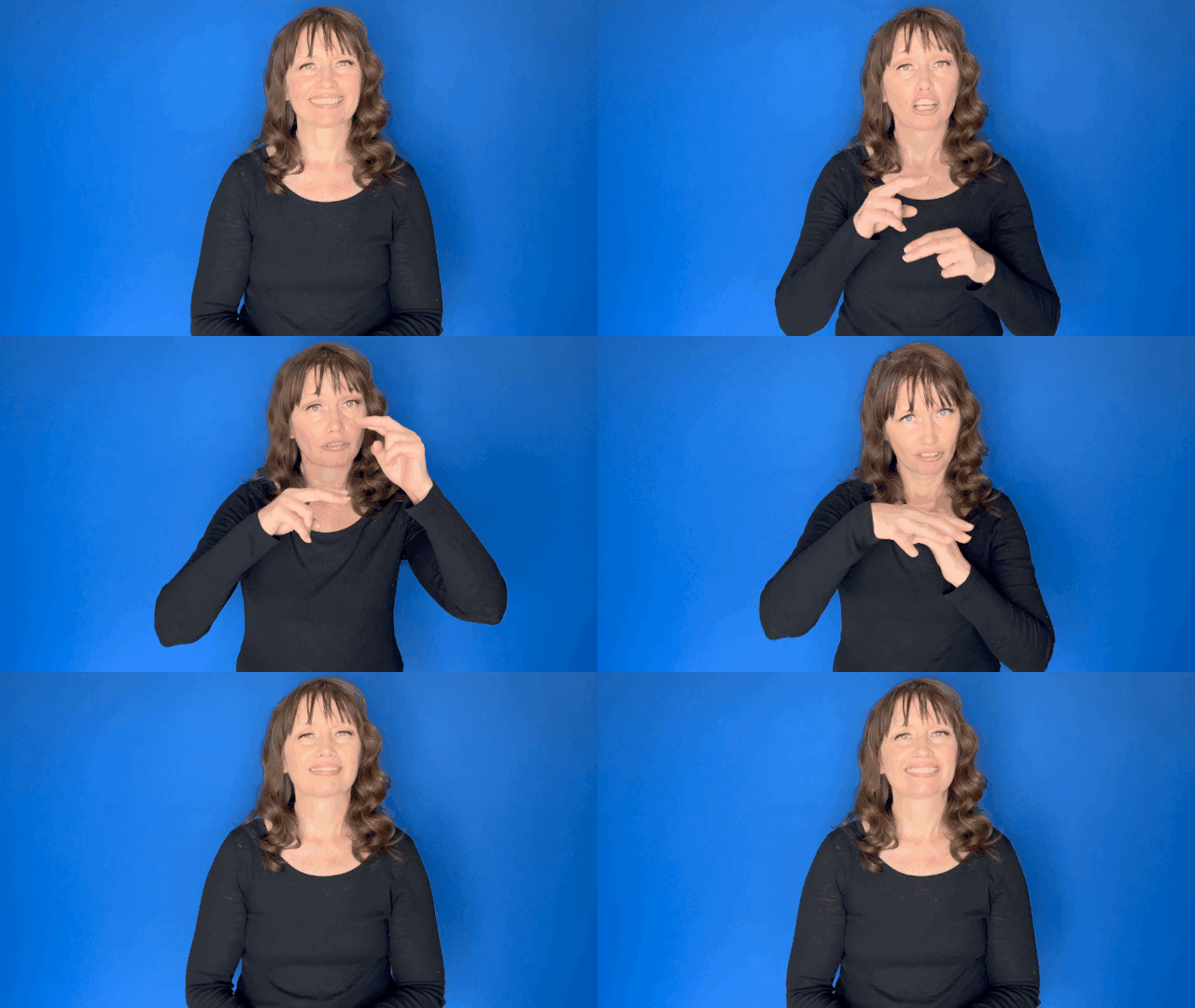
Sign for CONSTRUCTION SITE 2 in ASL

Practice Activities:
Start by practicing the sign for CONSTRUCTION SITE 2 in ASL in front of a mirror. This will help learners check handshape, movement, and facial expression. Repeat the sign slowly and clearly, focusing on muscle memory and fluency. Then increase speed while maintaining clarity.
Use flashcards or a video prompt to randomly show either “building,” “worker,” or “construction site” so you can quickly recognize and produce the sign in context. Practice pointing to a picture of a construction area and signing what you see. For example, sign “construction site” while pointing to a photo of a building zone, a hard hat, or caution tapes.
Create simple sentences using the sign for CONSTRUCTION SITE 2 in ASL such as “I see construction site,” “Construction site is noisy,” or “Workers build at construction site.” Practice signing these sentences multiple times while paying attention to your transitions between words. Record yourself and review for smoothness and hand placement.
With a partner, take turns describing what happens at a construction site. One person signs, the other guesses or adds to the description. For instance, one might start with “construction site have crane,” and the other follows with “they build building.” This back-and-forth activity builds comfort with the vocabulary.
Use storytelling to describe a typical day at a construction site. Include time key phrases like “morning,” “noon,” “late,” and describe what workers are doing. Keep the story simple: “Morning, workers arrive. They start work. Construction site is busy.”
Create a mini field trip activity: go near an actual construction site or look up a video. Observe and then retell what you saw using ASL, incorporating the sign for CONSTRUCTION SITE 2 in ASL as often as naturally possible. This connects real-world context to sign language use and helps solidify the vocabulary.
Cultural Context:
Understanding the sign for CONSTRUCTION SITE 2 in ASL connects closely with the cultural and environmental experiences of the Deaf community. In American Sign Language, location-based signs like CONSTRUCTION SITE 2 often reflect the physical and social realities of life, especially when navigating shared public spaces. Learning the sign for CONSTRUCTION SITE 2 in ASL supports clear communication about work areas, safety, and infrastructure in urban and rural environments.
In the Deaf community, visual access is everything. Construction zones can create barriers if there is no visual communication or signage. That’s why being able to sign CONSTRUCTION SITE 2 in ASL empowers Deaf individuals to advocate for safety and inclusivity in these noisy, often hazardous environments.
The sign for CONSTRUCTION SITE 2 in ASL might slightly vary depending on where someone is from or their local signing dialect. However, the concept is universally understood—a place where building or repair work happens. Whether it’s a roadside project or a high-rise being built, knowing how to sign CONSTRUCTION SITE 2 in ASL allows signers to describe places and events in daily life more accurately.
In Deaf culture, sharing detailed information through signing is considered respectful and necessary. When talking about specific locations like a job site or an obstruction ahead, using the exact sign for CONSTRUCTION SITE 2 in ASL enhances clarity. It shows cultural awareness and supports accessibility, especially in group conversations where visuals define the context.
ASL often draws from real-world visuals and experiences. The sign for CONSTRUCTION SITE 2 in ASL likely mimics real action you might see at a work zone, such as digging, building, or demarcating space. This visual storytelling approach is embedded in Deaf culture, making even technical or specialized terms accessible through dynamic sign expressions.
Worksites are filled with visual markers—flashing lights, orange cones, safety vests—all elements that align closely with the visual nature of ASL. When users learn how to sign CONSTRUCTION SITE 2 in ASL, they gain the tools to communicate both caution and awareness in an environment where hearing cues are often unavailable. This enhances both safety and independence for Deaf individuals navigating complex spaces.
Teaching the sign for CONSTRUCTION SITE 2 in ASL also supports broader community goals. It helps interpreters, teachers, and Deaf professionals easily explain environments, workplace instructions, or classroom lessons involving infrastructure and urban studies. Using ASL vocabulary centered on real-life locations brings broader meaning to educational and practical discussions.
Understanding how to sign CON
Extended Definition:
The sign for construction site 2 in ASL is a visual representation used in American Sign Language to describe a place where building or roadwork is actively occurring. This sign can be used in conversations about neighborhood projects, urban planning, or visits to areas under development.
When using the sign for construction site 2 in ASL, it’s important to consider facial expressions and context. ASL is a visual language, and the placement, movement, and intensity of the sign help communicate whether you’re referring to a small job site or a large-scale construction zone.
This particular variant of the sign might differ slightly from the commonly taught version of “construction site.” The number 2 indicates that it’s a second version or regional variation, often used for clarity or based on community preferences.
In ASL, concepts like construction and building are often shown with classifiers, hand shapes, and directional movement. The sign for construction site 2 in ASL usually starts with a base hand representing the ground and a dominant hand mimicking the structure or activity happening at the site.
People often use this sign when discussing ongoing projects, safety measures, or navigating around detours near construction areas. It’s especially helpful for deaf individuals working in construction-related industries or for interpreting in environments involving public works.
Understanding the regional uses of signs like this helps broaden a signer’s fluency. In some areas, there may be slight modifications to the sign for construction site 2 in ASL, depending on local preferences, incorporation of classifiers, or the influence of nearby schools for the Deaf.
Context plays a big role in how the sign is interpreted. For example, if you’re talking about road construction vs. building construction, you may pair this sign with additional signs like ROAD, BUILDING, or STREET to give a clearer picture.
When teaching or learning this sign, it can be useful to practice it alongside other common signs related to construction and city planning. Pairing the sign for construction site 2 in ASL with associated vocabulary helps learners build more natural sentence structures and improves visual memory.
Some signers may also use this sign when discussing topics in the news or current events related to urban development. It is practical in classroom settings, workplace discussions, or when reviewing blueprints and project timelines.
The sign for construction site 2 in ASL showcases the flexibility of ASL to represent even technical and environment-specific terms with clarity. It allows communication about visual and physical landscapes, which is essential in interpreting and everyday interactions.
To improve your understanding, watching a
Synonyms: construction area, building site, worksite, development zone, construction zone
Educational resources: Find related learning materials in our course bank!
Want more? Check out some of our popular learning activities on the homepage!
Need to look up a sign? Use our highly rated dictionary: https://aslinteractive.com/best-asl-dictionary/
Follow us on tiktok: https://www.tiktok.com/@aslinteractive. More social media links at the bottom of this page!
Long-tail Keywords: what is the sign for construction site in ASL, how to sign construction site in American Sign Language, ASL sign for construction site
Categories:
tags: construction site vocabulary in ASL, American Sign Language construction site terms, how to sign construction site in ASL, ASL signs for construction site vocabulary, learn construction site signs in ASL
Parameters
*Handshape*:
The handshape for the sign for CONSTRUCTION SITE 2 in ASL uses both hands in a flat “B” shape, representing structure and layers. The palms face each other and alternate moving up and down, mimicking the idea of building layers or stacking materials on a construction site ️.
This repetitive movement visually reinforces the layered aspect of constructing a site. The sign for CONSTRUCTION SITE 2 in ASL effectively combines physical representation with linguistic structure, making it both expressive and clear.
*Palm Orientation*:
The palm orientation for the sign for CONSTRUCTION SITE 2 in ASL typically involves both hands in a modified “C” shape with palms facing each other. The dominant and non-dominant hands alternate stacking motion, resembling bricks being laid, which captures the concept of construction .
For the sign for CONSTRUCTION SITE 2 in ASL, the movements occur in front of the torso, and the palms remain mostly inward or slightly tilted toward the center. This orientation reinforces the idea of assembling or building a structure.
*Location*:
The sign for CONSTRUCTION SITE 2 in ASL is produced within the neutral space in front of the torso. Hands are usually positioned around mid-torso level, not touching the body. Movements often stay in this central area to indicate layering or stacking, representing the idea of building.
To clearly show the concept in the sign for CONSTRUCTION SITE 2 in ASL, the sign maintains symmetry in front of the chest area. The hands stay slightly away from the body, allowing for clear visibility of the repetitive motion commonly used to show construction progress. ️
*Movement*:
To produce the sign for CONSTRUCTION SITE 2 in ASL, start with both hands in the “A” handshape. Hold them in front of the body, one above the other, and alternate tapping the knuckles together a few times, mimicking a bricklaying motion . This represents the concept of building or construction.
Next, move to the sign for “site” by using the dominant hand in a “C” handshape and circling it downward and outward in front of the non-dominant palm, which faces downward. The combination conveys both the act of building and the physical site, completing the sign for CONSTRUCTION SITE 2 in ASL with clear, repetitive movements.
*Non-Manual Signals*:
When signing the Sign for CONSTRUCTION SITE 2 in ASL, the signer typically uses a neutral facial expression with focused attention. Slight eyebrow furrowing helps convey the seriousness or specificity of the location being discussed.
Head nods or tilts may be used to indicate presence or positioning of the construction site, showing spatial awareness. The overall body posture should remain upright and directed toward the area indicated in the sign, reinforcing the meaning of the Sign for CONSTRUCTION SITE 2 in ASL ️.
*Prosody, Dominant/Non-Dominant Hand*:
The sign for CONSTRUCTION SITE 2 in ASL uses both hands. The dominant hand is in an open “5” shape, and the non-dominant hand mirrors it. Both hands alternately move as if stacking building layers, suggesting the action of construction. Following that, the dominant hand may outline a flat area in space, indicating a site or location.
In the sign for CONSTRUCTION SITE 2 in ASL, the use of prosody includes intentional pauses between the layering motion and the outlining motion. These pauses emphasize the concept of building followed by place. The hand movements are controlled and rhythmic, reinforcing the meaning of a structured and methodical process.
Tips for Beginners:
When practicing the sign for CONSTRUCTION SITE 2 in ASL, it’s important to focus on both accuracy and consistency of movement. This version often involves a layered or building motion with two flat hands, suggesting the stacking structure of a site. Pay close attention to your hand orientation and fingertips—they should remain aligned and controlled to clearly communicate the sign’s meaning.
Beginners often rush through the construction-related motion, which can make the concept unclear. Slow down and try to maintain even spacing and timing in your movements. Remember that in ASL, clarity often comes from controlled and deliberate signing rather than speed. Practicing in front of a mirror or recording yourself can help catch unclear angles or imprecise wrist motion.
One common issue when learning the sign for CONSTRUCTION SITE 2 in ASL is mixing it up with other signs like “building” or “construct.” Although they may share some similarities, the context of “site” adds a layer of meaning you need to express through spatial setup or widened hand placement. Be mindful of your facial expressions; an engaged, slightly focusing face often helps signal the seriousness and scale of a construction site.
To get the most out of your learning, try to expose yourself to the sign being used in conversations. Watching fluent signers sign about construction zones, work areas, or real-life scenarios will help you understand how the sign for CONSTRUCTION SITE 2 in ASL fits naturally into dialogue. Over time, your muscle memory will improve, and the fluidity of the motion will come more naturally.
Lastly, don’t hesitate to ask for feedback from deaf ASL users or instructors. When it comes to signs with physical shape representation like this, small adjustments in movement can greatly improve clarity . Keep practicing steadily and use real-world examples as your guide ♂️.
Connections to Other topics:
The sign for CONSTRUCTION SITE 2 in ASL closely ties into broader categories like work-related vocabulary and place-specific signs. It often incorporates elements from the signs for BUILD, WORK, and AREA, making it a composite sign that reflects both process and location. Understanding this helps learners see how ASL uses conceptual layering to convey nuanced meanings.
This sign can be linked to the sign for BUILDING or DEVELOPMENT, both of which share handshape and movement similarities. Because the sign for CONSTRUCTION SITE 2 in ASL typically uses a repeated stacking or layering motion, this aspect aligns with signs like PLAN or STRUCTURE. These shared features provide smoother transitions when discussing city planning, engineering, or infrastructure topics in ASL conversations.
Learners will notice that the sign for CONSTRUCTION SITE 2 in ASL can also be adapted to create context-rich phrases. For example, combining it with FUTURE or COMPLETE allows for expressions like “future construction area” or “site completed.” This capability to form compound expressions is a key feature of ASL grammar and enhances message clarity.
Related vocabulary also includes tools and machinery, such as signs for CRANE, HAMMER, or TRUCK, which are commonly used in this semantic space. When discussing job roles related to construction, learners might see the sign for WORKER or variations specific to ENGINEER or ARCHITECT, often formed by adding the AGENT marker to the occupational base sign. This helps expand learners’ ability to communicate about roles and tasks on a site.
The physical location aspect of the sign for CONSTRUCTION SITE 2 in ASL connects naturally with spatial referencing and classifiers. Describing where a site is located often involves using established map layouts or directional signs within a signer’s space. This encourages learners to master spatial grammar, a central feature of ASL.
Summary:
The sign for CONSTRUCTION SITE 2 in ASL utilizes descriptive classifiers and established signs to convey the concept of building and location. This version typically involves alternating brushing motions of both flat hands, palms facing downward, with one hand moving forward and then the other taking its place—evoking the layering or stacking associated with construction. Once this action is established, it is then followed by a spatial demarcation that represents the physical space or “site” component.
The motion in the sign for CONSTRUCTION SITE 2 in ASL mimics bricklaying or stacking actions commonly observed at an actual construction location. The movement direction—often linear and rhythmic—symbolizes the methodical process intrinsically tied to building work. The subsequent indication of the area surrounding the body conveys that this activity is taking place within a designated site or geographical zone.
The classifier-like approach used in this sign carries broader linguistic relevance in ASL, where spatial referencing provides context and grammatical relationships. The way the space is outlined visually aligns with ASL’s preference for using the signing space to represent real-world environments. This helps to frame the construction as not just an act but an ongoing process happening in a particular physical locale.
Culturally, the sign for CONSTRUCTION SITE 2 in ASL reflects the importance of visually mapping environments in Deaf communication. Construction is more than a workplace; it represents transformation, labor, and spatial design—ideas that resonate visually and conceptually in the Deaf community. This makes the sign both practical and symbolically rich.
The sign’s rhythm, using back-and-forth hand motions, can signify cooperation and progress, concepts widely appreciated within Deaf culture. These visuals reinforce the communal effort necessary in building something new—be it a structure or a concept. In this way, the sign for CONSTRUCTION SITE 2 in ASL contributes to a shared understanding of place and activity.
The layering motion has roots in iconicity, where the shape and rhythm of the sign directly relate to the physical characteristics of what is being described. This lends the sign a higher degree of transparency, making it more intuitive to learn for new users of ASL. Iconicity plays a meaningful role in bridging conceptual knowledge with physical representation in sign language.
Spatial grammar in ASL allows for efficient communication of location-oriented concepts like a construction site. The sign for CONSTRUCTION SITE 2 in ASL takes advantage of this linguistic system, using directional and locative movements to indicate not just action but relational space. It’s a key example of how ASL uses space dynamically.
This sign can often be followed by directional verbs or locative descriptions to elaborate on the nature or position of the construction. For example, a signer might indicate whether the site is in a rural or urban area by supplementing it with environmental signs. Thus, the sign integrates well within broader syntactic structures and narratives in ASL.
Related signs like BUILDING, WORK, and SITE GROUND often accompany or precede the sign for CONSTRUCTION SITE 2 in ASL. Even though this version is a standalone variant, it remains source-connected to these fundamental root signs. This layered quality enhances both linguistic economy and visual clarity.
Applied linguistically, the use of repetitive, alternating hand movements in this sign exemplifies the rhythmic properties of ASL. Regular pacing in such signs improves comprehension and mirrors the methodical nature of real construction work. These rhythmic cues are instrumental in maintaining attention and enhancing retention of visual information.
From an educational perspective, teaching the sign for CONSTRUCTION SITE 2 in ASL offers a moment to discuss compound structures in the language. Students can see how two distinct concepts—activity and location—meld into a cohesive unit. This teaches not only vocabulary but complex linguistic synthesis.
The construction metaphor is also relevant in discussions about language development and acquisition. Just as buildings are erected layer by layer, so is meaning in ASL signed through expressions, classifiers, and locative markers. The sign for CONSTRUCTION SITE 2 in ASL showcases that metaphor on a visual level.
The repetition and symmetry of the sign’s motion appeal to pattern recognition pathways in cognitive processing. These patterns make the sign memorable and functionally effective. Signers often build upon these foundational movements to express more elaborate stories around work, development, and space.
This version of the sign also frames construction as an ongoing activity, which aligns with the temporal fluidity of ASL. Its present-continuous aspect can be inferred from the ongoing, repeated motion. It visually represents labor not just as a static event but as a developing, progressive act.
Grammatically, the sign can be placed as a noun or anchor within a sentence, allowing for various modifiers to describe its size, type, or purpose. It acts as a referential hub around which other signs can orbit. This is particularly helpful in narrative ASL, where setting and action interplay tightly.
In community discussions, the sign for CONSTRUCTION SITE 2 in ASL might be used during dialogues about urban planning,
Want more? Check out some of our popular learning activities!
ASL Interactive Resources
ASLInteractive YouTube Channel
Follow us on tiktok: @aslinteractive.com
Follow us on Instagram: aslinteractive
Facebook page: aslinteractive
Facebook group: aslinteractive
LInkedIn: ASL Interactive LLC
Twitter: @ASL_interactive
*Some information on this page is AI-generated. AI can make mistakes. Please check the information.
Responses