
Definition: A site where construction is happening 3.
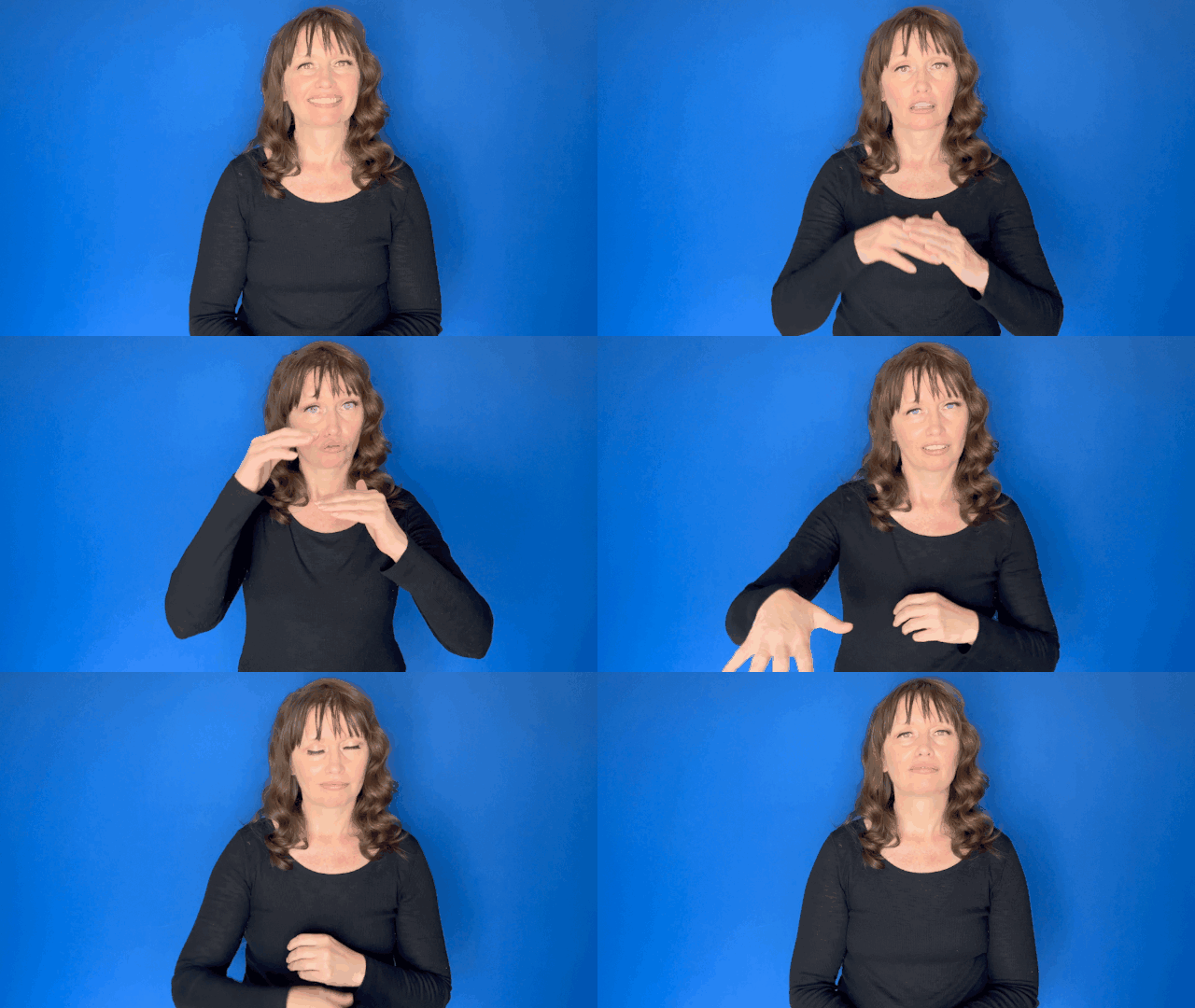
Sign for CONSTRUCTION SITE 3 in ASL

Practice Activities:
To practice the sign for CONSTRUCTION SITE 3 in ASL in isolation, begin with simple repetition drills in front of a mirror. Focus on maintaining consistent handshapes and movements. Record yourself signing and compare it with native signers or instructional videos.
Create flashcards that feature photos of different work-related scenes. When you see an image of a building area or a job site, sign CONSTRUCTION SITE 3 in ASL. Mix in similar workplace signs like BUILDING, WORK, and STRUCTURE to improve sign recognition and accuracy. Use a timer to speed up response time as you get more confident.
For contextual use, build simple sentences such as “I work at a CONSTRUCTION SITE” or “The CONSTRUCTION SITE is near school.” Practice varying the placement to show proximity or size using spatial referencing. Use facial expressions to indicate emotion or urgency, like showing concern if a site is dangerous.
Try storytelling prompts like: “Describe a morning routine for someone working at a CONSTRUCTION SITE.” Include the sign for CONSTRUCTION SITE 3 in ASL throughout your story. Think about aspects such as tools, safety gear, teamwork, and schedules. Add other relevant signs like HARD HAT, TRUCK, or BUILD to provide depth.
Partner up and take turns pretending to give tour directions to a new worker. Include phrases like “Walk down the road, then you’ll see the CONSTRUCTION SITE” or “He is moving supplies to the CONSTRUCTION SITE.” Add visual and spatial classifiers to make each conversation richer and more natural.
Finish your practice sessions by doing a five-minute themed signing where you explain a typical day at any construction location. Use the sign for CONSTRUCTION SITE 3 in ASL multiple times throughout the monologue and record it to self-evaluate fluency and clarity.
Cultural Context:
The sign for CONSTRUCTION SITE 3 in ASL is used to communicate about building areas, zones under development, or spaces where construction work is currently taking place. In Deaf culture, it’s important to have specific signs like this because they offer quick visual context, especially when navigating urban areas or discussing safety-related topics. The sign for CONSTRUCTION SITE 3 in ASL allows for clarity in everyday conversations about public spaces, work zones, or architecture.
Deaf and Hard of Hearing individuals often rely on visual cues more heavily than spoken cues, so using accurate and regionally accepted signs increases understanding. When someone uses the sign for CONSTRUCTION SITE 3 in ASL, they help convey important information like danger, blocked pathways, or building progress. In schools and community spaces, this sign can be especially useful when teaching younger learners about different job types or discussing how cities grow.
Construction is a major part of urban life, and so having a culturally validated sign for CONSTRUCTION SITE 3 in ASL adds value to everyday communication. ASL is a living language, and over time, signs evolve to reflect advancements in the world, including new types of work environments and changing societal needs. By standardizing signs like this one, we create consistency throughout ASL conversations, making it easier to share information.
Signs connected to occupations and locations, such as the sign for CONSTRUCTION SITE 3 in ASL, play a key role in topics ranging from employment to public safety. Whether someone is storytelling, interpreting the news, or giving directions, using this sign makes the message clearer and more specific. It also promotes awareness of how Deaf individuals access the world differently, relying on signs to understand their environment fully.
In Deaf education and workforce training programs, the sign for CONSTRUCTION SITE 3 in ASL supports learning within real-world contexts. It allows students or workers to discuss projects, roles, timelines, and hazards using ASL fluently. This increases employment accessibility and helps bridge the gap between Deaf professionals and their hearing colleagues through interpreters or direct communication.
The use of the sign for CONSTRUCTION SITE 3 in ASL also has cultural significance in art, storytelling, and theater settings by representing ideas of growth, change, and development. Within these creative spaces, vocabulary must be rich and contextually accurate to convey the right emotions and meanings. Incorporating this sign helps bring depth to visual storytelling and performance in the Deaf community.
Many public services now use ASL videos or signage in construction zones to
Extended Definition:
The sign for CONSTRUCTION SITE 3 in ASL represents a concept commonly used when describing areas designated for building projects. This version of the sign may be used in regional or school-based variations, with slight differences in motion or handshape depending on who is signing and where they learned it.
In this variation, the sign for CONSTRUCTION SITE 3 in ASL usually combines elements of the signs for construction and location or area, using a descriptive classifier or repetitive motion to signify ongoing work at a specific site. Facial expressions also play a key role in conveying the idea of a site actively under development.
ASL uses spatial referencing to describe locations, so a construction site is often illustrated by layering signs in a particular space in front of the signer. The sign for CONSTRUCTION SITE 3 in ASL may be used when explaining job sites, urban development, or areas blocked off for safety due to construction.
When teaching this sign, instructors may reference real-world scenarios such as road work, building renovations, or large-scale commercial development. This version of the sign helps bring clarity to the type and location of activity, helping the audience visualize a busy and actively changing environment.
Students learning the sign for CONSTRUCTION SITE 3 in ASL are often encouraged to incorporate directional signs, handshapes that show structures, and movements that simulate building activity. Using body shift or eye gaze can help establish the spatial element of the site being discussed.
The sign is often used in school settings, especially in STEM-related ASL classes or when discussing community events. Students in interpreting programs may also learn multiple variations of this sign to better match the speaker’s intent and the visual context.
Visual storytelling is key in American Sign Language, and the sign for CONSTRUCTION SITE 3 in ASL contributes to that narrative toolset. Using the sign correctly helps learners and ASL users describe environments that are changing or areas that need to be avoided.
This sign may also be used in job interviews, especially if someone is applying for work related to labor, architecture, engineering, or safety inspection. The ability to accurately describe a construction site in ASL shows fluency and attention to spatial details.
Parents, teachers, and interpreters use the sign for CONSTRUCTION SITE 3 in ASL to communicate safety messages with deaf and hard-of-hearing children. It helps explain restricted zones or noisy areas where awareness is important.
Online ASL dictionaries and video tutorials are great resources for exploring how the sign for CONSTRUCTION SITE 3 in AS
Synonyms: building site, worksite, construction zone, development site, building area
Educational resources: Find related learning materials in our course bank!
Want more? Check out some of our popular learning activities on the homepage!
Need to look up a sign? Use our highly rated dictionary: https://aslinteractive.com/best-asl-dictionary/
Follow us on tiktok: https://www.tiktok.com/@aslinteractive. More social media links at the bottom of this page!
Long-tail Keywords: what is the sign for construction site in asl, how do you sign construction site in asl, learn the sign for construction site in american sign language
Categories:
tags: Construction site in American Sign Language, ASL vocabulary construction site, learn ASL construction site, construction-related ASL signs, construction site terminology in ASL
Parameters
*Handshape*:
The handshape for the Sign for CONSTRUCTION SITE 3 in ASL typically involves using both hands in a modified flat hand (B-handshape) position. Palms face down and alternate tapping on one another as if laying down layers, mimicking bricklaying or building.
This visual motion helps convey the idea of structure or construction. For the Sign for CONSTRUCTION SITE 3 in ASL, the repeated hand contact creates a clear link to the gradual building process found on actual worksites.
*Palm Orientation*:
For the sign for CONSTRUCTION SITE 3 in ASL, both hands are typically in a modified “C” or “5” shape depending on variation, with palms facing each other or downward. When indicating the layering motion involved in “construction,” the dominant palm alternates facing down and out as it moves, creating an overlapping effect.
If performing the full compound concept of “construction site,” the orientation may shift slightly as the sign transitions to convey “site,” maintaining clarity and space references. Overall, palm orientation plays a key role in distinguishing the layered and spatial components in the sign for CONSTRUCTION SITE 3 in ASL ️.
*Location*:
The location for the sign for CONSTRUCTION SITE 3 in ASL is primarily in the neutral space in front of the torso. The dominant and non-dominant hands typically meet and move in a coordinated pattern near chest level, slightly away from the body. ️
This area allows for visibility of both the handshapes and the repeated motion indicating construction. The sign stays in front of the body to maintain clarity and ensure the representation of building action and space.
*Movement*:
To sign the Sign for CONSTRUCTION SITE 3 in ASL, begin by forming both hands into an open “B” shape and placing one hand above the other, palm down. Alternate tapping the fingertips of the top hand to the back of the bottom hand, mimicking the action of layering bricks .
Next, transition to the open “5” handshapes and gesture in a horizontal circle in front of the body, indicating a general area like a construction site. The combined movements in the Sign for CONSTRUCTION SITE 3 in ASL give a clear visual representation of both building structure and spatial setting.
*Non-Manual Signals*:
When signing the Sign for CONSTRUCTION SITE 3 in ASL, maintain a focused and alert facial expression to reflect the seriousness and precision often associated with construction zones ️. Slight head movement forward may enhance the sense of location or placement, helping to establish the idea of a physical site.
Raised eyebrows can be used to show clarification or emphasis, especially if the context involves explaining the type or location of the construction site. Keep eye contact steady and directional to support the spatial aspects of the Sign for CONSTRUCTION SITE 3 in ASL.
*Prosody, Dominant/Non-Dominant Hand*:
The dominant hand in the sign for construction site 3 in ASL typically uses a modified “C” or “B” handshape, depending on the sign variation. It mimics a stacking or layering motion, tapping alternately with the non-dominant hand held in a stationary flat position to represent a foundation or ground structure.
This motion reflects the building element of the construction concept ️. The sign captures the layered, repetitive nature of work done at a construction site. The non-dominant hand stays steady to represent the site itself while the dominant hand illustrates active construction.
Tips for Beginners:
The sign for CONSTRUCTION SITE 3 in ASL involves a layering or stacking motion to represent the act of building, combined with spatial referencing to designate a location. For beginners, your focus should be on mastering handshape accuracy and movement direction. Avoid rushing through the motion—each action should be deliberate to convey clear meaning. Practice in front of a mirror to monitor your non-dominant and dominant hand roles, especially in layered movements like those in this sign.
One common mistake with the sign for CONSTRUCTION SITE 3 in ASL is flattening the hands too much or misaligning the space where the construction motion happens. The stacking portion should mimic the laying of bricks or beams, so finger spacing and movement rhythm are key. Keep your hands relaxed—not stiff—but also not floppy. A balanced hand shape and steady, even-paced layering movement help make your sign readable and natural.
Another thing to pay attention to is your facial expression. Many learners focus only on their hands, but facial grammar adds crucial emphasis to your meaning. A slight nod or focused expression can help ground the concept of a physical site. Also, remember that placement in space is essential; pointing to a location while referencing the construction action helps define “site” visually.
If you’re using the sign for CONSTRUCTION SITE 3 in ASL during conversations, make sure your motion is scaled correctly—small, cramped signs tend to lose clarity. Practice signing in a mid-sized space in front of your torso, using consistent eye gaze and body orientation. Watching fluent signers or ASL teachers demonstrate the sign from several angles can enhance your understanding. Repetition through slow, deliberate practice will build your muscle memory and boost confidence when using the sign naturally in communication. ♂️ ️
sign for CONSTRUCTION SITE 3 in ASL, construction site in sign language, how to sign construction in ASL, construction related signs in american sign language, learn ASL locations vocabulary
Connections to Other topics:
The sign for CONSTRUCTION SITE 3 in ASL connects closely with other signs related to building, architecture, and manual labor. It often shares components with signs like BUILD, WORK, and PLACE, reflecting both the physical nature of the space and the activities typically seen there. Layering concepts like LOCATION and ACTIVITY can help reinforce contextual understanding, especially when describing where construction is taking place or what kind of project is underway ️.
In terms of compound signs, the sign for CONSTRUCTION SITE 3 in ASL might be combined with signs related to specific trades or projects, such as HOUSE, ROAD, or SCHOOL, to indicate what kind of site is being discussed. For example, combining SCHOOL and CONSTRUCTION SITE 3 allows users to communicate that a school is under construction. These kinds of combinations not only improve clarity but also reflect how ASL operates with conceptual blending.
This sign is also related to directional and spatial classifiers that can be used to show locations, machinery placement like cranes or scaffolding, and worker movement within the site. Classifiers such as Cl:3 (representing vehicles) or Cl:1 (representing people) add detail and depth, allowing for dynamic storytelling or explanation of a scene involving construction work ♂️.
Learning the sign for CONSTRUCTION SITE 3 in ASL opens the door to better understanding occupational signs and environmental settings in ASL conversations. It naturally supports vocabulary expansion into areas like ENGINEER, BLUEPRINT, SAFETY, and DEMOLISH. Using directional verbs along with this sign helps emphasize the actions taking place at or around a site, creating a holistic picture.
For advanced learners, understanding how the sign for CONSTRUCTION SITE 3 in ASL relates to both noun-verb pairs and topical chaining in ASL can aid in forming more complex and culturally accurate statements. These connections enhance fluency and bridge understanding between built environments and the signer’s perspective.
Summary:
The sign for CONSTRUCTION SITE 3 in ASL features a specific combination of handshapes and movements meant to emphasize the spatial and functional nature of building environments. It typically incorporates a classifier structure that visually represents construction materials being stacked or layered, often combined with space indexing to show the area as a “site.” This particular variation points to both the systematic layering involved and its conceptual link to structured development.
In executing the sign, dominant hands often alternate in palm-down flat “B” handshapes and move in a repeated motion to mimic the laying of bricks or foundational elements. This physical parallel reflects the visual nature of ASL and the importance of iconicity, a linguistic trait where form corresponds directly with meaning. The use of space alongside repetitive action also suggests a scenario where the signer constructs an imaginary space for the viewer.
The sign for CONSTRUCTION SITE 3 in ASL allows for a dynamic representation of a work zone. The classifier elements adapt to the construction’s type or scale, making it a versatile phrase within technical or occupational discussions. Using this sign in-context suggests not only a profession or location but also a process and progression.
ASL uses context-rich visual grammar to elevate the meaning of signs like these. It’s not just about naming places but visually assembling them brick by brick through motion and spatial parameters. This makes communication more immersive while reinforcing physical description through sign.
This variation also distinguishes itself from similar signs like BUILD or WORK, which might share handshapes but diverge in spatial use or motion. This distinction is important in ASL’s linguistic system, where meaning is derived not just from shape but from movement and placement. Understanding these differences deepens one’s fluency and appreciation for ASL’s structure.
Cultural relevance emerges in how the sign for CONSTRUCTION SITE 3 in ASL reflects the Deaf community’s engagement with trades and labor industries. Many Deaf individuals thrive in vocational fields such as construction, electrical work, and carpentry. This sign serves both as a functional vocabulary term and a cultural touchstone.
The term also invites connection with Deaf Gain—the concept that deafness and sign language offer unique advantages. Within the realm of construction, visual spatial awareness is an asset, and the sign for CONSTRUCTION SITE 3 in ASL exemplifies how that strength is embedded in language. The act of visually representing construction aligns with how many Deaf workers naturally navigate 3D environments.
From a pedagogical perspective, teaching the sign for CONSTRUCTION SITE 3 in ASL allows educators to explore classifiers and constructivist representation. Younger learners and ASL students benefit from kinesthetic engagement, and this sign offers a great example of language rooted in action. By practicing layered movements, students not only grasp lexicon but also grammar-in-motion.
This sign also bridges ASL with broader linguistic theory, particularly in morphology and syntax. The use of repeated movement to signify “construction” is a linguistic morpheme—an indivisible meaning unit. ASL makes wide use of such visual morphemes, often stacked like bricks themselves to build meaning.
The site component is typically indicated by establishing a spatial frame, showing where the imaginary construction takes place. Indexing or pointing expands the concept into real or imagined space, reinforcing the three-dimensional nature of ASL communication. This shows how the modal structure of ASL embraces a spatial grammar that is difficult to replicate in spoken language.
The sign for CONSTRUCTION SITE 3 in ASL often appears in interpretation settings, especially when translating safety videos, training seminars, or workplace orientations. The specification of “3” in the phrasing indicates a particular variation geared toward either regional preferences or contextual nuances. Signers may select this version when clarity or emphasis on staging is especially important.
ASL often develops multiple versions of complex ideas like construction to suit evolving needs. The flexibility shown in signs like CONSTRUCTION SITE 3 reflects the language’s organic growth and adaptability. As industries change, so does the way the Deaf community talks about them in sign.
Technological expansion in construction—such as the use of drones or modular building methods—may lead to added variations of this sign. ASL constantly evolves, and new classifiers or compound signs may emerge to reflect these innovations. The richness of this adaptability adds depth to both language and community discourse.
Metaphorical use of the sign for CONSTRUCTION SITE 3 in ASL allows Deaf creatives and educators to reference building knowledge, growing movements, or assembling plans. This duality mirrors how the English language uses construction as a metaphor. It shows that ASL possesses equal depth in metaphor and conceptual extension.
Visual accessibility in the workplace is another dimension connected with this sign. Employers providing sign language access through interpreters benefit from understanding signs like this. It reflects their commitment to ensuring that all employees understand safety protocols and job processes.
Understanding the sign for CONSTRUCTION SITE 3 in ASL can improve cross-linguistic comprehension during bilingual interaction, such as between English-speaking supervisors and Deaf laborers. This fosters more
Want more? Check out some of our popular learning activities!
ASL Interactive Resources
ASLInteractive YouTube Channel
Follow us on tiktok: @aslinteractive.com
Follow us on Instagram: aslinteractive
Facebook page: aslinteractive
Facebook group: aslinteractive
LInkedIn: ASL Interactive LLC
Twitter: @ASL_interactive
*Some information on this page is AI-generated. AI can make mistakes. Please check the information.
Responses