Definition: A plastic card for purchasing on credit.
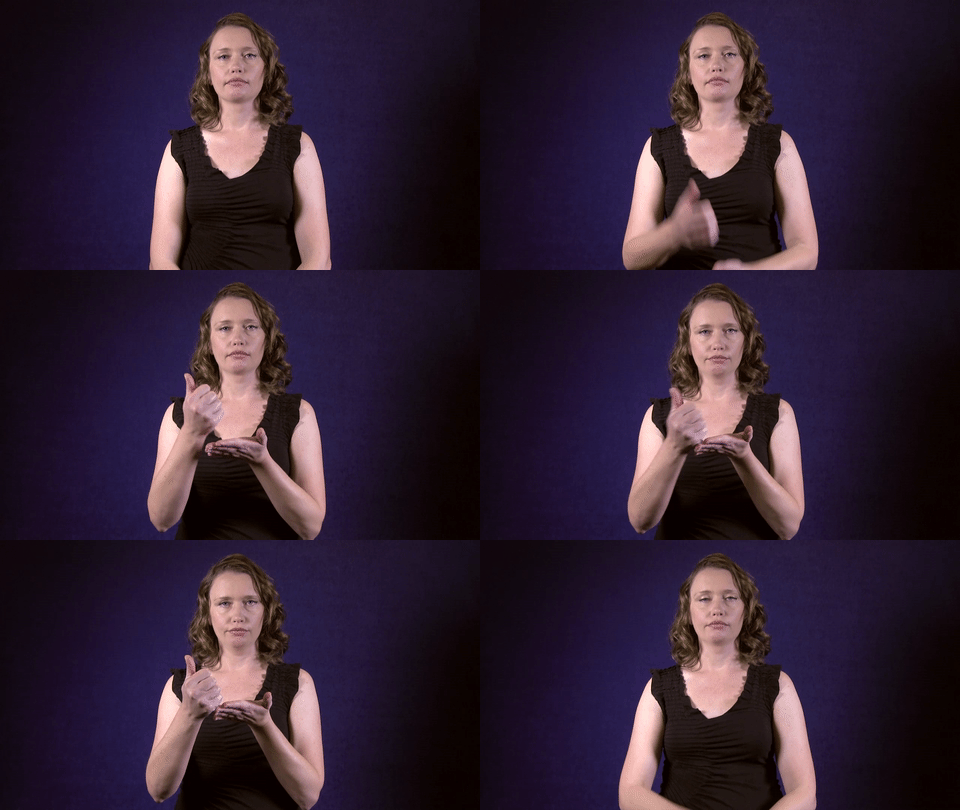
Sign for CREDIT CARD in ASL

Practice Activities:
Start by practicing the sign for CREDIT CARD in ASL in isolation. Stand in front of a mirror and repeat it multiple times while paying attention to your handshape and movement. Use both slow and fast repetitions to build muscle memory.
After you feel comfortable with the isolated sign, begin using it in simple sentences. For example, sign “I NEED CREDIT CARD,” “I FORGOT MY CREDIT CARD,” or “CREDIT CARD LOST, WHAT DO?” Practice signing each sentence with clear facial expressions and correct grammar.
Create a mini-skit or story using the sign for CREDIT CARD in ASL. You could tell a short story about shopping at the mall and realizing you’ve left your credit card at home. Include signs for related vocabulary such as STORE, WALLET, BUY, FORGOT, and PAY to give the story more context and flow.
Pair up with a classmate or language partner for interactive practice. One person can act out real-life scenarios while the other responds using ASL. For example, role-play paying a restaurant bill or checking out at a grocery store and needing to use a credit card. Switch roles to practice expressive and receptive skills.
Play a signing game where one partner signs a sentence and the other translates it to English, focusing on sentences that include the sign for CREDIT CARD in ASL. Try using more complex sentence structures as your confidence grows.
Watch ASL video clips or vlogs that include financial or shopping vocabulary. Try to pick out when the credit card sign is used, and copy their usage. This will help strengthen your understanding in fluent, natural signing environments.
Create flashcards with signs related to credit card use—such as BANK, MONEY, DEBIT, PAY—and include the sign for CREDIT CARD. Practice them daily to reinforce your signing vocabulary in this category.
Cultural Context:
The sign for credit card in ASL connects to both modern consumer culture and practical communication within the Deaf community. As credit cards have become a common tool for transactions in stores, online shopping, and everyday expenses, it’s important that this concept is easily expressed in American Sign Language.
Knowing the sign for credit card in ASL helps Deaf individuals navigate situations like making purchases, asking for card payments, or discussing finances. Whether buying groceries, booking a hotel, or paying for services, the ability to sign credit card clearly ensures smoother communication and equal access.
This sign reflects the way ASL adapts to society’s changes and evolving technologies. The need to talk about credit cards in sign language has grown alongside the rise of digital banking, mobile payments, and online retail . Including signs for these financial tools supports ASL users in professional and personal environments.
The sign for credit card in ASL can vary slightly based on context or region, but it’s generally understood across communities. This allows conversations involving money, credit, and transactions to flow naturally when Deaf individuals interact with cashiers, banks, or customer service reps.
The concept of a credit card in the Deaf community extends beyond simple purchases. It also relates to credit scores, financial planning, and debt management. Knowing the sign for credit card in ASL supports discussions around budgeting, teaching financial literacy in classrooms, and even negotiating payment options.
From a cultural standpoint, having access to a clear sign for credit card in ASL reflects the value placed on accessibility. It ensures financial independence is not hindered by communication gaps. It also empowers Deaf consumers to ask questions, make informed choices, and advocate for fair treatment in financial matters .
In daily life, the sign for credit card in ASL supports activities like lending a card to a friend, reporting a lost card, or explaining how to use a chip reader. It also allows for social-sharing moments like telling someone you just got approved for your first credit card or joking about overspending online ️.
Educational programs that teach the sign for credit card in ASL often expand into lessons about banking, saving, and responsible spending. These lessons are valuable for both children and adults, and they help bridge the communication gap when financial institutions offer services to Deaf clients.
The visual nature of ASL supports clear expression of financial actions, and the sign for credit card in ASL fits naturally when paired with signs like cash, bill, or account. It can also be used during classroom instruction
Extended Definition:
The sign for credit card in ASL is a common sign used in both casual and professional settings. It is especially useful when discussing payments, shopping, or financial topics in American Sign Language. Knowing the correct sign for credit card in ASL helps improve accessibility and communication for Deaf individuals in everyday financial transactions.
To sign credit card in ASL, one typically mimics the motion of swiping a card. The dominant hand, shaped like a flat hand or the index finger extended, moves across the palm of the non-dominant hand. This movement represents using a credit card at a terminal or inserting it into a machine. The sign is easily recognizable and closely resembles the action of real-life credit card use.
The context in which the sign is used may influence the movement or accompanying signs. For example, when asking someone if they accept a credit card, the sign may be paired with a facial expression or signs related to purchase, cost, or payment. The sign for credit card in ASL can be combined with signs for store, bank, or money to form complete sentences.
Like many signs in ASL, the sign for credit card in ASL has some regional variations. While most Deaf communities in the U.S. use a standard version, some individuals may choose a slightly different motion or handshape. These differences are generally understandable among fluent signers.
When teaching the sign for credit card in ASL, it’s helpful to use visual demonstrations and real-life examples. Videos and clear images can show the motion and hand placement more accurately than descriptions alone. This is especially true for signs like credit card, where hand movement plays a key role in expressing the concept.
Using the correct facial expressions can also help add clarity when signing. Since ASL is a visual language, non-manual signals such as facial expressions, head tilts, or eye contact play a big part. Combining the sign for credit card in ASL with the right expressions builds more natural and fluent communication.
Parents, educators, and interpreters often teach this sign to beginners who need vocabulary related to shopping or banking. It may also appear in financial literacy lessons taught in ASL. As more institutions move toward cashless transactions, knowing the sign for credit card in ASL becomes increasingly relevant.
In online ASL dictionaries and sign language educational apps, users often search for everyday terms like this. That makes the inclusion of signs such as credit card essential for a complete learning experience. Understanding how to use the sign
Synonyms: credit card, charge card, payment card, plastic card, debit card
Educational resources: Find related learning materials in our course bank!
Want more? Check out some of our popular learning activities on the homepage!
Need to look up a sign? Use our highly rated dictionary: https://aslinteractive.com/best-asl-dictionary/
Follow us on tiktok: https://www.tiktok.com/@aslinteractive. More social media links at the bottom of this page!
Long-tail Keywords: What is the sign for Credit card in ASL, How do you sign Credit card in ASL, Credit card in ASL sign
Categories:
tags: finance, shopping, payment methods, objects, transactions
Parameters
*Handshape*:
The sign for CREDIT CARD in ASL typically uses a flat “B” handshape on the non-dominant hand to represent a card. The dominant hand forms a modified “X” or bent index finger that mimics swiping a card across the flat palm, symbolizing a credit transaction . This movement reinforces the concept of the sign for CREDIT CARD in ASL by visually referencing the way credit cards are used.
In some variations, both hands may use flat “B” handshapes to suggest the shape and size of a physical card. This enhances clarity, especially in contexts where the sign for CREDIT CARD in ASL is used repeatedly. The handshapes work together to create a strong visual metaphor for card use.
*Palm Orientation*:
The palm orientation for the sign for CREDIT CARD in ASL typically involves one flat hand held upright, palm facing inward toward the body, while the dominant hand mimics the motion of swiping a card across it. The dominant hand is in a bent shape, often with fingers together, moving side to side as if swiping on a credit card reader.
In some versions of the sign for CREDIT CARD in ASL, the palm of the non-dominant hand stays steady while the dominant hand’s palm remains horizontal or angled slightly down. This helps represent the action associated with actual card usage for better clarity.
*Location*:
The sign for credit card in ASL is typically produced in the neutral space in front of the body, at chest level. One hand may represent the shape of a card while the other hand simulates the swiping or inserting motion used with an actual credit card.
This location allows for clear visibility and easy execution of the motion, making it intuitive for the viewer. The neutral zone is commonly used for signs related to technology or financial transactions like the sign for credit card in ASL.
*Movement*:
To perform the sign for credit card in ASL, start with your dominant hand in the shape of a bent “B” or flat hand. Move the fingertips across the palm of your non-dominant hand, mimicking the motion of swiping a card through a reader. The movement is smooth and horizontal, like using an actual card.
The sign for credit card in ASL visually represents a common interaction with cards, making it intuitive to remember. Some variations may include using a finger to trace a rectangle or flick across the palm, enhancing clarity depending on context.
*Non-Manual Signals*:
When signing the sign for credit card in ASL, facial expression should remain neutral or slightly inquisitive, depending on context. Raised eyebrows can be used when the sign appears within a question about payment or finances.
Mouth movement may include a slight pursing or mouthing of the word “card” to support clarity. The sign for credit card in ASL typically uses calm, smooth motions, so your facial tone should reflect that ease and normalcy in conversation.
*Prosody, Dominant/Non-Dominant Hand*:
The dominant hand is shaped like a flat “C” hand, representing the edge of a card. It moves across the palm of the non-dominant flat hand, mimicking the action of swiping a credit card. The sign for credit card in ASL can also include a slight flick or swipe motion to emphasize the transaction.
This sign for credit card in ASL visually mimics how one would use a card at a register. Make sure both hands are at chest level for clear visibility and expression.
Tips for Beginners:
When learning the sign for CREDIT CARD in ASL, start by focusing on the visual concept. Think about the physical use of a credit card—swiping or tapping a rectangular object. Many people use a classifier or mime the swiping motion to depict the concept, which helps solidify the meaning. Practicing in a mirror can help you refine your gesture so it looks natural and clear.
A common method for the sign for CREDIT CARD in ASL is to fingerspell “C-A-R-D” after making a simple mime of swiping or holding a thin rectangular object. Others may sign “MONEY” followed by “CARD” using initialized signs. Both are accepted depending on region and context. It’s helpful to ask native signers in your area which version is most understandable.
Handshape clarity is essential. If you choose to fingerspell CARD, make sure each letter is crisp, especially the transition from “A” to “R.” Beginners often blur the letters when signing quickly—go slow until the muscle memory strengthens. Practice fingerspelling with other finance-related terms, like “DEBIT” or “BANK” to build fluency.
Facial expressions matter too. You can add emphasis to the sign depending on urgency or tone—such as raising eyebrows when asking if someone has a credit card. Using the sign in storytelling or real-life pretend situations, like at a restaurant or store, can improve recall and fluidity.
Don’t be discouraged by variations. The sign for CREDIT CARD in ASL may differ between Deaf communities or even among individual signers. Watch videos, attend Deaf events, and seek feedback. By exposing yourself to different dialects, you’ll learn to understand and adapt your signing style, making you more confident and versatile in conversations around purchasing or finance.
Connections to Other topics:
The sign for CREDIT CARD in ASL connects to broader financial vocabulary within the language, including concepts like MONEY, BANK, DEBT, and PAY. These signs often use similar handshapes or movements to represent abstract financial processes. For example, the sign for MONEY typically uses a flat “O” handshape tapping into the palm, and this handshape may also appear in variations of financial terms like PAY and CREDIT CARD, linking them visually and conceptually.
In everyday conversation, the sign for CREDIT CARD in ASL can be combined with other signs to express specific ideas such as CREDIT CARD PAYMENT or LOST CREDIT CARD. In these compound phrases, context helps to modify or clarify meaning. For example, combining the sign for CREDIT CARD with the sign for STEAL can indicate a stolen card, while adding the sign for CANCEL can refer to canceling a credit card account.
This sign also has connections to discussions around IDENTITY and SECURITY in ASL. When talking about fraud, privacy, or online payments, signs like PASSWORD, PROTECT, and PERSONAL INFO often follow or precede CREDIT CARD. This contextual use allows for clear communication about topics like data breaches or verification procedures using ASL structure.
Related technology-focused signs also reinforce the use and context of the sign for CREDIT CARD in ASL. Terms like ONLINE, PURCHASE, and ACCOUNT are commonly used alongside it. For instance, a user might sign something like ORDER CREDIT CARD ONLINE to describe the process of obtaining a new card digitally. These compound structures help learners better understand topic sequencing and sentence morphology in everyday ASL.
Familiarity with the sign for CREDIT CARD in ASL strengthens one’s ability to engage in conversations about consumer life, financial planning, and modern digital habits. It bridges daily interactions like shopping or checking out, with more complex ideas like budgeting or credit history. As users become more fluent, these signs form pathways into broader topics of independence and responsible decision-making in Deaf culture.
Summary:
The sign for CREDIT CARD in ASL combines signs for “credit” and “card,” but is often conveyed through mimetic depiction, incorporating elements of classifiers and iconic representation. Typically, the dominant hand makes a swiping motion across the non-dominant palm, mimicking the way a credit card is swiped through a card reader or tapped on a terminal.
This sign is highly visual and relies on shared cultural understanding of how credit cards function in everyday transactions. The simulation of the swiping motion is a defining aspect of its clarity and contextual meaning. Some variations may feature the fingers miming the act of inserting or tapping a card rather than swiping.
The widespread use of digital financial tools gives the sign for CREDIT CARD in ASL strong cultural relevance. ASL users in the Deaf community often adopt and adapt signs that reflect evolving technologies, and the sign for CREDIT CARD in ASL is a perfect example of this adaptability. ✨
While some may fingerspell “credit” and “card,” a more efficient and fluid representation is often preferred in rapid conversation. This gesture-based sign saves time and blends well into sentence flow. It offers a compact alternative to multiple fingerspelled components.
This sign aligns with classifiers in ASL that utilize handshape and movement to describe objects or actions rather than spelling them out. It is part of a broader pattern in ASL where many signs aim for efficiency through iconic or depictive gestures. This visual storytelling is at the core of ASL’s rich linguistic texture.
The location of the sign remains in the palm area, a neutral space that mimics the act of financial transaction processing. Movement tends to be horizontal or downward, depending on the form of transaction being illustrated — swiping or tapping. This captures subtle nuances and creates semantic layering.
The sign for CREDIT CARD in ASL frequently appears in discussions about banking, purchasing, online orders, and fiscal responsibility. It’s common in contexts involving money, budgeting, or consumer habits. Social conversations, educational videos, and Deaf financial literacy programs feature this sign regularly.
From a grammatical standpoint, the sign functions as a noun and may be modified contextually to clarify plurality, ownership, or relational use. When paired with role-shifting techniques or directional verbs like ‘pay’ or ‘owe,’ the semantic contours sharpen powerfully. This mirrors the flexibility and expressiveness of ASL grammar.
In everyday interactions, the sign may be paired with facial expressions that convey ease, frustration, urgency, or satisfaction depending on whether the transaction is successful. Nonmanual markers provide emotional coloring to otherwise neutral financial vocabulary. These expressions help humanize the sign’s meaning and enhance communicative nuance.
Many ASL users may lean on surrounding sentence structure to clarify whether the CREDIT CARD being referenced is debit, personal, company-issued, or expired. Additional signs like “expired,” “stolen,” or “declined” expand on the base term. The sign for CREDIT CARD in ASL becomes a foundational piece in an evolving, descriptive network.
The iconographic nature of the sign may change as technology evolves. As chip readers transitioned to tap pay or contactless systems, subtle motion changes emerged in how the sign is produced. Some now use a quick downward tap gesture resembling the “contactless” pay symbol.
Digital natives within the Deaf community have further helped refine and diversify its production. Younger ASL users, exposed to a variety of fintech tools, may create slang signs or regional idiomatic versions. This marks generational evolution in sign use and construction.
Interpreters sometimes encounter challenges when conveying the sign for CREDIT CARD in ASL into English because of its layered visual dimensions. While it can be easily misread by non-signers as tapping, signing contexts make it clear it’s related to financial tools. This shows how visual grammar differs widely from auditory forms.
The sign reflects not only material culture but also abstract systems like creditworthiness, costs, loans, and debt. Though CREDIT CARD implies a physical object, it evokes an entire framework of capitalist interaction. In this way, it becomes semiotic shorthand for entire financial systems.
Linguists studying space and movement in ASL analyze signs like this in terms of role space. Transactional zones within signing space become imagined objects like registers, ATMs, or card readers. The dynamic quality of ASL allows objects and ideas to be rendered through body spatiality.
Variation in this sign can depend on age, region, and level of exposure to Deaf culture. In traditional ASL circles, the swipe gesture is most common. In more urban Deaf communities, the tap or insertion motions may gain preference.
International sign variations for CREDIT CARD don’t always align with ASL, even if swiping is globally understood. Sign languages in other countries may use entirely different movements based on cultural type of usage, such as showing handheld scanning devices or mobile app gestures. That makes the ASL version culturally specific but globally interpretable.
Children learning ASL often
Want more? Check out some of our popular learning activities!
ASL Interactive Resources
ASLInteractive YouTube Channel
Follow us on tiktok: @aslinteractive.com
Follow us on Instagram: aslinteractive
Facebook page: aslinteractive
Facebook group: aslinteractive
LInkedIn: ASL Interactive LLC
Twitter: @ASL_interactive
*Some information on this page is AI-generated. AI can make mistakes. Please check the information.
Responses