
Definition: A person who buys goods or services.
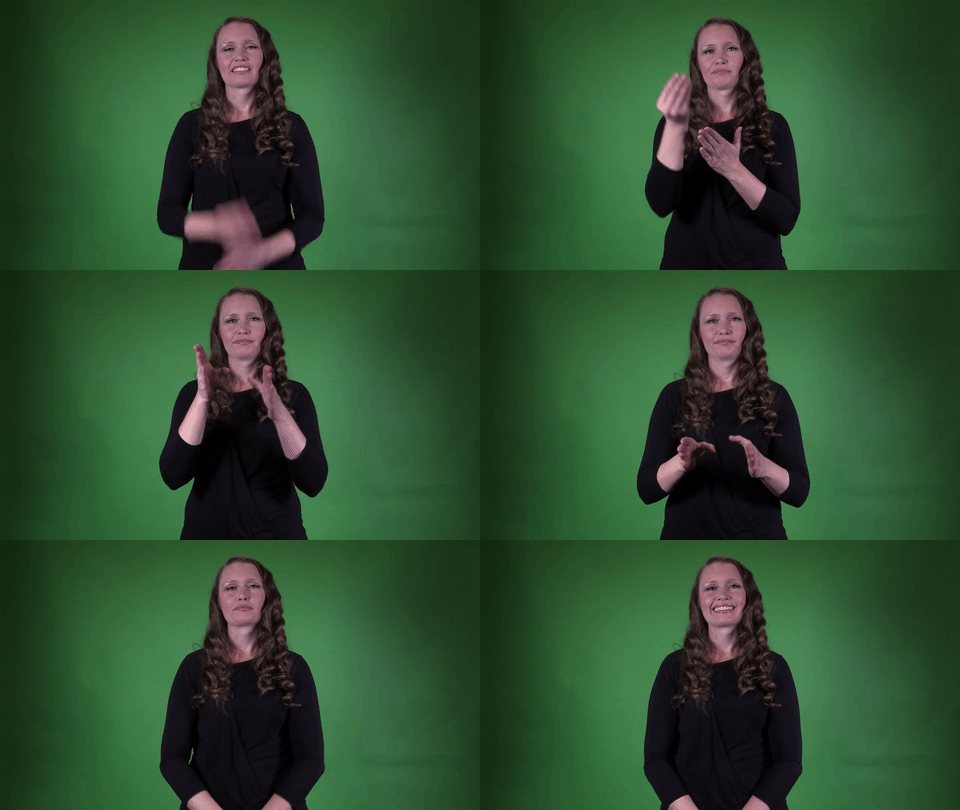
Sign for CUSTOMER 2 in ASL

Practice Activities:
Start by practicing the sign for CUSTOMER 2 in ASL in front of a mirror. Focus on your handshape, palm orientation, and facial expression. Repeat the sign slowly and carefully, then increase your speed while maintaining clarity. Do it ten times in a row to build muscle memory.
Next, incorporate the sign into situational phrases. Practice short phrases like “help customer,” “talk with customer,” or “customer waiting.” This will improve your fluency transitioning in and out of the sign. Say the phrase out loud as you sign to reinforce meaning and context.
Use flashcards to mix the sign for CUSTOMER 2 in ASL with other business-related signs like EMPLOYEE, BUY, SELL, and STORE. Shuffle the cards and sign each word you see. Then, pair signs to form useful business phrases and sign them one after another to practice flow.
Try storytelling related to customer situations. For example, tell a short story using signs about a day working in a store where a customer asks for help. You can keep it simple—describe how the customer entered, asked a question, and left happy. Retell the story using different facial expressions to practice conveying tone.
Do partner practice with another learner. One person plays the role of a customer, the other a worker. Use the sign for CUSTOMER 2 in ASL several times throughout your role-play. Switch roles after each scenario to ensure both people practice equally.
Record yourself signing the sign for CUSTOMER 2 in ASL in sentences like “The customer bought shoes” or “I saw the customer at the counter.” Watch the recording and check if your sign is accurate and natural. Repeat the video exercise weekly to track your improvement.
Finish your session by signing five full sentences that include the sign and review them with a teacher or peer for feedback.
Cultural Context:
Understanding the sign for CUSTOMER 2 in ASL involves more than just knowing the handshape and motion. It ties deeply into the values and interactions of the Deaf community where visual language is a vital part of daily communication.
The sign for CUSTOMER 2 in ASL reflects the common exchanges between people in service-based environments. Whether at a store, restaurant, or business meeting, this sign is used when discussing roles, expectations, and experiences from the perspective of a customer.
In Deaf culture, direct and clear communication is highly valued. The sign for CUSTOMER 2 in ASL supports that value by expressing the concept visually, which allows for accurate and respectful conversation in business and social situations.
Deaf individuals often advocate for equal access and inclusive service. Knowing and using the sign for CUSTOMER 2 in ASL helps create more inclusive experiences in customer service environments, where Deaf people are often underserved or ignored due to lack of signing staff.
Interpreters, educators, and Deaf professionals frequently use the sign for CUSTOMER 2 in ASL to describe scenarios in role-plays or discussions about consumer rights and responsibilities. It plays a key role in dialogues about accessibility and equal treatment in stores, banks, or public services.
In social conversations, the sign for CUSTOMER 2 in ASL can help describe a person’s part in a story or a situation involving service or help. For instance, someone might use it to explain a time they got great service—or poor service—and emphasize the perspective of the person receiving the service.
This sign also fosters connection between hearing and Deaf communities. When hearing people learn to use the sign for CUSTOMER 2 in ASL, it shows respect, increases cultural competence, and bridges gaps that often exist in everyday communication.
In the classroom or on social media platforms, using the sign for CUSTOMER 2 in ASL gives learners more than vocabulary—it gives cultural insight. It connects to broader themes like respect, fairness, and equality that are essential conversations in the Deaf community.
Workshops on Deaf awareness often examine real-world customer service scenarios and teach the sign for CUSTOMER 2 in ASL as part of building empathy and understanding. It becomes a tool for advocacy as well as daily interaction.
The sign for CUSTOMER 2 in ASL fits into a broader narrative of empowerment and visibility for the Deaf community. Using the correct sign in context upholds the authenticity of ASL and reinforces the importance of using ASL appropriately in interpersonal and professional spaces.
For anyone learning ASL or working alongside Deaf
Extended Definition:
The sign for customer 2 in ASL refers to an additional or alternative way to express the concept of a customer using American Sign Language. While many signs can have a standard representation, some words and phrases may have multiple variations depending on region, context, or evolving signing styles. The variation known as customer 2 might be more commonly used in specific Deaf communities or in certain conversational settings.
To produce the sign for customer 2 in ASL, you typically incorporate elements that reference a transaction, a person receiving services, or a consumer role. This version may blend the sign for person with a gesture related to shopping, purchasing, or service. Because this version is dynamic, it helps express a deeper connection between the customer’s role and the action they’re performing in the interaction.
Context plays a big role in which version of a sign a person uses. The customer 2 version might be more appropriate in conversations involving formal business interactions, sales discussions, or customer service scenarios. ASL is highly visual and expressive, so signers may choose the customer 2 variation to be more precise or culturally appropriate in certain settings.
In ASL, signs can evolve based on usage, social trends, and influence from broader Deaf communities. The sign for customer 2 in ASL reflects that flexibility by offering diversity in expression while maintaining clarity. When learning this variation, it’s important to consider the context and intent of your message.
Non-manual markers such as facial expressions and body posture also help clarify whether a signer is referring to a casual shopper, a client in a business sense, or any other type of customer. This makes the customer 2 version even more useful in distinguishing tone and context. Using the correct sign helps prevent confusion and supports richer communication.
This sign may also be influenced by contemporary references or workplace ASL that includes industry-related vocabulary. Occupations in retail, sales, or hospitality often require a specific way to refer to the people they serve, and the sign for customer 2 in ASL provides an effective tool for clear interaction. It serves both the Deaf and hearing worlds efficiently in professional settings.
When searching for the best way to sign a word like customer, it’s helpful to learn and compare different versions, including this one. The sign for customer 2 in ASL gives signers more options and supports expressive freedom. It also helps learners develop a deeper understanding of how sign language adapts to real-world contexts.
Videos and visual examples are the best way to fully grasp how this sign
Synonyms: client, purchaser, buyer, consumer, patron
Educational resources: Find related learning materials in our course bank!
Want more? Check out some of our popular learning activities on the homepage!
Need to look up a sign? Use our highly rated dictionary: https://aslinteractive.com/best-asl-dictionary/
Follow us on tiktok: https://www.tiktok.com/@aslinteractive. More social media links at the bottom of this page!
Long-tail Keywords: what is the sign for customer in ASL, how do you sign customer in ASL, customer in American Sign Language
Categories:
tags: customer, commerce, shopping, business, occupations
Parameters
*Handshape*:
The handshape used in the sign for CUSTOMER 2 in ASL involves both hands forming the letter “C” handshape. The thumbs and fingers curve to create the shape of the letter, with palms generally facing each other or slightly forward depending on the variation.
This sign for CUSTOMER 2 in ASL typically mimics the motion of measuring or tailoring, which aligns with the idea of serving or interacting with a customer. The consistent use of the “C” shape allows for easy visual association with the concept.
*Palm Orientation*:
The palm orientation for the sign for CUSTOMER 2 in ASL begins with both hands in a flat “C” shape. The dominant hand is slightly higher, with palms facing each other and oriented inward toward the chest area. As the sign is produced, the hands move down the torso, keeping that inward orientation.
In the sign for CUSTOMER 2 in ASL, maintaining the palm orientation through the downward movement is essential for clear communication. This ensures the sign is distinct and not confused with similar occupational signs.
*Location*:
The location for the sign for CUSTOMER 2 in ASL is at the front of the body, near the chest or upper torso. The dominant hand moves downward in front of the body, often starting at the shoulder level and ending near the waist.
This positioning emphasizes interaction or service, aligning with the meaning behind the sign for CUSTOMER 2 in ASL. The movement typically stays close to the body to reflect a context of personal exchange.
*Movement*:
The sign for CUSTOMER 2 in ASL involves forming both hands into the “C” handshape. Place one hand near the upper chest and the other below it. Move both hands vertically in a short, alternating up-and-down motion, as if outlining a person or a vertical column. This movement mimics the idea of client interaction or service.
This motion in the sign for CUSTOMER 2 in ASL symbolizes the connection between a service provider and a person being helped. The “C” handshape helps clearly identify the concept of a customer or consumer. ️
*Non-Manual Signals*:
When using the sign for CUSTOMER 2 in ASL, the facial expression should remain neutral or slightly attentive, reflecting a typical business interaction. Slight head nodding may emphasize engagement or acknowledgment, especially if referring to a specific customer.
Eyebrows should be in a relaxed position unless turned into a yes/no or WH-question, depending on sentence structure. Maintain eye contact with the signer or referent to reinforce clarity while using the sign for CUSTOMER 2 in ASL.
*Prosody, Dominant/Non-Dominant Hand*:
The sign for customer 2 in ASL uses both hands symmetrically. The dominant hand and non-dominant hand form the letter “C” and move downward from the chest area as if outlining a person, indicating the concept of a user or patron. This reflects a modified version of the sign for “person” following the sign for “buy.”
When signing the sign for customer 2 in ASL, keep both hands parallel and use a steady, clear movement. The prosody of the sign often includes a neutral facial expression, appropriate for formal or business contexts.
Tips for Beginners:
When learning the sign for CUSTOMER 2 in ASL, it’s important to first recognize that this variation might differ slightly depending on region or context. Start by mastering the foundational sign for CUSTOMER, which typically incorporates the concepts of “shop” or “purchase” using modified “C” handshapes, placed around the torso area. For this variation, observe if there is an additional movement, facial expression, or hand transition that adds specificity.
Practice signing in front of a mirror to check for clear handshape and facial expression. Many beginners forget to keep their non-dominant hand steady if it plays a supporting role. This can lead to unclear meaning. The sign for CUSTOMER 2 in ASL might involve subtle nuances, so always cross-reference with a trusted resource like a video of a native signer or your ASL instructor.
Facial expressions are key in conveying tone and context in ASL, even for nouns like CUSTOMER. Ensure your face matches the role of someone interacting with a customer if you’re using the sign in a full sentence or dialogue. A common beginner mistake is using a static facial expression while signing, which can lessen the impact of the message.
Repetition is your friend . Don’t just learn the sign in isolation—try using it in different sentences. For example, practice sentences like “Are you a new customer?” or “The customer wants help” to reinforce memory and context. The more you use the sign for CUSTOMER 2 in ASL in real conversations or practice sessions, the faster it will stick.
Finally, always ask for feedback. Whether it’s from a Deaf friend, teacher, or study group, checking if your version of the sign for CUSTOMER 2 in ASL is understood and appropriate is the best way to improve.
Connections to Other topics:
The sign for CUSTOMER 2 in ASL connects closely with signs that describe service, commerce, and professional interactions. It typically utilizes the sign for BUY or SHOP as a base and then incorporates person-marking elements that indicate someone engaging in that role. This structurally resembles other occupational signs like TEACHER, STUDENT, or DOCTOR, where the core activity is followed by the agent marker to indicate a person associated with it. Understanding this pattern helps learners conceptualize and produce other role-based signs within ASL smoothly.
There are also practical connections to signs used in transactional settings, such as STORE, CASHIER, or CLIENT. The sign for CUSTOMER 2 in ASL is often used in narratives involving consumer behavior, job descriptions in retail, or interactions within customer service training sessions. This sign can also compound naturally with signs like COMPLAIN, ASK, or HELP to describe interactions, for example, “CUSTOMER COMPLAIN” or “CUSTOMER ASK HELP,” offering useful contextual expressions in professional environments ️.
Moreover, the sign fits into a broader grammar system where classifiers describe the actions and movements of the customer in space. If describing a CUSTOMER walking through a STORE, one could integrate CL:1 (person walking) or directional verbs to show the flow of the interaction physically. This spatial grammar deepens the depiction and makes ASL more visually rich and context-driven.
The sign for CUSTOMER 2 in ASL also aligns with vocabulary in educational fields, especially in teaching business or employment-related ASL classes. It is a helpful anchor for discussing abstract ideas like customer satisfaction, feedback, or reputation. Learning this sign supports better fluency for those planning to work in service industries or interpret contexts related to consumer behavior .
Summary:
The sign for CUSTOMER 2 in ASL typically uses classifiers and role-shifting to highlight the transactional and interactional nature of a customer in specific contexts. The sign blends personification with transactional handshape roots. This version may differ slightly from the more generic CUSTOMER sign, as it incorporates more nuanced context about the customer’s behavior or role.
To sign this variation, the signer begins by using dominant C-handshapes on both hands, or sometimes only one hand depending on context. These C-hands may move downward vertically from the chest to the stomach level, indicating the idea of a person involved in an ongoing or service-based relationship. The movement reflects participation in an exchange where the signer may be roleplaying or visually illustrating a customer’s involvement.
Facial expressions are key elements in the sign for CUSTOMER 2 in ASL. Signers may raise their eyebrows slightly to represent a polite inquiry or satisfaction, or squint to show dissatisfaction, making the sign contextually richer. The intensity or speed of the hand movement can also reflect the type of customer—impatient, calm, curious, or demanding.
In grammatical terms, the sign for CUSTOMER 2 in ASL may function as a noun and also suggest an agent within a transaction. It interacts with directional verbs like GIVE, SELL, or OFFER. By altering the facial expression and body orientation, a signer can construct complete visual sentences such as “the customer asked” or “the customer complained.”
This variation allows a signer to move beyond a static sign and embody a character. Role-shifting can be leveraged to show interactions, such as a customer arguing with a salesperson, or receiving a service. These features support richer storytelling in both informal and formal discourse zones.
The keyword phrase sign for CUSTOMER 2 in ASL plays a powerful role in business-related ASL conversations. It surfaces frequently in contexts like debate, education, presentation, storytelling, and customer service roleplays. Cultural familiarity with consumer behavior enhances signers’ narrative clarity and performative control.
Culturally, the sign for CUSTOMER 2 in ASL reflects broader American consumer behaviors where service interactions are dynamic and rich with facial emotion and intention. In Deaf culture, signing CUSTOMER isn’t just identifying a buyer—it represents a social role that demands politeness, clarity, and respect. These cultural elements underpin the visual delivery of the sign.
This sign connects closely with related signs such as CLIENT, CONSUMER, BUY, and CUSTOMER SERVICE. Each one shares some root classifiers or person markers, but CUSTOMER 2 utilizes more performative elements, often depending on classifier storytelling. Deaf consumers signing CUSTOMER 2 might emphasize different physical or emotional components to reflect nuanced meanings in lived experience.
In applied linguistics, analyzing the sign for CUSTOMER 2 in ASL sheds light on how visual languages construct roles surrounding economic and social functions. The C-handshape doubles as both a classifier and a letter sign, demonstrating layering of morphemes within a single motion. This structure reveals how ASL economizes movement while expanding expression.
When ASL students study nuance through the keyword phrase sign for CUSTOMER 2 in ASL, they learn how modification of existing signs can sharpen narrative specificity. It’s a rich case study of how variation supports communication goals in situational dialogue. This deepens understanding of how meaning shifts depending on lexicon-gesture synergy.
Thumb placement and wrist direction in the CUSTOMER 2 variant can demarcate whether the customer is engaged, passive, or actively querying. The orientation of the C-hands—slightly outward, downward, or rotating—bring visually logical depth to the sign. A tilt in the head or intentional eye gaze also modifies the sign’s undertones.
The keyword phrase sign for CUSTOMER 2 in ASL also aligns with visual-gestural economy principles. In practice, the signer demonstrates highly communicative agency through minimal yet intentional movement. This clears ambiguous interpretations and allows for reduced dependency on supplemental signs.
Teaching the sign for CUSTOMER 2 in ASL in ASL curriculum integrates core modules on classifiers, role shifting, and expressive affect. Students are often guided to use this sign in performance, such as mock job interviews or simulations, reinforcing both professional vocabulary acquisition and cultural realism in signing.
In cognitive linguistics, this variation gives insight into how the human brain categorizes economic roles. The visual difference between CUSTOMER and CUSTOMER 2 maps to layered understandings of transactional agency. Subtle gestural shifts mirror changes in internal conceptions of self and others within an exchange.
Sign language interpreters often apply CUSTOMER 2 in business, customer support, or vocational settings when capturing emotional dynamics between clients and providers. The variation allows interpreters to synch facial grammar with consumer identity interpretation, ensuring higher fidelity translation.
The sign for CUSTOMER 2 in ASL can mirror ‘Karen’ stereotype representations in Deaf social commentary, when sharpened facial expressions and sharp directional movements are exaggerated. In this context, the phrase becomes a semiotic tool for unpacking interpersonal conflict or complaint culture.
Want more? Check out some of our popular learning activities!
ASL Interactive Resources
ASLInteractive YouTube Channel
Follow us on tiktok: @aslinteractive.com
Follow us on Instagram: aslinteractive
Facebook page: aslinteractive
Facebook group: aslinteractive
LInkedIn: ASL Interactive LLC
Twitter: @ASL_interactive
*Some information on this page is AI-generated. AI can make mistakes. Please check the information.
Responses