
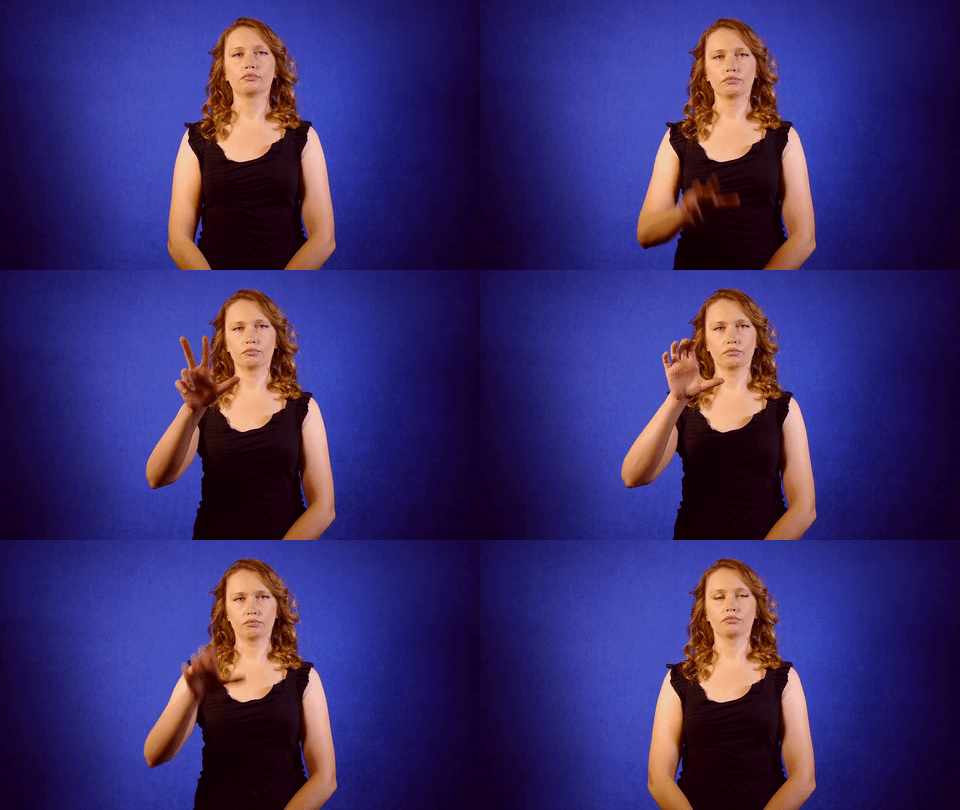
Definition: Refers to the number three hundred
Sign for NUMBER THREE HUNDRED in ASL

Practice Activities:
Practicing the sign for number three hundred in ASL can be both fun and effective with a variety of exercises. Start by signing it in isolation multiple times to build muscle memory. Try signing numbers leading up to it, such as one hundred, two hundred, and then continue past three hundred to see how the pattern works.
Use real-life contexts to reinforce the sign for number three hundred in ASL. Practice by counting items, such as books, coins, or marbles, and pause to sign three hundred when appropriate. Try writing down numbers on flashcards and signing each one when you pick it up. This will help with quick recall of numerical signs.
Challenge yourself with creative exercises. Sign different amounts and ask a partner to identify the number. You can also play a game in which you and a friend take turns signing prices, such as “$300 for a computer.” Think of historical events, like “300 years ago,” and use storytelling to give context.
Incorporate the sign into daily conversations. If discussing money, mention items that cost this amount and sign it fluidly. If you are talking about population or statistics, use three hundred naturally. Even when setting goals, such as “reading 300 pages,” integrating the sign will improve fluency.
Record yourself signing numbers, including the sign for number three hundred in ASL, and review for accuracy. Watching videos of fluent signers using numbers can also improve understanding and help with signing speed. Consistent practice with varied exercises will make signing this number second nature.
Cultural Context:
The sign for number three hundred in ASL is formed using a combination of number signs and movement. Numbers play a significant role in ASL, helping to convey exact amounts, time, and quantifiable concepts. Knowing the correct way to sign number three hundred in ASL ensures effective communication in educational, financial, and daily life situations.
ASL numbers follow a structured pattern, and the sign for number three hundred in ASL follows rules that make it clear and efficient. Unlike spoken languages, ASL relies on handshapes and palm orientation to differentiate numbers and avoid misunderstandings. Understanding these patterns is essential for both beginner and advanced ASL learners.
Deaf culture places a strong emphasis on accurate signing, including numbers like three hundred. Proper formation of the sign for number three hundred in ASL shows respect for the language and its grammatical structure. Practicing clear and consistent number signs helps improve fluency and comprehension among signers.
Numbers are frequently used in everyday conversations, whether discussing age, prices, addresses, or statistics. The ability to sign number three hundred in ASL allows for seamless communication in shopping, business, and academic discussions. Since ASL is a visual language, number signs are designed for clarity and efficiency.
In the Deaf community, numerical accuracy is especially important in education and professional settings. Learning the correct sign for number three hundred in ASL supports discussions in math classes, science lectures, and financial negotiations. Mastering number signs enhances confidence in both casual and formal interactions.
ASL number signs have evolved over time, influenced by regional variations and linguistic history. While the sign for number three hundred in ASL follows a standardized pattern, slight differences may exist depending on location or signer preference. Being aware of these variations promotes flexibility and adaptability in communication.
The use of classifiers and numerical incorporation in ASL expands the way quantities are expressed. The structure of the sign for number three hundred in ASL aligns with number compounding found in other numerical expressions. Understanding these concepts is crucial for developing strong sign language skills.
Numbers also have cultural significance, including in storytelling, traditions, and symbolic meanings. The sign for number three hundred in ASL may appear in historical references, sports scores, or business transactions. Recognizing these uses increases language immersion and cultural awareness.
Fluent signers use facial expressions and pacing when signing numbers to ensure clarity. When signing number three hundred in ASL, maintaining a clear handshape and steady movement prevents confusion. These small
Extended Definition:
The sign for number three hundred in ASL follows a combination of number signs commonly used in American Sign Language. This sign incorporates the number “3” and “C” handshape to represent three hundred in a clear and concise way. Understanding how to sign numbers like this is crucial for effective communication in ASL.
To sign number three hundred in ASL, start with the number “3” handshape, with your index, middle, and thumb extended. Then transition into the “C” handshape, forming the shape of the number hundred. This movement expresses “three hundred” efficiently and visually.
ASL numbers follow specific rules, making them distinct from spoken language. When signing number three hundred in ASL, maintain a smooth transition from “3” to “C” to ensure clarity. Proper hand positioning and movement are essential for accurate signing.
Numbers in ASL can be expressed with one or two motions depending on their structure. The sign for number three hundred in ASL uses a logical pattern that fits into the broader number system. Practicing this sign repeatedly can help improve fluency and recognition.
When signing large numbers like three hundred, make sure to maintain eye contact with the person you are communicating with. Facial expressions are a key part of ASL and help provide emphasis. Consistently practicing number signs improves overall signing skills and comprehension.
Understanding the sign for number three hundred in ASL is useful in many everyday situations, such as discussing prices, counting, or sharing numerical information. Learning number patterns in ASL makes it easier to sign other large numbers. Mastering ASL numbers builds confidence in signing conversations.
ASL numbers are essential for clear and effective communication in various situations. Becoming comfortable with numbers like three hundred allows for smoother interactions in daily life. Repeated practice and exposure to ASL make number signs second nature.
By learning the sign for number three hundred in ASL, signing numbers in conversation becomes more natural. Whether discussing math, finances, or simply counting items, knowing ASL number signs is beneficial. Expanding ASL number knowledge makes communication more efficient.
Synonyms: three hundred, 300, 3 hundred
Educational resources: Find related learning materials in our course bank!
Want more? Check out some of our popular learning activities on the homepage!
Need to look up a sign? Use our highly rated dictionary: https://aslinteractive.com/best-asl-dictionary/
Follow us on tiktok: https://www.tiktok.com/@aslinteractive. More social media links at the bottom of this page!
Long-tail Keywords: what is the sign for number three hundred in ASL, how do you sign number three hundred in ASL, learn how to sign number three hundred in American Sign Language
Categories: Numbers – Basics, hundreds, cardinal numbers
tags: Numbers, Counting, Mathematics, Educational, Language Learning
Parameters
*Handshape*:
The sign for NUMBER THREE HUNDRED in ASL uses a combination of number handshapes. To start, form the number THREE with your dominant hand, keeping the thumb, index, and middle fingers extended while the ring and pinky fingers remain folded. Then, smoothly transition into the number THREE handshape changing into the letter “C” to represent “hundred.” This movement visually represents the concept of 300 in ASL.
When signing NUMBER THREE HUNDRED in ASL, ensure a natural and fluid transition between the handshapes. The fingers should stay relaxed, and the motion should be clear to avoid confusion with other number signs. Proper hand positioning and clarity make this sign easy to read for fluent ASL users.
*Palm Orientation*:
The palm orientation for the sign for NUMBER THREE HUNDRED in ASL begins with the dominant hand forming the number three, with the palm facing out. As the sign transitions to three hundred, the hand moves into a bent “C” shape, with the palm shifting slightly to face inward. This motion smoothly connects the numeric concept of three to the rounded handshape representing hundred, creating a fluid and natural sign.
*Location*:
The sign for NUMBER THREE HUNDRED in ASL is produced in the neutral signing space in front of the body. For “three,” the dominant hand forms the number three handshape (thumb, index, and middle fingers extended) at chest level. To indicate “hundred,” the dominant hand transitions from the number three shape into a curved “C” hand, pulling back slightly. This movement represents the numerical concept smoothly. The sign is performed at chest level for clarity.
*Movement*:
To produce the sign for number three hundred in ASL, begin by forming the number 3 with your dominant hand, extending the index, middle, and thumb while keeping the ring and pinky fingers down. Then, smoothly transition into a “C” handshape by curling the index and middle fingers downward as the thumb curves outward. This movement visually represents the shift from three to hundred in ASL number formation. Keep the motion fluid for clarity and natural expression.
*Non-Manual Signals*:
Facial expressions remain neutral or slightly focused when performing the sign for NUMBER THREE HUNDRED in ASL. If emphasizing the quantity, raised eyebrows and a slightly open mouth may be used. When clarifying or confirming the number, a head nod or slight forward tilt can reinforce understanding. If asking about the number, eyebrows raise, and the head tilts slightly forward to indicate a question. Maintaining appropriate eye contact ensures clear communication.
*Prosody, Dominant/Non-Dominant Hand*:
The sign for NUMBER THREE HUNDRED in ASL uses the dominant hand to form the number THREE, with the index, middle, and thumb extended while the other fingers are curled. Then, the hand moves into the sign for HUNDRED, which often resembles a “C” shape formed from the number THREE. This movement smoothly transitions, showing the numerical concept clearly. The non-dominant hand is not required for this sign, and the motion remains in the neutral signing space.
Tips for Beginners:
Mastering the sign for NUMBER THREE HUNDRED in ASL requires precision in handshape and movement. To sign the number three, extend your index, middle, and thumb while keeping the rest of your fingers curled. Then, smoothly transition to signing three hundred by forming the number three again and moving into the “C” handshape to represent hundred.
A common beginner mistake is not fully forming the correct handshape for three. Ensure that your ring and pinky fingers stay tucked in to avoid confusion with other numbers. When transitioning to the hundred part, keep the movement smooth and controlled to maintain clarity. A sharp or jerky motion can make the sign difficult to read.
Finger positioning and hand orientation are crucial for accuracy. If your fingers are stiff or tense, it may make the sign less natural and harder to recognize. Try relaxing your hand slightly while still maintaining the correct shape. In larger conversations, making signs too small can reduce visibility, so adjust the size of your movements depending on distance and audience.
Practice signing the sign for NUMBER THREE HUNDRED in ASL in front of a mirror to check for clarity. Record yourself or ask a fluent signer for feedback. Watching ASL number videos can reinforce correct hand formations and transitions, helping you build confidence and fluency.
Numbers in ASL follow patterns, so understanding how three hundred fits into the broader numbering system will improve overall comprehension. Review similar signs such as one hundred and two hundred to see the consistency in movement. Developing muscle memory through repetition is key to signing numbers smoothly and confidently.
Connections to Other topics:
The sign for number three hundred in ASL connects to other number signs and counting concepts. In ASL, whole numbers are generally signed in a structured manner, making it easy to represent various numerical values. Signing three hundred follows the general rule of forming the initial number (three) and then incorporating the hundred concept, which can be linked to larger values like six hundred, nine hundred, or even one thousand.
This sign is useful when discussing topics involving money, age, or quantities. In finance-related discussions, signing three hundred can apply to dollar amounts, pricing, or counting large units like three hundred dollars or three hundred grams. Similarly, it appears in sports statistics, historical dates, or distances, showing how ASL incorporates numbers into different real-world contexts.
Numbers in ASL often combine with classifiers to give more clarity. For example, when talking about three hundred people, a corresponding classifier may describe a group of individuals. In education or business settings, the sign for number three hundred in ASL is frequently seen when discussing large class sizes, enrollment figures, or statistical data. These applications reinforce how ASL integrates numerical signs into broader communication needs.
Since ASL numbers build on a pattern-based system, learning three hundred also helps learners understand how to sign similar numbers with different values. This applies to numbers like two hundred, four hundred, and beyond, where the hundreds unit remains the same, but the leading digit changes. Recognizing these patterns helps with fluency in expressing numerical information efficiently. This number also connects with ordinal structures such as signing three hundredth, which would modify the base number sign to reflect order rather than quantity.
Summary:
The sign for number three hundred in ASL combines elements of numerical representation and natural handshape transitions. It begins with the number three, which uses the index finger, middle finger, and thumb extended while the other fingers remain folded into the palm. This is a standard numerical handshape in ASL and represents the foundational aspect of the sign.
To transition from three to three hundred, the dominant hand moves smoothly into a modified “C” handshape, mimicking the pattern found in other round-number signs like one hundred or two hundred. The transition is fluid, emphasizing the natural shift from a numerical digit to a collective value. This modification of the movement helps maintain the visual and conceptual clarity of representing a number in the hundreds range.
Number signs in ASL rely heavily on efficient shape transitions to ensure clarity. The sign for number three hundred in ASL follows this principle, minimizing hand movement while preserving accuracy. A signer must maintain a consistent dominant-hand orientation and ensure each part of the sign is distinct but connected.
ASL number signs follow a general pattern where the shift from single digits to rounded hundreds is predictable. This pattern allows numbers to be signed with relative ease once a signer is familiar with the base handshapes. The progression from three to three hundred follows the expected numerical conventions in ASL.
The sign for number three hundred in ASL illustrates the role of symmetry and balance in numerical signing. The economy of movement ensures that signers can quickly transition between consecutive number signs without confusion. This is particularly useful when signing numerical sequences in rapid succession.
For hearing individuals learning ASL, recognizing the nuanced transition between numerical sets is crucial. The shift from basic counting numbers to more complex figures like three hundred follows a logical structure. Understanding this helps reinforce overall proficiency in ASL numerical structures.
Numbers in ASL serve not only as stand-alone concepts but also as integral components of broader conversation. The sign for number three hundred in ASL may appear in discussions about dates, finance, measurements, or quantities. Users must be adept at integrating numerical values into various conversational contexts.
The broader linguistic framework of ASL supports efficient number formations that prioritize visual clarity. The movement from individual digits to rounded numbers like three hundred is an example of this efficiency. This contributes to ASL’s overall accessibility and fluidity in signed communication.
ASL numbers are closely tied to Deaf culture and historical language development. The sign for number three hundred in ASL reflects the standardized methods that have been shaped over generations of signers. Learning ASL numbers involves understanding both the technical formation and cultural relevance of numerical representation.
The manual dexterity required for number signs helps refine fine motor control. Signing three hundred requires precision in finger positioning and smooth transition between handshapes. Mastering these movements builds confidence and fluency in ASL users.
For beginners, transitioning from static numerical signs to movement-based ones like three hundred can be challenging. Consistent practice and observing native users will help solidify the structure of large number signs. The key is to maintain a steady, fluid motion while signing.
The sign for number three hundred in ASL also provides insight into linguistic economy. ASL minimizes unnecessary gestures while optimizing sign readability. This principle ensures that number signs remain efficient and recognizable.
Number signing in ASL adheres to systematic progressions that simplify communication. The adaptation of three to three hundred follows a discernible logic that aligns with other numeric structures. Recognizing these patterns allows for quicker comprehension during signed exchanges.
Fluency in ASL involves mastering number sequences for practical application. The sign for number three hundred in ASL is relevant in financial discussions, timekeeping, academic settings, and everyday transactions. A solid grasp of this sign is necessary for functional ASL usage.
Historical shifts in ASL structure have influenced numerical formation styles. Although standardization exists, some regional variations affect number sign execution. Awareness of subtle differences in number signs can enhance overall ASL comprehension.
Signed numbers play a crucial role in education and accessibility. The sign for number three hundred in ASL may be used in classroom settings, commerce, or digital communication. The presence of signed numbers ensures that numerical information remains accessible to the Deaf and hard-of-hearing community.
ASL’s reliance on visual-spatial structuring makes number signs easy to distinguish in context. The sign for number three hundred in ASL leverages predictable formations to minimize confusion. This reinforces ASL’s effectiveness as a structured visual language.
The connection between handshape evolution and numeric signs remains a subject of interest in linguistic studies. Evidence suggests that earlier versions of some number signs featured alternative movements before becoming standardized. The sign for number three hundred in ASL has remained largely consistent in modern usage.
Numbers often appear in combination with other ASL signs to provide clarity. The sign for number three hundred in ASL may appear alongside time-related signs, monetary units, or quantity indicators. Understanding these combinations enhances overall communicative
Want more? Check out some of our popular learning activities!
ASL Interactive Resources
ASLInteractive YouTube Channel
Follow us on tiktok: @aslinteractive.com
Follow us on Instagram: aslinteractive
Facebook page: aslinteractive
Facebook group: aslinteractive
LInkedIn: ASL Interactive LLC
Twitter: @ASL_interactive
*Some information on this page is AI-generated. AI can make mistakes. Please check the information.
Responses