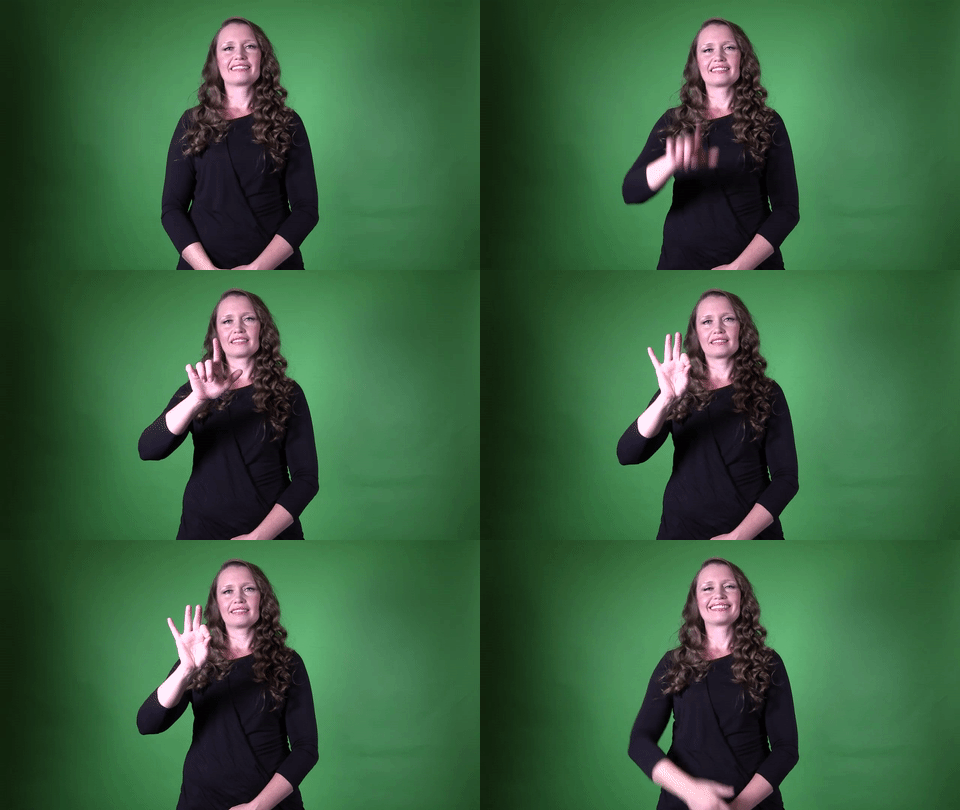
Definition: The number twenty-nine
Sign for TWENTY-NINE in ASL

Practice Activities:
Practicing the sign for twenty-nine in ASL can be more effective when incorporating different exercises. Start by signing twenty-nine repeatedly in front of a mirror to check for clarity and accuracy. Try signing it slowly at first, then gradually speed up while maintaining correct hand movement. Recording yourself and comparing it to a reference video can help refine your technique.
Use number sequences to reinforce learning. Count from twenty to thirty, making sure to correctly sign twenty-nine in ASL as part of the sequence. Mix up various numbers and sign them randomly, ensuring you can quickly identify and sign twenty-nine without hesitation. Challenge yourself to count backward from thirty to twenty to improve recall.
Incorporate twenty-nine into real-world context practice. Sign your age as if you were introducing yourself. Practice signing someone else’s age, using twenty-nine when applicable. Try stating prices while pretending to shop, such as “This book costs twenty-nine dollars” in ASL. You can also practice identifying house or apartment numbers with twenty-nine included.
Engage in storytelling to integrate the sign naturally. Create a short story that includes the number twenty-nine multiple times, such as talking about a person celebrating their twenty-ninth birthday or describing an event that occurred twenty-nine years ago. Present your story to a friend or record it to analyze fluency.
For partnered practice, have one person randomly sign numbers between twenty and thirty while the other writes them down. You can also play a game where one person asks, “How old are you?” and the other must respond using twenty-nine in ASL if applicable. Switching roles helps reinforce comprehension and production.
By incorporating these exercises, you will gain confidence in signing twenty-nine in ASL with accuracy and ease. Keep refining your movements and using the sign in various contexts for mastery.
Cultural Context:
The sign for twenty-nine in ASL is commonly used in both casual and formal contexts. Numbers play a vital role in American Sign Language, and signing twenty-nine correctly ensures clear communication. Whether discussing age, dates, or quantities, knowing how to sign twenty-nine in ASL is essential for everyday conversations.
ASL numbers follow a consistent pattern, but twenty-nine has its own unique movement. Handshape and motion are important for clarity when using the sign for twenty-nine in ASL. With practice, this sign becomes second nature for both beginner and advanced signers.
In Deaf culture, numbers are frequently used in stories, sports statistics, and personal details. The sign for twenty-nine in ASL is useful when discussing birthdays, addresses, and prices. Expressing numbers fluently in ASL helps maintain natural conversations and improves signing confidence.
Deaf communities value clear and accurate number signs for effective communication. The sign for twenty-nine in ASL allows for precise discussions in academic, social, and professional settings. Mastering number signs like twenty-nine makes signing with native users more natural and engaging.
ASL numbers are an essential part of everyday interactions, from ordering food to discussing schedules. The sign for twenty-nine in ASL fits into a structured counting system and is easy to learn with practice. Consistently using this sign correctly enables smoother conversations with Deaf and Hard-of-Hearing individuals.
Visual languages like ASL rely on facial expressions and hand movements to convey meaning. When signing twenty-nine in ASL, maintaining proper finger positioning is crucial for understanding. Practicing in front of a mirror or with a partner can help ensure accuracy and confidence.
Learning the sign for twenty-nine in ASL can be beneficial for both Deaf and hearing individuals. Since ASL is widely used in education, interpretation, and social settings, mastering number signs is very useful. Signing twenty-nine correctly contributes to seamless communication and mutual understanding in ASL conversations.
Numbers are often used in storytelling and jokes within the Deaf community. The sign for twenty-nine in ASL might appear in ASL poetry, presentations, or casual discussions. Understanding how to sign twenty-nine strengthens overall fluency and engagement with native signers.
Many ASL learners find number signs challenging at first, but frequent use makes them easier to remember. The sign for twenty-nine in ASL follows a logical movement that becomes intuitive over time. Watching native signers can help reinforce proper technique and improve overall signing skills.
ASL
Extended Definition:
The sign for twenty-nine in ASL is a combination of the numerals two and nine, smoothly transitioning from one handshape to the next. This sign is part of the American Sign Language numerical system, which consists of distinct handshapes for each number. When signing twenty-nine, it’s important to maintain fluid motion and correct finger positioning for clarity.
To sign twenty-nine in ASL, start with the number two, using an open “V” handshape with the palm facing forward. Then, transition into the number nine by curling the index finger while keeping the thumb extended. This movement happens in one smooth motion, ensuring the sign remains clear and easy to recognize.
Facial expressions and hand positioning contribute to the accuracy of the sign for twenty-nine in ASL. A relaxed hand and natural movement help maintain the integrity of the sign. Practicing this number alongside others can improve fluency in signing larger numbers.
The number system in ASL follows specific patterns, making it easy to recognize and produce numbers quickly. The sign for twenty-nine in ASL follows the same structure as other numbers in the twenties, transitioning from one handshape to the next. Understanding number signs is essential for conversations related to age, money, time, and counting.
Context plays a role in how numbers are signed in ASL. For example, signing ages involves placing the number near the chin, while signing prices may incorporate the dollar sign movement. The flexibility of ASL numbers allows for clear and efficient communication in various situations.
Learning the sign for twenty-nine in ASL is beneficial for students, teachers, and anyone communicating with the Deaf community. Numbers are frequently used in everyday conversations, making them an important aspect of ASL vocabulary. Mastering numerical signs enhances overall communication skills in sign language.
In ASL, numbers are often incorporated into larger expressions and phrases. The sign for twenty-nine in ASL can be combined with other number signs to express higher values or sequences. Practicing number transitions helps improve signing speed and comprehension.
Watching videos or referring to ASL dictionaries can assist in learning the correct way to sign twenty-nine. Observing native signers is a great way to pick up the natural flow of ASL numbers. Regular practice ensures accuracy and builds confidence in signing numbers fluently.
Fingerspelling is not necessary when signing twenty-nine in ASL, as dedicated number signs exist for clarity. However, fingerspelling may be used alongside number signs in certain
Synonyms: twenty-nine, number twenty-nine, number 29, the number 29, the number twenty-nine
Educational resources: Find related learning materials in our course bank!
Want more? Check out some of our popular learning activities on the homepage!
Need to look up a sign? Use our highly rated dictionary: https://aslinteractive.com/best-asl-dictionary/
Follow us on tiktok: https://www.tiktok.com/@aslinteractive. More social media links at the bottom of this page!
Long-tail Keywords: what is the sign for twenty-nine in ASL, how do you sign twenty-nine in American Sign Language, ASL sign for the number twenty-nine
Categories: Numbers – Basics, Numbers 21-30, cardinal numbers
tags: Numbers 21-30, Numbers, Math, Language Learning, Educational
Parameters
*Handshape*:
The sign for TWENTY-NINE in ASL uses a transitioning handshape. Begin with the “L” handshape, where the thumb and index finger form an “L” while the other fingers remain folded. Then, transition into a “9” handshape by curving the index finger to touch the thumb while the remaining fingers stay closed.
This sign is performed using the dominant hand and typically stays in a neutral space. The movement is fluid, shifting from the “L” to the “9” handshape in one smooth motion. The sign for TWENTY-NINE in ASL is visually distinct yet follows the standard number formation rules in American Sign Language.
*Palm Orientation*:
The palm orientation for the sign for TWENTY-NINE in ASL starts with the palm facing outward. The dominant hand forms the number “2” and then transitions to a “9” with a flicking motion. The palm remains forward as the fingers change position smoothly. This ensures clarity and visibility in the sign for TWENTY-NINE in ASL, making it easily understood. The hand should stay relaxed to maintain natural movement throughout the sign.
*Location*:
The sign for TWENTY-NINE in ASL is produced in the neutral space in front of the body, typically at chest level. The dominant hand starts by forming the number TWENTY with an “L” handshape, where the thumb and index finger repeatedly touch. Then, the hand transitions into the number NINE, where the thumb and index finger form an “F” handshape. This movement ensures clarity when signing numbers.
*Movement*:
To make the sign for twenty-nine in ASL, start by forming the number twenty with your dominant hand. Hold your palm facing outward and repeatedly tap the index finger and thumb together. Then, transition into the number nine by extending the thumb and index finger while keeping the other fingers curled down. Move the hand smoothly from twenty to nine in a continuous motion, keeping a natural handshape transition.
*Non-Manual Signals*:
When performing the sign for TWENTY-NINE in ASL, the facial expression remains neutral or slightly focused, depending on context. If emphasizing quantity, the eyebrows may raise slightly, and the mouth may form a small “oo” shape. If confirming or repeating the number, a subtle head nod can be incorporated. The overall expression should align with the natural flow of conversation, maintaining clarity for the signer and viewer.
*Prosody, Dominant/Non-Dominant Hand*:
The sign for TWENTY-NINE in ASL uses the dominant hand only. Start with the number 2 handshape, palm facing out, and then transition to the number 9 handshape by folding the index finger down while keeping the thumb and middle finger touching. This movement is fluid and happens quickly in a single motion. Keep the hand steady, and ensure clarity between the two number formations to maintain proper signing accuracy.
Tips for Beginners:
Mastering the sign for TWENTY-NINE in ASL takes practice, especially when transitioning smoothly between numbers. This sign is a combination of TWENTY and NINE, and fluidity is key. Keep your dominant hand in an “L” shape for TWENTY and then change it into a “9” shape by extending the thumb and index finger while curling the rest of the fingers.
One common mistake beginners make with the sign for TWENTY-NINE in ASL is hesitating between the two number formations. Try to make the transition seamless without pausing too long. Keeping your wrist relaxed and fingers naturally curved will also help maintain clarity.
Pay attention to finger placement and hand orientation to ensure accuracy. The “L” shape for TWENTY should have the thumb and index forming a stable position before shifting into the “9” handshape. If the fingers are too stiff or shaky, it may confuse viewers.
Practice in front of a mirror to observe how quickly and smoothly you change between the two numbers. If needed, break the motion into two distinct handshapes before focusing on speed. Over time, muscle memory will make the transition feel effortless.
Consistency in hand orientation is crucial when signing for clarity. Keep the palm slightly outward during the shift, as rotating your hand too much can make the numbers harder to recognize. A controlled and steady movement will make the sign appear more natural.
Another helpful tip is to watch fluent signers perform the sign in conversation. Seeing the sign in context will reinforce how smoothly it should be executed. Keep practicing, and soon, signing TWENTY-NINE will become second nature.
Connections to Other topics:
The sign for twenty-nine in ASL relates to other number signs, particularly those in the twenties series, as it is signed in a sequence similar to other numbers in that range. The numbers twenty through twenty-nine follow a consistent pattern, helping learners recognize and recall primary number signs. Learning the sign for twenty-nine in ASL also reinforces the broader concept of numerical formation in ASL, including palm orientation, movement, and handshape transitions.
Numbers often appear in age, dates, and measurements, making the sign for twenty-nine in ASL useful in everyday conversation. For example, signing an age like “twenty-nine years old” or discussing prices and addresses requires fluency in number formation. It also connects to related concepts such as counting, ranking, and mathematical operations, demonstrating how numbers integrate into diverse topics.
Ordinal numbers also share similarities with cardinal number signs. For example, in contexts like “twenty-ninth place” in a competition, the number sign modifies slightly to indicate an ordinal number. This helps signers develop a more nuanced understanding of number modifications in ASL. The connection between cardinal and ordinal numbers strengthens comprehension in sports, academics, and scheduling contexts.
Numbers also play a major role in time-related signs, linking the sign for twenty-nine in ASL to months, years, and minutes. Phrases like “twenty-nine days ago” or “in twenty-nine minutes” show how numerical signs blend into everyday interactions. Understanding this connection improves overall ASL fluency, allowing for smoother integration of numbers in communication.
The sign for twenty-nine in ASL is also related to fingerspelling because certain concepts involve numbers embedded within words. For example, some proper names, addresses, or technical terms require fingerspelled numbers. Learning number signs fluently improves the ability to fingerspell efficiently with numerical components.
Summary:
The sign for twenty-nine in ASL follows a numerical pattern consistent with other numbers in the twenties. It begins by forming the handshape for the number twenty, which consists of the index finger and thumb touching and then repeatedly tapping together. This movement resembles a pinching motion and is common for numbers in the twenties.
After signing twenty, the hand transitions smoothly into the formation for nine. The number nine in ASL is formed by extending the thumb and index finger while keeping the rest of the fingers curled inward. The index finger and thumb come close together without touching, creating an “open O” handshape.
The motion between twenty and nine should be fluid and natural. Signers should avoid abrupt stops or breaks between the two numbers. This ensures clarity and ease of comprehension for the viewer.
The sign for twenty-nine in ASL is used in everyday communication for age, quantity, addresses, years, and counting sequences. It is essential in expressing dates, telling time, and referring to significant numerical values within various contexts.
ASL numbers have evolved over time. Some older signers may use alternative methods for forming numbers in the twenties. However, the version described here is the standard contemporary way to sign twenty-nine.
Numbers in ASL follow specific grammatical structure when incorporated into sentences. For example, the structure shifts depending on whether the number is alone, part of a sequence, or modifying a noun. Understanding syntax is crucial for effectively using twenty-nine in ASL.
Hand dominance plays a role in signing numbers, including twenty-nine. Right-handed signers use their dominant hand to form the sign, while left-handed signers mirror the motion with their left hand. Consistency in hand dominance improves fluency.
The sign for twenty-nine in ASL connects to broader linguistic studies, such as morphology and phonology. The handshape transition exemplifies how ASL numbers incorporate morphological shifts while maintaining a clear visual representation of numerical values.
Applied linguistics considers how numerical signs facilitate learning for deaf children and new learners of ASL. The clear, recognizable patterns in signing numbers help create structured frameworks for education and comprehension.
The sign for twenty-nine in ASL also highlights cultural aspects of the Deaf community. Numbers play an essential role in everyday interactions such as birthdays, addresses, and monetary exchanges. Mastering numerical signs enhances communication fluency.
Numeric classifiers in ASL provide an additional layer of meaning. While twenty-nine is generally presented in its standard number format, it can also be incorporated into classifier constructions, such as indicating a series, ranking, or quantity.
Numbers in ASL are highly visual and spatial. For instance, twenty-nine can be emphasized by adjusting placement, incorporating facial expressions, or modifying movement speed to indicate significance, urgency, or size.
Finger dexterity is essential for smoothly transitioning between twenty and nine. Practicing sequential number signing enhances fluidity and ensures clarity when numbers are used within rapid discourse.
Comparing ASL numbers to other sign languages provides insight into the diversity of signed languages worldwide. Different signed languages may use unique structures or handshapes to represent numbers like twenty-nine.
Twenty-nine may hold personal or historical significance for individuals. It could represent a specific date, an important event, or an age milestone. The ability to express numbers accurately in ASL ensures meaningful communication.
Number incorporation in ASL is an interesting linguistic feature. While some numerical concepts blend into other signs, most numbers, including twenty-nine, retain their distinct form across various sentence structures.
The phonological elements of ASL, including handshape, movement, palm orientation, and location, all play a role in forming the sign for twenty-nine. Each component contributes to the legibility and recognizability of the sign.
ASL learners often struggle with number fluency, making consistent practice essential. Repetitive exercises with signs like twenty-nine help reinforce memory, accuracy, and speed in numerical communication.
Facial expressions and non-manual markers enhance the meaning of numbers in ASL. Depending on context, signers may use raised eyebrows, head tilts, or specific mouth shapes to clarify numerical concepts such as estimation or emphasis.
The use of twenty-nine in financial contexts, such as pricing and billing, demonstrates how essential numerical fluency is in various real-world scenarios. Mastery of number signs contributes to effective navigation of daily transactions.
ASL numbering conventions sometimes adapt to evolving communication needs. Technological integration, such as using video calls or digital platforms, has reinforced the importance of clear, well-articulated number signing.
ASL poetry and storytelling frequently incorporate numerical signs for rhythmic and visual impact. Numbers like twenty-nine may be used symbolically or structurally within creative expressions of storytelling.
Misinterpretation of numbers in ASL is a common challenge for beginners. Practicing side-by-side number comparisons helps distinguish between visually similar signs, ensuring accuracy in communication.
Fingerspelling and numerical signs often appear
Want more? Check out some of our popular learning activities!
ASL Interactive Resources
ASLInteractive YouTube Channel
Follow us on tiktok: @aslinteractive.com
Follow us on Instagram: aslinteractive
Facebook page: aslinteractive
Facebook group: aslinteractive
LInkedIn: ASL Interactive LLC
Twitter: @ASL_interactive
*Some information on this page is AI-generated. AI can make mistakes. Please check the information.


Responses