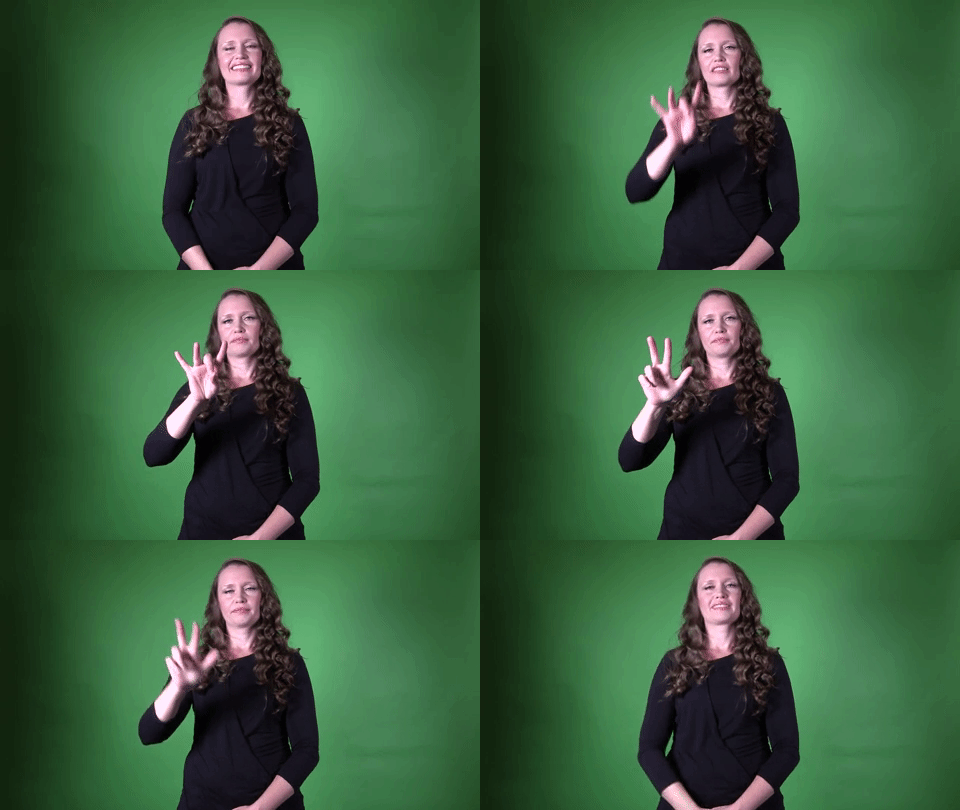
Sign for NUMBER 83 in ASL | 🔢 ASL Dictionary

Definition: Refers to the number eighty-three

Sign for NUMBER 83 in ASL 

YouTube player

Practice Activities:

Practicing the sign for number 83 in ASL can help improve fluency in number recognition and signing accuracy. Start by signing the numbers 8 and 3 separately, ensuring proper handshape for each. Then, smoothly transition from the 8 handshape to the 3 handshape in a fluid motion without hesitation. Repeat this sequence multiple times, focusing on clarity and consistency.

Use a mirror or record yourself signing the number 83 to check hand positioning and movement. Try signing other numbers in the 80s sequence, such as 81, 82, and 84, to develop consistency in signing numbers. Challenge yourself by signing a series of random two-digit numbers, including the sign for number 83 in ASL, and see how quickly you can produce them.

Practice using the sign for number 83 in ASL in real-world contexts. For example, imagine you are giving a price or counting objects, like “I bought 83 apples at the market.” Create number-related sentences such as “My grandmother is 83 years old” or “I read page 83 in my book.” This helps reinforce understanding while practicing numeric context.

Partner with a friend and take turns signing random numbers while the other person identifies them. Make it a challenge by signing quickly and increasing numbers in complexity. You can also play a bingo-style game where one person signs numbers, including the sign for number 83 in ASL, and the other marks the correct ones on a sheet.

Create a short story or role-play situation where numbers naturally appear, incorporating the sign for number 83 in ASL whenever possible. For example, pretend to be a store cashier giving a total amount or a teacher marking attendance. The more you incorporate numbers in everyday signing, the more fluent and confident you will become.

Cultural Context:

American Sign Language is a visual language that relies on precise hand movements and facial expressions. When signing the sign for number 83 in ASL, proper handshape and motion are essential for clear communication. Knowing how to form numbers in ASL is key to understanding dates, addresses, and quantities in everyday conversations.

The sign for number 83 in ASL follows a consistent pattern used when signing double-digit numbers. The transition between 8 and 3 should be smooth to maintain fluency. Many ASL users rely on these number signs for counting, listing, and expressing numerical information efficiently.

In Deaf culture, numbers play an important role in conversations, storytelling, and education. The sign for number 83 in ASL may be used in various contexts, from discussing sports scores to referring to specific years. Mastering number signs ensures effective communication within the Deaf community.

ASL numbers are also used in phone numbers, financial discussions, and measurements. Whether in academic settings or daily life, the sign for number 83 in ASL can appear in multiple situations. Learning ASL numbers enhances accessibility and interaction for both Deaf and hearing individuals.

Signing numbers correctly improves fluency and comprehension in sign language. The sign for number 83 in ASL requires clear hand positioning to avoid confusion with similar numbers. Practicing number signs helps build confidence when communicating in ASL.

ASL is a dynamic language that blends movement and structure to convey meaning. The sign for number 83 in ASL follows standard number formation rules, making it easier to learn once familiar with ASL counting patterns. Numbers are an essential building block of ASL communication.

Cultural awareness is crucial when using sign language in various settings. The sign for number 83 in ASL is just one of many number signs that allow for precise numerical expressions. Understanding how numbers are signed enhances interactions within the Deaf community.

Using ASL numbers correctly empowers individuals to engage meaningfully in conversations. The sign for number 83 in ASL is part of a larger system that enables fluid numerical communication. Mastering numerical signs benefits both casual signers and fluent ASL users alike.

Technology and education continue to promote ASL learning among hearing and Deaf individuals. The sign for number 83 in ASL, like other number signs, is widely used in classrooms and digital platforms teaching ASL. Learning and practicing numbers in ASL contributes to greater language accessibility.

Consistent practice helps improve ASL number fluency.

Extended Definition:

The sign for number 83 in ASL follows a pattern used for many two-digit numbers. It combines the signs for 8 and 3 in a fluid motion. This handshape makes it easy to recognize and remember.

To form the sign for number 83 in ASL, start by making the handshape for 8. Then smoothly transition into the handshape for 3. The movement should be clear and controlled for proper understanding.

Numbers in American Sign Language often require smooth transitions between digits. The sign for number 83 in ASL is no exception. Practicing fluid motion helps with clarity and speed.

Facial expressions do not play a major role when signing 83, but hand placement matters. Keep your palm orientation consistent to ensure accuracy. Proper positioning makes the number easy to read.

The sign for number 83 in ASL is commonly used in various contexts. It might appear in addresses, years, or numerical sequences. Knowing how to sign numbers correctly improves overall ASL fluency.

Speed and clarity are important when signing multi-digit numbers. It helps to practice signing the number 83 smoothly and naturally. Over time, muscle memory will make signing large numbers easier.

In ASL, the sign for number 83 follows the same numerical pattern as other two-digit numbers. Once you understand this pattern, learning other numbers becomes simpler. This technique applies to many number signs in ASL.

Some regional or stylistic variations may exist, but the sign for number 83 in ASL generally remains consistent. Watching native signers can help improve accuracy. Observing experienced signers also builds confidence.

Mastering the sign for number 83 in ASL is useful for daily conversations, interpreting, and teaching. Regular practice ensures clear communication. Becoming comfortable with ASL numbers strengthens overall signing skills.

The sign for number 83 in ASL is an essential part of number literacy in sign language. Practicing frequently makes it second nature. This skill is beneficial in both formal and casual signing situations.

Synonyms: eighty-three, number eighty-three, number 83, the number 83, the number eighty-three

Educational resources: Find related learning materials in our course bank!

Want more? Check out some of our popular learning activities on the homepage!

Need to look up a sign? Use our highly rated dictionary: https://aslinteractive.com/best-asl-dictionary/

Follow us on tiktok: https://www.tiktok.com/@aslinteractive. More social media links at the bottom of this page!

Long-tail Keywords: what is the sign for number 83 in ASL, how do you sign number 83 in ASL, learn how to sign number 83 in American Sign Language

Categories: Numbers – Basics, Numbers 81-90, cardinal numbers

tags: Numbers, Numbers 81-90, Math, Language Learning, Educational Content

Parameters

*Handshape*:

The sign for NUMBER 83 in ASL uses a fluid transition between two handshapes. It begins with the “8” handshape, where the thumb touches the middle finger while the other fingers extend. Then, it shifts to the “3” handshape, with the thumb touching the pinky while the index and middle fingers remain extended. This movement happens with a slight twisting motion, staying in a neutral signing space. ✨

When signing the sign for NUMBER 83 in ASL, maintain smooth transitions to keep the motion natural. The movement symbolizes the counting sequence commonly used in ASL numbering conventions. Hand orientation should face outward with relaxed fingers to ensure clarity. Keep the speed moderate to maintain accuracy.

*Palm Orientation*:

The sign for number 83 in ASL starts with the palm facing outward, ensuring the hand is visible to the viewer. The thumb, index, and middle fingers form the number eight briefly before transitioning into three by extending the index, middle, and thumb while the ring and pinky close. Throughout the movement, the palm orientation remains outward, maintaining clarity and consistency in the transition between numbers.

*Location*:

The sign for number 83 in ASL is made in the neutral signing space in front of the torso. Both hands remain in a comfortable position, ensuring clear visibility of the handshape transition. The number is signed with a smooth motion, transitioning from the “8” handshape to the “3” handshape. The hands should remain at chest level, maintaining a natural and relaxed posture while emphasizing clarity in the number articulation.

*Movement*:

To produce the sign for number 83 in ASL, begin by forming the number 8 with your dominant hand, where the thumb touches the middle finger. Then, transition smoothly into the number 3 by extending the thumb, index, and middle fingers while retracting the ring and pinky fingers. The movement should be fluid and natural, maintaining a slight outward orientation. This sign for number 83 in ASL follows standard number transition guidelines, ensuring clarity.

*Non-Manual Signals*:

When signing the sign for number 83 in ASL, maintain a neutral facial expression or slight focus to ensure clarity. Eyebrows should remain relaxed unless contextual emphasis is needed. Head movement should be minimal, with a slight tilt if emphasizing or clarifying the number. Eye gaze should be directed toward the hand to keep visual connection consistent. Avoid exaggerated lip movements, as mouthing is not necessary for this number sign.

*Prosody, Dominant/Non-Dominant Hand*:

The sign for number 83 in ASL uses the dominant hand, forming the number 8 with the thumb touching the middle finger, followed by the number 3 with the thumb, index, and middle fingers extended. The movement involves a quick change between the two numbers in a slight twisting motion. The non-dominant hand is not typically used. Maintain a neutral facial expression and fluid motion for clarity.

Tips for Beginners:

The sign for NUMBER 83 in ASL requires precise finger movement and hand positioning. Begin by forming the number 8 by touching the tip of your thumb to the tip of your middle finger while extending the rest of your fingers. Then smoothly transition to the number 3 by keeping your index, middle, and thumb extended while curling your pinky and ring finger down. The shift between 8 and 3 should look natural and fluid to maintain clarity.

One common mistake is performing the transition too rigidly or too slowly. Aim for a smooth motion so that each number is distinct but effortless. Another issue beginners often face is unclear finger positioning—double-check that your 8 and 3 are formed correctly so they are easily recognizable. Practicing in front of a mirror can help you ensure your hand shapes are accurate.

Finger orientation is crucial for the sign for NUMBER 83 in ASL to be easily understood. Keep your palm facing outward, as that is the standard for number signs. If your palm orientation is unclear, it could cause confusion, making it more challenging for others to recognize the numbers. Keep your wrist relaxed to avoid stiffness while transitioning between the two numbers.

When signing numbers, consistency is key. Try practicing various number sequences, including NUMBER 83, to get comfortable with switching between digits. Speed should come naturally with practice, so focus first on clarity, then on fluidity. Watching fluent signers and mimicking their hand transitions can be a great way to refine your technique.

To make the sign for NUMBER 83 in ASL feel natural, incorporate it into daily practice. Use it in number-based conversations, like discussing ages, addresses, or prices. With enough repetition, it will become second nature, improving both fluency and confidence. Keep practicing, and soon, signing numbers will feel effortless!

Connections to Other topics:

The sign for NUMBER 83 in ASL follows the pattern of number signs incorporating both handshape and movement. Numbers in ASL share a consistent structure, making it easier to understand patterns in signed counting. This sign connects to other number signs, ensuring that as learners understand NUMBER 83, they can also recognize the patterns in other numbers like 82 and 84. Mastering these number transitions supports fluency in expressing numerical information in various contexts.

Beyond basic number recognition, the sign for NUMBER 83 in ASL is useful in contexts such as addresses, prices, and measurements. Learning how to incorporate numbers effectively into signed conversations enhances comprehension of numerical sequences. Many advanced number-related signs, such as years and percentages, also build upon foundational number signs. Being comfortable with different numerical formations allows for clear and efficient communication.

Number signs frequently appear in ASL classifiers, which represent shapes, amounts, or movements. Expressing quantities with classifiers, such as indicating a group of 83 objects, requires the ability to fluidly sign NUMBER 83 in ASL. Proficiency with numbers also aids in understanding concepts like rankings, fractions, and comparisons. These skills are particularly helpful in educational or professional discussions requiring precise numerical representation.

The structure of the sign for NUMBER 83 in ASL also connects to broader linguistic topics, such as numerical incorporation in time signs. For example, signing an age like “83 years old” is similar in form, demonstrating how numbers integrate seamlessly into other ASL concepts. Learning numerical signs strengthens overall signing ability, as numbers frequently appear in daily communication. Practicing number signs in context fosters greater confidence in using ASL for practical and conversational purposes.

Summary:

The sign for NUMBER 83 in ASL follows a structured numerical pattern common to ASL numbering conventions. To form this sign, the dominant hand initially shapes the number eight by touching the thumb to the tip of the middle finger while the other fingers remain extended. The hand then smoothly transitions into the number three by extending the index, middle, and thumb while folding the ring and pinky fingers down.

This movement ensures a fluid visual transition between the two digit representations, making the sign clear and easily recognizable. ASL numbers follow structured patterns that help maintain consistency, particularly when communicating sequences. For numbers like NUMBER 83 in ASL, this means each digit appears distinctly, and transitions between digits retain clarity.

Numbers are an essential component of ASL grammar, playing a role in dates, counting, and mathematical expressions. The sign for NUMBER 83 in ASL exemplifies ASL’s efficiency in conveying numerical information through a single, swift hand movement. In rapid signing environments, fluent signers may produce this number with a slight shift in movement speed, ensuring comprehension without sacrificing accuracy.

ASL numbers follow a general right-hand dominance for right-handed signers, but left-handed signers will mirror the motion. The structure of the number system in ASL allows for quick visual processing, making numerical communication accessible. When signing the number NUMBER 83 in ASL, ensuring the timing and clarity of each numeral helps maintain readability, especially in academic or instructional settings.

Cultural significance plays a role in how numbers are used in ASL communication. Certain numbers may carry historical or community-based meanings that go beyond numerical value. For instance, within Deaf culture, numbers are often incorporated into names, addresses, and symbolic references that add depth to communication.

The ASL numerical system connects to broader themes in visual-spatial language structure, emphasizing movement economy and distinct finger configurations. The efficiency of the system ensures that signers can easily express large numerical values without confusion. The sign for NUMBER 83 in ASL exemplifies this efficiency, with a fluid transition between digits providing visual clarity to the observer.

Numbers in ASL often appear in various sentence structures that require shifts in grammatical rules. When discussing age, time, or quantity, number signs must comply with linguistic structures specific to ASL syntax. The sign for NUMBER 83 in ASL would follow ASL sentence structure rather than a direct translation from English, making it a functional part of signed communication rather than an isolated numeric concept.

Comparing ASL numbers with other sign languages reveals unique linguistic adaptations in numeral expression. Some signed languages use different handshapes or palm orientations for numbers, demonstrating how languages evolve independently while maintaining visual logic. The sign for NUMBER 83 in ASL stays consistent with broader ASL numerical patterns, ensuring mutual understanding within the ASL community.

Educational settings frequently emphasize the importance of clear numerical formation in ASL instruction. Signers learning ASL must develop precise movements and transitions between numbers to maintain fluency. The sign for NUMBER 83 in ASL is an example of a number that requires two visually distinct signs combined in a smooth transition.

Linguistically, the ASL numbering system aligns with concepts of sequential processing and cognitive memorization. Learning number signs enhances a signer’s ability to structure numerical data quickly. Fluent signers can recall and produce the sign for NUMBER 83 in ASL without hesitation, developing muscle memory that reinforces their overall language comprehension.

The visual component of numbers in ASL plays a crucial role in ensuring clarity in communication. Unlike spoken languages that rely on auditory perception, ASL numbers rely on defined handshapes and movement transitions. The sign for NUMBER 83 in ASL maintains this visual-based logic, allowing a signer to present numerical information efficiently.

Applied linguistics research highlights the importance of numerical signs in various language contexts. Studies on signed number recognition reveal that visually representing numerical sequences strengthens cognitive recall. The sign for NUMBER 83 in ASL contributes to this broader discussion by illustrating how a simple two-number sequence can be efficiently processed and understood.

Variations in number signs can depend on regional differences and individual signing styles. Some signers may emphasize transitions between numbers more clearly, while others might sign fluidly with minimal hesitation. The sign for NUMBER 83 in ASL may exhibit minor stylistic variations without affecting overall comprehension among fluent signers.

Broader themes within ASL numerical representation include its application in financial transactions, counting, and identifier systems. Numbers are essential in daily communication for managing prices, addresses, and personal identification information. The sign for NUMBER 83 in ASL fits into this practical framework, making it a valuable linguistic tool.

Signers often incorporate numbers within broader sentences, requiring grammatical shifts based on linguistic context. ASL syntax rules determine how numbers fit within descriptions of age, quantity, rankings, and more. Using the sign for NUMBER 83 in ASL within a sentence requires consideration of placement, movement, and transition between numbers.

Technology and digital communication have influenced how ASL

Want more? Check out some of our popular learning activities!

ASL Interactive Resources

ASLInteractive YouTube Channel

Follow us on tiktok: @aslinteractive.com

Follow us on Instagram: aslinteractive

Facebook page: aslinteractive

Facebook group: aslinteractive

LInkedIn: ASL Interactive LLC

Twitter: @ASL_interactive

*Some information on this page is AI-generated. AI can make mistakes. Please check the information.

Sign for 83 in ASL, Sign for EIGHTY-THREE in ASL, Sign for NUMBER EIGHTY-THREE in ASL, Sign for THE NUMBER EIGHTY-THREE in ASL, Sign for THE NUMBER 83 in ASL, Sign for NUMBER 83 in ASL 

Responses