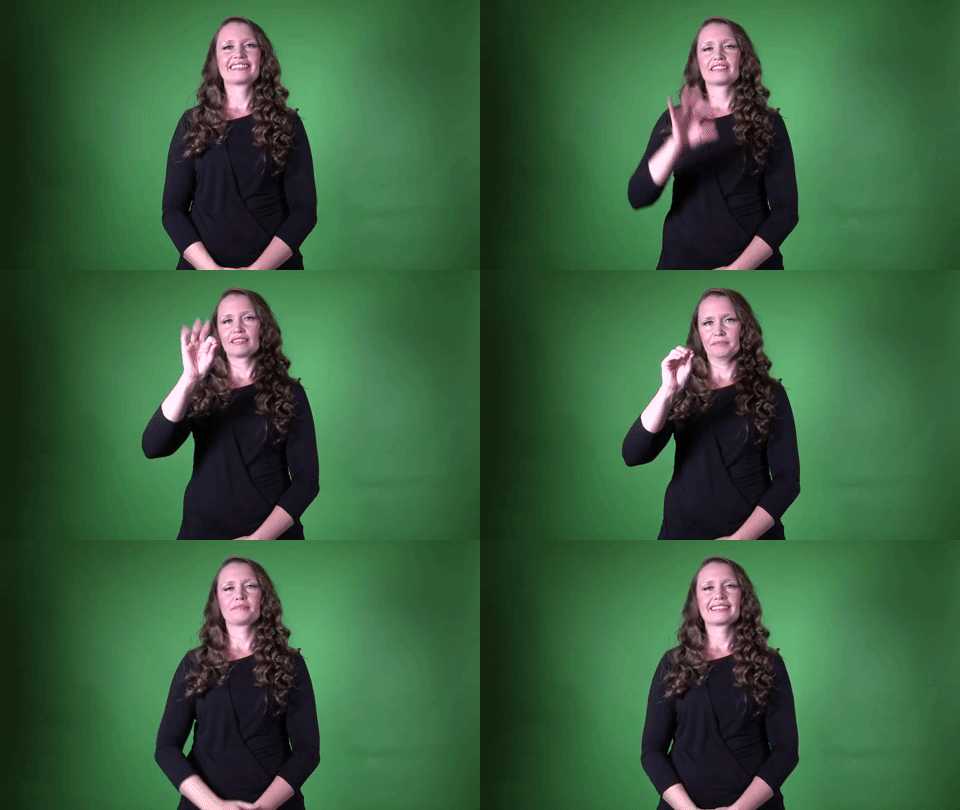
Sign for NINETY in ASL | 🔢 ASL Dictionary

Definition: The number ninety

Sign for NINETY in ASL 

YouTube player

Practice Activities:

To practice the sign for ninety in ASL, start by signing the number multiple times in front of a mirror. This will help you check your handshape and movement. Try signing it at different speeds while maintaining accuracy.

Use the sign for ninety in ASL while counting from 80 to 100. This will reinforce its placement within numerical sequences. Try counting by tens, saying each number aloud before signing to strengthen number recognition.

Create simple sentences using the sign for ninety in ASL, such as “My grandfather is ninety years old” or “There are ninety days until my trip.” Repeat these sentences while signing to improve fluidity. Challenge yourself by signing different numbers within the same sentence to enhance transition skills.

Practice finger-spelling short words followed by signing ninety to mix up different hand movements. For example, fingerspell “age” or “sale” and then sign ninety. This will help you become more comfortable transitioning in conversations.

Work with a partner and take turns signing numbers while the other person writes them down. One person should sign a series of numbers, including ninety, while the other recognizes and records them. Switch roles to practice both production and recognition.

Tell a short story incorporating the sign for ninety in ASL. For example, describe a scenario where a person finds ninety dollars or where a race lasts ninety minutes. This adds context and supports recall.

Incorporate the sign for ninety in ASL into a timed exercise. Set a timer and challenge yourself to sign different numbers, ensuring ninety appears frequently. This will build speed and confidence in using the number naturally.

Cultural Context:

The sign for ninety in ASL is an essential part of learning American Sign Language numbers. Understanding number signs helps with everyday communication, from discussing prices to sharing ages. Mastering the sign for ninety in ASL ensures clear and effective interactions.

In ASL, number signs follow a structured pattern that makes learning easier. The sign for ninety in ASL builds on the formation of other number signs, helping signers recognize and remember similar movements. Using a consistent structure benefits both beginners and fluent signers.

Numbers in ASL are widely used in personal and professional settings. The sign for ninety in ASL is helpful in various situations, such as discussing large quantities or referring to historical dates. Knowing this sign enhances fluency and comprehension in conversations.

ASL relies on facial expressions, handshapes, and movement to convey meaning. When using the sign for ninety in ASL, maintaining clear hand positioning is key for accurate communication. Proper execution ensures that the sign is understood correctly within the conversation.

Counting in ASL is a fundamental skill for both Deaf and hearing individuals learning sign language. The sign for ninety in ASL fits into a larger system of numerical signs that are important for daily interactions. Recognizing these numbers helps build confidence in signing.

ASL numbers are frequently used in education, finance, and social settings. Whether discussing a total cost or stating an age, the sign for ninety in ASL is useful in many contexts. Learning this sign is essential for expanding ASL vocabulary.

The sign for ninety in ASL is part of the larger number system that follows a logical progression. By understanding how numbers are structured, signers can easily transition from one number to another. This consistency makes learning and recall more effective.

Deaf culture incorporates ASL numbers into storytelling, dates, and everyday conversations. The sign for ninety in ASL might come up when discussing history or upcoming events. Proficiency in ASL numbers strengthens overall communication skills.

ASL is a visual language, making clarity of movement essential when signing numbers. The sign for ninety in ASL should be performed accurately to prevent any confusion. Practicing this sign regularly helps improve fluency and comprehension.

Fluency in ASL includes the ability to sign numbers quickly and correctly. The sign for ninety in ASL is a crucial part of this fluency, making communication more efficient. Familiarity with number signs enhances overall signing skills.

Learning ASL numbers supports better interaction with the Deaf community. The sign for ninety in ASL contributes to

Extended Definition:

The sign for ninety in ASL is an essential part of learning American Sign Language numbers. It is one of the higher numbers used in everyday communication, especially when discussing age, money, percentages, and other numerical topics. Understanding how to sign ninety in ASL helps improve fluency and comprehension.

To sign ninety in ASL, start with the same handshape used for the number nine. Extend the thumb and index finger while keeping the other three fingers folded down. Move the hand slightly as needed to ensure clarity when signing in conversation.

Numbers in ASL follow a pattern, making them easier to remember with practice. The sign for ninety is closely related to other numbers in the nine series, such as nineteen and nine. Recognizing these patterns will help learners sign numbers quickly and naturally.

When using the sign for ninety in ASL, consider the context in which it appears. Numbers can indicate quantities, addresses, or rankings, meaning they must be signed clearly. Practicing with different numerical phrases will help reinforce confidence in using ASL numbers.

American Sign Language relies on visual and spatial elements to convey meaning. Signing ninety in ASL correctly requires not only proper handshape but also facial expressions and body positioning. These non-manual signals ensure clarity, especially in conversations with fluent ASL users.

Many ASL learners find that practicing numerical signs in sequences helps with memorization. Try signing eighty, ninety, and one hundred in order to reinforce recognition. Grouping numbers this way strengthens understanding and improves recall during conversations.

Learning the sign for ninety in ASL is useful in many real-life scenarios. Whether discussing finances, sports scores, or someone’s age, numbers play an important role in communication. Mastering these number signs makes conversations in ASL more efficient and expressive.

In ASL, numbers can also be modified slightly for emphasis. For example, when signing a large number like ninety thousand, the movement or repetition may change slightly. Learning these variations helps improve fluency and communication skills.

Consistent practice is key to mastering the sign for ninety in ASL. Using it frequently in everyday signing will reinforce accuracy and speed. Watching native signers or using ASL resources can also support learning and retention.

By incorporating the sign for ninety in ASL into regular practice, learners improve their ability to communicate numerical information clearly. Whether in personal conversations, classroom settings, or professional environments, knowing how to sign numbers fluently is an essential skill in ASL.

Synonyms: ninety, number ninety, number 90, the number 90, the number ninety

Educational resources: Find related learning materials in our course bank!

Want more? Check out some of our popular learning activities on the homepage!

Need to look up a sign? Use our highly rated dictionary: https://aslinteractive.com/best-asl-dictionary/

Follow us on tiktok: https://www.tiktok.com/@aslinteractive. More social media links at the bottom of this page!

Long-tail Keywords: what is the sign for ninety in ASL, how do you sign ninety in ASL, learn how to sign ninety in American Sign Language

Categories: Numbers – Basics, Numbers 81-90, cardinal numbers

tags: Numbers, Numbers 81-90, Math, Language Learning, Educational Content, rocking numbers, 86, 87, 89 rocking numbers

Parameters

*Handshape*:

The sign for NINETY in ASL uses the “9” handshape, which means the thumb and index finger touch to create a circular shape while the remaining three fingers extend outward. The hand begins in the “9” position and smoothly transitions into a relaxed “0” shape. This motion represents the numerical progression visually and is an essential component of number signs in American Sign Language.

*Palm Orientation*:

The palm orientation for the sign for NINETY in ASL begins with the dominant hand in an open 9 handshape, where the palm faces outward. As the movement starts, the fingers bend into an O handshape while maintaining the outward palm orientation. The motion is fluid, smoothly transitioning between the 9 and O handshapes to represent the number. Throughout the sign, the palm remains in a forward-facing position for clarity and accuracy.

*Location*:

The sign for NINETY in ASL is located in the neutral space in front of the dominant side of the body. The hand begins near shoulder level and moves slightly downward as the sign is executed. This placement allows for easy visibility and mirrors the formation of other number signs within ASL. The neutral positioning ensures clarity while maintaining a natural, comfortable movement for the signer.

*Movement*:

To make the sign for ninety in ASL, start with your dominant hand in the number 9 handshape, where the thumb and index finger make a circle while the other fingers remain extended. Move your hand slightly outward while transitioning from the 9 handshape to a relaxed 0 handshape, closing the extended fingers. This motion should be smooth and fluid, emphasizing the shift from 9 to 0 to represent ninety in ASL.

*Non-Manual Signals*:

When signing the sign for NINETY in ASL, maintain a neutral or slightly focused facial expression. The eyebrows generally remain relaxed unless emphasizing the number in a larger context. If clarifying or confirming, a slight head tilt or raised brows may naturally accompany the sign. The mouth may remain neutral or slightly open, especially if counting in sequence. For emphasis, you can slightly nod while signing the sign for NINETY in ASL.

*Prosody, Dominant/Non-Dominant Hand*:

The sign for NINETY in ASL uses the dominant hand in the “9” handshape , with the index finger and thumb touching while the other fingers remain extended. The hand starts in this position and moves into a “0” handshape, where the fingertips touch to form a closed circle. The movement is fluid and smooth, symbolizing the transition from nine to zero. The non-dominant hand is not typically used in this sign.

Tips for Beginners:

The sign for NINETY in ASL follows the number pattern used for other multiples of ten. This sign starts with the hand forming the number 9, with the thumb and index finger touching to create an “O” shape while the other fingers extend. Then, the fingers move into a loose “zero” handshape, mirroring the movement used in other decade numbers like seventy and eighty. Keep the transition smooth and natural to maintain clarity.

When signing the sign for NINETY in ASL, ensure your hand position is near shoulder height and facing outward. Avoid curling your fingers too tightly in the number 9 handshape or making the transition to zero too abruptly. The motion should be fluid and continuous, not jerky, so it remains easy to recognize. Maintaining consistency in the movement helps ensure the sign is understood in conversation.

One common mistake beginners make when signing the sign for NINETY in ASL is turning the hand at the wrong angle. Keep your palm orientation consistent with other number signs to maintain readability. Another pitfall is not fully transitioning from 9 to 0. If the motion is incomplete or rushed, it may be misinterpreted as a different number. Practicing in a mirror can help refine the motion and improve accuracy.

Finger dexterity plays a key role in executing the sign for NINETY in ASL correctly. Stretching and warming up your fingers before signing can improve fluidity. If you find the transition challenging, practice numbers 10 through 100 in sequence to build confidence. Repeating the movement slowly at first, then increasing speed over time, will help you master the motion naturally. Consistent repetition and real-life practice will make recalling this sign effortless.

Connections to Other topics:

The sign for NINETY in ASL is part of the numerical system in ASL, which includes signs for numbers from one to infinity. The number signs are essential for counting, giving prices, telling ages, and expressing quantities. In ASL, numbers are often incorporated into other signs to create concepts such as time-related terms like NINETY MINUTES or numerical rankings like NINETY-FIRST.

The sign for NINETY in ASL is closely related to other numbers in the ninety series, such as NINETY-ONE through NINETY-NINE. These numbers follow a consistent pattern in ASL, making it easier to learn them once the base number NINETY is understood. Understanding this pattern helps with fluency, as signers can quickly move through numerical sequences when discussing large amounts, years, or statistics.

Many compound signs involve numbers, such as expressing years like 1990 or combining numbers with classifiers to show quantities. In contexts like banking or mathematics, signers use numerical incorporation, where specific handshapes represent both the number and the concept being signed. For example, signs for money or percentages can incorporate NINETY to mean “ninety dollars” or “ninety percent.”

ASL number signs also connect to the larger category of classifiers, which allow signers to visually organize and express exact quantities. Using classifiers with the sign for NINETY in ASL can describe a group of ninety people, objects, or locations within a space. These classifiers enhance meaning by helping visualize quantities more clearly.

Additionally, the sign for NINETY in ASL is useful in historical and cultural discussions. It helps describe events from the 1990s, referencing years and other decade-related concepts. ASL users may combine it with other signs like DECADE or HISTORY to talk about past events.

Summary:

The sign for NINETY in ASL follows a consistent numerical pattern similar to other tens-based numbers in American Sign Language. It is formed using the dominant hand with the number nine handshape, where the thumb and index finger create an open “O” shape while the other three fingers remain extended. The movement involves a quick flick or a slight shake, similar to the transition from the number nine to zero, symbolizing the rounded nature of ninety.

ASL numbers, especially those related to multiples of ten, often share consistent patterns to aid fluency and comprehension. The sign for NINETY in ASL builds upon the same structure established for twenty through eighty, where the base digit transitions smoothly to represent the decade form. This systematic approach in ASL number signing ensures clarity and efficiency, allowing signers to quickly convey mathematical values in conversations.

A unique linguistic feature of ASL numbers includes the visual-spatial representation of number formations, which supports quick recognition. The sign for NINETY in ASL exemplifies how ASL incorporates iconicity, where the form of the sign aligns with a conceptual understanding of numerical progression. Though ASL is not a direct visual representation of English, its numerical system builds on logical finger movements that mirror arithmetic patterns.

Numbers in ASL are essential to daily interactions, ranging from stating prices to sharing ages and measurements. Expressing larger values such as ninety ensures effective communication in contexts like business transactions, historical dates, and statistical references. The clarity of signing numbers like NINETY is crucial in professions involving finance, education, and research, where numerical precision is required.

The grammatical rules in ASL consider numerical incorporation for broader expressions. When expressing numbers like ninety in sequences, ASL signers often employ a smooth transition into adjacent numerical signs without pausing. This fluid transition makes it easy to say figures like ninety-nine or one hundred without disrupting conversational flow.

Cultural significance often surrounds milestone numbers, and ninety is no exception. Reaching ninety years in age is considered a significant lifespan, often recognized with respect and celebration. When discussing such milestones in ASL, the sign for NINETY in ASL plays a role in expressing honor, tradition, and historical acknowledgment.

In ASL storytelling and poetry, numerical signs like ninety can be utilized metaphorically. The combination of number signs can create emphasis within narrative structures, adding depth to character ages, time passage, or symbolic meanings. The sign for NINETY in ASL, like other numerical expressions, is woven into cultural narratives that emphasize time and experience.

Numerical consistency in ASL provides a structured approach to understanding multiples of ten. Learning the sign for NINETY in ASL reinforces the ability to count sequentially and use number signs accurately. Mastering such numerical handshapes ensures smoother and more coherent numerical conversations among Deaf and Hard of Hearing individuals.

Historical perspectives on ASL numbers reveal their evolution as part of Deaf education and community development. Early methods of numerical representation in signed languages adapted based on the needs of Deaf students, evolving into the modern system used today. The sign for NINETY in ASL reflects this development by maintaining an intuitive and accessible gesture for general use.

Numeric classifiers in ASL allow for expanded meanings of number signs beyond simple enumeration. In some contexts, ninety can relate to measurements, quantities, or specific numeric groupings. Recognizing the versatility of the sign for NINETY in ASL highlights the adaptability of numerical signs in broader linguistic applications.

In sports, statistics frequently use numerical values to track player achievements and game scores. The sign for NINETY in ASL plays a role when discussing scores, jersey numbers, and sports analytics. Sport commentators and ASL interpreters often rely on clear numerical signs to convey accurate data during broadcasts and live events.

Mathematical education in ASL relies heavily on effective numerical signing. Teaching numbers like NINETY requires both clarity in handshape execution and reinforcement through repetition. Deaf students benefit from consistent exposure to numerical signs in classroom settings where math concepts are discussed using ASL.

Interpreters working with ASL must ensure precision in numerical translations. When interpreting financial data, legal references, or historical dates, the sign for NINETY in ASL must be executed distinctly. Accuracy in signing numbers can prevent miscommunication in crucial areas such as courtroom proceedings and medical settings.

Technology has expanded the accessibility of ASL numeracy through digital learning methods. Video tutorials and online courses help users refine their understanding of number signs, including the sign for NINETY in ASL. Mobile applications designed for ASL learners often incorporate numerical recognition drills to reinforce fluency.

Social media platforms have contributed to ASL number education through interactive content. Users frequently share number-related challenges or signing tutorials, making it easier to learn signs like ninety. Seeing the sign for NINETY in ASL demonstrated in different visual formats enhances comprehension across various learning styles.

Sign language linguistics

Want more? Check out some of our popular learning activities!

ASL Interactive Resources

ASLInteractive YouTube Channel

Follow us on tiktok: @aslinteractive.com

Follow us on Instagram: aslinteractive

Facebook page: aslinteractive

Facebook group: aslinteractive

LInkedIn: ASL Interactive LLC

Twitter: @ASL_interactive

*Some information on this page is AI-generated. AI can make mistakes. Please check the information.

Sign for 90 in ASL, Sign for NINETY in ASL 

Responses