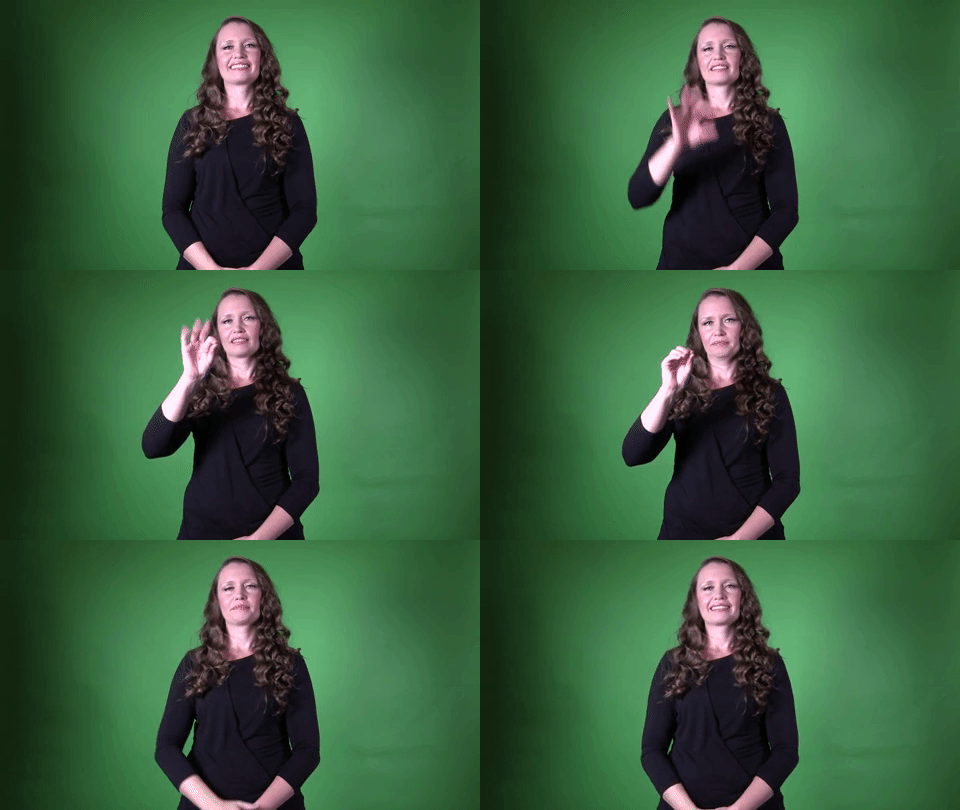
Definition: Refers to the number ninety
Sign for NUMBER NINETY in ASL
Practice Activities:
Practicing the sign for number ninety in ASL starts with repetition. Stand in front of a mirror and sign it multiple times, ensuring your handshape and movement are accurate. Try signing numbers in sequence, counting from eighty to one hundred to reinforce fluency.
Use the sign for number ninety in ASL in real-world contexts. Practice telling someone’s age or discussing large numbers in sports scores. Try signing a price, such as “ninety dollars,” or a year, like “ninety-nine.” This helps cement the sign in meaningful conversation.
Engage in a number recognition game with a partner. One person signs a number, and the other signs it back correctly. To increase difficulty, mix in similar-looking numbers such as nineteen or ninety-nine. This builds quick recognition and response skills.
Challenge yourself with a storytelling prompt. Describe an event that took place in the 1990s or explain a situation where ninety of something was significant. For example, tell a story about a classroom with ninety students or a person who lived for ninety years.
Practice signing the number in speed drills. Time yourself signing from one to one hundred, ensuring smooth transitions. If you make a mistake, slow down and focus on clarity before increasing speed. Repeating this often will improve fluency and confidence in using the sign for number ninety in ASL in everyday conversations.
Cultural Context:
The sign for number ninety in ASL is an important part of American Sign Language, used in everyday communication, education, and conversation. Numbers play a vital role in ASL, especially when discussing age, money, time, and quantities. Learning the sign for number ninety in ASL helps improve fluency and comprehension in numerical expressions.
In ASL, number signs follow a structured pattern, making it easier to recognize and remember them. The sign for number ninety in ASL follows the same principles as other multiples of ten, offering consistency in numerical signing. Understanding these number signs enhances communication when discussing prices, measurements, or statistics.
The Deaf community relies on ASL numbers for various daily interactions, from telling a story to providing specific details. The sign for number ninety in ASL is useful in business transactions, classroom settings, and social conversations. Whether counting, giving directions, or discussing history, knowing this number sign is essential for clear and effective communication.
Numbers in ASL are not only about quantity but also cultural significance. The sign for number ninety in ASL may come up when discussing historical events, milestones, or even a person’s age. Mastering ASL number signs helps bridge communication gaps between Deaf and hearing individuals, fostering a more inclusive society.
When signing numbers, handshape, orientation, and movement play a critical role. The sign for number ninety in ASL follows a logical structure that fits within the broader ASL numerical system. Practicing this sign regularly helps develop confidence in using ASL numbers fluently.
ASL is a visual language that relies on hand movements, facial expressions, and body language for meaning. The sign for number ninety in ASL, like all other number signs, must be performed with the correct handshape and movement to be understood clearly. Precision in signing ensures accurate communication in personal and professional settings.
Educators and interpreters often teach number signs early in ASL learning. The sign for number ninety in ASL is commonly used in math lessons, storytelling, and everyday interactions. Learning these numbers early helps ASL users build a strong foundation for more advanced signing skills.
In Deaf culture, the ability to sign numbers quickly and accurately is highly valued. The sign for number ninety in ASL, along with other number signs, allows for efficient and expressive communication. Mastering ASL numbers helps build confidence in signing and enhances interactions within the community.
Online resources, ASL classes, and Deaf events provide opportunities to practice
Extended Definition:
The sign for number ninety in ASL is an important part of learning American Sign Language numbers. Numbers play a crucial role in communication, and understanding how to sign them correctly helps with dates, quantities, and mathematical concepts. The sign for number ninety in ASL follows the same pattern as other numbers in the tens series, making it easy to learn once you understand the pattern.
To sign number ninety in ASL, start with the number nine handshape, which is formed by touching the thumb and index finger together while keeping the other three fingers extended. Then, smoothly transition the hand into a zero handshape, where all fingers and the thumb form a closed circle. This movement clearly represents ninety as a combination of nine and zero.
Learning the sign for number ninety in ASL is useful for various real-life situations, such as talking about ages, prices, years, or large quantities. Whether you are discussing history, statistics, or personal milestones, knowing how to sign numbers accurately enhances conversations. Practicing the transition between nine and zero helps make the sign look smooth and natural.
Numbers in ASL follow specific patterns, and the sign for number ninety in ASL is part of the tens series that follows a counting rhythm. Mastering these signs is essential for fluency, as numbers frequently appear in everyday conversations. By practicing frequently, you can improve both accuracy and speed.
American Sign Language relies on visual and hand movements rather than spoken words, making handshape consistency critical. When signing number ninety in ASL, ensure that the transition between handshapes is fluid and clear. Clarity helps make the sign easily recognizable to other ASL users.
Number signs in ASL are standardized, which means everyone signs them the same way to avoid misunderstandings. If you are learning ASL for personal or professional reasons, numbers are among the most commonly used signs. Using the correct signing technique ensures effective communication with other signers.
When practicing the sign for number ninety in ASL, it helps to use a mirror or record yourself to check accuracy. Watching fluent ASL signers is another great way to improve your skills. The more you practice, the easier signing numbers will become.
Since ASL numbers are essential for communication, learning them in sequence strengthens overall signing ability. Recognizing patterns in number signs makes learning faster and more intuitive. The sign for number ninety in ASL is a great example of how ASL uses logic and consistency.
If you regularly use numbers
Synonyms: ninety, number ninety, number 90, the number 90, the number ninety
Educational resources: Find related learning materials in our course bank!
Want more? Check out some of our popular learning activities on the homepage!
Need to look up a sign? Use our highly rated dictionary: https://aslinteractive.com/best-asl-dictionary/
Follow us on tiktok: https://www.tiktok.com/@aslinteractive. More social media links at the bottom of this page!
Long-tail Keywords: what is the sign for number ninety in ASL, how do you sign number ninety in ASL, learn how to sign number ninety in American Sign Language
Categories: Numbers – Basics, Numbers 81-90, cardinal numbers
tags: Numbers, Numbers 81-90, Math, Language Learning, Educational Content, rocking numbers, 86, 87, 89 rocking numbers
Parameters
*Handshape*:
The sign for NUMBER NINETY in ASL uses a handshape that begins with the number 9, where the thumb and index finger form an open circle while the remaining fingers extend upward. The hand then transitions to a 0 handshape, where all the fingers come together to form a closed circle. This smooth movement visually represents the numerical concept. The sign for NUMBER NINETY in ASL is fluid, ensuring clear communication in numerical contexts. ✋
*Palm Orientation*:
The palm orientation for the sign for NUMBER NINETY in ASL starts with the palm facing outward as the hand forms the number nine shape. The thumb and index finger touch to create a closed circular shape, while the remaining fingers extend upward. As the motion completes, the hand remains in this orientation, ensuring clear visibility for the viewer. Proper palm positioning helps distinguish the sign for NUMBER NINETY in ASL from similar number signs.
*Location*:
The sign for number ninety in ASL is produced in the neutral signing space in front of the body, around chest level. The dominant hand moves fluidly as the fingers transition from the number nine shape to a relaxed “O” handshape. This movement takes place centrally, ensuring the sign remains clearly visible to the viewer. The positioning and orientation of the hand maintain consistency with other signed numbers in ASL. ️
*Movement*:
To produce the sign for number ninety in ASL, start with the hand in the “9” handshape, where the index finger and thumb form a circle while the other three fingers remain extended. Then smoothly transition into the “0” handshape by bringing all the fingers together to touch the thumb. This movement should be fluid and natural, making sure to maintain a consistent palm orientation throughout.
*Non-Manual Signals*:
Facial expression remains neutral or slightly focused when signing the sign for number ninety in ASL. Eyebrows may be slightly furrowed if emphasizing the quantity or inquiring about the number. Head movement can be minimal, but a slight nod may accompany the sign for number ninety in ASL when used in an affirmative statement. If asking a clarifying question, the head may tilt slightly forward while maintaining eye contact.
*Prosody, Dominant/Non-Dominant Hand*:
The sign for number ninety in ASL uses the dominant hand, forming the number nine handshape ( ) with the thumb and index finger making a circular shape while the other fingers extend. The hand transitions smoothly into a zero handshape ( ) in a fluid motion. This movement represents the numerical value and is done with a slight bounce or shift to indicate clarity. Non-dominant hand is not used in this sign.
Tips for Beginners:
Mastering the sign for NUMBER NINETY in ASL requires smooth hand movement and awareness of finger positioning. Start by forming the number nine with your dominant hand—extend the thumb and index finger while keeping the other three fingers curled down. Then, transition smoothly into a zero by bringing your fingers together to form an “O” shape.
Consistency in motion is essential when signing the sign for NUMBER NINETY in ASL. The shift from “9” to “0” should be fluid and controlled, avoiding exaggerated or jerky movements. Keep your palm facing forward to ensure clarity, as changing the palm orientation can make the number difficult to understand.
A common mistake is allowing the curled fingers in “9” to loosen too much, making it unclear. Another issue is an incomplete “O” shape in the second part of the sign. To avoid this, practice in front of a mirror or record yourself to check for accuracy.
Finger flexibility plays a role in executing this sign clearly and comfortably. If you struggle with forming “9” or “0”, try finger exercises to improve dexterity. Strengthening your fingers will make the transition between handshapes smoother.
Context matters when signing numbers, so be sure to sign at a comfortable pace. Whether you are listing numbers or providing quantities, maintaining a steady speed helps keep your message clear. If you rush, the transition may become messy, leading to misunderstandings.
Watching fluent signers use the sign for NUMBER NINETY in ASL can help reinforce the correct motion. Observe native ASL users in videos or real-life conversations to see natural movement and pacing. The more you see and practice the sign, the more confident and accurate you will become.
Connections to Other topics:
The sign for NUMBER NINETY in ASL follows a pattern similar to other multiple-of-ten numbers. This connection makes learning the tens series easier because they often involve a similar motion or handshape transition. Recognizing these patterns helps with fluency in signing numbers, especially when discussing prices, years, or group counts.
Numbers in ASL connect with many topics, such as math, time, and measurements. The sign for NUMBER NINETY in ASL can be paired with signs for percentages, money, or countdowns. For example, signing “ninety percent” integrates NUMBER NINETY with the sign for PERCENT, indicating proportion. These combinations appear often in educational discussions and statistical contexts.
Learning numbers like NUMBER NINETY in ASL builds a foundation for discussing larger figures. The number system extends into the hundreds, thousands, and beyond, making it important to recognize transitions between tens and higher values. Incorporating NUMBER NINETY into conversations about age, speed, or quantities reinforces number comprehension in ASL.
Ordinal numbers also relate to NUMBER NINETY, where modifications introduce concepts like “ninetieth” for ranking or event placement. This distinction highlights how ASL modifies base signs to create new meanings without fingerspelling extraneous details. Understanding this transformation helps in discussions where sequence or order is essential.
The sign for NUMBER NINETY in ASL also connects with sports, statistics, and historical dates. For example, discussions about sports scores, highway numbers, or events from the 1990s might require the use of NUMBER NINETY. Recognizing how numbers integrate into everyday topics ensures accurate communication in both casual and professional environments.
Summary:
The sign for number ninety in ASL is part of the numerical system in American Sign Language that follows a logical pattern. This sign involves handshape transitions that are consistent with other numbers in the same range. Learning this sign helps reinforce the broader understanding of ASL numeracy.
To sign number ninety in ASL, start with the number nine handshape. The number nine is formed by touching the thumb to the tip of the index finger while the other fingers remain extended. Then, smoothly transition into the zero handshape by forming an “O” with all fingers touching.
The movement is fluid, showing a clear shift between the two number handshapes. This consistency aligns with how other numbers ending in zero are signed. Practicing the transition ensures clarity and prevents confusion with similar signs.
ASL numbers follow a structured pattern that makes memorization easier. The sign for number ninety in ASL follows the established conventions, making it intuitive for those familiar with ASL numbering. Mastering this transition prepares signers for larger numbers and mathematical expressions.
Numbers in ASL are visually distinct, helping to prevent misunderstandings. The transition between nine and zero visually represents the changing values. Facial expressions and context further clarify the number being communicated.
Historically, ASL has adapted numerical signs for efficiency and clarity. The sign for number ninety in ASL maintains this principle by using efficient movements. The logical structure makes it easier for both beginners and advanced signers to understand.
Numerical fluency in ASL is crucial when discussing math, finances, and general counting. The sign for number ninety in ASL is frequently used in contexts like pricing, dates, and measurements. Mastering numerical signs expands overall ASL proficiency.
Learning ASL numbers enhances communication accessibility in educational and professional settings. The sign for number ninety in ASL is an essential part of this system. Understanding number signs supports broader fluency within signed conversations.
Practicing number signs helps build a strong ASL foundation. The sign for number ninety in ASL is essential for counting sequences and numerical comprehension. Learning the sign through repetition strengthens signing accuracy.
Context matters when using numerical signs in ASL conversations. When signing number ninety in ASL, signers should consider if they are discussing age, money, or another topic. Nonmanual markers like slight head tilts or facial expressions can clarify meaning.
The sign for number ninety in ASL connects directly to other number-related signs. Understanding how it fits into the broader numerical system improves overall ASL numeracy. Recognizing patterns between different number signs makes learning faster.
ASL relies on clear handshape differentiation to distinguish numbers. The sign for number ninety in ASL should be performed with distinct movements to prevent misinterpretation. Proper finger positioning helps maintain clarity.
Numbers in ASL adapt to regional and cultural variations. While the sign for number ninety in ASL remains standard, slight variations may exist among different signing communities. Exposure to various styles enhances adaptability in ASL communication.
Number signs are frequently used in daily life for referencing addresses, scores, and statistics. The sign for number ninety in ASL is essential for discussing numerical values in all sorts of real-world scenarios. Proficiency in number signs is particularly important in academic and professional settings.
Technology advancements have influenced sign language learning. Videos and online tutorials help learners master the sign for number ninety in ASL more efficiently. Digital resources provide visual reinforcement for correct handshape transitions.
ASL instructors emphasize consistency when teaching number signs. The sign for number ninety in ASL follows a predictable handshape pattern that simplifies learning. Structured repetition encourages confidence in signing numerical values.
In fast-paced conversations, number signs should remain precise for accuracy. The sign for number ninety in ASL benefits from clear handshape formation to prevent misunderstanding. Maintaining steady hand transitions ensures comprehension.
Numbers often appear in ASL storytelling, enhancing the richness of visual narratives. The sign for number ninety in ASL contributes to delivering accurate details within a signed story. Storytelling in ASL showcases the beauty of numerical signs in context.
Sign language interpreters must master number signs for effective communication accuracy. The sign for number ninety in ASL is a key component of numerical interpretation. Clarity in number sign production ensures precise translations.
The sign for number ninety in ASL is highly valuable for various professions, particularly those involving finance, education, and healthcare. Accurate numerical signing is essential for workplace accessibility. Mastering numerical signs ensures inclusivity in professional environments.
Bilingualism in ASL and English allows for seamless communication across different modes. The sign for number ninety in ASL bridges language gaps between spoken and signed communication. Recognizing numerical patterns across languages strengthens overall linguistic skills.
ASL learners benefit from practicing number sequences regularly. Signing number ninety in ASL alongside other numbers reinforces muscle memory. Frequent usage solidifies the transition between numerical handshapes.
The role of number signs in ASL education
Want more? Check out some of our popular learning activities!
ASL Interactive Resources
ASLInteractive YouTube Channel
Follow us on tiktok: @aslinteractive.com
Follow us on Instagram: aslinteractive
Facebook page: aslinteractive
Facebook group: aslinteractive
LInkedIn: ASL Interactive LLC
Twitter: @ASL_interactive
*Some information on this page is AI-generated. AI can make mistakes. Please check the information.


Responses