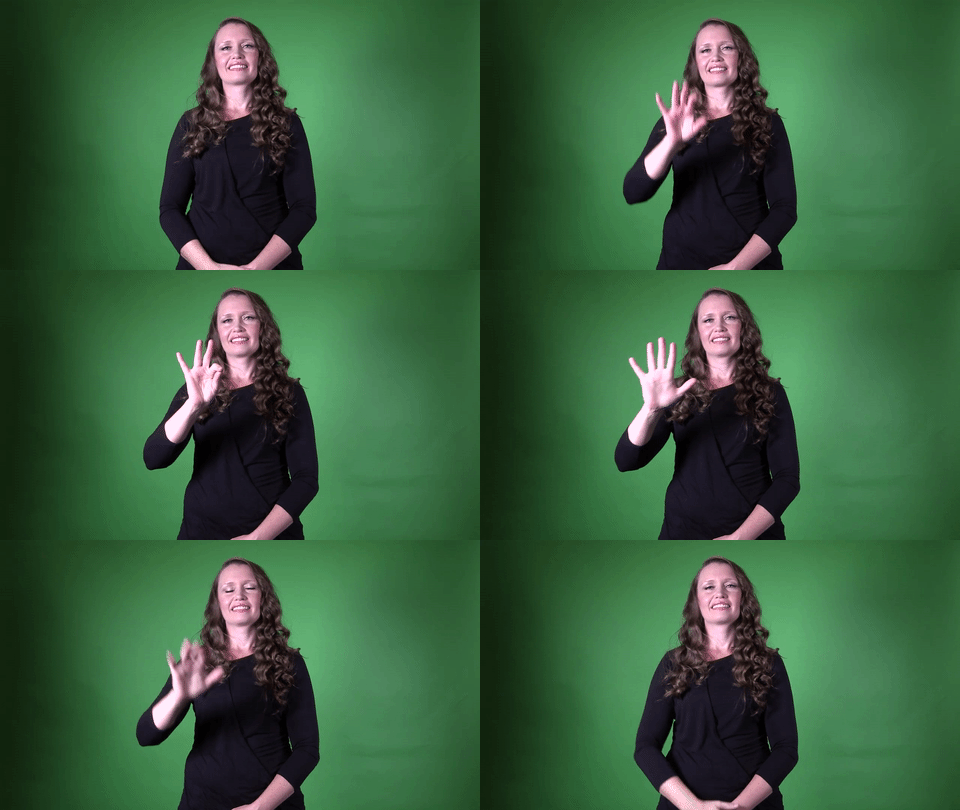
Sign for NINETY-FIVE in ASL | 🔢 ASL Dictionary

Definition: The number ninety-five

Sign for NINETY-FIVE in ASL 

YouTube player

Practice Activities:

Practicing the sign for ninety-five in ASL can be done through repetition and engaging activities. Begin by signing ninety-five in isolation multiple times, paying attention to handshape and movement. Use a mirror to check your accuracy or record yourself for self-assessment. Try signing the number slowly and then gradually increase your speed while maintaining clarity.

Incorporate the sign for ninety-five in ASL into numerical sequences. Count from ninety to one hundred, pausing at ninety-five to ensure proper signing. Another method is to sign numbers randomly, making sure to include ninety-five among them. This helps reinforce recognition and recall in different contexts.

Use the sign for ninety-five in ASL within sentences to build fluency. Practice phrases like “My grandpa is ninety-five years old” or “I saw ninety-five birds outside.” Create a short story that involves the number ninety-five, such as describing a shopping trip where something costs ninety-five dollars. This will help you practice the sign naturally while improving expressive skills.

Engage in partner activities by quizzing each other on random numbers, including ninety-five. One person signs a number while the other reads it aloud. Play a game where one person describes an age, a price, or a measurement, and the other signs the corresponding number. This strengthens interactive and receptive signing skills.

Apply the sign for ninety-five in ASL to practical situations. Pretend to be at a store and sign different price amounts, including ninety-five. Use it in a discussion about birthdays, ages, or countdowns. The more varied your practice, the more comfortable you will become with the sign.

Cultural Context:

The sign for ninety-five in ASL is an essential part of number fluency in American Sign Language. Numbers are commonly used in everyday conversations, whether discussing ages, prices, quantities, or years. Understanding how to correctly sign ninety-five in ASL helps improve communication with the Deaf and hard-of-hearing community.

Number signs in ASL follow a specific handshape and movement pattern. The sign for ninety-five in ASL uses common number-hand configurations that follow ASL number conventions. Being familiar with ASL number signs ensures clarity when discussing numerical information in various contexts.

Numbers in ASL are frequently used in education, business, and daily interactions. The sign for ninety-five in ASL may come up when discussing monetary amounts, counting objects, or sharing information related to statistics. Mastery of number signs like ninety-five enhances fluency and comprehension in signed conversations.

Deaf culture places a strong emphasis on visual communication, making number signs an integral part of ASL conversations. The sign for ninety-five in ASL, like other number signs, is visually distinct and follows ASL grammatical structures. Learning to sign ninety-five correctly ensures clear and effective communication in personal and professional settings.

Understanding ASL number signs helps with literacy and numerical comprehension in the Deaf community. Whether used in classrooms, workplaces, or casual conversations, the sign for ninety-five in ASL supports effective communication. Practicing ASL numbers contributes to greater confidence and accuracy in signing.

Signed numbers have variations based on regional influences and signing speed. While the sign for ninety-five in ASL generally follows a standard format, slight variations may exist depending on individual signing styles. Exposure to different signing styles helps improve overall ASL proficiency.

Fingerspelling is sometimes used in ASL, but numbers have their own unique signs, including the sign for ninety-five in ASL. Proper number signing reduces misunderstandings and improves clarity in conversations. Knowing how to sign numbers fluently is an essential skill for ASL users at all levels.

Technology and social media have increased the visibility of ASL, making number signs more accessible to learners. Videos and tutorials help new signers learn the sign for ninety-five in ASL accurately. Engaging with the Deaf community and practicing regularly enhances ASL learning and fluency.

ASL relies on facial expressions and body language in addition to hand signs. While signing ninety-five in ASL, maintaining appropriate facial expressions ensures natural and fluent communication. Non-manual markers play a

Extended Definition:

The sign for ninety-five in ASL is an essential number sign used in American Sign Language. It is commonly used when discussing age, percentages, money, measurements, and quantities. Learning to sign numbers correctly is key to clear communication in ASL.

To sign for ninety-five in ASL, start with the number nine handshape, which is formed by touching the tip of the thumb to the tip of the index finger while keeping the other fingers extended. Then transition smoothly to the number five handshape, with all fingers extended and separated. This movement should be fluid to maintain clarity and accuracy when signing.

Number signs like ninety-five in ASL belong to a specific group of number signs that follow a consistent pattern. Many of these signs require minimal movement, focusing instead on handshape changes. Signing numbers correctly ensures proper understanding, especially in conversations involving precise numerical information.

The sign for ninety-five in ASL is used frequently in everyday life. Whether discussing temperatures, sports scores, or percentages, this sign plays a vital role in relaying numerical values quickly and efficiently. Proper handshape and movement keep the sign visually distinct from similar numbers, preventing confusion.

When signing ninety-five in ASL, facial expressions and non-manual markers can add meaning. For example, raising the eyebrows while signing may indicate a question, while a slight head nod can emphasize certainty. These subtle facial expressions contribute to ASL’s rich visual communication.

Practicing the sign for ninety-five in ASL alongside other number signs can improve fluency. Signing numbers in sequences, such as counting by tens or naming prices, builds confidence in using numerical signs naturally. Frequent repetition helps reinforce muscle memory for seamless communication.

In ASL conversations, numbers often appear in various contexts, such as ages, addresses, and phone numbers. The sign for ninety-five in ASL can also be used when discussing historical dates or numerical comparisons. Becoming comfortable with signing numbers is an important skill for effective ASL communication.

Using correct handshapes and smooth transitions between signs ensures clearer understanding among signers. Since ASL relies heavily on visual cues, slight variations in positioning or movement can change a number’s meaning. Practicing in front of a mirror or with a fluent signer can help refine accuracy.

The sign for ninety-five in ASL is part of a broader numerical system that follows specific signing rules. Numbers from one to one hundred have unique variations that must be learned individually. Understanding these variations allows signers to use

Synonyms: ninety-five, number ninety-five, number 95, the number 95, the number ninety-five

Educational resources: Find related learning materials in our course bank!

Want more? Check out some of our popular learning activities on the homepage!

Need to look up a sign? Use our highly rated dictionary: https://aslinteractive.com/best-asl-dictionary/

Follow us on tiktok: https://www.tiktok.com/@aslinteractive. More social media links at the bottom of this page!

Long-tail Keywords: what is the sign for ninety-five in ASL, how do you sign ninety-five in American Sign Language, learn how to sign ninety-five in ASL

Categories: Numbers – Basics, Numbers 91-100, cardinal numbers

tags: Numbers, Numbers 91-100, Math, Language Learning, Educational Content

Parameters

*Handshape*:

The sign for ninety-five in ASL uses the number 9 handshape, where the thumb and index finger touch to form a circle while the other fingers remain extended. To produce the sign, the hand shifts to the number 5 handshape, spreading all fingers apart. This transition smoothly moves between the two forms without extra motion. The sign for ninety-five in ASL is performed with one hand, usually in a neutral space in front of the body.

*Palm Orientation*:

The palm orientation for the sign for ninety-five in ASL begins with the dominant hand forming a nine, with the palm facing outward. The thumb and pinky touch while the remaining fingers extend. Then, it smoothly transitions into a five by spreading all fingers apart while maintaining the outward palm position. This movement should be fluid and natural, ensuring clarity when signing the sign for ninety-five in ASL.

*Location*:

The sign for ninety-five in ASL is produced in the neutral space in front of the body, around chest level. The dominant hand forms the number nine and then transitions into the number five, with the palm facing outward. The movement is smooth, maintaining a steady position in the signing space. Keep the hand centered without excessive motion to ensure clarity. This sign remains within the standard one-handed number system in ASL.

*Movement*:

To produce the sign for ninety-five in ASL, start with the number nine handshape, where the thumb and index finger form a circle, and the remaining three fingers extend upward. Then smoothly transition to the number five handshape by opening the fingers into a spread position while keeping the palm facing out. This movement should be fluid to indicate the numerical value correctly.

*Non-Manual Signals*:

When using the sign for ninety-five in ASL, maintain a neutral or slightly focused facial expression to ensure clarity. The eyebrows should remain in a relaxed position unless emphasizing or questioning the number. Slight head nodding can help reinforce understanding, especially in a teaching or clarification setting. Keeping eye contact with the recipient ensures effective communication, reinforcing the numerical concept conveyed by the sign for ninety-five in ASL.

*Prosody, Dominant/Non-Dominant Hand*:

The sign for NINETY-FIVE in ASL uses the dominant hand only. Begin by forming the number 9 handshape (thumb and index finger touching in a circular shape, with other fingers extended). Then, smoothly transition into the number 5 handshape (all fingers extended and spread apart). This transformation should be fluid and natural, maintaining clear hand positioning. Keep the movement steady, and ensure fingers remain distinct for clarity.

Tips for Beginners:

When learning the sign for ninety-five in ASL, it’s important to maintain a fluid motion for accuracy. Begin with the number nine, forming an “open 9” handshape by touching the thumb and index finger while extending the other fingers. Then, smoothly transition to the number five by opening all fingers with the palm facing out. Keeping the movement controlled ensures the sign remains clear and natural.

A common mistake is not fully extending the fingers when shifting from nine to five. This can make the sign look unclear or resemble other number signs. Pay attention to finger positioning and avoid curling the fingers too much when forming the five. Keeping the hand relaxed and steady will help maintain accuracy.

Finger movement should be quick but not rushed. New signers often hesitate between the number transition, making the sign look unnatural. Practicing in front of a mirror will help you build confidence and smooth out the motion. Watch native signers or videos to mimic the proper flow.

Hand orientation is crucial for clarity. The palm should face outward for both numbers, ensuring visibility. If the palm faces sideways or inward, it may be misunderstood. Always double-check your orientation when practicing the sign for ninety-five in ASL.

Consistent practice will build muscle memory, making the transition between numbers effortless. Repetition will help improve speed and precision. Signing numbers in sequences, like ninety-one through ninety-nine, is an effective way to practice and reinforce the motion. Regular practice will make signing feel natural and automatic.

Using the sign naturally in conversations is the final step. Apply it in real-world situations when discussing numbers or counting. The more you use the sign for ninety-five in ASL, the more comfortable it will become.

Connections to Other topics:

The sign for ninety-five in ASL connects to various number signs by following a similar movement pattern to those for ninety, ninety-one, ninety-two, ninety-three, and ninety-four. These numbers are all part of the counting sequence and help learners recognize the handshape adjustments needed for each. Understanding the sign for ninety-five in ASL also strengthens familiarity with the numerical system and its efficient use of handshapes for expressing multi-digit values.

Numbers in ASL often appear in financial contexts, age descriptions, and time-related discussions. The sign for ninety-five in ASL might be used when specifying a year, such as 1995, or conveying a quantity in discussions about prices, statistics, or measurements. Being comfortable with this number allows signers to smoothly transition between related numerical expressions and apply them in everyday conversations.

Ordinal numbers, such as ninety-fifth, are closely related and follow a different signing pattern by incorporating a slight wrist twist or movement. These differences highlight the importance of precision when using numbers in ASL, as a minor change in movement can alter the meaning. Mastering variations and understanding when to use cardinal versus ordinal forms is an essential skill for effective communication in ASL.

Numbers also frequently appear in larger mathematical or financial discussions, where the sign for ninety-five in ASL may be part of percentages, rankings, or age references. In sports, for example, a jersey number or game score might use this sign. The ability to recognize and reproduce large numerical values fluently increases confidence in both casual and formal ASL interactions.

Additionally, learning high numbers like ninety-five helps students understand how ASL organizes numerical concepts logically. This reinforces the ability to quickly express prices, statistics, and dates without hesitation. Recognizing how these numbers interact with other ASL concepts provides deeper insight into the efficiency and structure of ASL numerical expressions.

Summary:

The sign for NINETY-FIVE in ASL follows a consistent pattern based on the numerical system established in the language. It combines the signs for NINETY and FIVE in a fluid motion. This type of numerical structure falls under ASL’s broader system of counting, which is designed to be both efficient and visually clear.

The sign for NINETY begins with the hand in the “9” shape, formed by extending the index finger and thumb while keeping the other fingers curled inward. It then transitions into a “5” shape where all fingers are spread out. This transformation between the two numbers allows for smooth communication and reinforces the importance of maintaining handshape clarity.

Numbers in ASL have a unique flow that differs from English numerals. Rather than stating “ninety-five” as two separate words, the transition between handshapes is seamless. This efficiency is an example of ASL’s visual nature, where grammatical components are often expressed through movement rather than word order.

The sign for NINETY-FIVE in ASL is commonly used in discussions involving age, money, quantities, and measurements. It’s particularly important in financial contexts when discussing prices or large numerical figures. Because numerical comprehension is critical in education, deaf students are taught number signs early to ensure fluency.

ASL numbers exhibit linguistic characteristics such as assimilation and fluidity. The smooth transition from NINETY to FIVE is an example of how numbers emphasize economy of motion. This fluidity helps maintain clarity and reduces misunderstandings when communicating large numerical values.

The numbering system of ASL is deeply influenced by visual-spatial representation. Unlike spoken language, where numbers are purely auditory, ASL numbers must be easily distinguishable by sight. Each number in the sequence of 90-99 follows a similar format, emphasizing a logical and systematic approach to numerical communication.

Knowing the sign for NINETY-FIVE in ASL increases accessibility for those who regularly communicate in sign language. It helps in situations such as workplace settings, financial discussions, and everyday conversations. The efficiency of number signs reflects ASL’s overall goal of making communication as visual and intuitive as possible.

Numbers tend to be signed with a dominant hand, ensuring consistency for clear comprehension. The dominance of one hand over the other in signing plays a critical role in syntax and fluidity. Most right-handed signers will use their right hand for numbers, while left-handed signers adjust accordingly.

When signing large numbers, facial expressions can enhance meaning. In a setting where emphasis is needed, signers may adjust speed or add slight nodding to indicate importance. These visual components ensure that precise numerical values are conveyed accurately.

ASL number signs also have regional variations, though the system remains relatively consistent nationwide. In some regions, slight modifications in handshape formation or movement may occur. However, the sign for NINETY-FIVE in ASL generally follows standard numerical rules understood across ASL communities.

Numbers play a significant role in Deaf culture, particularly in storytelling, education, and historical references. Signers often incorporate numbers naturally into conversations when recounting specific ages, dates, or statistical information. Understanding numbers in ASL allows for richer, more accurate storytelling.

Handshape clarity is crucial when signing numerical values. If the transition between NINETY and FIVE is unclear, it could lead to confusion with similar-looking numbers. Practice and repetition help signers maintain precision in their numerical signing.

The efficiency of number signs mirrors ASL’s broader linguistic principles. The language thrives on economy of motion, ensuring minimal physical effort while maintaining maximum communicative clarity. This approach differs from spoken English, which relies on linear sequencing rather than visual representation.

Numerical comprehension in ASL is not just about individual signs but about how they integrate into larger conversations. For example, discussing percentages, discounts, or statistical data requires fluid use of ASL numbers. The sign for NINETY-FIVE in ASL is a part of this detailed numerical framework.

ASL’s numbering system also connects with classifiers when discussing measurements or statistics. In contexts like sports statistics or financial trends, numbers need to be signed clearly and accurately. This reinforces the importance of maintaining handshape integrity when conveying numerical information.

The frequency of using numbers in ASL varies depending on the signer’s daily routine. Some individuals, such as those who work in finance or education, rely heavily on numerical signs. Mastering the sign for NINETY-FIVE in ASL helps enhance overall fluency in professional, academic, and personal settings.

Learning number signs provides insight into the broader linguistic system of ASL. Numbers highlight how ASL relies on logical sequencing and fluid movement rather than spoken grammar. This reinforces ASL’s identity as an independent language with distinct structural features.

Facial expressions and body language often accompany numerical signs to add emphasis or clarify meanings. For example, if someone is emphasizing an exact count, their expression may become more concentrated. Such nuances are essential in avoiding miscommunication when signing numbers.

Numbers in ASL also

Want more? Check out some of our popular learning activities!

ASL Interactive Resources

ASLInteractive YouTube Channel

Follow us on tiktok: @aslinteractive.com

Follow us on Instagram: aslinteractive

Facebook page: aslinteractive

Facebook group: aslinteractive

LInkedIn: ASL Interactive LLC

Twitter: @ASL_interactive

*Some information on this page is AI-generated. AI can make mistakes. Please check the information.

Sign for 95 in ASL, Sign for NINETY-FIVE in ASL 

Responses