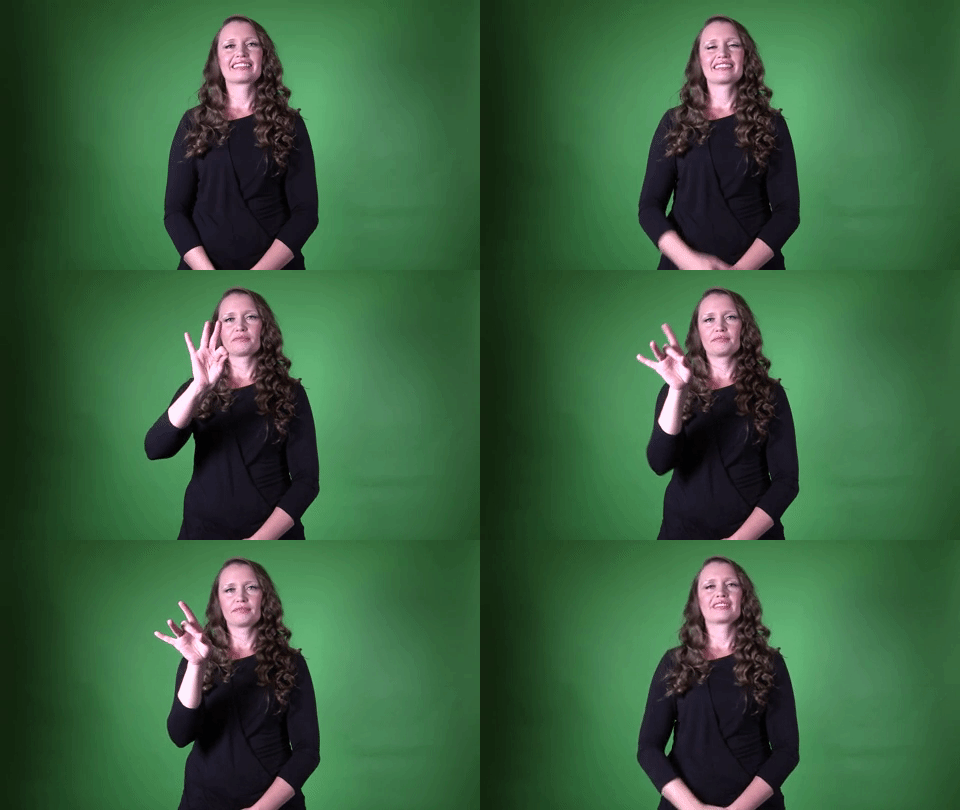
Sign for THE NUMBER NINETY-EIGHT in ASL | 🔢 ASL Dictionary

Definition: Refers to the number ninety-eight

Sign for THE NUMBER NINETY-EIGHT in ASL 

YouTube player

Practice Activities:

To practice the sign for the number ninety-eight in ASL, begin by signing it in isolation multiple times. Focus on handshape, movement, and palm orientation. Use a mirror to check your accuracy or record yourself and compare it with a reference video.

Next, practice counting down from one hundred to ninety using ASL numbers, stopping when you reach the sign for the number ninety-eight in ASL. Repeat this exercise with a partner, taking turns saying the numbers while the other signs them.

Incorporate the sign for the number ninety-eight in ASL into sentences and phrases. For example, sign “My grandmother is ninety-eight years old” or “I saw ninety-eight birds in the sky.” Try constructing similar sentences using different contexts, such as money, age, or items in a collection.

Try a quick-paced number drill where someone randomly signs a number between ninety and one hundred, and you must quickly sign the correct response. This helps build speed and accuracy in number recognition and production.

Create a short story using the sign for the number ninety-eight in ASL. For example, tell a personal anecdote about finding ninety-eight coins, buying something for ninety-eight dollars, or meeting a ninety-eight-year-old person. Add expressive facial movements and smooth transitions between signs.

For group practice, play a game where each person must sign a number, and the next person signs the following number. When someone reaches the sign for the number ninety-eight in ASL, they must create a sentence incorporating the number before continuing.

Use flashcards with different numbers written on them. When you see ninety-eight, sign it immediately. Mix the numbers up each time to better recognize and recall the correct sign without hesitation.

Cultural Context:

American Sign Language (ASL) is a rich visual language used by the Deaf community to communicate effectively. The sign for the number ninety-eight in ASL follows the logical pattern of ASL number signs, making it easy to learn and recognize. Numbers play an essential role in daily conversations, whether discussing age, time, or quantity.

In ASL, numbers from 90 to 99 follow a consistent pattern using the handshape for 9 and transitioning smoothly to the second digit. The sign for the number ninety-eight in ASL is formed using the handshape for 9, then transitioning to the handshape for 8. This pattern helps keep ASL number signs efficient and visually clear.

The Deaf community relies on precise number signs to discuss phone numbers, addresses, and prices. The sign for the number ninety-eight in ASL is commonly used in various contexts, from giving directions to sharing scores in sports. Mastering ASL numbers is essential for fluent communication in conversations.

Learning the sign for the number ninety-eight in ASL is part of understanding the overall numbering system in ASL. Signers naturally incorporate numbers into casual and formal interactions, demonstrating fluidity in their signing. Proper number usage in ASL helps convey messages accurately and enhances clarity in conversations.

Numbers in ASL are an important aspect of expressing time, counting money, and describing quantities. Whether discussing statistics or a simple count, the sign for the number ninety-eight in ASL follows the established pattern. Awareness of ASL number signs can help improve communication skills and fluency.

Understanding the sign for the number ninety-eight in ASL helps signers engage in meaningful exchanges involving numbers. The consistency in ASL number patterns makes it easier to recognize and use different numbers effectively. Signing numbers correctly avoids confusion and ensures smooth communication.

With ASL being a primarily visual language, number signs must be performed with clear handshapes and movements. Practicing the sign for the number ninety-eight in ASL helps develop confidence in number usage. Signers benefit from using correct number signs in discussions about dates, measurements, and personal information.

Fluency in ASL includes mastering both basic and advanced number signs. Understanding the sign for the number ninety-eight in ASL allows for better engagement in conversations involving numerical data. Using appropriate number signs ensures efficient communication within the Deaf and signing communities.

Numbers in ASL are used in both formal and casual situations, from school settings to daily life. The sign for the number ninety-eight in ASL

Extended Definition:

The sign for the number ninety-eight in ASL is a combination of the number nine and the number eight, signed in sequence. This number follows the standard pattern of forming two-digit numbers in American Sign Language. It is commonly used for counting, age, money, and other numerical references.

To sign the number ninety-eight in ASL, start by forming the number nine with your dominant hand. Touch the tip of your thumb to the tip of your index finger while keeping the other fingers extended. Then transition smoothly into the number eight by touching the tip of your thumb to the tip of your middle finger, with the rest of your fingers extended.

The movement between digits should be fluid and natural to maintain clarity. Native signers make this transition quickly, ensuring that both numbers are distinct yet connected. Practicing the sign for the number ninety-eight in ASL will help improve your speed and accuracy.

Numbers in ASL are an essential part of everyday conversations. Whether discussing quantities, phone numbers, prices, or addresses, knowing how to sign two-digit numbers correctly is important. The sign for the number ninety-eight in ASL is useful in various situations, from school settings to business transactions.

When signing larger numbers like ninety-eight, facial expressions and hand positioning play a role in clear communication. Slight emphasis on each number ensures the concept is easily understood. ASL uses a visual-spatial structure, so clarity and positioning are key components of effective signing.

Learning the sign for the number ninety-eight in ASL can improve your overall fluency in American Sign Language. Practicing numbers regularly will build confidence and enhance your speed in signing numerical sequences. Repetition and real-life usage will help reinforce proper hand shapes and transitions.

Numbers play a significant role in daily life, and signing them accurately is important in conversations. The sign for the number ninety-eight in ASL follows the logical number system used in American Sign Language. Understanding and recognizing these patterns make learning numbers easier over time.

For beginners, it may take some time to master fluid number signs, but practice will lead to improvement. Watching native signers and using ASL resources can help with accuracy. Signing the number ninety-eight in ASL correctly will help build essential communication skills.

Using numerical signs in ASL allows for efficient and clear exchanges of information. The ability to sign numbers smoothly will make conversations more natural in signed communication. The sign for the number ninety-eight in ASL is one of many numeric signs that enhance

Synonyms: ninety-eight, number ninety-eight, number 98, the number 98, the number ninety-eight

Educational resources: Find related learning materials in our course bank!

Want more? Check out some of our popular learning activities on the homepage!

Need to look up a sign? Use our highly rated dictionary: https://aslinteractive.com/best-asl-dictionary/

Follow us on tiktok: https://www.tiktok.com/@aslinteractive. More social media links at the bottom of this page!

Long-tail Keywords: what is the sign for the number ninety-eight in ASL, how do you sign the number ninety-eight in ASL, learn the ASL sign for the number ninety-eight

Categories: Numbers – Basics, Numbers 91-100, cardinal numbers

tags: Numbers, Numbers 91-100, Math, Language Learning, Educational Content, 96 97 98 rocking numbers, rocking numbers

Parameters

*Handshape*:

The sign for the number ninety-eight in ASL uses a two-part movement. It starts with the number nine handshape, where the thumb and index finger form a circular shape while the other fingers remain extended. Then, it transitions smoothly to the number eight handshape, in which the thumb touches the middle finger while the remaining fingers stay extended. This quick shift between the two numbers maintains a fluid and natural motion.

*Palm Orientation*:

For the sign for the number ninety-eight in ASL, the palm is generally oriented outward, facing away from the signer. The motion starts with the number nine handshape (thumb and index finger touching) and smoothly transitions into the number eight handshape (thumb and middle finger touching). Keeping the palm forward ensures clarity, making the sign for the number ninety-eight in ASL easy to recognize.

*Location*:

The sign for the number ninety-eight in ASL is produced in the neutral space in front of the body, at approximately chest level. The dominant hand forms the number nine shape (thumb and index finger touching) before smoothly transitioning into the number eight shape (thumb and middle finger touching). This movement happens fluidly without unnecessary pauses, ensuring clear numerical representation. The location remains within a comfortable visual field to maintain easy readability.

*Movement*:

To sign for the number ninety-eight in ASL, start with your dominant hand in an “L” shape with the index finger and thumb extended. Curve the index finger and thumb slightly to form the number nine, then transition smoothly by touching the tip of the thumb to the bent index finger to form the number eight. The movement should be fluid, shifting seamlessly between the two numbers without excessive pauses. Keep your palm facing forward throughout the motion.

*Non-Manual Signals*:

Facial expression while signing the sign for the number ninety-eight in ASL remains neutral or slightly focused, depending on context. Eyebrows may be slightly raised if emphasizing or seeking confirmation. Mouth may remain closed or form a slight “mm” shape to indicate thoughtfulness. Head movement may be minimal, though slight nodding or tilting can add emphasis. Eye gaze should be directed towards the listener or numbers being referenced.

*Prosody, Dominant/Non-Dominant Hand*:

The sign for the number ninety-eight in ASL uses the dominant hand. Start with the number 9 handshape (thumb and index finger touching in an open “O” shape while the other fingers extend). Then smoothly transition to the number 8 handshape by bringing the middle finger to the thumb while the index finger extends. The movement is fluid, ensuring clarity when signing the number ninety-eight in ASL. Maintain a steady hand position to keep the numerical sign distinct.

Tips for Beginners:

When learning the sign for the number ninety-eight in ASL, start by practicing the individual number signs for nine and eight separately. The number nine is formed by touching the tip of the thumb and index finger to create an “O” shape, while the other three fingers remain extended. The number eight follows a similar pattern, except the thumb touches the tip of the middle finger instead. Transition smoothly from nine to eight in a fluid motion to maintain clarity.

One common mistake is stiff transitions between the digits. The sign for the number ninety-eight in ASL should shift naturally from one number to the next. Keep the hand steady and within your signing space, avoiding unnecessary movement. Overexaggerating the shift can make the sign unclear. Practice in front of a mirror to ensure a natural and controlled transition.

Finger positioning is crucial for accuracy. Be sure that each number is clearly formed before transitioning to the next. Sometimes beginners accidentally create an unclear handshape, making the numbers difficult to recognize. If this happens, slow down and focus on precise finger placement. Watching experienced signers can help reinforce correct technique.

Hand dominance plays an important role in signing numbers. Whether you are right-handed or left-handed, always use your dominant hand for the sign. Switching hands mid-signing can make the number inconsistent and harder to understand. Using the dominant hand consistently will improve muscle memory and signing fluency.

Lastly, repetition and real-life practice are essential for mastering the sign for the number ninety-eight in ASL. Engage in number games, practice with a partner, or use flashcards to reinforce recognition. Building confidence through daily practice will ensure your signs are both precise and fluent. Keep practicing, and soon the motion will become second nature!

Connections to Other topics:

The sign for the number ninety-eight in ASL is part of the broader number system in American Sign Language, which follows specific handshape patterns. This number is signed using a combination of the digits nine and eight, maintaining the same movement patterns as other two-digit numbers in ASL. Learning the sign for the number ninety-eight in ASL helps reinforce number sequencing and numerical fluency, which is essential for counting, math concepts, and expressing quantities in everyday conversation.

Numbers in ASL are closely linked to time, money, and measurements, making them crucial for communication in a variety of settings. The sign for the number ninety-eight in ASL falls into the category of two-digit numbers that use a transitional movement between the two digits, just like ninety-nine or ninety-seven. Recognizing these number patterns helps a signer become more efficient, as similar handshapes are used for related numbers, enabling smoother transitions in signing.

Another related topic is ordinal numbers, which indicate position or ranking, such as ninety-eighth place in a competition or sequence. While cardinal numbers like the sign for the number ninety-eight in ASL represent quantity, ordinal numbers are formed by modifying the signing movement slightly, often adding a twist or an additional motion. Understanding these distinctions improves clarity when discussing dates, rankings, or organizing information in ASL.

The sign for the number ninety-eight in ASL is also important when discussing years, addresses, or large financial amounts. Numbers appear frequently in everyday signed conversation, such as listing prices, giving phone numbers, or stating historical events. Mastery of ASL numbers, including ninety-eight, allows fluent communication in these contexts while strengthening overall numeracy and ASL competence.

Summary:

The sign for the number ninety-eight in ASL follows the standard pattern for signing numbers in the ninety range. It begins with the number nine handshape, which is formed by extending the thumb and index finger and touching their tips while keeping the other fingers extended but slightly curved. The sign transitions smoothly into the number eight handshape, which is created by touching the tip of the thumb to the tip of the middle finger while keeping the remaining fingers extended.

This transition is typically performed in a fluid motion, with the dominant hand retaining a consistent orientation throughout. American Sign Language emphasizes efficiency in movement, which means that the sign for the number ninety-eight in ASL should be performed naturally without unnecessary shifts in hand positioning. The movement should be clear, without hesitation, so that it is easily understood by fluent signers.

Numbers play a vital role in ASL grammar, influencing how concepts such as dates, ages, quantities, and rankings are expressed. The sign for the number ninety-eight in ASL can be used to indicate a specific age, a price, or part of a numbered sequence, among other contexts. When used for numbering, signers typically follow the natural numerical progression to ensure connectivity with the surrounding numbers.

In ASL, number incorporation often occurs within specific categories such as time and money. However, the sign for the number ninety-eight in ASL is typically signed as a separate number rather than embedded into another sign. This clarity ensures that the number is distinct and not confused with a related sign that incorporates numerical meaning, such as a unit of measurement or quantity.

From a linguistic perspective, numbers in ASL require proper hand configuration and fluency to differentiate them from similar-looking numbers. The sign for the number ninety-eight in ASL shares similarities with other numbers in the ninety range but must be distinguished by crisp transitions to avoid confusion with visually similar numbers like ninety-six or ninety-nine. Context also plays an essential role in ensuring clarity.

American Sign Language plays a crucial role in Deaf culture, and numbers hold particular significance in historical and everyday contexts. The sign for the number ninety-eight in ASL could reference historical events, birth years, or other numerical details of cultural importance. Within discussions about history and personal connections, fluent signing of numbers ensures communication is accessible and precise.

Related signs to the number ninety-eight include ninety-seven and ninety-nine, which follow the same numerical transition pattern. Signers must ensure a smooth progression when counting or listing options, maintaining fluid movement. The sign for the number ninety-eight in ASL also connects to larger numerical concepts, such as sequences used in math or finance.

Numbers in ASL follow clear rules regarding palm orientation. The sign for the number ninety-eight in ASL typically faces outward, ensuring visibility for the recipient. If signed inward, it may be less readable, depending on regional or personal variations in signing. Maintaining orientation consistency prevents confusion.

Children learning ASL develop number recognition as a cornerstone of their language skills. The sign for the number ninety-eight in ASL might come later in their learning process as they build up familiarity with number patterns. Teaching numbers often follows a sequence that makes higher numbers easier to recognize and sign fluidly.

In interpreting settings, clarity in signing numbers is essential. The sign for the number ninety-eight in ASL may appear in business contexts, monetary discussions, or when relaying specific numerical details. Interpreters must ensure precise transitions between numbers so that information remains accurate during communication exchanges.

Numerical incorporation in ASL differs from that in spoken English, as numbers rely on handshape transitions rather than vocal articulation. The sign for the number ninety-eight in ASL follows the rule of simple transitions, where digits are signed sequentially rather than modifying the sign itself. This is distinct from classifier-based number use, where numbers blend into descriptive signs.

ASL has variations depending on region and community preferences. While the sign for the number ninety-eight in ASL maintains standard numerical transitions, some slight regional shifts in speed or orientation may exist. Learning these nuances ensures broader communicative fluency within different Deaf communities.

The rhythmic nature of signing plays a role in fluency. The sign for the number ninety-eight in ASL benefits from a steady, controlled motion that allows the transition from nine to eight to appear seamless. Too fast a transition risks misinterpretation, while too slow a movement could disrupt the flow of conversation.

The use of number signs extends into sports, rankings, and statistical data. The sign for the number ninety-eight in ASL might be used in sports scorekeeping, research statistics, or even numerical references in news discussions. Depending on the context, the positioning and clarity of the number become even more crucial in relaying the correct information.

Historical references can make numbers significant in collective memory. The sign for the number ninety-eight in ASL might be used to reference the year 1998, which could be relevant in discussions about cultural events, personal annivers

Want more? Check out some of our popular learning activities!

ASL Interactive Resources

ASLInteractive YouTube Channel

Follow us on tiktok: @aslinteractive.com

Follow us on Instagram: aslinteractive

Facebook page: aslinteractive

Facebook group: aslinteractive

LInkedIn: ASL Interactive LLC

Twitter: @ASL_interactive

*Some information on this page is AI-generated. AI can make mistakes. Please check the information.

Sign for 98 in ASL, Sign for NINETY-EIGHT in ASL, Sign for NUMBER NINETY-EIGHT in ASL, Sign for THE NUMBER NINETY-EIGHT in ASL 

Responses