Sign for BECOME in ASL | 🦋 ASL Dictionary

Definition: To come into existence.

Sign for BECOME in ASL

YouTube player

Practice Activities:

To practice the sign for BECOME in ASL, start by focusing on producing the sign clearly in isolation. Watch yourself in a mirror or record your handshape and movement to ensure accuracy. Repeat the sign multiple times while maintaining smooth transitions and palm orientation.

Next, incorporate the sign into simple sentence structures. For example, practice phrases such as “I become tired,” “They become friends,” or “He wants to become a doctor.” Signing these phrases slowly, then increasing your speed, helps with fluency and confidence. Try signing in front of a family member or language partner.

Storytelling is a great way to reinforce the sign for BECOME in ASL. Create a short narrative about someone’s transformation—like a caterpillar becoming a butterfly. Sign each part of the story, using BECOME when showing the change. Add facial expressions and transition signs to make the story more dynamic and fluid.

For partner activities, take turns signing career aspirations or imaginary scenarios. One person signs, “When I grow up, I become…” and fills in the blank with different professions, while the other guesses or repeats. This not only builds familiarity with the sign for BECOME in ASL but also enhances receptive skills.

Use flashcards with scenarios on them and draw one at random. Sign a sentence using the word BECOME and describe the shift or transformation taking place. For example, “The weather becomes cold” or “The leaves become orange in fall.” This builds connection between language and real-world context.

Finish by playing a charades-style game where one person silently acts out a change, and the other signs the scenario including the sign for BECOME. This encourages creativity, quick thinking, and deepens comprehension. Practice consistently for better retention and expression in various settings.

Cultural Context:

The sign for BECOME in ASL carries more than just a simple transformation in meaning. In Deaf culture, to become something or someone reflects a powerful journey of identity, growth, and evolution. Using the sign for BECOME in ASL often implies personal development or a shift in roles, which aligns closely with how identity is shaped within the Deaf community.

Unlike spoken languages where words can feel abstract, ASL conveys BECOME with a vivid, physical motion that emphasizes change. This visual representation can symbolize both internal and external transitions. Whether it refers to becoming a teacher, a parent, or more confident, the sign for BECOME in ASL invites a deep emotional and cultural context.

Deaf and hard-of-hearing individuals often share experiences of becoming more confident in their Deaf identity as they learn ASL and engage with the community. The sign for BECOME in ASL can illustrate this significant transformation. It’s more than language—it’s identity realized through communication and cultural pride.

In educational settings, the sign for BECOME in ASL is commonly used to talk about goals and future aspirations. It can appear in classroom discussions about career paths, personal dreams, or describing historical figures who became influential. Teaching this sign opens space for meaningful conversations and cultural reflection among ASL users.

In storytelling, poems, or Deaf performances, the sign for BECOME in ASL helps convey themes of personal journeys. It’s commonly used in ASL poetry and narratives to symbolize growth, maturation, or change over time. The richness of using the sign in artistic expression adds cultural depth to its everyday use.

For parents and educators teaching ASL to children, using the sign for BECOME in ASL supports the development of complex thought and future planning. It helps children conceptualize time and transformation in ways that align with Deaf cultural values. Learning how to sign BECOME in ASL can empower young signers to express their evolving identities.

In the workplace, the sign for BECOME in ASL may be used in discussions about promotions, new roles, or personal achievements. Signing BECOME allows Deaf professionals to express their growth and success. The sign supports meaningful exchanges that strengthen inclusion and communication in Deaf-friendly environments.

Socially, using the sign for BECOME in ASL reinforces the importance of growth and adaptation, both key values in the Deaf community. It acknowledges how Deaf people continually evolve in how they see themselves and their relationships to others. The use of this sign

Extended Definition:

The sign for BECOME in ASL is a fluid and dynamic movement that reflects transition or change. It is often used to describe how something or someone transforms from one state to another. This sign captures the idea of shifting identity, roles, or conditions over time.

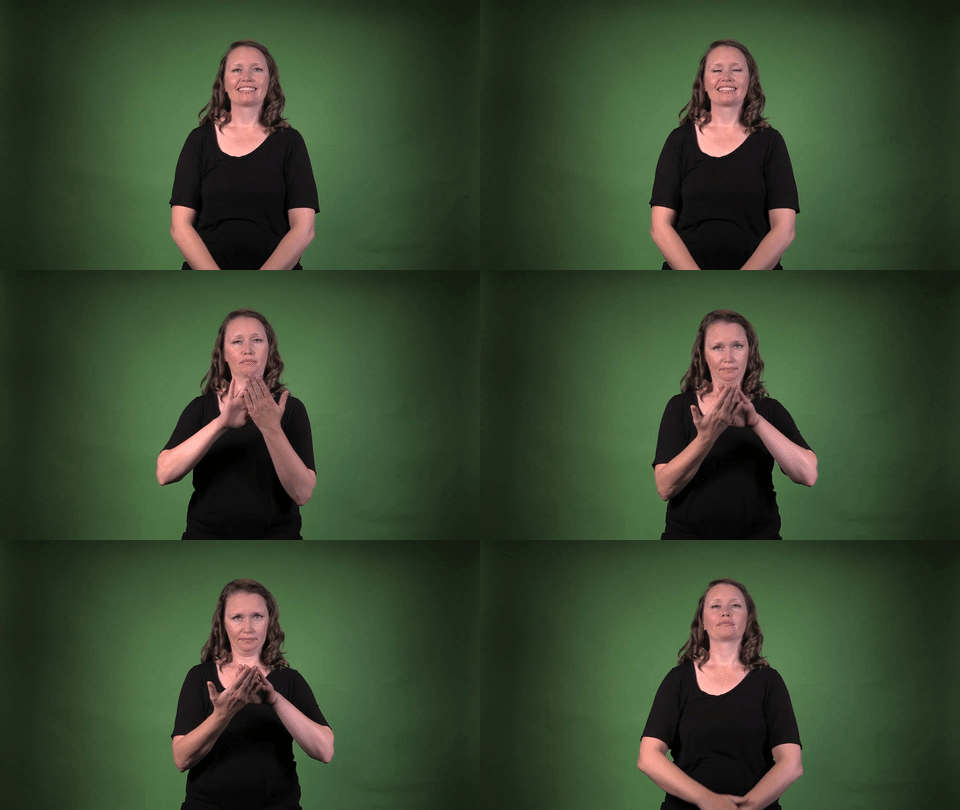
To perform the sign for BECOME in ASL, start with both hands open and flat, palms facing each other. One hand is placed over the other in front of the body. Then, smoothly twist both hands in opposite directions so the positions switch, with the top hand moving to the bottom and vice versa. This motion illustrates a transformation, showing how one thing turns into another.

The sign is commonly used in daily conversations and storytelling. It can describe personal growth, professional changes, weather conditions, or even emotional shifts. For example, saying someone has become a teacher or that the sky became cloudy can both use the sign for BECOME in ASL.

This concept plays an important role in American Sign Language grammar and expression. Because ASL often emphasizes visual conceptualization, the sign for BECOME in ASL allows signers to paint a picture of transformation. It helps provide rich, descriptive context in both casual chats and formal conversations.

In narrative ASL, the sign for BECOME is a key element when explaining changes over time. It supports the storytelling flow by helping indicate progress, development, or cause and effect. Whether it’s describing a character who becomes brave or a scenario where water becomes ice, the sign makes the shift clear and visual.

The sign is adaptable depending on speed and facial expressions. A smoother, slower movement might emphasize a gradual change, while a quick twist could represent a sudden shift. Facial cues and body language work hand-in-hand with the hand movement to give the sign more meaning and tone.

ASL learners often find this sign helpful as they grow their vocabulary. It connects easily with other signs that express time, emotion, or condition. Understanding how to use the sign for BECOME in ASL also strengthens a signer’s ability to talk about goals, dreams, and changes, which are essential topics in any language.

Common phrases using this sign might include become strong, become friends, or become tired. Pairing the BECOME sign with various adjectives and nouns allows for a wide range of expression. This matches how people express transformation in spoken languages.

In classroom settings or ASL practice groups, this sign is often introduced when discussing identity or change-related topics. It’s frequently

Synonyms: turn into, grow into, transform into, evolve into, develop into

Educational resources: Find related learning materials in our course bank!

Want more? Check out some of our popular learning activities on the homepage!

Need to look up a sign? Use our highly rated dictionary: https://aslinteractive.com/best-asl-dictionary/

Follow us on tiktok: https://www.tiktok.com/@aslinteractive. More social media links at the bottom of this page!

Long-tail Keywords: what is the sign for become in ASL, how to sign become in American Sign Language, ASL sign for become

Categories:

tags: become, verbs, actions, language learning, transitions

Parameters

*Handshape*:

The handshape for the sign for BECOME in ASL uses both hands in a flat “B” handshape, with fingers extended and together, and thumbs aligned with the fingers. Initially, the dominant hand is placed palm-down on top of the non-dominant hand, which is palm-up.

To complete the sign for BECOME in ASL, the hands twist so their positions flip — the dominant hand ends up palm-up and the non-dominant palm-down. This turning motion reflects the idea of transformation or change.

*Palm Orientation*:

In the sign for BECOME in ASL, both hands start in an open flat B-handshape, with the dominant hand placed on top of the non-dominant hand. The palms begin facing each other horizontally. As the motion progresses, the hands twist to switch positions, ending with the dominant hand underneath and the palms still facing each other though now reversed.

This fluid movement emphasizes transformation, and the palm orientation shift reinforces the concept visually. The shifting palm orientation is essential to accurately performing the sign for BECOME in ASL.

*Location*:

The sign for BECOME in ASL takes place in the neutral space directly in front of the torso, typically at chest level. Both hands start in open B-handshapes with palms facing each other, then rotate to switch positions as the dominant hand moves to where the non-dominant hand was and vice versa.

This movement happens in mid-air and does not contact the body, which places the location firmly in the signing space. The use of neutral space helps keep the sign for BECOME in ASL clear and visually distinct.

*Movement*:

The sign for BECOME in ASL involves placing the dominant hand palm down and the non-dominant hand palm up, with both palms touching at the fingertips. The hands then flip, so the dominant hand ends palm up and the non-dominant palm down, switching positions smoothly in one motion.

This transitional movement reflects the idea of change or transformation, which is central to the sign for BECOME in ASL. The gesture should be fluid and deliberate, indicating a natural shift from one state to another.

*Non-Manual Signals*:

The non-manual signals used with the sign for BECOME in ASL typically include a neutral but engaged facial expression. As the hands rotate and transition during the sign, the signer might show slight eyebrow movement to reflect the idea of change or transformation.

Head movement may follow the flow of the hands to emphasize the shift from one state to another. The sign for BECOME in ASL pairs well with a focused gaze to show the significance of the transition being described.

*Prosody, Dominant/Non-Dominant Hand*:

The sign for BECOME in ASL uses both hands. Start with the dominant hand flat, palm facing down, and the non-dominant hand flat, palm facing up. Place the palms together so they meet at the fingertips. Then smoothly rotate both hands in opposite directions until they switch positions—dominant hand ends on top, palm up, and non-dominant hand ends on bottom, palm down. This fluid motion shows transformation or change, which is central to the sign for BECOME in ASL. ✨

Tips for Beginners:

When learning the sign for BECOME in ASL, it’s helpful to remember that smooth, clear motion is key. This sign involves placing one open hand palm-up on top of the other open hand pointing palm-down, then flipping both hands so their positions are reversed. The movement should be fluid and without hesitation—think of one identity or state changing into another. Keep shoulders relaxed while executing the sign, as tension can cause stiffness in the hands and arms, making the sign look unclear.

One common mistake that beginners make when signing the sign for BECOME in ASL is moving the hands too slowly or with a jerky motion. Consistent hand shape and steady movement lend clarity to the sign and help convey meaning accurately. Avoid over-exaggerating the motion; instead, aim for a confident and deliberate flip of the hands with a natural rhythm.

Make sure both palms are flat and fingers are extended and together—not loose or curled. Practice in front of a mirror to ensure your hand position changes are well-aligned and symmetrical. This is especially important because the sign for BECOME in ASL visually represents transformation or change, so sloppy hand alignment can confuse the concept.

Consider watching native ASL signers use this sign in different contexts to reinforce your understanding. Since signs can shift slightly depending on sentence structure or emphasis, observing fluent signers helps you develop intuition for proper usage. Also, try practicing with a peer or ASL instructor to receive direct feedback on hand position and movement.

Consistency in handshape, spatial orientation, and motion will significantly help reduce misunderstandings when using the sign for BECOME in ASL. With regular practice and mindful attention to detail, you’ll gain confidence and fluency in including this sign in everyday conversations.

Connections to Other topics:

The sign for BECOME in ASL connects closely with transformation and process-oriented concepts in the language. It is often used to indicate change from one state or identity to another, making it a key verb when discussing development, growth, or transitions over time.

This sign frequently pairs with other verbs or nouns in compound sentence structures. For example, you might sign LEARN BECOME TEACHER to describe someone who studied and became a teacher. The sign for BECOME in ASL enables clear cause-and-effect statements in storytelling, making it a powerful tool for narrative structure.

It also shares thematic relevance with signs like CHANGE, DEVELOP, or GROW, all of which reflect progress or evolution. These relationships give learners deeper insight into how ASL expresses abstract ideas, moving beyond simple vocabulary to more nuanced communication.

In conversational ASL, the sign for BECOME often appears in complex grammatical contexts involving future tense or hypothetical outcomes. For instance, one might use IF STUDY HARD, BECOME SUCCESSFUL to discuss potential future results. This positions it as an important sign for building conditional statements.

The handshape reversal in the sign for BECOME mirrors transformation, a visual metaphor that aligns well with other ASL signs that embody motion as a conceptual representation. This visual-spatial orientation helps learners internalize abstract content more intuitively.

Additionally, the sign for BECOME in ASL can serve as a bridge for forming compound concepts such as BECOME INTERESTED or BECOME SICK, expressing the onset of emotional or physical states. These are useful when discussing changes in well-being or mentality, both in casual and formal discourse.

Understanding the multiple contexts for using the sign for BECOME in ASL supports more fluid and expressive communication. It allows users to talk about identity shifts, career changes, emotional development, and more, all essential components of everyday conversation.

Summary:

The sign for BECOME in ASL is both conceptually rich and visually metaphorical. It expresses transition, change, or transformation, and does so by showing a physical movement that reflects a shift in state.

To produce the sign for BECOME in ASL, start with both hands in flat-B handshapes, palms facing each other, fingertips touching. Then flip the hands so that the position of the hands switch, showing a clear reversal.

This movement represents the concept of turning into something else, directly matching the idea of transformation. The sign is iconic in how it demonstrates this transition from one state to another.

The sign for BECOME in ASL is directional and symmetrical. It emphasizes equal movement on both sides, implying mutual or linear transformation, as seen in biological, emotional, or intellectual growth.

Culturally, the sign for BECOME in ASL speaks to the Deaf community’s deep understanding of personal development. It is frequently used in bilingual discussions, especially to describe identity evolution.

In storytelling, especially within visual vernacular, BECOME provides a literal and metaphorical bridge. It transitions time frames, scenes, or even emotional states.

ASL philosophers and linguists often admire the sign for BECOME for its metaphorical clarity. It acts as a visual metaphor for metamorphosis, both physical and abstract.

Grammatically, the sign for BECOME in ASL serves as a linking verb. It connects the subject with a resulting condition or title, like ‘become happy’ or ‘become a leader’.

Because ASL relies on context and facial grammar, the sign for BECOME is often modified by use of facial expressions. A neutral expression might indicate a simple change, while an emphasized expression could mark a dramatic or unexpected transition.

The sign for BECOME in ASL contrasts with signs related to identity, such as BE or EXIST, which indicate presence, but not necessarily change. BECOME, by contrast, highlights transformation.

Variations of the sign for BECOME in ASL include nuanced movement shifts for poetic or cinematic effect. Some users reorient the hands slightly or adjust speed to match artistic context.

Linguistically, the sign for BECOME aligns with the ASL tendency toward visual-spatial metaphors. The transition shown in the movement reflects a conceptual shift used across many verbs of change.

Pragmatically, this sign is flexible across conversational uses. Whether discussing career goals, personal change, or environmental shifts, the sign for BECOME in ASL plays a central role in the storytelling function of daily communication.

When teaching the sign for BECOME in ASL, educators often pair it with real-life analogies. Examples like a caterpillar becoming a butterfly or a child maturing into adulthood support conceptual learning.

In Deaf poetry and performance, the sign for BECOME functions as a pivot point for narrative motion. It physically marks the evolution of thought or action on stage.

It is useful to compare the sign for BECOME with related transformation signs such as DEVELOP or PROGRESS. Each of these contains its own nuance but shares a conceptual family with BECOME.

Students new to ASL often learn the sign for BECOME early in their studies because it’s a central verb in self-expression and identity. Phrases like “I want to become…” are foundational in both everyday and aspirational talk.

Within Deaf culture, the sign for BECOME may symbolize more than individual change—it also reflects social and collective transformation. This includes discussions about civil rights, education reform, and Deaf identity evolution.

Because of its flexible usage, the sign for BECOME in ASL is also used metaphorically. It can mark the transition in mood, topic, or argumentation within discourse.

In narrative linguistics, BECOME operates as both a bridge and a spotlight. It illuminates the change while simultaneously connecting the old and new information.

In technical ASL linguistics, it is classified as a transitional verb with transformational semantics. It shares cognitive-linguistic parallels with signs like TURN-INTO or CHANGE.

Unlike static verbs in ASL, which indicate a state of being, BECOME is inherently dynamic. Its movement makes it one of the clearest signs to indicate narrative or conceptual momentum.

The iconic nature of the flip in the sign mimics how physical rotation can symbolize philosophical or emotional upheaval. This lends the sign high usefulness in metaphor-heavy communication.

Linguists studying sign morphology appreciate the use of flat handshapes in BECOME because it maintains a non-agentive structure—it marks change without implying an external force.

Signed literature often teaches children the sign for BECOME alongside stages of character development. It helps explain moral change or transformation through time.

The sign for BECOME in ASL also has a significant connection to identity politics. It’s used to express how one may take on new roles in life, such as becoming Deaf-centered, becoming an advocate

Want more? Check out some of our popular learning activities!

ASL Interactive Resources

ASLInteractive YouTube Channel

Follow us on tiktok: @aslinteractive.com

Follow us on Instagram: aslinteractive

Facebook page: aslinteractive

Facebook group: aslinteractive

LInkedIn: ASL Interactive LLC

Twitter: @ASL_interactive

*Some information on this page is AI-generated. AI can make mistakes. Please check the information.

Sign for BECOME in ASL

Responses