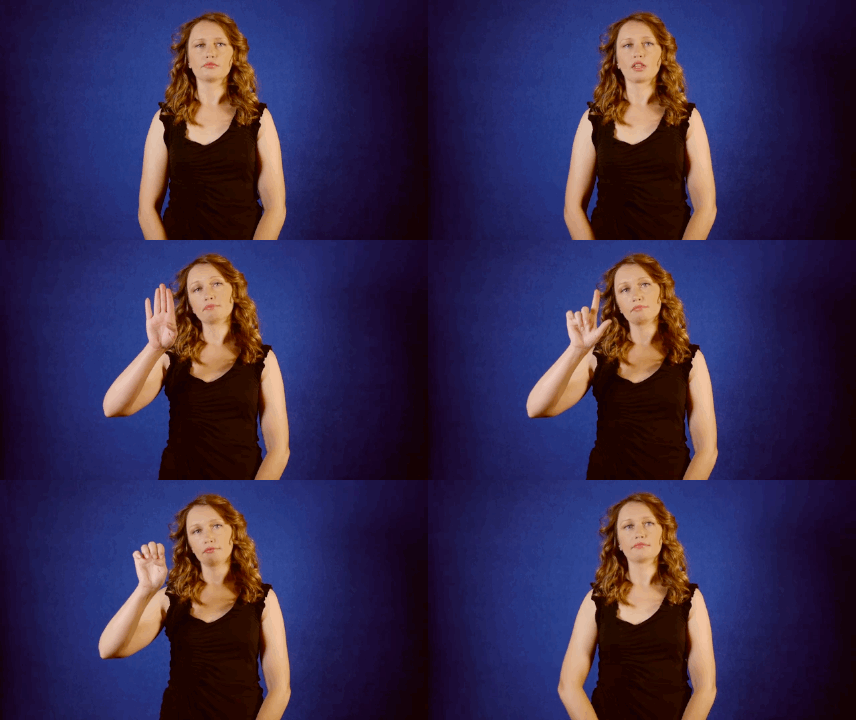
Definition: A country in Central America.
Sign for BELIZE in ASL

Practice Activities:
Start by fingerspelling BELIZE slowly and clearly, focusing on each letter: B-E-L-I-Z-E. Practice fingerspelling it several times in front of a mirror or recording yourself to check for clarity and fluidity. Pay extra attention to the transitions between L-I-Z, which can be challenging for beginners.
Once you are comfortable spelling BELIZE in isolation, try using the sign for BELIZE in ASL within simple sentences. For example, you can practice saying: “I want to visit BELIZE,” or “My friend is from BELIZE.” Repeat these sentences multiple times while maintaining the correct spelling and facial grammar.
Create flashcards with the names of different countries and include BELIZE among them. Mix them up and practice fingerspelling each country as quickly and accurately as possible. This will help reinforce your recall while developing speed and confidence with country names.
Use the sign for BELIZE in ASL in a short story. For instance, tell a short narrative like, âI traveled by plane to BELIZE. The weather was hot. I swam in the ocean and ate new foods.â Practice telling this story with expressive signs and appropriate pauses between sentences.
For partner activities, work with someone to ask and answer questions using BELIZE in context. Examples could include: âHave you been to BELIZE?â or âWhat is BELIZE known for?â This will help build conversational confidence with the fingerspelling.
Add variety by practicing with ASL video chat partners or joining an online group, taking turns signing vacations or dream trips that include BELIZE. Challenge yourself to respond naturally and incorporate the sign smoothly into your signing. Review your progress by recording and watching your signing to self-correct and measure improvement with the sign for BELIZE in ASL.
Cultural Context:
The sign for BELIZE in ASL reflects not just the name of a country, but a rich cultural connection within the Deaf community. When learning any place name, especially country names like the sign for BELIZE in ASL, it’s important to consider how these signs are shared across regions and communities. Signs for countries often evolve or are adopted based on historical, geographical, or cultural ties.
Belize, a Central American country with diverse roots in Mayan, Creole, Garifuna, and Mestizo cultures, has unique representation in sign languages. The sign for BELIZE in ASL may vary based on local or regional usage, especially among Deaf individuals of Caribbean or Central American heritage. This variation is common due to the influence of local signs within international Deaf communities.
When learning or using the sign for BELIZE in ASL, it’s helpful to understand its place in both Deaf culture and global geography. Identifying landmarks, cultural elements, or common associations with Belize can often shape how its sign is remembered or conceptualized in the Deaf world . Country signs often use visual clues related to the country’s shape, flag, or a notable feature to make them easier to recall.
In the context of American Sign Language, the sign for BELIZE in ASL helps connect the Deaf community to global awareness and cultural appreciation. ASL students and fluent signers alike benefit from understanding the significance behind place name signs. Using the sign for BELIZE in ASL is more than naming a location â it’s a way of acknowledging Belizean identity and presence in the wider Deaf world.
For travelers, culturally curious learners, or heritage signers, knowing the sign for BELIZE in ASL may also lead to deeper understanding of Belizean Deaf culture. Belize is home to a small but vibrant Deaf community, and the use of both local and ASL signs creates a bilingual or even trilingual environment in some settings. Signs shared across countries often foster connections between Deaf individuals beyond borders .
Communication in the Deaf community relies heavily on clarity and shared understanding, so using the widely accepted version of the sign for BELIZE in ASL promotes inclusion and mutual respect. In educational settings, teaching the correct sign supports cultural literacy as well as geographic knowledge. Teachers, interpreters, and ASL learners are encouraged to use culturally respectful and accurate signs when referencing places like Belize.
The sign for BELIZE in ASL is a reminder of how language connects people to place and history. It’s a small but meaningful part of linguistic
Extended Definition:
The sign for BELIZE in ASL is a culturally and linguistically specific sign used to identify the Central American country of Belize in American Sign Language. This sign is primarily used during conversations related to geography, travel, culture, or international affairs when discussing Belize.
To express the sign for BELIZE in ASL, a signer may use a proper noun sign specific to this country. In some contexts, fingerspelling B-E-L-I-Z-E is also used, especially when the person is not familiar with the dedicated sign. Some signers prefer fingerspelling when first introducing Belize and then switch to the sign for conversational ease.
Because Belize is not a U.S. state, but rather an independent nation, its sign can vary between different signing communities. When in doubt, fingerspelling is always acceptable and understood across all ASL users. Proper usage depends on whether one is dealing with native signers or a mixed signing environment.
The sign for BELIZE in ASL might also reflect certain cultural elements of the country. Some signs incorporate visual or iconic features that represent aspects of Belize’s geography, such as the Caribbean Sea or rainforests. Teachers and interpreters often explain these variations when teaching or presenting about countries in ASL.
In educational settings, knowing the correct sign for BELIZE in ASL is especially important for geography units, diversity activities, or multicultural projects. Students learning countries in ASL benefit from visual and physical clues tied to the meaning of each sign. Understanding variations of this sign can help learners gain a broader grasp of ASL vocabulary and how it evolves.
Travelers preparing presentations or blog content in ASL will benefit from learning the accurate and preferred sign for BELIZE in ASL. It ensures clear communication when creating travel vlogs or news content in sign language. This is especially helpful when discussing destinations, travel warnings, or cultural sites in Belize.
ASL users interested in Caribbean and Central American countries will frequently encounter the sign for BELIZE in ASL during conversations about global issues, tourism, or heritage. Many people from Belize live in the U.S., and representation of their homeland in sign language is a way of promoting cultural connection through ASL. Using accurate country signs fosters inclusivity in the Deaf community.
Sign language interpreters often research the updated signs for countries like Belize to ensure they are accurately representing spoken content. Using the sign for BELIZE in ASL correctly demonstrates professionalism and respect toward Deaf viewers and ASL users. Many resources are available to confirm regional
Synonyms: Belize, Belizean territory, Nation of Belize, Belizean country, Central American Belize
Educational resources: Find related learning materials in our course bank!
Want more? Check out some of our popular learning activities on the homepage!
Need to look up a sign? Use our highly rated dictionary: https://aslinteractive.com/best-asl-dictionary/
Follow us on tiktok: https://www.tiktok.com/@aslinteractive. More social media links at the bottom of this page!
Long-tail Keywords: What is the sign for Belize in ASL, How do you sign Belize in American Sign Language, ASL sign for Belize
Categories:
tags: Belize, Countries, Geography, Travel, Culture
Parameters
*Handshape*:
The handshape used in the Sign for BELIZE in ASL involves fingerspelling. You form the hand into the shape of each corresponding letter: âB,â âE,â âL,â âI,â âZ,â and âE.â Each letter has a distinct static handshape using one or both hands, but they are signed one at a time in a fluid sequence to represent the name.
Since the Sign for BELIZE in ASL is fingerspelled, accuracy in forming each individual letter is essential. The motion should be smooth and steady, using the dominant hand in front of the shoulder area for best visibility. This spelling serves as the primary and recognized way to sign this countryâs name.
*Palm Orientation*:
In the sign for BELIZE in ASL, the palm orientation begins with the fingerspelled handshape. The dominant hand spells out B-E-L-I-Z-E, maintaining a natural and neutral palm orientation throughout, with each letter flowing clearly from one to the next.
While fingerspelling, the palm generally faces slightly outward or toward the listener to ensure visibility. The clarity and directionality of the palm are crucial when producing the sign for BELIZE in ASL for accurate understanding.
*Location*:
The sign for BELIZE in ASL is produced in the neutral space in front of the body, typically at chest level. This common signing area allows clear visibility and comfort when fingerspelling the word.
Because the sign for BELIZE in ASL is fingerspelled, the hand moves smoothly from one letter to the next in that central area. Keeping the hands in this neutral space ensures the name is easily understood during communication.
*Movement*:
To perform the sign for BELIZE in ASL, begin by fingerspelling each letter of the country’s name: B-E-L-I-Z-E. Use clear, deliberate handshapes for each letter, and maintain a consistent orientation and space between the letters as your dominant hand moves slightly from left to right across the front of your chest.
The sign for BELIZE in ASL depends entirely on fingerspelling due to its proper noun status and lack of a standardized sign. Make sure your hand remains at chest height and your palm stays facing outward throughout the motion.
*Non-Manual Signals*:
When using the sign for BELIZE in ASL, maintain a neutral facial expression with slightly raised eyebrows to indicate that you are naming a place. Keep eye contact with your conversation partner and avoid exaggerated emotion, as the focus is on the geographical reference.
The sign for BELIZE in ASL usually includes polite body posture and attentiveness, signaling respect for the location being referenced. Calm, steady movements paired with smooth non-manual signals help reinforce clarity and prevent confusion with similar signs.
*Prosody, Dominant/Non-Dominant Hand*:
The sign for BELIZE in ASL is typically fingerspelled using a fluid motion for clarity. The dominant hand is used to fingerspell each letter B-E-L-I-Z-E, positioned in the neutral space in front of the shoulder or slightly forward. The non-dominant hand remains still or is not used.
When signing the full name in a conversation, maintain steady eye contact and pace to keep the fingerspelling clear. The sign for BELIZE in ASL may vary slightly depending on region or context, but fingerspelling is the most widely understood version.
Tips for Beginners:
The sign for BELIZE in ASL is a fingerspelled word, so consistent handshape and smooth transitions are crucial. When fingerspelling “Belize,” itâs important to articulate each letter clearlyâespecially the “B,” “L,” and “Z”âsince they can be misread if rushed. Practice the sign slowly at first, making sure each letter is formed correctly. As you grow more comfortable, work on increasing your speed while maintaining clarity. âïž
A helpful tip is to watch native signers or fluent users of American Sign Language and observe how they fingerspell “Belize” in natural conversation. Youâll notice that their hand remains relaxed and their movement fluid. Beginners often tense up or keep their hand too rigid, which makes their fingerspelling look unnatural or difficult to read.
Another common issue is not maintaining a stable placement for your signing hand. Keep your dominant hand at shoulder height and slightly in front of your body. Avoid letting your hand float or bounce between letters. This keeps your sign for BELIZE in ASL visually accessible and easy to follow for your conversation partner.
Using a mirror or recording yourself while practicing can be incredibly useful. Be sure to focus on palm orientationâit should face outward. Donât twist your wrist or change angles between letters, as this disrupts the rhythm and can cause confusion.
Finally, practice fingerspelling the word in different contexts. Try incorporating it into mock dialogues or signing when discussing travel, geography, or culture. The more organically you can use the sign for BELIZE in ASL, the more confident and natural it will feel during real interactions. Remember, clarity and consistency are more important than speed. Over time, your fluency will improve with steady practice.
Connections to Other topics:
The sign for BELIZE in ASL is typically fingerspelled, as are the names of many countries and geographical locations. Fingerspelling connects closely to other areas in ASL such as proper nouns, brands, and new vocabulary that don’t have an established sign. For learners, understanding that the sign for BELIZE in ASL involves fingerspelling can reinforce fluency in recognizing and producing the manual alphabet smoothly.
This sign is also connected to how ASL handles geography and international topics. Countries can have unique signs or be fingerspelled depending on community usage, familiarity, or frequency of use. Learning the sign for BELIZE in ASL builds awareness of how fingerspelling bridges gaps in vocabulary, particularly for less commonly referenced locations.
In conversations involving travel, cultural identity, or international relations, using signs like BELIZE along with signs for TRAVEL, VISIT, or FROM can create richer expressions. Compound messages such as TRAVEL + fs-BELIZE or PEOPLE + fs-BELIZE are common and provide insight into how signs work together in ASL grammar structure. These combinations support fluency in both storytelling and formal presentations.
The sign for BELIZE in ASL also supports discussions in educational contexts, especially when covering topics like world geography or diversity. Teachers often combine signs like COUNTRY, MAP, and ISLAND with the name of a specific location to contextualize the topic. For example, a lesson might include the setup: WHERE + fs-BELIZE + MAP (point), creating a scaffolded learning approach.
Fingerspelled location names like BELIZE also serve as bridges to understanding regional signs and dialects in ASL. Some communities may adopt slight variations or even initialize certain signs over time, evolving how frequently fingerspelling is used in casual versus formal settings. This helps learners be more adaptable in diverse signing environments.
Summary:
The sign for BELIZE in ASL is fingerspelled. This means each letter of the English word is signed individually using the ASL manual alphabet. Fingerspelling is commonly used for proper nouns, especially place names like Belize.
When signing the sign for BELIZE in ASL, the handshape remains consistent with standard fingerspelling conventions. Each letterâB, E, L, I, Z, and Eâis signed from left to right in a smooth, deliberate fashion. The hand typically stays near shoulder level or just below the chin.
The motion of the hand should be fluid, and speed adjusted based on the audience. Native signers may fingerspell more swiftly, while learners or formal settings may benefit from slower articulation. Clarity is key when fingerspelling the sign for BELIZE in ASL.
Fingerspelling plays an essential role in American Sign Language because it bridges the gap between languages. In the case of the sign for BELIZE in ASL, it allows the signer to refer to the country accurately. Belize, being a unique geographic name, lacks a designated sign with iconic elements.
Often, commonly referenced countries develop initialized or symbolic signs, but the sign for BELIZE in ASL remains fingerspelled. This might reflect the country’s relatively lower frequency in ASL discourse compared to nations like France or Mexico which have more established signs. Over time, increased use might lead to an abbreviated or initialized version, but none is standardized as of now.
Grammatically, when integrating the sign for BELIZE in ASL into a sentence, it behaves like any other proper noun. For example, one might sign âI VISIT BELIZE FSâ or âFS BELIZE BEAUTIFUL COUNTRY.â Proper noun markers and non-manual signals support this usage.
Fingerspelling also interacts with linguistic variation across regions. Some signers reduce or adjust hand motion for smoother transitions between frequently fingerspelled words. The sign for BELIZE in ASL may vary slightly in speed or letter articulation depending on the signerâs fluency or regional dialect.
Belize is a culturally rich and linguistically diverse nation, marked by its Creole, English, and various Mayan languages. In conveying this identity, using the fingerspelled sign in ASL shows respect to the country’s uniqueness. The lack of a lexicalized sign may also preserve its cultural specificity.
The sign for BELIZE in ASL emphasizes the relationship between written/spoken and signed languages. Fingerspelling essentially imports English orthography into ASL structure. This makes it a prime example of bilingualism in action.
For ASL learners, practicing fingerspelling for country names like BELIZE builds vital receptive and productive skills. The pattern and rhythm of fingerspelling help improve fluency. Itâs also useful for spelling names, brands, and technical terms.
Embedding the sign for BELIZE in ASL within a broader sentence context also teaches ASL grammar elements like topic-comment structure. Signs surrounding the fingerspelled word adapt visually to maintain clarity. This integration supports linguistic fluidity.
Non-manual markers often co-occur with fingerspelling. For BELIZE, the signerâs eyebrows might raise slightly to indicate topic shading or emphasis. The signerâs facial expressions contribute to meaning even when the manual sign is static.
Linguistically, fingerspelling belongs to the lexical class of âborrowed forms.â These are words that exist in ASL but originate from English. The sign for BELIZE in ASL is not transformed iconically but remains faithful to its English spelling.
Iconicity is largely absent from this sign, contrasting with other national signs. For example, the sign for France uses an F-shaped hand pulling away from the head, resembling a feathered hat. The sign for BELIZE in ASL offers none of these iconic cues, relying entirely on orthography.
Cognitive research has shown that fingerspelling activates different processing areas in deaf signersâ brains. It blends visual, motor, and linguistic information in unique ways. The sign for BELIZE in ASL thus engages these cognitive pathways distinctly from iconic or gestural signs.
In Deaf culture, particular attention is often placed on accuracy in fingerspelling proper names. Improper spelling leads to confusion. Correctly producing the sign for BELIZE in ASL shows linguistic respect and clarity.
In signed conversations, fingerspelled countries often prompt further description. A signer might fingerspell BELIZE and then add signs such as âBEAUTIFUL,â âBEACH,â âTROPICAL,â or âCARIBBEAN.â These descriptors give visual context and enrich the narrative.
This form of elaboration makes fingerspelled nouns like BELIZE more dynamic. It opens pathways to deeper cultural storytelling or shared experience in the Deaf community. Signers often supplement labels with visual signs for engagement.
The frequency of use of the sign for BELIZE in ASL may vary across conversational topicsâtravel, heritage, geography, or politics. In academic ASL
Want more? Check out some of our popular learning activities!
ASL Interactive Resources
ASLInteractive YouTube Channel
Follow us on tiktok: @aslinteractive.com
Follow us on Instagram: aslinteractive
Facebook page: aslinteractive
Facebook group: aslinteractive
LInkedIn: ASL Interactive LLC
Twitter: @ASL_interactive
*Some information on this page is AI-generated. AI can make mistakes. Please check the information.


Responses