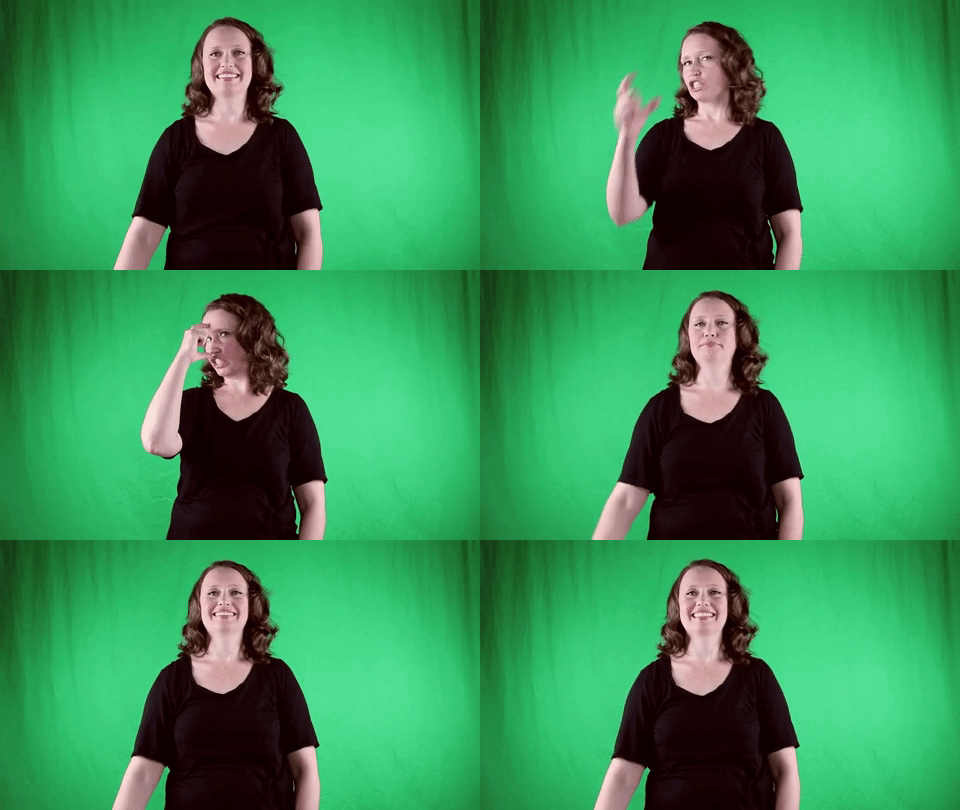
Sign for BIG NOSE in ASL | 👃 ASL Dictionary

Definition: A person with a large nose.

Sign for BIG NOSE in ASL

YouTube player

Practice Activities:

To practice the sign for BIG NOSE in ASL, start by standing in front of a mirror and repeating the sign slowly, paying attention to facial expressions and handshape. Practice producing the sign five times while incorporating exaggerated facial expressions to emphasize the concept of “big.” This is especially important because facial grammar adds intensity and clarity in ASL.

Move on to using the sign for BIG NOSE in ASL in short phrases. Try sentences like “That man has a big nose” or “The cartoon character has a really big nose.” Repeat each sentence several times, adjusting your facial expression to match the tone you want—silly, surprised, or neutral. Record yourself and watch the video to self-evaluate.

Create flashcards with different physical characteristics described on one side and practice signing them, switching to the appropriate sign for BIG NOSE in ASL when you draw a matching card. Mix other features like “small ears” or “long hair” to avoid only practicing one sign at a time. This will help strengthen your receptive skills and make you faster at recognizing and producing the right signs.

Storytelling is another excellent exercise. Come up with a character that has a memorable feature, like an animal or person with a big nose, and build a short story around them. Sign the story from beginning to end, including the sign for BIG NOSE in ASL in context. This encourages fluid signing and reinforces memory through narrative.

Pair up with a partner for a role-play game where you describe people or animals from a picture. Take turns signing descriptions that include the sign for BIG NOSE in ASL. Your partner must guess who you’re describing. This activity builds vocabulary, strengthens comprehension, and fosters confidence in using descriptive signs.

Cultural Context:

In American Sign Language, signs that describe physical features like the sign for BIG NOSE in ASL can carry unique cultural context. Understanding these signs requires more than just knowing what each hand movement means—it involves appreciating how Deaf culture interprets and represents different traits.

The sign for BIG NOSE in ASL is often used to describe someone with a noticeably large nose, but it’s important to consider how it is perceived. Within the Deaf community, such descriptions are usually factual rather than judgmental. Facial features are often a focus when identifying or describing people, so the sign for BIG NOSE in ASL plays a practical role in communication.

Deaf consumers of American Sign Language often use a direct and visual style. This means that physical features are not softened or hidden; instead, they are plainly shown in signs. When using the sign for BIG NOSE in ASL, clarity and visual accuracy are more important than sensitivity based on hearing culture norms.

That said, context matters. While the sign for BIG NOSE in ASL can be neutral or descriptive among fluent signers, it can be interpreted differently depending on tone and social dynamics. In some cases, it could be misunderstood if used outside of appropriate contexts or among people less familiar with Deaf norms.

Facial expressions play a key role in giving meaning to signs. When using the sign for BIG NOSE in ASL, the expression on the signer’s face might indicate whether the statement is humorous, neutral, or possibly teasing. Non-manual markers like raised eyebrows or a smirk can shift the meaning subtly.

It’s also crucial to understand that ASL represents a visual language shaped by its own grammar and cultural values. Descriptors like the sign for BIG NOSE in ASL are linked to how the Deaf community naturally communicates. There’s less focus on political correctness and more emphasis on visual clarity and effective description.

Parents, educators, and interpreters often teach learners how to sign descriptive features appropriately. Learning the sign for BIG NOSE in ASL gives new signers insights into how detailed and descriptive ASL can be without being rude or inappropriate. Knowing when and how to use such signs is a part of cultural fluency and respect.

Using the sign for BIG NOSE in ASL is not inherently negative. It depends on the intention and the rapport between the people signing. The same sign used by an unfamiliar person might come off as awkward, while the same used among friends could serve as a useful descriptor.

Learning physical description signs like the sign for

Extended Definition:

The sign for BIG NOSE in ASL refers to a specific gesture used to describe someone who has a noticeably large nose. In American Sign Language, signs often incorporate visual elements that represent the concept or appearance of the object or feature being described. The sign for BIG NOSE combines a general size modifier with the sign for nose, creating a clear representation.

To create the sign for BIG NOSE in ASL, you typically start with the hand close to the face near the nose and then use a size-indicating motion away from the nose. This movement helps show that the size of the nose is big or exaggerated. Facial expressions also play an important role in conveying that the description is meant to suggest something larger than average.

In ASL, modifying a sign with size or intensity helps add meaning without needing extra words. The sign for BIG NOSE in ASL uses this principle. It shows how descriptive and expressive American Sign Language can be, especially when describing physical features.

It’s important to be culturally aware when using signs that describe physical attributes. The sign for BIG NOSE in ASL can be used in casual or humorous contexts, but just like in spoken language, intent and respect matter. Avoid using signs in ways that could be interpreted as rude or offensive.

In educational or interpretive settings, the sign for BIG NOSE in ASL might be used to describe a character in a story or to help students recognize ASL descriptors. Teachers often use signs like this in storytelling to help reinforce vocabulary about facial features and adjectives. It’s one of many signs that show how ASL conveys appearance using spatial and visual cues.

When searching for signs like BIG NOSE in American Sign Language, learners should remember that regional variations may exist. Some Deaf communities might use slightly different motions. However, the general idea of combining the concept of big with the location near the nose is widely recognized.

Learning signs for facial features, such as BIG NOSE, helps build a stronger base in ASL. These signs are a key part of describing people and characters. They’re useful for storytelling, everyday conversation, and interpreting.

Facial grammar is essential when signing BIG NOSE in ASL. A slight exaggeration in your facial expression helps clarify that you’re describing something larger in size. ASL relies heavily on non-manual markers to give full meaning, especially for descriptive language.

If you’re unsure of how to sign BIG NOSE in ASL, watching video dictionaries or working with a fluent signer can help. Practice in

Synonyms: large nose, prominent nose, huge nose, oversized nose, bulbous nose

Educational resources: Find related learning materials in our course bank!

Want more? Check out some of our popular learning activities on the homepage!

Need to look up a sign? Use our highly rated dictionary: https://aslinteractive.com/best-asl-dictionary/

Follow us on tiktok: https://www.tiktok.com/@aslinteractive. More social media links at the bottom of this page!

Long-tail Keywords: what is the sign for big nose in ASL, how to sign big nose in American Sign Language, ASL sign for big nose

Categories:

tags: nose, facial features, body parts, physical descriptions, description

Parameters

*Handshape*:

The handshape for the sign for BIG NOSE in ASL uses the modified “L” handshape. The thumb and index finger form an “L” while the rest of the fingers are closed. This shape emphasizes the length or size, typical for indicating exaggerated facial features.

To clearly express the sign for BIG NOSE in ASL, the “L” handshape starts close to the nose and arcs outward slightly in a motion that mimics a large or long nose . This helps visually represent the concept of a big nose through space and movement.

*Palm Orientation*:

For the sign for BIG NOSE in ASL, the palm orientation typically faces inward toward the signer. The dominant hand forms a modified L or bent index shape, and the palm is angled slightly toward the face, focusing movement around the nose area.

To depict the sign for BIG NOSE in ASL, the hand moves outward from the nose while maintaining consistent palm orientation. This motion can be slightly exaggerated to emphasize the size aspect of “big.”

*Location*:

The sign for BIG NOSE in ASL is made in the neutral space directly in front of the face, focusing on the nose area. The dominant hand can be used to indicate the nose, and then expand outward to emphasize the size, helping to communicate the concept effectively.

This location near the face ensures the sign for BIG NOSE in ASL remains visually clear and directly connected to the facial feature being described, enhancing clarity and visual storytelling ‍♂️.

*Movement*:

To perform the sign for BIG NOSE in ASL, begin by forming the dominant hand into an “L” shape, placing the thumb on the side of the nose. Move the index finger and thumb outward in a curving motion, indicating the exaggerated size of the nose.

This movement visually represents a large nose, with the outward curve reinforcing the concept of “big” in the sign for BIG NOSE in ASL. Facial expression can further clarify the meaning.

*Non-Manual Signals*:

When showing the sign for BIG NOSE in ASL, puff your cheeks slightly and raise your eyebrows to emphasize the exaggerated size. Use a comical or playful facial expression to indicate that the size is unusually large.

Depending on context, tilt your head slightly forward as if pointing to a nose. The non-manual signals help reinforce that the sign for BIG NOSE in ASL refers to a distinctive or noticeable nose, not just any size.

*Prosody, Dominant/Non-Dominant Hand*:

The dominant hand is typically used in the sign for BIG NOSE in ASL. Form the dominant hand into an “L” shape with the index finger and thumb extended. Starting near the bridge of the nose, drag the hand slightly outward and downward, curving slightly to suggest the shape of a large nose ‍♀️.

The non-dominant hand is not usually involved in the sign for BIG NOSE in ASL. This is a descriptive sign that relies on size and shape, and facial expression is important to convey that the nose is big.

Tips for Beginners:

When learning the sign for BIG NOSE in ASL, it’s important to focus on both clarity and facial expressions. To sign this concept correctly, you’ll typically use your dominant hand in an L-handshape starting from the bridge of your nose and moving outward slightly in a curved arc, mimicking the shape of a prominent nose. The movement and intensity of the sign can help to illustrate the size of the nose, so facial expressions play a key role in communicating the intended meaning.

Beginners should be careful not to over-exaggerate or use the sign in a way that seems offensive or mocking. In Deaf culture, physical descriptions are commonly used as natural identifiers, but it’s always important to be respectful and culturally aware. When signing to describe someone, keep your expression neutral or descriptive, not mocking or comedic.

Practice in front of a mirror to monitor both your hand movements and your facial expressions. This can help catch unclear movements or expressions that may send the wrong message. Make sure the motion is smooth and purposeful—hesitation or jerky movements can cause confusion or misunderstandings.

Another frequent challenge when learning the sign for BIG NOSE in ASL is distinguishing it from similar signs like “nose” or “big.” Confusing these can distort the intended meaning. It helps to isolate and practice the component signs first, then combine them thoughtfully. Think of BIG NOSE as a descriptive compound—the size factor adjusts the basic sign for “nose.”

Use repetition when practicing and ask fluent signers for feedback. Signing with others will help reinforce the correct use and identify areas that need refinement. Use the sign naturally in descriptive conversation to build fluency and comfort. Over time, you’ll develop clearer muscle memory and confidence using the sign for BIG NOSE in ASL accurately and respectfully.

Connections to Other topics:

The sign for BIG NOSE in ASL connects strongly to facial features vocabulary, a common category in both everyday conversation and descriptive storytelling. Understanding how to sign features like NOSE, EARS, MOUTH, and EYES helps learners build a more detailed and expressive signing vocabulary. These signs are often used in combination with modifiers like BIG, SMALL, or LONG to provide specificity or humor.

The sign for BIG NOSE in ASL also relates to body classifiers. For example, a signer might pair a classifier showing the shape or size of a part of the face with the descriptive term BIG to emphasize exaggeration or uniqueness. This makes the sign especially useful in storytelling or character description where physical traits are important for visual imagery.

ASL frequently uses compound signs like combining BIG with NOSE, and this blending of concepts is essential in visually descriptive language. Learners gain fluency by noticing how signs work together rather than existing in isolation. Using facial expressions alongside the sign for BIG NOSE in ASL enhances meaning and aligns with ASL’s emphasis on non-manual markers.

In conversation about family traits or teasing between friends, the sign for BIG NOSE in ASL can be used to describe genetic features or joke around in a playful manner. It’s important, though, to be culturally aware and sensitive about context so the sign is not perceived as mocking or offensive. This connects to the broader ASL topic of tone and intention.

The sign also ties into the depiction of characters in ASL poetry and performance. Signers often exaggerate features like a BIG NOSE to portray whimsical or larger-than-life personalities. This reinforces the visual storytelling style of ASL and offers a creative connection for learners exploring performance or narrative forms.

Summary:

The sign for BIG NOSE in ASL is both descriptive and culturally situated, as it conveys not only physical characteristics but also connotations about attention to facial features. ASL uses space and iconic representations, and the morphology of this sign reflects those qualities. It may vary slightly by region, but the core visual concept remains centered around exaggerating the shape and size of a nose.

To form the sign for BIG NOSE in ASL, use a dominant hand in an L-shape, starting at the side of the nose and moving outward in a curved line to imply a prominent or protruding nose. This movement iconically reflects the shape and relative size of the nose being described. The size and exaggeration can indicate tone—comical, descriptive, or even offensive depending on intent and expression.

Facial expressions play a crucial role when signing descriptors like BIG NOSE. Raised eyebrows may add emphasis, while exaggerated facial movements can suggest humor or sarcasm. ASL grammar relies heavily on non-manual signals to complement or modify the manual signs’ meanings and emotional tone.

The sign for BIG NOSE in ASL often appears in personal descriptions and storytelling. It can describe someone’s appearance in a neutral or humorous way, depending on the surrounding context. This highlights how ASL creatives often engage visual-spatial representations to vividly convey character traits.

Grammatically in ASL, when using a descriptive sign such as BIG NOSE, it comes after the noun or person being discussed. For example, a proper name or the sign for “man” would precede the descriptor. This usage aligns with ASL’s adjective-noun ordering pattern, different from English structure.

In linguistic terms, the sign is a blend of classifier and iconic representation. The confluence of these elements showcases ASL’s reliance on embodiment and spatial metaphor. Rather than just representing a word, the movement and handshape reflect the subject’s visual reality.

The cultural lens is also vital. While some might use the sign benignly, it’s important to understand that physical descriptors can cross social boundaries. The impact of the sign for BIG NOSE in ASL can change based on who is signing, who is being signed about, and the relationship between them. What is light humor in close-knit communities might feel offensive in others.

There are cultural sensitivities around physical descriptions, particularly when signs appear judgmental or mocking. Deaf culture emphasizes inclusivity, so handling this sign with care and expressive intent is paramount. Navigating humor and directness in Deaf culture requires awareness and true engagement with the language.

As for variations, some signers might elongate the facial expression or extend the outward movement further to intensify the emphasis. Regional dialects of ASL also play a role in shaping how the sign for BIG NOSE looks. These variations reveal linguistic change and diversity within the Deaf community.

Comparing the sign for BIG NOSE in ASL with related signs like SMALL NOSE or long face reveals the nuanced nature of physical descriptors. These signs vary in handshape and motion, offering layered options when signing descriptions. Such differences allow for more tailored and expressive communication.

From a linguistic standpoint, the sign involves both morphological and syllabic structure. There is one root sign with potential affix-like embellishments, such as prolonged motion or altered speed. These minor shifts change the pragmatics attached to the sign.

Applied linguistics examines how signs like BIG NOSE are learned, taught, and perceived across learning stages. ASL learners are often unaware of how much cultural nuance is packed into physical description signs. Understanding when and how to use a sign like this appropriately comes with language socialization and exposure.

Children learning ASL pick up signs related to body parts early in language development. BIG NOSE is thus accessible to learners at young ages, but the pragmatic layers might develop with maturity. Learning this sign often involves understanding gesture, facial grammar, and context.

In storytelling, characters are often defined with physical attributes first, making signs like BIG NOSE common in visual narratives. Storytellers use this to establish personality or inject humor into tales. The visual economy of sign language allows for rich character portrayal in fewer signs compared to spoken language.

Humor is deeply rooted in Deaf culture and often involves physical exaggeration. The sign for BIG NOSE in ASL is frequently used in playful exchanges or comic retellings. It resonates more in communities where exaggerated storytelling is cherished.

In translation work, this sign presents a case study in maintaining tone and culture. ASL interpreters must balance humor, clarity, and respect when deciding to use it. Literal translation might not display the register or mood intended by the original speaker.

Despite seeming like a simple descriptor, the sign for BIG NOSE in ASL operates across multiple levels—being informative, expressive, contextual, and relational. It may show up in classroom settings, casual conversation, or theatrical performance. This flexibility shows its enduring place in linguistic practice.

It’s useful to contrast the sign

Want more? Check out some of our popular learning activities!

ASL Interactive Resources

ASLInteractive YouTube Channel

Follow us on tiktok: @aslinteractive.com

Follow us on Instagram: aslinteractive

Facebook page: aslinteractive

Facebook group: aslinteractive

LInkedIn: ASL Interactive LLC

Twitter: @ASL_interactive

*Some information on this page is AI-generated. AI can make mistakes. Please check the information.

Sign for BIG NOSE in ASL

Responses