Sign for BOOKSTORE in ASL | 📚 ASL Dictionary

Definition: A store that sells books.

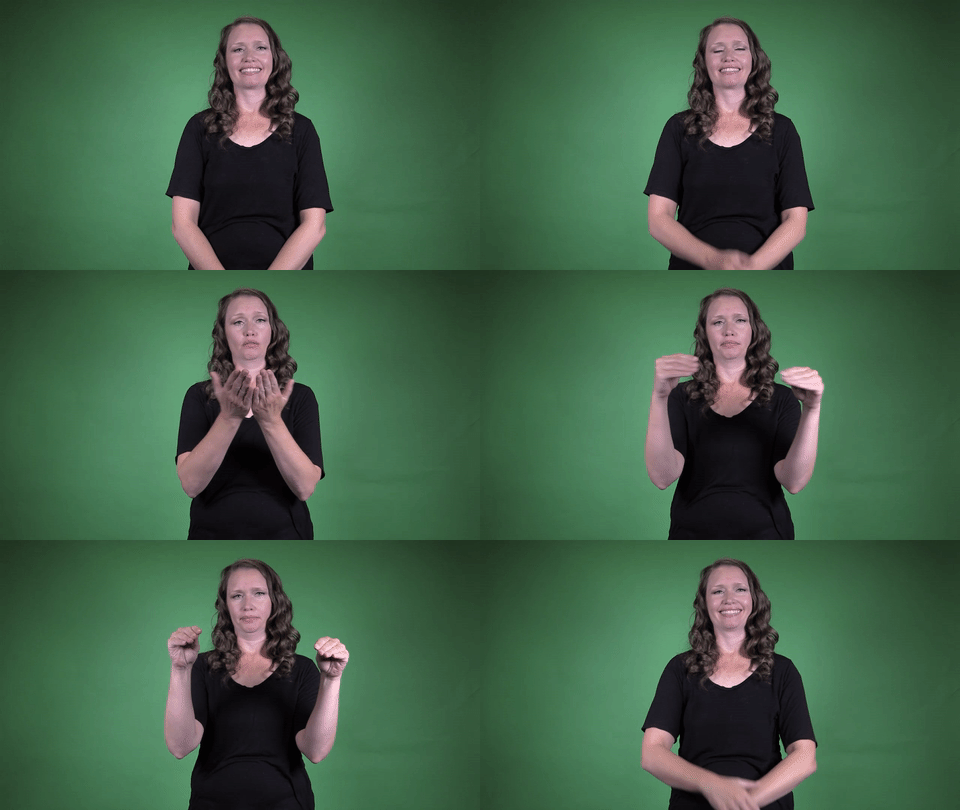
Sign for BOOKSTORE in ASL

YouTube player

Practice Activities:

To practice the sign for BOOKSTORE in ASL, begin by isolating each concept: BOOK and STORE. Practice signing BOOK first by opening your hands like the pages of a book, and then STORE by brushing both flattened ‘O’ handshapes forward from the shoulder area. Combine the two signs smoothly for consistency and fluid motion.

Use the sign for BOOKSTORE in ASL in various sentence drills. For example, sign sentences such as “I go to the bookstore,” “Bookstore closed today,” or “She works at the bookstore.” This helps reinforce not just the vocabulary but also ASL grammar and structure. Practice signing each sentence with understanding and correct facial expressions.

In a storytelling activity, create a simple narrative involving a visit to a bookstore. Describe who is going, what they are looking for, and what they buy. Include other common signs like READ, WANT, BUY, or FIND to enrich your story. This deepens retention and fluency while keeping the focus on the sign for BOOKSTORE in ASL.

Partner practice is also helpful. One person signs a sentence involving the word bookstore, and the other responds appropriately. Practice dialogues like “Where is the bookstore?” followed by “It’s next to the school.” This context-based interaction develops conversational skills and encourages spontaneous use of the vocabulary.

You can make a category game where learners identify places like SCHOOL, LIBRARY, and STORE, then must sign each one correctly. When it’s the sign for BOOKSTORE in ASL, they must break it down and explain its two-part construction. This reinforces comprehension of compound signs while improving expressive skills.

Use a mirror to self-check while signing, making sure your movements are clear and accurate. Try signing in front of your camera and replay the video to observe fluidity, especially when moving from BOOK to STORE.

Cultural Context:

In Deaf culture, the sign for BOOKSTORE in ASL represents more than just a place to buy books. It reflects a space where Deaf individuals gather for learning, community events, and sharing knowledge. Understanding the sign for BOOKSTORE in ASL connects individuals to the values of literacy and education that are deeply rooted within the Deaf community.

Bookstores have long played an important role in Deaf culture. They are not just retail spaces but often serve as central hubs for Deaf-friendly events, sign language workshops, and author meet-ups. These gatherings reinforce the importance of communication accessibility and foster a sense of belonging.

Using the correct sign for BOOKSTORE in ASL is important in preserving clear communication and cultural identity. The sign itself is a combination of concepts for BOOK and STORE, which are core to daily ASL vocabulary. Learning this sign helps build fluency and reflects respect for the linguistic integrity of American Sign Language.

Children in Deaf schools often visit bookstores as part of learning activities. Teachers and interpreters use the sign for BOOKSTORE in ASL to help students navigate real-world environments. These visits are often part of lessons on budgeting, reading, and community engagement, making the sign practical and culturally relevant.

Deaf authors and scholars have also contributed significantly to the presence of ASL materials in bookstores. Understanding the sign for BOOKSTORE in ASL helps individuals find these resources and participate in cultural exchange. Promoting books about Deaf history and ASL literature is easier when this sign is known widely.

In cities with Deaf communities, local bookstores may even carry ASL-specific content, from sign language dictionaries to storybooks in sign-supported English. Communicating about these spaces using the sign for BOOKSTORE in ASL encourages inclusivity and awareness. It ensures that Deaf patrons have the same access to literary culture as hearing individuals.

Some signs have minor regional variations, and the sign for BOOKSTORE in ASL may look slightly different depending on the community. However, the core components are understood universally across most ASL users. This consistency helps foster communication when traveling or attending Deaf events in other regions.

Cultural respect comes from understanding the context of signs like the sign for BOOKSTORE in ASL. It’s not just a gesture but a symbol of community, learning, and participation in broader society. Using the sign correctly signals an appreciation for Deaf culture and its linguistic depth.

Events like Deaf Awareness Week often feature book fairs and literacy drives where the sign for BOOKSTORE in ASL is commonly seen. These cultural moments showcase the significance

Extended Definition:

The sign for bookstore in ASL is a combination of the signs for book and store. It begins with the motion used to signify book, where both hands are brought together in a clapping motion and then opened as if opening a book. After that, the sign for store is made by holding both hands near the sides of the face and flicking the fingertips outward, mimicking the way items are sold or displayed in a store.

Understanding the sign for bookstore in ASL offers more than just a word-for-word translation. It reflects how American Sign Language builds meaning through visual concepts. You aren’t just saying “bookstore”; you’re using your hands to show what it is and its purpose. It’s a functional and expressive way to build vocabulary in ASL.

When learning the sign for bookstore in ASL, it’s helpful to understand each component. The book sign represents the main product, and the store sign represents the place. This approach is common in ASL, where compound signs are formed by combining smaller meaningful signs. This helps learners see how new signs are constructed from familiar ones.

In everyday conversations, the sign for bookstore in ASL is useful in contexts like asking where to find a bookstore , expressing where you’ve been, or planning a visit. For example, you might use it in a sentence like “Tomorrow, I go bookstore,” depending on your level and grammar knowledge. It helps give context through location and activity-focused signs.

The sign for bookstore in ASL may vary slightly depending on regional dialects or the preferred style of the signer. However, the foundational two-part structure remains consistent across the U.S. This consistency helps ensure mutual understanding for learners and native signers alike.

When signing bookstore in ASL, facial expressions and body movement also enhance meaning. Non-manual markers like raised eyebrows or body shifts can change a yes-no question to a statement, even while signing the same vocabulary word. These aspects are crucial in ASL communication and help ensure your meaning is clear.

For ASL students, practicing the sign for bookstore in ASL in full sentences can speed up fluency. Use it in context by creating sentences like “I go bookstore every Saturday” or “Bookstore where?” Interactive apps or video-based tutorials can also offer visual localization, making it easier to remember how to sign the word when chatting in real-life situations.

Since ASL is a visual language, watching fluent signers demonstrate the sign for bookstore in ASL is especially important. Visual repetition through videos

Synonyms: book shop, book retailer, book seller, book depot, book emporium

Educational resources: Find related learning materials in our course bank!

Want more? Check out some of our popular learning activities on the homepage!

Need to look up a sign? Use our highly rated dictionary: https://aslinteractive.com/best-asl-dictionary/

Follow us on tiktok: https://www.tiktok.com/@aslinteractive. More social media links at the bottom of this page!

Long-tail Keywords: what is the sign for bookstore in ASL, how do you sign bookstore in ASL, bookstore in American Sign Language

Categories:

tags: Bookstore, Facilities and other locations/needs, Language Learning, Objects in the Classroom, Activities

Parameters

*Handshape*:

The handshape for the sign for BOOKSTORE in ASL begins with both hands in flat “B” handshapes, palms together, mimicking the motion of opening a book. This part represents the “book” portion of the sign.

Next, transition to the “store” portion by forming both hands into flattened “O” handshapes and holding them near the mouth or front of the shoulders, then flicking the wrists outward twice. The sign for BOOKSTORE in ASL fluidly combines these two handshape transitions to represent both concepts clearly.

*Palm Orientation*:

For the sign for BOOKSTORE in ASL, palm orientation changes between the two components of the sign. For the BOOK part, both hands are in a flat B-handshape, palms facing each other as they open like a book. For the STORE part, both flattened O-hands face downward and flick forward from the sides of the mouth or jaw area. The palm orientation helps distinguish the two separate concepts in the compound sign for BOOKSTORE in ASL .

*Location*:

The sign for BOOKSTORE in ASL is produced in two parts and takes place in front of the upper torso and chest area. First, the sign for BOOK is made by placing both flat hands together, then opening them like a book, close to the center of the chest.

Next, to sign STORE, both flattened O-hands are held near the shoulders or upper chest and flicked forward twice. The combined location positions both parts of the sign in front of the body, making the sign for BOOKSTORE in ASL easy to see and understand.

*Movement*:

The sign for BOOKSTORE in ASL combines two separate signs. First, both hands are placed together palm-to-palm in front of the body like a closed book, then opened and closed once to represent “book.” Next, transition into the sign for “store” by forming both hands into flattened “O” handshapes and flicking them forward at shoulder height with a slight outward motion.

This two-part action shows the concept of a place where books are sold. The sign for BOOKSTORE in ASL uses clear movements to represent both the object and the location, making it easy to understand.

*Non-Manual Signals*:

When signing the sign for BOOKSTORE in ASL, your facial expression should remain neutral or slightly affirmative, especially when indicating the concept of location or offering information. Eyebrows can be slightly raised if you’re clarifying or pointing out the store.

Mouth movements may include mouthing the word “store” softly, without voicing, to complement the sign and provide additional context. Overall, maintain relaxed posture and natural eye contact while using the sign for BOOKSTORE in ASL .

*Prosody, Dominant/Non-Dominant Hand*:

The sign for BOOKSTORE in ASL uses both hands. The dominant hand begins with the sign for BOOK: both palms together like closed hands in a prayer shape, then they open flat like a book.

Next, the dominant hand shifts to represent STORE: both hands in the “O” handshape twist outward near the sides of the face, showing a selling motion. The sign for BOOKSTORE in ASL combines these two signs in sequence.

Tips for Beginners:

When learning the sign for BOOKSTORE in ASL, it’s helpful to first break it down into two parts: BOOK and STORE. Start by mastering the sign for BOOK—this typically involves both hands opening and closing like a book. Your fingers should be together, palms facing, and the motion should be clear and deliberate. Make sure your hands are centered at chest level to keep the sign within the typical signing space.

Once you feel confident with BOOK, practice the sign for STORE. This sign involves holding both flattened O-hands with palms facing down, then flicking them outward twice from your temple area or near the cheeks. The handshape and motion must be distinct to separate it from other signs that use a similar movement. Don’t rush the transition between the two signs; a smooth and deliberate shift maintains clarity and helps others follow along easily.

A common mistake when signing BOOKSTORE is blending the two components too quickly, which can cause the viewer to misunderstand. Keep the pacing even and allow a small pause between BOOK and STORE to reinforce the compound nature of the concept. It’s also key to maintain eye contact and use facial expressions, which add essential context.

Practicing in front of a mirror can help improve your accuracy and confidence. Since the sign for BOOKSTORE in ASL is a compound sign, consistency is crucial. Avoid signing too low or too close to the body—this can make the sign less visible or confusing.

Watching fluent signers and mimicking their tempo and hand position is beneficial. Repetition with feedback can take your sign for BOOKSTORE in ASL from beginner to polished. Use the sign in context while pretending to give directions or describe errands to solidify your memory and comfort level.

Connections to Other topics:

The sign for BOOKSTORE in ASL is a compound sign made by combining the sign for BOOK and the sign for STORE. This follows a common pattern in ASL where individual signs are merged to express a compound concept, providing visual clarity and efficiency. Understanding this structure helps learners see how ASL builds ideas differently from English, emphasizing visual-spatial relationships.

This compound sign connects directly to vocabulary related to learning, reading, and places. For example, signs like LIBRARY, SCHOOL, and CLASSROOM are frequently used alongside the sign for BOOKSTORE in ASL during conversations about education or daily routines. These associations help contextualize the term and enhance comprehension.

In storytelling or casual dialogue, you might use the sign for BOOKSTORE in ASL followed by signs such as BUY, VISIT, or LOOK-FOR to discuss shopping trips or errands. The STORE portion of the sign can also be seen in other similar compound signs like GROCERY-STORE and CLOTHING-STORE, revealing a pattern and helping learners recognize the meaning of STORE when preceded by different nouns.

Familiarity with the sign for BOOKSTORE in ASL also assists in understanding how physical locations are commonly described in the language. Since ASL is spatially organized, many location-based terms are signed in similar positions or use movements that suggest function or purpose.

Learning this sign encourages broader knowledge of compound structures in ASL and supports understanding of how new vocabulary is logically created. It can also lead to discussions about behavior and culture, such as Deaf community preferences for accessible reading materials or favorite bookshop events. Learners will often see this sign used in Deaf school settings or in narratives about student life, travel, or hobbies, linking it to both practical and cultural contexts in meaningful ways.

Summary:

The sign for BOOKSTORE in ASL is a compound sign made from combining the sign for BOOK and the sign for STORE. The process of creating compound signs is common in ASL and demonstrates how two conceptual ideas can merge linguistically into a unified term. A signer begins by signing BOOK and then immediately transitions into signing STORE.

To create the sign for BOOK, both hands are placed together palm-to-palm in front of the body, and then they open and close once like a book. This mimics the action of opening a book, making it an iconic sign. The clarity of this visual makes it intuitive and easy to associate with the concept of a book.

After signing BOOK, the signer transitions smoothly into the STORE sign. The STORE sign involves both hands held near the shoulders with fingers together and palms facing downward; the hands are then moved forward in short pushing motions. This motion is used in various signs related to commerce or sales.

The exact sequencing of the sign for BOOKSTORE in ASL highlights the principle of morphological compounding in signed languages. ASL often uses this method to construct new concepts by combining existing known signs. This provides a way to express nuanced meanings efficiently.

The sign is not simply a random combination of gestures; it follows specific, rule-governed structures in ASL linguistics. Such compound words typically undergo some morphological simplification or alteration in rhythm and movement to reflect native usage. Over time, BOOKSTORE as a sign can reduce from a two-step motion into a single fluid concept.

In everyday communication, the sign for BOOKSTORE in ASL is frequently used in conversations about academics, commerce, errands, and community spaces. Deaf individuals may use this sign while discussing where to buy materials for school, describe favorite local businesses, or recount errands involving the bookstore.

In grammatical terms, the sign can serve as a noun. However, depending on syntax and non-manual features like facial expression, it can take on a broader or more specific meaning. By adjusting non-manual markers, a signer can express questions, rules, or statements involving a bookstore.

ASL’s use of space in signing facilitates clarity when multiple locations or entities like different bookstores are discussed. A signer may refer to multiple bookstores in an area and locate them in the signing space left, right, or ahead to distinguish between them. This use of space adds spatial richness that spoken English does not visually convey.

The cultural relevance of the sign for BOOKSTORE in ASL extends beyond its linguistic form. Bookstores play an important role in Deaf culture, serving as outlets for Deaf authors, Deaf literature, and ASL learning materials. They are spaces often aligned with Deaf community centers and learning institutions.

In recent years, Deaf-owned bookstores and online platforms have expanded, giving further cultural importance to this sign. Signing the term often carries a hint of cultural pride or appreciation for accessible resources. This enhances its significance in community dialogues.

Variations of the sign might exist regionally or generationally, yet the compound form remains widely accepted and understood. Regional sign variation reflects the dynamic and diverse nature of ASL. Despite these differences, mutual intelligibility is typically preserved.

Applied linguistics research on compound signs like BOOKSTORE offers insight into how signs evolve over time to suit communicative efficiency. Linguists often study how compound signs are grammaticalized, examining their rhythm, handshapes, and movement dynamics. This can reveal patterns of language change within ASL.

For new learners of ASL, understanding compound signs like this one is a milestone in moving beyond fingerspelling or individual vocabulary towards fluent expression. The sign for BOOKSTORE in ASL exemplifies how meaning in ASL relies not just on the hands but also on movement flow and transition. Mastering seamless transitions in compound signs adds to natural fluency.

Additionally, this sign’s visibility in educational contexts ties it to broader themes in Deaf education and literacy. Bookstores often represent access to knowledge and learning, which are crucial values in Deaf communities. The representation of these ideas in ASL vocabulary highlights how language and culture intertwine.

This compound sign is also connected with related signs like LIBRARY, SCHOOL, or CLASSROOM, which frequently occur together in narratives or explanations. These signs share location and context in many ASL conversations. Grouping them enables signers to build cohesive storytelling or explain routines.

The emphasis on iconicity in the BOOK part of the sign underscores ASL’s strength in using visual metaphors to map meaning. Students of sign language benefit from learning how visually representative signs anchor abstract concepts in concrete imagery. This helps build memory and meaningful association.

From a semantic view, the combination of the objects (book) and the commercial setting (store) encapsulates a concrete example of how ASL mirrors real-world concept connections. Rather than creating arbitrary vocabulary for bookstore, ASL builds from recognizable elements already meaningful in the language. This semantic layering deepens comprehension.

The sign can also be expanded contextually with time or quantity indicators like ‘YEST

Want more? Check out some of our popular learning activities!

ASL Interactive Resources

ASLInteractive YouTube Channel

Follow us on tiktok: @aslinteractive.com

Follow us on Instagram: aslinteractive

Facebook page: aslinteractive

Facebook group: aslinteractive

LInkedIn: ASL Interactive LLC

Twitter: @ASL_interactive

*Some information on this page is AI-generated. AI can make mistakes. Please check the information.

Sign for BOOKSTORE in ASL

Responses