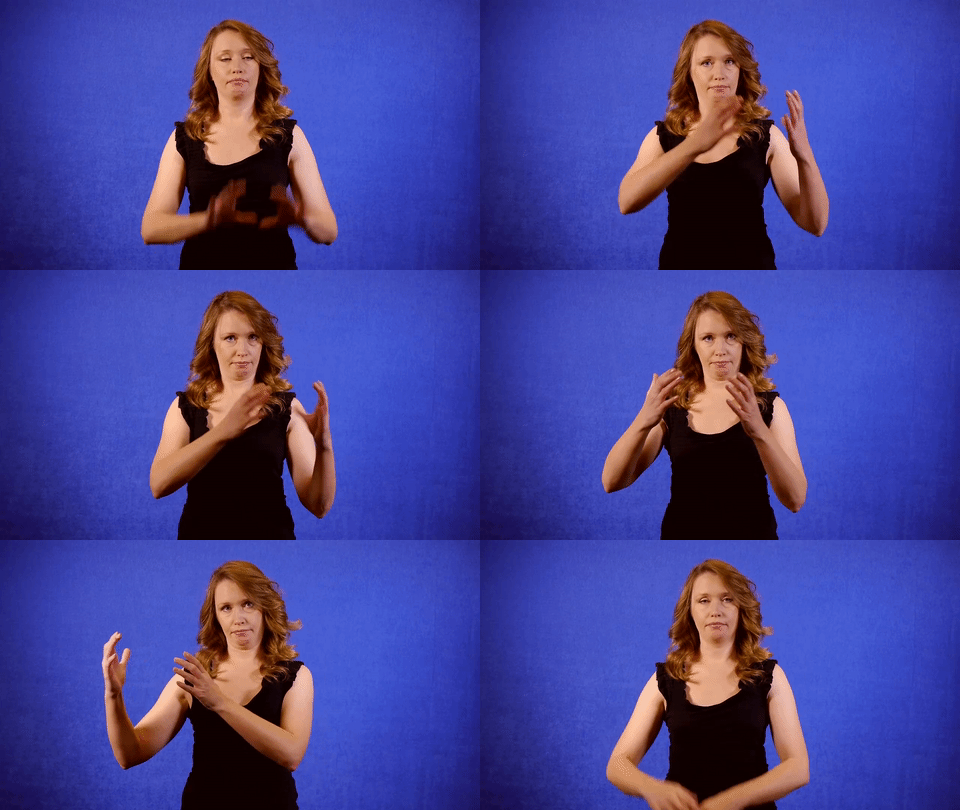
Sign for CATEGORY 2 in ASL | 🙆‍♂️ ASL Dictionary

Definition: Category 2 refers to a classification level used to group similar items, concepts, or conditions based on predefined criteria, often indicating moderate intensity or significance.

Sign for CATEGORY 2 in ASL 

YouTube player

Practice Activities:

To practice the sign for CATEGORY 2 in ASL, begin by isolating the sign and repeating it multiple times while watching yourself in a mirror. Pay attention to your handshape and movement, making sure your fingers are clear and your arm movement is consistent. Try this with both dominant and non-dominant hands to build confidence.

Next, incorporate the sign for CATEGORY 2 in ASL into simple sentences. For example, sign “ANIMAL CATEGORY 2” or “FOOD CATEGORY 2” with facial expressions to show emphasis. Practice these phrases with slow and fast tempos to build fluency. Record yourself and review to catch any errors in rhythm or clarity.

Try a categorizing game. Write or draw ten objects or topics on flashcards. Pick one card and sign what category it belongs to using the sign for CATEGORY 2 in ASL. For example, if your card says “apple,” you could sign “FRUIT CATEGORY 2.” This will support your ability to sign with clarity while also enhancing vocabulary.

Work with a partner to play a category-guessing game. One person signs a few examples within a category and ends with the sign for CATEGORY 2 in ASL, allowing the partner to guess the category. This promotes quick thinking and receptive skill development.

For storytelling, create a short story involving two or three different categories. Include the sign for CATEGORY 2 in ASL each time you refer to classifications within your narrative. Incorporate topics like types of weather, animals, or vehicles to diversify your vocabulary.

End your practice by signing in front of a teacher, friend, or in a video chat, using the sign for CATEGORY 2 in ASL at least five times in context. Ask for feedback or self-evaluate your signs, facial grammar, and transitions between signs.

Cultural Context:

In American Sign Language (ASL), understanding the sign for CATEGORY 2 in ASL involves both linguistic knowledge and cultural awareness. ASL is a visual language deeply rooted in Deaf culture, and each sign often represents more than just a direct English word—it carries context and community understanding. The sign for CATEGORY 2 in ASL, like many classification signs, often draws from conceptual grouping and numbering systems used regularly in academic or professional settings.

Deaf culture places importance on clarity and visual organization, so when communicating categories, signs need to be both precise and easy to understand. The sign for CATEGORY 2 in ASL reflects this need for clarity, helping the signer specify a subset or level within a broader grouping. In educational settings, medical contexts, or institutions where data and information are organized by categories, this sign supports clear and efficient communication.

Classifiers in ASL often represent groups or classes of information. When using the sign for CATEGORY 2 in ASL, signers may indicate a second tier or type within a particular classification system. This might apply to subjects like weather categories, safety levels, or skill divisions. The numeral 2 is typically signed clearly to show it refers to the second classification, and it is often paired with a sign that conceptually means category or group.

ASL prioritizes visual space and handshape accuracy. When signing the phrase, a signer combines the concept of category with the number 2 in a way that fits the grammar and structure of ASL. Rather than signing word-for-word translations, signers apply cultural understanding to structure the phrase naturally. This means the sign for CATEGORY 2 in ASL may vary slightly depending on the topic or context.

Context plays a major role in how this sign is received. In a conversation about emergency preparedness, for instance, CATEGORY 2 might refer to a hurricane level. Within that context, the sign for CATEGORY 2 in ASL helps Deaf individuals receive and give crucial information quickly and clearly. The importance increases when interpreting real-time news or alerts, where categorization can impact safety decisions.

In Deaf communities, accessible communication includes understanding how systems like categorization are expressed visually. Whether in classrooms, work meetings, or conversations about specialized topics, the sign for CATEGORY 2 in ASL contributes to smoother exchanges. By mastering signs tied to structured information, ASL users can engage more fully in every aspect of society.

Regional variation may influence how signers show CATEGORY 2, with local signs sometimes preferred. Still

Extended Definition:

The sign for CATEGORY 2 in ASL represents a specific classification or group used in various contexts, from weather terminology to organizational systems. In American Sign Language, conveying the concept of CATEGORY 2 requires both an understanding of the numeric sign for “2” and the broader concept of categorization.

To express the sign for CATEGORY 2 in ASL, users typically combine the concept of a category with the numerical handshape for two. This means the sign involves a classifier for “group,” “type,” or “category,” followed by the ASL sign for the number 2. Depending on context, the sign may be delivered with emphasis to reflect the importance of the second category in a series.

For example, when discussing storms, a CATEGORY 2 hurricane means the storm falls within a particular strength level. In this case, the signer would indicate the general topic of “hurricane” and then perform the sign for CATEGORY 2 to specify it. If used in academic or organizational settings, CATEGORY 2 could refer to a label for data grouping or level in a structured hierarchy.

Context plays a key role in understanding the sign for CATEGORY 2 in ASL. Whether referring to meteorological events, educational levels, or safety ratings, ensuring that the category concept is clear enhances communication. Facial expressions and pacing can further define the meaning, which is standard in ASL grammar.

The handshape for the number two is made with the index and middle fingers extended, while the category part of the sign may involve circling motions or palm orientation that shows inclusion in a specific group. Combining these signs naturally and fluidly comes with practice and familiarity with compound ASL signs.

Category signs in ASL often differ based on what is being categorized. For instance, a CATEGORY 2 storm sign will look different from a CATEGORY 2 seating level in a theater, because classifiers and context-specific signs adapt accordingly. ASL is a visual language that uses space, movement, and context to provide clarity.

For learners, practicing the sign for CATEGORY 2 in ASL in different situations can improve understanding. Try using it in weather discussions, lists, rankings, or even classroom scenarios. This builds retention and helps develop conversational fluency.

When creating sentence structures using the sign for CATEGORY 2 in ASL, be sure to include the topic first, then the specific category. For example, you might sign something like SCHOOL CATEGORY 2 if you’re referring to a level or group in an educational

Synonyms: ASL category two, ASL category 2, category 2 in American Sign Language, category two ASL, category 2 American Sign Language

Educational resources: Find related learning materials in our course bank!

Want more? Check out some of our popular learning activities on the homepage!

Need to look up a sign? Use our highly rated dictionary: https://aslinteractive.com/best-asl-dictionary/

Follow us on tiktok: https://www.tiktok.com/@aslinteractive. More social media links at the bottom of this page!

Long-tail Keywords: Got it! Please provide the specific “category 2” term for which you’d like long-tail keywords created.

Categories:

tags: category, classification, sorting, organizing, themes

Parameters

*Handshape*:

The handshape for the Sign for CATEGORY 2 in ASL uses both hands in a curved “C” shape, resembling parentheses or open claws. The fingertips face each other with a small gap in between, and the hands are positioned at chest level.

This handshape helps convey the idea of grouping or classifying, which aligns with the meaning of the Sign for CATEGORY 2 in ASL. The “C” handshape plays a crucial role in representing a set or category visually.

*Palm Orientation*:

For the sign for CATEGORY 2 in ASL, the palm orientation involves both hands in a curved ‘C’ shape, facing each other. Palms are oriented inward toward the center of the body, as if holding an invisible category or group between the hands.

Throughout the motion involved in the sign for CATEGORY 2 in ASL, the palms remain mostly stable, maintaining inward orientation. This positioning helps visually group items or concepts into a specific category, reinforcing the meaning behind the sign.

*Location*:

The sign for CATEGORY 2 in ASL is typically produced in the neutral space in front of the chest. Hands are held between mid-chest and shoulder level, comfortably away from the body. This location helps maintain clarity and visibility, making it easier to differentiate between similar concepts.

For the sign for CATEGORY 2 in ASL, it’s important that the signer maintains even spacing and symmetry when forming the movement. Keeping the sign in this central area ensures natural eye-line focus and supports clear communication.

*Movement*:

To produce the sign for CATEGORY 2 in ASL, both hands form flat “C” handshapes, palms facing each other, held about shoulder-width apart. Move the hands in a short circular motion toward each other, ending with the fingertips nearly touching, as if grouping items into a category.

After signing CATEGORY, follow with the number 2 using the dominant hand in a simple upright “2” handshape, palm facing out. The sign for CATEGORY 2 in ASL combines classification and enumeration in a clear sequence.

*Non-Manual Signals*:

When demonstrating the sign for CATEGORY 2 in ASL, maintain a focused and neutral facial expression to indicate general classification without emotional bias. Slight brow lowering may occur depending on the context, especially if you’re comparing different categories.

Keep your head positioned upright and your eyes directed toward the hands or the conversational partner. These non-manual signals help clarify the intention behind the sign for CATEGORY 2 in ASL, especially when distinguishing among different groupings or hierarchical systems.

*Prosody, Dominant/Non-Dominant Hand*:

The sign for CATEGORY 2 in ASL typically uses both hands in a symmetrical movement. The dominant and non-dominant hands form curved “C”-shapes and start together, then move apart horizontally as if dividing information into groups or classes. This movement visually represents sorting items into a specific “category.”

For the number 2, the dominant hand flashes the number 2 handshape (index and middle finger extended). In the context of the sign for CATEGORY 2 in ASL, the number is added after signing “category” to specify which group is being referred to. ✌️

Tips for Beginners:

When learning the sign for CATEGORY 2 in ASL, it’s important to first recognize that “category” is typically signed using a concept that expresses grouping or classification. You’ll form both hands into curved C-shapes and bring them together slightly in front of you, mimicking the action of grouping items. For the “2” part of the sign, simply follow up with the number 2 signed with your palm facing out. Always make sure to pause very slightly between “category” and “2” so that your meaning is clear.

For beginners, consistent practice with handshape formation is key. C-handshapes can be difficult at first due to tension in the fingers. Keep your hands relaxed but structured. When combining the sign for CATEGORY with a numerical classifier like 2, remember to space them for visibility without over-exaggerating. This helps communicate the intended meaning clearly and naturally.

Facial expressions are also important to match context. If you’re discussing types or groupings in a serious or academic context, keep your face neutral. If it’s casual conversation, a slight nod or raised eyebrows can help emphasize the intention behind the sign for CATEGORY 2 in ASL, offering conversational clarity .

One common mistake is using a flat O handshape or cupping your hands incorrectly. Watch native signers and observe the subtleties in motion and space. Use a mirror to check your hand positioning. Don’t rush—precision builds confidence .

To boost memory, associate the curved C-hand movement with putting items into an invisible box. This visual cue reinforces the grouping concept. Also, use the sign for CATEGORY 2 in ASL during daily classification tasks—grouping books, organizing files, or labeling folders— to internalize the movement and context naturally.

Practice with feedback whenever possible. Record yourself or work with a signing partner or teacher, and make small corrections as you go.

Connections to Other topics:

The sign for CATEGORY 2 in ASL connects to broader concepts such as grouping, classification, and organizing information. ASL often incorporates spatial organization when communicating about categories, where visual grouping on the signing space symbolizes how concepts are sorted. This use of space aligns with how ASL users describe hierarchies, levels, or structures in various fields like science, business, and education.

In discussions involving the sign for CATEGORY 2 in ASL, the number 2 might be added to clarify a specific subcategory or level within a category framework. This variation frequently appears in formal or technical contexts, such as labeling items in a curriculum (e.g., Math Category 2), data analysis, or even weather-related terms like storm category designations. The number sign preceding 2 in ASL supports this notion of tiered or progressive levels.

The sign CATEGORY is visually and conceptually related to signs like GROUP, CLASS, and TYPE. These signs share a general motion of sweeping or enclosing space with C- or G-handshapes and are used to define collections or clusters. They provide a foundational understanding for learners to grasp how ASL handles abstract ideas such as taxonomy or classification systems used across various disciplines.

An example of a compound sign involving CATEGORY can arise in educational settings, where one might combine CATEGORY with signs like SUBJECT or LANGUAGE to describe academic divisions. Another example includes compound use in commerce, like combining signs for PRODUCT, CATEGORY, and PRICE to explain store layouts or digital menu systems. These compound constructs demonstrate how the sign for CATEGORY 2 in ASL builds into broader communication strategies.

Furthermore, classifiers in ASL support the visualization of categorized objects by showing shape, function, or size, often used in combination with CATEGORY for deeper context. By examining these connections, ASL learners deepen their understanding of abstract structuring and discourse in the language .

Summary:

The sign for CATEGORY 2 in ASL reflects both a linear and classification concept, typically using a manual motion that mimics sorting or segmenting ideas. The hands often mimic compartments or divisions, representing how information or items are sorted into distinct types.

To form the sign for CATEGORY 2 in ASL, start by shaping both hands into the letter “C” handshapes. Then bring them parallel in front of the body, palms facing inward and fingers forward. Slide both hands apart slightly to show division or grouping.

This movement suggests separating items by shared traits or characteristics. It’s similar to the sign for GROUP or CLASS but adjusted to emphasize segmentation relative to categories.

The number 2 can be incorporated afterwards by signing the digit “2” using the upright “V” handshape. This is placed next to or following the signing of CATEGORY to imply hierarchy or distinction within category types.

The sign emphasizes organization and categorization, something deeply rooted in both visual language and Deaf culture. Using visual classifiers to indicate separation, difference, and grouping aligns with the primary strengths of ASL as a spatial and conceptual language.

The concept of category has broad cognitive and educational applications, making the sign common in academic and instructional contexts. Teachers, interpreters, and students use this sign regularly across disciplines such as math, science, sociology, and linguistics.

In grammatical usage, CATEGORY appears frequently in ASL classifying sentences, where objects or concepts are divided and explained. It also functions well as a preface to list classifiers, allowing smoother transitions into more detailed descriptions.

The sign for CATEGORY 2 in ASL may be accompanied by facial expressions that reinforce the idea of distinction or varying types. Raised eyebrows and focused eye gaze help clarify the message, especially when identifying a second level or example.

It’s culturally relevant in contexts where specifying differences benefits shared understanding. For instance, Deaf community discussions that compare advocacy strategies might use this sign when defining diverse types of activism.

Linguistically, this sign serves as an important noun form that encapsulates taxonomy, a vital process in signed and spoken languages. In ASL, demonstrating classification spatially enhances comprehension rather than relying on abstract naming.

From a morphological lens, the sign embodies internal movement that conveys the essence of its meaning. The sliding apart of the hands is symbolic of breaking things down into ordered components.

Applied linguistics connects this sign to curriculum designs in bilingual education settings. Where Deaf students learn concepts like sorting or taxonomy, it becomes integral to scaffold layered knowledge.

In broader ASL usage, CATEGORY transitions smoothly into other related signs like LIST, TYPE, KIND, or GROUP. These signs share symmetrical movements or handshape comparisons, creating an intuitive visual network.

Understanding the sign for CATEGORY 2 in ASL also helps with interpreting and translating contexts where qualifiers matter, especially when dealing with multi-option scenarios or decision-making processes.

The language thrives on spatial awareness, and this concept—a visual division of ideas—highlights ASL’s power to encode thought in a way that’s both clear and expressive. Real-time spatial storytelling benefits when such organizational signs are used.

From a linguistic anthropology viewpoint, the use of this sign shows how ASL captures the everyday need to sort and label experience. This is different from auditory routes, which define categories primarily through sound and word order.

The sign for CATEGORY 2 in ASL aligns with the Deaf community’s emphasis on visual clarity. It provides an anchor when dealing with complex information and is often used in meetings, legal formats, and educational environments to define protocols.

In bilingual classrooms with ASL and English, signs like this one help bridge the conceptual understanding of abstract terms. Instead of merely fingerspelling “category,” the signer conveys meaning through spatial modeling.

Language researchers often note that signs like CATEGORY demonstrate key ASL features: symmetry, dual movement, and conceptual immediacy. These features all work to ensure the term is not just translated but visually embodied.

Within mental lexicons of fluent signers, the concept of categorizing items is deeply stored with related visual-tactile memories. This makes the sign intuitive and reinforces its use in spontaneous visual storytelling.

Moreover, ASL classifiers are often set up under overarching categories. For instance, vehicle classifiers might be introduced by signing CATEGORY to denote a discussion limited to transportation forms.

When instructing new signers, educators often emphasize signs like CATEGORY that help structure conversations. It’s a meta-linguistic tool, laying down the framework before diving into specifics.

ASL inherently respects spatial logic. With signs like CATEGORY 2, clash or contrast between two grouped ideas can be visually arranged side by side, creating both a narrative and analytical dimension.

Cognitive science connects well with how ASL signs like CATEGORY mirror actual thinking processes. The movement of dividing by C-hands mimics the mental categorization human brains undertake for memory and association.

In storytelling and narration, using a sign for CATEGORY allows the signer to set up characters or elements that belong to different “worlds” or identities,

Want more? Check out some of our popular learning activities!

ASL Interactive Resources

ASLInteractive YouTube Channel

Follow us on tiktok: @aslinteractive.com

Follow us on Instagram: aslinteractive

Facebook page: aslinteractive

Facebook group: aslinteractive

LInkedIn: ASL Interactive LLC

Twitter: @ASL_interactive

*Some information on this page is AI-generated. AI can make mistakes. Please check the information.

Sign for CATEGORY 2 in ASL 
Category/Class, Sign for CATEGORY 2 in ASL 

Responses