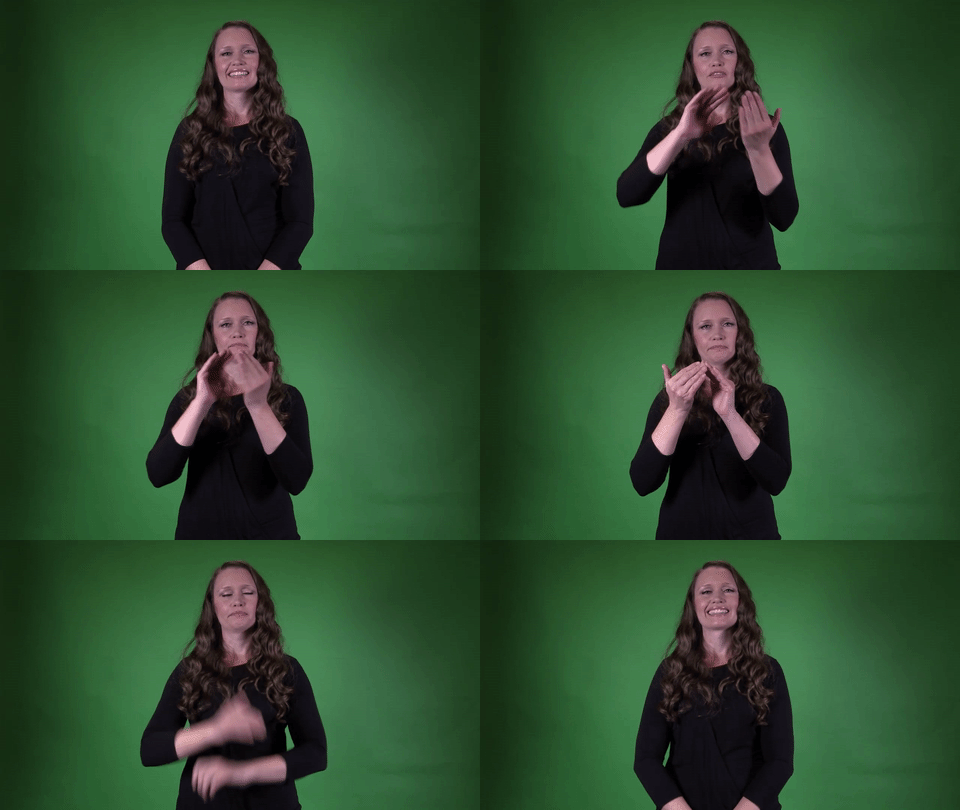
Definition: A large town.
Sign for CITY in ASL

Practice Activities:
To build fluency with the sign for CITY in ASL, start by practicing it in isolation in front of a mirror. Focus on the movement and handshape, making sure your fingertips touch and twist as you mimic the overlapping rooftops of a city. Say the English word to yourself as you practice the sign to solidify the connection.
Create flashcards with different location signs such as TOWN, COUNTRY, and NEIGHBORHOOD to compare with the sign for CITY in ASL. Flip through them and sign each one, paying attention to your hand placement and motion. This helps reinforce subtle differences and supports your visual memory of each concept.
Use the sign for CITY in ASL in simple sentence drills such as “I live in the city,” “That is a big city,” or “I will visit the city tomorrow.” Repeat them several times, slowly at first and then at a natural speed. Include signs for actions, places, and descriptions to build fuller sentences.
Find a practice partner and take turns describing imaginary cities. Include details like buildings, people, food, and transportation, and use the sign for CITY in ASL each time it fits the context. Use prompts like “Describe a city you’ve visited” or “What would your dream city include?”
Write out a mini-story in English that takes place in a city, and then translate it to ASL using visual language and classifiers. Sign it in front of a camera and review your accuracy, especially how naturally you use the sign for CITY in ASL within your narrative.
Finally, play a role-play game where one person pretends to be a tourist and the other gives directions or local recommendations. Use city-related vocabulary as much as possible to integrate the sign in a real-world scenario. Keep the exchanges light and conversation-focused for confident, everyday use.
Cultural Context:
The sign for CITY in ASL reflects the visual and spatial nature of American Sign Language. In Deaf culture, signs often go beyond literal translation and incorporate the concept or function of the word. When someone uses the sign for CITY in ASL, they are not just identifying a location, but communicating a larger idea of an environment filled with buildings, people, and activity.
Understanding the cultural context of the sign for CITY in ASL helps highlight how the Deaf community perceives urban areas. A city is more than a cluster of buildings—it can represent a place of connection, communication, and diverse interactions. For Deaf individuals, cities often serve as important hubs for access to interpreters, Deaf services, education, and employment opportunities.
The visual nature of the sign echoes the structure of a city, usually made with a motion that mimics buildings coming together. This makes the sign for CITY in ASL visually descriptive and easy to connect with. Signs like these are designed to mirror meaning through movement and shape, rather than rely solely on spoken language concepts.
In ASL, many signs are influenced by how Deaf individuals experience the world. The sign for CITY in ASL reflects an understanding of space and architecture in ways that spoken language might not. This approach to signing offers a deeper, more interactive understanding of what cities mean within Deaf culture.
In cultural discussions, the sign for CITY in ASL may also be used symbolically. It might represent systems, government, or even community life, depending on context. The sign helps provide a framework for discussing urban culture and spaces from a Deaf perspective.
Deaf communities in major cities often form tight-knit networks, and the sign for CITY in ASL sometimes carries those social and cultural connotations. When signing about a city, users may be referring not just to the geography, but to the people and experiences that define that place. The sign becomes a symbol of belonging and identity for many in the Deaf community.
The evolution of the sign for CITY in ASL has also been shaped by exposure to different regional signs and variations over time. In larger cities, where Deaf culture is more visible and respected, the sign may take on even more nuanced meanings. Signing CITY in a storytelling context can allow users to share vivid descriptions of life, challenges, and victories in an urban environment.
ASL emphasizes fluid, dynamic communication. The sign for CITY in ASL is a great example of how Deaf individuals use language creatively to reflect real-life settings. The cultural layers attached to the
Extended Definition:
The sign for CITY in ASL is a common and useful sign when discussing locations, geography, or travel. In American Sign Language, the concept of a city goes beyond a place with buildings and roads—it’s often associated with community, development, and culture. Whether you’re talking about a small town or a major urban center, the ASL sign helps express these ideas clearly.
To sign CITY in ASL, bring your hands together in flat shapes with fingertips touching, then rotate them in a small arc and touch fingertips again. This motion represents the idea of intersecting streets or connected buildings. The movement is subtle but symbolic of a city’s bustling and structured environment.
The sign for CITY in ASL can also be used to refer to concepts like downtown, urban areas, or metropolitan life. When combined with other signs, like those for specific states or famous landmarks, it helps create a fuller picture of location. Context often helps clarify whether you’re referring to a generic city or a specific place.
You might use the sign for CITY in ASL when telling someone where you’re from, or asking where a person lives. It’s also useful when describing trips, destinations, or giving directions. This makes it a foundational sign in everyday conversation and storytelling.
When teaching or learning ASL, the sign for CITY is often introduced early on because it comes up frequently in dialogues about population, lifestyle, or shopping. Students practice it along with other location-related signs like state, town, or country. This reinforces spatial concepts and helps build more fluent signing.
Cultural background is also important. Different regions might incorporate variations in facial expressions or signing style when communicating about cities. These subtleties add depth to the language and show how regional differences influence ASL usage.
If you pair CITY with signs for famous places like New York, Los Angeles, or Chicago, you provide a richer context. These combinations are common in conversations about travel, weather forecasts, or even news reporting in ASL. So learning how to use the sign flexibly makes your communication more effective.
The sign for CITY in ASL can also be used in metaphorical or symbolic ways. For example, someone might use it when discussing economic trends or cultural events tied to urban life. This versatility makes it a valuable part of any signer’s vocabulary.
Parents can use this sign with young children when discussing weekend plans or everyday routines. Educators find it helpful during geography lessons or social studies. Its clear visual representation makes it accessible for signers of
Synonyms: town, metropolis, urban area, municipality, borough
Educational resources: Find related learning materials in our course bank!
Want more? Check out some of our popular learning activities on the homepage!
Need to look up a sign? Use our highly rated dictionary: https://aslinteractive.com/best-asl-dictionary/
Follow us on tiktok: https://www.tiktok.com/@aslinteractive. More social media links at the bottom of this page!
Long-tail Keywords: What is the ASL sign for city, how to sign city in American Sign Language, how do you sign city in ASL
Categories:
tags: Cities, Facilities and other locations/needs, Transportation, Housing, Describing Residence
Parameters
*Handshape*:
The handshape used in the sign for CITY in ASL involves both hands in the flat “B” handshape with fingers together and extended straight. The fingertips of both hands touch lightly at an angle, usually in front of the body, forming the outlines of buildings or rooftops.
This handshape is crucial to clearly depict the concept in the sign for CITY in ASL. The palms and fingers remain firm but relaxed to maintain accuracy in the visual representation.
*Palm Orientation*:
For the sign for CITY in ASL, both hands are held flat with fingers pressed together in a “B” handshape. The palms face each other slightly off-center, angled toward each other rather than perfectly parallel. As the sign is made, the fingertips of both hands touch and then twist slightly against each other in a small movement.
This slight rotation keeps the palms generally facing inward but shifts subtly to emphasize a connection. The palm orientation helps convey the concept of buildings and structures, central to the sign for CITY in ASL ️.
*Location*:
The sign for CITY in ASL is produced in front of the upper chest, in the neutral signing space. Hands are held slightly forward from the body, around mid-chest level, with fingers spread and palms facing each other as the fingertips of both hands touch lightly.
Maintaining this placement ensures clarity and visibility, supporting proper expression of the sign for CITY in ASL. This location helps distinguish CITY from similar signs like TOWN or COMMUNITY.
*Movement*:
The sign for CITY in ASL uses both hands in a flat “O” or bent “B” handshape, with the fingertips touching each other. The hands begin in front of the chest and then perform a small twisting or sliding motion, as if showing buildings or rooftops connecting.
This repeated movement suggests the layout of a city and gives visual sense to its structure. The sign for CITY in ASL reflects how various buildings or areas come together to form an urban space ️.
*Non-Manual Signals*:
When using the sign for CITY in ASL, your non-manual signals should convey a neutral or slightly inquisitive facial expression, depending on context. Slight head tilt or raised eyebrows might be used when asking about a city or expressing curiosity. ️
The overall facial expression should remain calm and engaged to match the neutral tone of the sign for CITY in ASL, especially when naming or identifying specific locations. Avoid exaggerated emotions unless the conversation context specifically calls for it.
*Prosody, Dominant/Non-Dominant Hand*:
The sign for CITY in ASL uses both hands. The dominant and non-dominant hands are flat with fingers together, palms facing each other. The fingertips of both hands touch lightly at an angle and then move apart slightly in a small circular motion, simulating the rooftops or layout of a city.
In the sign for CITY in ASL, the dominant hand leads the movement, and the non-dominant hand mirrors it closely. This symmetrical motion reflects the concept of a structured, built environment. ️
Tips for Beginners:
One of the best ways to improve at the sign for CITY in ASL is to focus on the clarity and fluidity of your hand movements. This sign uses a movement that mimics the overlapping of buildings or rooftops, so practicing the motion smoothly will enhance communication and reduce confusion. Make sure your fingers are extended and slightly curved when the fingertips of each hand meet in a tapping motion.
Keep your hand placement around chest level and don’t raise the sign too close to your face. Consistency in location is important for the sign for CITY in ASL, especially when signing quickly or in conversation. It helps your signing remain clear and easy to read for fluent users and beginners alike.
A common issue for beginners is making the gesture too static or too fast. The sign should have a natural bounce or tap between the hands to show the repeated contact of structures. Practice in front of a mirror or record yourself to evaluate the precision of your signing.
Use context when learning the sign for CITY in ASL. It often appears in compound signs like “city name” or “big city,” so being aware of pacing and flow across multiple signs is key. Pairing the sign with well-known city names and fingerspelling them can also help reinforce it through repetition and context.
Lastly, don’t forget to make eye contact and maintain facial expressions while signing. ASL is a visual language, and adding non-manual markers can improve the delivery and make your communication more engaging . Keep practicing in real-life situations to build confidence using the sign for CITY in ASL in conversations about location, travel, or community.
Connections to Other topics:
The sign for CITY in ASL connects closely to other signs like TOWN, VILLAGE, and COMMUNITY. These signs all involve similar hand movements and concepts, centered around places where people live and gather. Learners often benefit from comparing the handshape and motion of CITY with TOWN, which is nearly identical but may be used differently depending on regional or contextual nuances. ️
The sign for CITY in ASL can also be used in compound signs to refer to specific locations or metropolitan areas, such as NEW YORK CITY, where NEW YORK is first signed, followed by CITY. Similarly, you might see it paired with STATE or CAPITAL to describe certain government-related places like STATE CITY or CAPITAL CITY. This shows how the sign functions as a building block within larger phrases.
CITY also connects to more abstract ASL concepts that deal with people and infrastructure. For instance, it relates to signs like POPULATION, BUSY, or TRAFFIC when discussing urban environments. These connections give learners insight into how CITY fits into day-to-day communication in discussions involving lifestyle, community size, and environment.
In storytelling or conversation, the sign for CITY in ASL might appear alongside signs like GROW-UP, MOVE-TO, or VISIT. This helps depict someone’s history or experience with urban living. For example, someone might sign I GROW-UP CITY to mean they were raised in an urban setting.
Moreover, learning the sign for CITY in ASL encourages better understanding of classifiers within ASL. The classifier CL:3 can be used to represent vehicles moving through a CITY, adding depth to visual storytelling. By using CITY in such visual-spatial descriptions, signers convey not only location but also action and relationship between elements.
Summary:
The sign for CITY in ASL is a visually metaphorical representation of urban structures and community spaces. To perform this sign, both hands use flat-O or slightly bent-B handshapes, and the fingertips of each hand tap together and then slightly rotate and tap again, mimicking the idea of building clusters or rooftops.
This movement reflects the layout of a city, where many buildings meet and overlap, expressing the density and complexity of urban areas. The sign allows a signer to encapsulate the idea of a developed place with structured buildings and dense cultural or human activity.
The sign for CITY in ASL is not iconic in the strictest sense but still utilizes visual-spatial metaphors to indicate the concept of a built environment. This abstraction aligns with how many ASL signs operate—neither purely iconic nor arbitrary but grounded in spatial reasoning.
In ASL grammar, the sign for CITY can function as either a noun or as part of a compound noun. Its placement within a sentence depends on whether the signer is discussing location, direction, or type of place, emphasizing ASL’s spatial grammar.
When talking about a specific city, the general CITY sign may be accompanied by a fingerspelled name or initialized sign, such as FS-NEW YORK or FS-CHICAGO. These signs often follow or precede the sign for CITY depending on context or emphasis.
ASL users regularly use the sign for CITY in conversation when referring to travels, hometowns, current residence, or urban issues. Because urban centers are hubs of education, culture, and advocacy, especially for the Deaf community, the term carries strong cultural value.
Many Deaf schools, community events, and institutions are based in prominent cities, so the sign for CITY in ASL frequently comes up in storytelling, sharing of lived experiences, and histories. For example, Detroit, Boston, and Washington, D.C. hold special significance due to their Deaf-centric institutions.
The sign for CITY in ASL conveys more than just location—it also portrays sociocultural context. Cities are often depicted as spaces of connection, where Deaf people connect politically, artistically, and socially via shared spaces.
ASL classifiers can extend the meaning of CITY by describing the layout or character of the city. For instance, a signer may use Classifier 3s to describe wide roads, traffic flow, or the intricate design of urban systems after signing CITY.
Moreover, the concept of CITY often leads to layered dialogues about accessibility and Deaf-friendliness. Signers may discuss whether a city has visual alert systems, ASL interpreters, or Deaf-owned businesses, deepening the sign’s meaning.
Linguistically, the sign for CITY in ASL demonstrates how abstract concepts are spatially and visually represented. Unlike English, where descriptive adjectives pile on linear modifiers, ASL encapsulates essence through holistic units.
Applied linguistics research has noted how signs like CITY promote spatial cognition. Signers use relative hand position, movement, and modification to detail smaller towns or sprawling metropolises, which promotes a naturally occurring mental map.
As cities evolve over time, the ASL sign for CITY remains stable, but regional variations can emerge. For example, some communities may use modified signs that echo the regional architecture or cultural traits of their local urban settings.
The sign for CITY in ASL has related signs such as TOWN, which utilizes a similar handshape and motion but usually involves fewer repetitions and may include smaller arcs, symbolizing a more intimate setting than a bustling city.
The sign for VILLAGE also parallels CITY in ASL but is often confined in scope or presented with classifier descriptions to evoke community living, fewer buildings, or rural simplicity.
Culturally, the idea of city versus rural can be meaningful in the Deaf world. Access to technology, interpreter agencies, and social networks for Deaf individuals is often more concentrated in urban areas, making the sign for CITY in ASL part of a deeper cultural discussion.
When teaching the sign for CITY in ASL, educators often pair it with visual aids and comparisons to environment-based signs. This helps learners cognitively anchor the vocabulary to meaningful structures and lived experiences.
Many early ASL learners remember the sign by associating it with two buildings tapping or the movement of cities being “built” in front of them linguistically. That spatial metaphor supports memory retention.
The sign for CITY in ASL also becomes critical in narrative storytelling when recounting events such as attending a march, moving to a new place, or retelling the events of a famous Deaf conference. The sign provides geographical and thematic structure to these narratives.
In poetic ASL, CITY can be used with expanded movement and constructed action, illustrating the sensory experience of urban life. Signs may build upon CITY with added expressions, enabling performative and meaningful compositions.
In Deaf literature and theater, cities often serve as backdrops for drama, growth, and conflict. The sign for CITY in ASL becomes a symbolic threshold where isolation becomes connection or oppression finds community.
Want more? Check out some of our popular learning activities!
ASL Interactive Resources
ASLInteractive YouTube Channel
Follow us on tiktok: @aslinteractive.com
Follow us on Instagram: aslinteractive
Facebook page: aslinteractive
Facebook group: aslinteractive
LInkedIn: ASL Interactive LLC
Twitter: @ASL_interactive
*Some information on this page is AI-generated. AI can make mistakes. Please check the information.


Responses