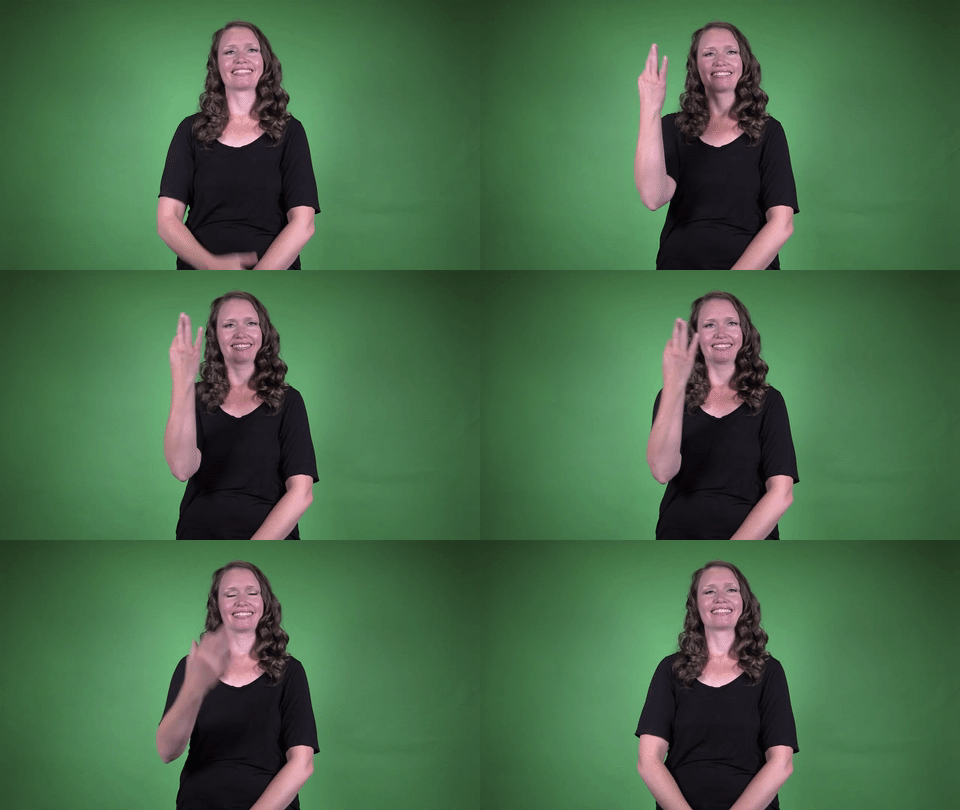
Sign for FRIDAY in ASL | ASL Dictionary

Definition: The sixth day of the week.

Sign for FRIDAY in ASL

YouTube player

Practice Activities:

Start by practicing the sign for FRIDAY in ASL on its own in front of a mirror. Repeat it slowly at first and then build up to a natural speed. Make sure the palm orientation and circular motion with the handshape are accurate, and pay attention to facial expressions.

Once you’re comfortable, try using the sign for FRIDAY in ASL in different phrases such as “See you on Friday,” “Friday is my favorite day,” or “School ends early on Friday.” Signing these short sentences will help you build fluency and connect vocabulary in a real-world context. Record yourself and compare your signing with video models for accuracy.

Create a mini calendar on paper or a whiteboard, and practice signing the days of the week, placing emphasis on Friday. Point to the “Friday” square and sign it aloud, then describe activities that typically happen on that day like “Friday night movie” or “Friday test.” This connection with common events strengthens understanding.

Use storytelling prompts to increase creativity. For example, tell a short story using signs about what you usually do on Fridays. You might say “On Friday, I go to the park, eat pizza, and watch TV.” Each time you come to the sign for FRIDAY in ASL, emphasize it slightly to reinforce it.

If you have a practice partner, take turns asking and answering questions like “What do you do on Friday?” or “Do you like Friday?” Focus on clarity and signing at a conversational pace. Try giving each other tasks like acting out a scene from a Friday routine using only ASL, incorporating the specific sign throughout.

Use emojis ️ ️ in your practice materials to visually represent Friday-themed ideas and enhance engagement. The more you link the sign for FRIDAY in ASL to meaningful activities or conversations, the easier it will be to retain and use naturally.

Cultural Context:

In American Sign Language, days of the week are a common part of everyday conversation. The sign for FRIDAY in ASL is used frequently in scheduling, planning events, or talking about routines. Because ASL is a visual language, the sign for FRIDAY in ASL has a distinct handshape and movement that reflects its own cultural rhythm.

In Deaf culture, time and days hold specific importance based on community events and traditions. The sign for FRIDAY in ASL often carries a sense of excitement or relief since it’s associated with the end of the traditional work week. You might see Deaf community members use the sign for FRIDAY in ASL during casual chats, vlogs, or posts when talking about weekend plans.

Each day of the week in ASL has a standardized sign, allowing for clear communication across regions. The sign for FRIDAY in ASL uses a specific hand movement that can be easily understood by native signers and students learning the language. When someone uses the sign for FRIDAY in ASL, it’s often part of a sentence referring to upcoming events, meetings, or days off.

Understanding how to use the sign for FRIDAY in ASL is essential for participating in Deaf events. Many Deaf schools and community centers have activities that begin or end on a Friday, so being able to sign this day fluently helps bridge communication. It also shows respect for the language and community by using the correct day signs in social settings.

In casual sign conversations, the sign for FRIDAY in ASL might be expressed with added facial expressions or body language depending on the speaker’s mood. If someone is excited about plans after work or school, they might exaggerate the sign a bit, showing enthusiasm nonverbally. That’s a key aspect of ASL—its cultural richness includes combining hand signs with expressive movement.

Social media content, especially videos by Deaf influencers, often include the sign for FRIDAY in ASL to mark weekly updates or weekend content. Friday is a popular day for community announcements, online gatherings, and stories. So knowing how and when to use the sign for FRIDAY in ASL helps connect signers to these online conversations.

ASL students often learn the days of the week early in their studies. Recognizing the sign for FRIDAY in ASL is an important milestone in developing everyday vocabulary. It opens the door to discussing schedules, planning, and participating in shared calendar-based events.

The American Deaf community places strong emphasis on shared language and clear communication. Using the sign

Extended Definition:

The sign for FRIDAY in ASL is a commonly used weekday sign during everyday conversations, calendars, school lessons, and workplace schedules. Knowing how to express the days of the week in American Sign Language gives you tools to engage in more natural, fluent communication. The sign for FRIDAY in ASL uses the handshape for the letter F, moving it in a small circular motion in front of the body.

When you want to refer to a specific day, such as making weekend plans or discussing work schedules, being able to use the correct sign is important. The sign for FRIDAY in ASL makes it easy to refer to this day directly without needing to fingerspell it each time. It helps build language fluency and comprehension for both deaf and hearing signers.

This sign belongs in the category of ASL weekday signs. Most of the weekday signs in ASL follow a similar structure by incorporating the manual alphabet. For FRIDAY, that means using an F-handshape and incorporating a simple movement that visually separates it from signs for other days.

You can use the sign for FRIDAY in ASL in many sentence structures. If someone asks, “What day are we meeting?” you can respond with the sign along with other signs such as MEET or TOMORROW or NEXT WEEK. Learning how to apply this target sign in real conversation supports both receptive and expressive skills.

The circular motion with the F-handshape is performed palm-in, facing the signer. This is distinct from other fingerspelled letters that may use palm-out orientation. Getting the orientation and movement correct ensures clarity and helps your conversation partners understand you without confusion.

The sign for FRIDAY in ASL can be taught early in ASL education, alongside vocabulary for other common days like MONDAY, SATURDAY, and HOLIDAY. These signs provide the groundwork for conversations about time, appointment setting, or events. Clear communication around time and days can prevent misunderstandings in work, education, and personal life.

Practicing the sign for FRIDAY in ASL within the context of full sentences builds comfort and fluency. Try combining it with other time-related vocabulary such as NEXT, THIS, or EVERY. For example, you could sign EVERY FRIDAY to talk about a recurring event or class.

Signers may notice slight regional variations in how the sign for FRIDAY in ASL is performed. The exact motion or speed may shift slightly depending on your signing community, but the F-handshape remains consistent. Watching multiple fluent deaf sign

Synonyms: Friday, end of the week, last weekday, fifth day, weekday before weekend

Educational resources: Find related learning materials in our course bank!

Want more? Check out some of our popular learning activities on the homepage!

Need to look up a sign? Use our highly rated dictionary: https://aslinteractive.com/best-asl-dictionary/

Follow us on tiktok: https://www.tiktok.com/@aslinteractive. More social media links at the bottom of this page!

Long-tail Keywords: what is the sign for Friday in ASL, how do you sign Friday in American Sign Language, learn the ASL sign for Friday

Categories:

tags: Friday in American Sign Language, how to sign Friday in ASL, ASL days of the week Friday, learn Friday in ASL, Friday ASL sign meaning

Parameters

*Handshape*:

The handshape used in the sign for FRIDAY in ASL features the dominant hand forming the letter “F” from the ASL manual alphabet. The thumb and index finger touch to form a circle, while the remaining three fingers are extended upright.

To complete the sign for FRIDAY in ASL, the “F” handshape is held outward, then moved in a small circular motion. This consistent use of the “F” handshape helps clarify the day of the week with visual precision.

*Palm Orientation*:

The palm orientation for the sign for FRIDAY in ASL involves forming the hand into the letter “F” handshape, with the palm facing outward. As the hand moves in a small circular motion, the palm continues to face away from the signer toward the viewer.

This consistent outward palm orientation helps distinguish the sign for FRIDAY in ASL from other days of the week. The hand remains upright, ensuring the “F” shape is clearly visible throughout the motion.

*Location*:

The sign for FRIDAY in ASL is made in the neutral space in front of the chest, typically about six to eight inches away from the body. The location is stable and accessible, making it easy for the dominant hand to create the circular motion necessary for the sign.

When producing the sign for FRIDAY in ASL, the handshape forms the letter “F” and rotates in a small circle at chest level. This consistent location helps reinforce the clarity and ease of recognition during conversation.

*Movement*:

The sign for FRIDAY in ASL uses the dominant hand in an “F” handshape. Position the hand in front of the shoulder or upper chest area with the palm facing outward.

Move the “F” hand in a small circular motion, typically clockwise. The motion is gentle and fluid, and the hand maintains the same orientation throughout. To clearly convey the sign for FRIDAY in ASL, ensure the motion is smooth and the handshape remains well-formed.

*Non-Manual Signals*:

When performing the sign for FRIDAY in ASL, the facial expression is typically neutral or slightly pleasant, reflecting the positive anticipation often associated with the end of the week. A soft smile is common , especially if you’re discussing weekend plans or expressing excitement.

Eye contact should be maintained with your conversation partner to ensure engagement. Head posture remains upright and steady, supporting the clarity and intent of the sign for FRIDAY in ASL.

*Prosody, Dominant/Non-Dominant Hand*:

Use your dominant hand in the “F” handshape, palm facing outward. Rotate your wrist in a small circular motion in front of your chest area. The non-dominant hand is not used in the sign for FRIDAY in ASL, making the movement smooth and centered.

The sign for FRIDAY in ASL relies on both handshape and motion to communicate the specific day effectively. Make sure the palm orientation remains consistent throughout the circular motion to maintain clarity.

Tips for Beginners:

When learning the sign for FRIDAY in ASL, consistency with handshape and orientation is key. This sign uses the dominant hand in an “F” handshape, and it’s important to face your palm toward yourself while making a small circular motion in front of your chest. New learners should focus on keeping the circle smooth and fluid instead of jerky or stiff, which can change the clarity of the sign.

Pay close attention to your facial expressions. Although the sign for FRIDAY in ASL does not require a specific expression, keeping a neutral and friendly face helps with general signing clarity. Avoid excessive movement or turning the hand away from your body, as this can make the day signs look incorrect or confusing.

One common mistake is confusing the signs for different days of the week, especially if you’re signing quickly. Practice all weekday signs in order to keep each one distinct. Using a mirror or video yourself practicing so you can spot errors like reversed movements or incorrect handshapes, especially for signs like the one for FRIDAY in ASL, which use a specific letter handshape.

If you’re learning in a classroom or with a Deaf mentor, ask for feedback early on. Sometimes it’s hard to feel whether you’re making clear circles or if your handshape needs adjusting. Don’t hesitate to slow down your signing while you’re building muscle memory.

Consistency across practice will help you gain fluency. Set aside a few minutes daily to review signs you’ve learned. Integrate the sign for FRIDAY in ASL into short sentences or calendar discussions so it becomes a natural part of your vocabulary. With repetition and mindful practice, your confidence will grow, and your sign production will improve.

Connections to Other topics:

The sign for FRIDAY in ASL is closely connected to the signs for other days of the week. Most of these are formed using the first letter of the word in a circular motion, which helps create a visual and linguistic pattern that learners can recognize and use. In the case of FRIDAY, the handshape is the letter “F” moving in a small circle, which links it visually to other weekday signs like MONDAY and TUESDAY.

Understanding the sign for FRIDAY in ASL provides a pathway to mastering time-related vocabulary. Days of the week are part of a broader set of signs around time and scheduling, which include signs for TODAY, TOMORROW, and WEEK. Once someone knows the sign for FRIDAY in ASL, they’re better equipped to learn how to structure conversations around appointments, plans, and weekly routines.

There are also compound signs that incorporate the sign for FRIDAY in ASL, especially when referring to recurring events. For example, phrases like “every Friday” combine the sign for FRIDAY with a repeated or sweeping motion to express scheduled occurrences. This usage is particularly helpful when discussing work or school schedules, religious services, or social gatherings.

In narrative or storytelling contexts, knowing signs for specific days like FRIDAY helps anchor events in time. This allows for clearer timelines and enhances the ability to describe sequences of events. It also strengthens understanding of temporal grammar in ASL, where the placement and repetition of time-related signs change the meaning of the sentence.

The cycle of days is often taught in conjunction with calendar-related vocabulary. The sign for FRIDAY in ASL fits naturally into lessons about months, holidays, and seasons, reinforcing chronological concepts. This integration helps learners build broader language fluency and connect time-based signs to real-life conversations.

Summary:

The sign for FRIDAY in ASL is produced by forming an “F” handshape with the dominant hand and moving it in a small circular motion in front of the body, palm facing outward. This motion is fluid, and the hand remains in a relaxed, neutral plane, typically around shoulder height.

This sign is part of the broader set of weekday signs in American Sign Language, each associated with a corresponding handshape from the manual alphabet. For FRIDAY, the handshape “F” represents the initial letter of the English word, providing a linguistic bridge between ASL and English.

Culturally, the sign for FRIDAY in ASL carries more than just temporal meaning. Within the Deaf community, weekends are often a valuable time for social gatherings, Deaf events, or relaxation, just as in the hearing world.

Understanding the sign for FRIDAY in ASL offers insight into how weekday concepts are adapted into a visual language. It also demonstrates the use of initialized signs, where the handshape corresponds to the first letter of the English equivalent.

Initialized signs like this one are sometimes debated within ASL linguistics for their connections to English. While functional, they may be seen by ASL purists as representing influence from spoken language rather than organic ASL structures.

However, initialized signs for days of the week are widely accepted due to their long-term use and their clear and efficient visual differentiation from one another. Each day has a different handshape, allowing for quick, unambiguous communication.

The sign for FRIDAY in ASL is particularly relevant in scheduling contexts, classroom routines, calendar discussions, and when making plans. It’s commonly used in educational and social settings alike.

While the handshape is standardized, there may be slight regional variations in the size or direction of the circular motion. Some signers may use a clockwise circle, while others use counter-clockwise, based on local practices or individual comfort.

Days of the week in ASL follow a pattern, providing an excellent entry point for learners engaging with the language. Memorizing each sign by linking the handshape to the English initial creates cognitive reinforcement.

ASL teaching strategies often use visual calendars to reinforce the signs for weekdays. FRIDAY, along with other days, becomes embedded in learners’ memory through repetition and visual association.

In narrative ASL conversations, the inclusion of FRIDAY allows for temporal clarity. Describing a sequence of events or making plans depends on the correct use of time markers, such as this sign.

The sign for FRIDAY in ASL becomes more dynamic when used alongside non-manual markers. Eyebrow raises or head tilts can denote a question, such as “Is it Friday?” while lip movement may mirror the spoken word subtly.

Like all ASL signs, this one must be understood within context. Using the sign for FRIDAY in ASL with proper facial expressions builds clarity and demonstrates proficiency in nuanced communication.

Its connection to the Deaf world extends beyond translation. For many Deaf individuals, Friday may signal upcoming community events or Deaf club meetings, where sign language is celebrated and predominantly used.

This cultural layer reflects how signs aren’t solely linguistic but deeply intertwined with lifestyle and identity within the Deaf community. FRIDAY may carry anticipation or emotional resonance unique to each signer.

In the classroom, Deaf educators make robust use of weekdays in routine greetings and schedules. Using the sign for FRIDAY in ASL helps cement daily structure and encourages student participation.

Grammatically, time signs like FRIDAY typically appear at the beginning of an ASL sentence for clarity and flow. For example, in a sentence like “On Friday I go to the store,” FRIDAY would lead with a pause before the next clause.

This temporal fronting emphasizes when something occurs, which is standard practice in ASL grammar. The structured positioning of time elements improves communication efficiency in visual-spatial modality.

The sign for FRIDAY in ASL also relates to other calendar signs, such as WEEK, TODAY, TOMORROW, or YESTERDAY. Combining these together builds complexity and precision in conversation.

From a linguistic standpoint, initialized signs such as FRIDAY provide examples of simultaneous morphology and phonological constraints in ASL. They demonstrate how shape, orientation, location, and motion interact to create meaning.

The circular motion of FRIDAY, as in other weekday signs, can subtly change depending on whether you’re referencing last Friday, this coming Friday, or every Friday. Such modifications demonstrate the language’s visual economy.

Some signers may also use fingerspelling during formal or specifically detailed signing. However, the standard circular “F” sign is far more efficient and widely recognized in everyday conversation.

The frequency with which FRIDAY is signed in educational, social, and professional settings underlines the importance of its memorization and proper execution by learners. It also builds the signer’s fluency in temporal expressions.

Children learning ASL often look forward to Fridays as it signals the end of the academic week. Teachers use signs for weekdays, like FRIDAY,

Want more? Check out some of our popular learning activities!

ASL Interactive Resources

ASLInteractive YouTube Channel

Follow us on tiktok: @aslinteractive.com

Follow us on Instagram: aslinteractive

Facebook page: aslinteractive

Facebook group: aslinteractive

LInkedIn: ASL Interactive LLC

Twitter: @ASL_interactive

*Some information on this page is AI-generated. AI can make mistakes. Please check the information.


Responses